
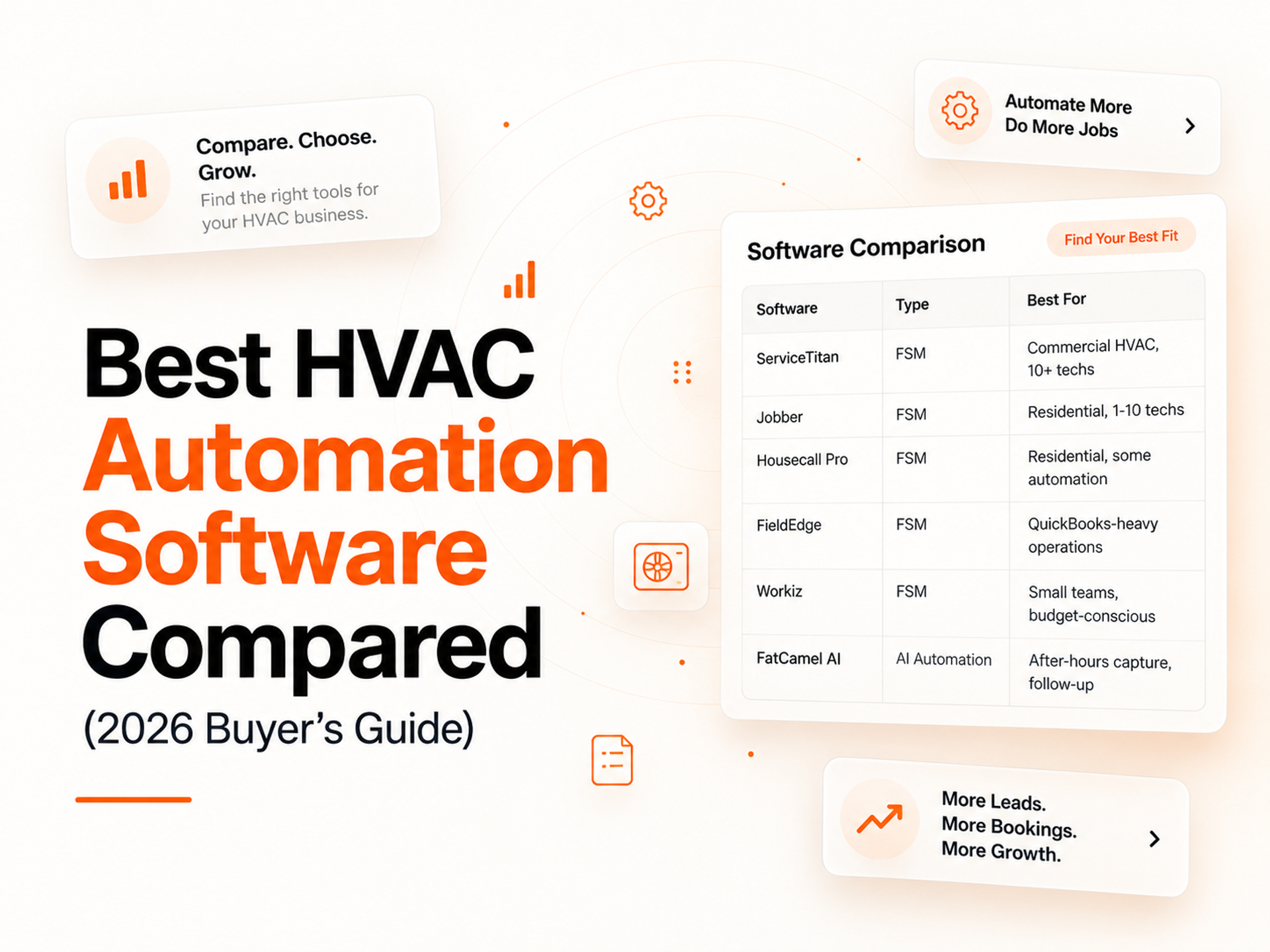
HVAC automation software falls into two distinct categories that most comparison guides blend together. Field service management platforms (ServiceTitan, Jobber, Housecall Pro) manage job scheduling, dispatch, and invoicing they're the operational backbone. AI automation tools (FatCamel AI, GoHighLevel, CallBird) handle lead capture, follow-up, CRM automation, and marketing they're the revenue layer that fills the gaps the FSM platform doesn't cover. Most HVAC businesses need both, not one instead of the other.
Every HVAC software buying guide lists the same five or six platforms, compares their feature checklists, and leaves the reader exactly where they started uncertain about which one to buy and why. This guide is organized differently. It separates the two types of software that HVAC businesses actually need, explains what each type covers, and gives honest pricing so the comparison is useful rather than just comprehensive.
Table of Contents
The Two Types of HVAC Automation Software
Category 1: Field Service Management Platforms
Category 2: AI Automation and Revenue Automation Tools
How the Two Categories Work Together
What HVAC Businesses Should Buy First
2026 Pricing Comparison
How FatCamel AI Fits Into the HVAC Software Stack
FAQ
References
The Two Types of HVAC Automation Software
Most HVAC software comparisons treat all automation software as a single category. That's why they're not very useful. The software that manages your dispatch board and invoices your completed jobs is doing something fundamentally different from the software that answers your after-hours calls, follows up on estimates, and reactivates dormant leads. Buying the right tool for the wrong job is the most expensive mistake HVAC businesses make with software.
Category 1 - Field Service Management (FSM) platforms are the operational core. ServiceTitan, Jobber, Housecall Pro, FieldEdge. These platforms manage the active life of a job: scheduling, dispatch, work orders, job costing, inventory, invoicing, and customer records. They're essential. Every HVAC business above a certain size needs one. What they don't do is capture leads when the office is closed, follow up on estimates nobody chased, or re-engage past customers who haven't had service in 14 months.
Category 2 - AI automation and revenue automation tools fill those gaps. They work on top of the FSM platform connecting to it through API integrations, reading from its data, and writing outcomes back to it. They handle the parts of the business that run between jobs: answering after-hours calls, running follow-up sequences, chasing estimates, generating reviews, reactivating dormant contacts, and managing commercial outreach campaigns.
Understanding this distinction saves HVAC businesses from buying an expensive FSM platform expecting it to solve a lead conversion problem, or buying a marketing automation tool expecting it to replace their dispatch software.
Category 1: Field Service Management Platforms
These platforms manage active HVAC operations. The comparison criteria that matter for FSM selection are integration depth, mobile app quality, commercial vs residential fit, and pricing model.
ServiceTitan
The most feature-complete FSM platform for HVAC businesses with 10 or more technicians, particularly commercial operations. Covers scheduling, dispatch, work orders, time tracking, flat-rate pricing, maintenance agreements, inventory, invoicing, and reporting. Includes Dispatch Pro for AI-assisted technician routing and Marketing Pro for basic customer communication automation.
Best for commercial HVAC businesses and larger residential operations with complex scheduling requirements.
Pricing: Starts at approximately $398 per month. Per-user pricing model. Implementation fees typically $1,500 to $5,000+ depending on business size.
Limitation: Expensive for smaller contractors. Feature depth that benefits large operations can feel overwhelming for businesses with fewer than 5 technicians.
Jobber
Clean, practical FSM platform built for residential service contractors. Strong customer communication features, self-serve client portal, and straightforward scheduling and dispatch. Easier to learn than ServiceTitan and considerably less expensive. API access on Connect and Grow plans supports AI automation integrations.
Best for residential HVAC contractors with 1 to 10 technicians who want solid core FSM without enterprise complexity.
Pricing: Core plan from $49 per month. Connect plan (with API access) from $129 per month. Grow plan from $249 per month.
Limitation: Less suited for commercial HVAC businesses with complex multi-property management requirements.
Housecall Pro
Mid-market FSM platform with a strong automation layer built in automated appointment reminders, review requests, and email marketing are included at higher tiers. Integrates with Zapier and supports webhook connections for external AI automation tools.
Best for residential HVAC businesses that want some native automation without a separate marketing platform.
Pricing: Basic from $59 per month. Essentials from $149 per month. MAX plan (with full automation) from $299 per month.
Limitation: Automation features are useful but not as configurable as dedicated AI automation tools for complex multi-touch follow-up or HVAC-specific call handling.
FieldEdge
HVAC-specific FSM platform with deep QuickBooks integration and HVAC-specific price books. Good fit for businesses already managing accounting in QuickBooks who want a tightly integrated field service platform without switching accounting software.
Best for established HVAC businesses with existing QuickBooks workflows and pricing book data.
Pricing: Custom pricing requires a demo call.
Limitation: Less modern interface than Jobber or Housecall Pro. API access more limited than the major platforms, which constrains some AI automation integrations.
Workiz
Lighter-weight FSM platform designed for small HVAC contractors. Covers scheduling, dispatch, customer management, invoicing, and basic online booking. Flat pricing model rather than per-user, which can be economical for teams with many part-time or subcontract technicians.
Best for small HVAC operations (1 to 5 technicians) that want affordable FSM without committing to the complexity of ServiceTitan or the subscription cost of Housecall Pro at higher tiers.
Pricing: Starts at $65 per month for small teams.
Limitation: Less feature depth than the major platforms. Limited automation capabilities.
Read More: Best AI Tools for HVAC Contractors in 2026 (Ranked by What Actually Books Jobs)
Category 2: AI Automation and Revenue Automation Tools
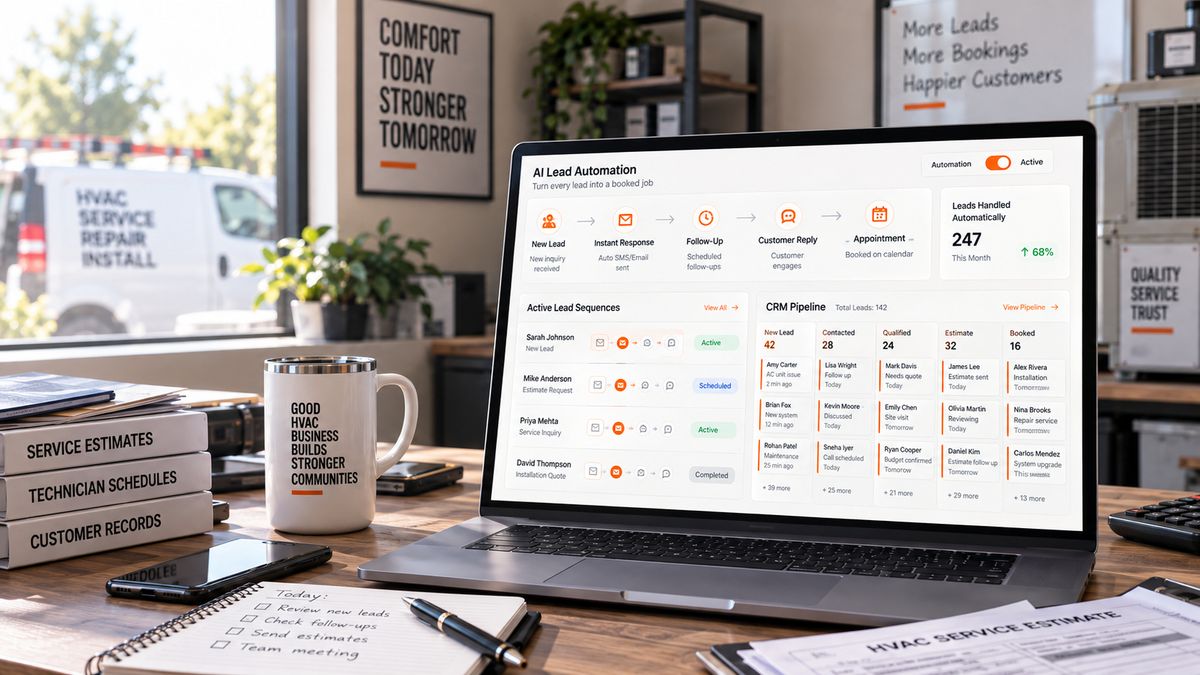
These tools work on top of the FSM platform. They don't replace it. They handle the revenue-critical workflows that FSM platforms don't cover: answering calls after hours, running follow-up sequences, chasing estimates, reactivating dormant customers, and building the marketing presence that makes every advertising dollar convert better.
FatCamel AI
Purpose-built AI automation for HVAC contractors and home service businesses. Covers the complete revenue automation stack: RealtorVoiceAI for after-hours call answering and instant lead capture, Lead Activation Engine for multi-touch follow-up sequences and estimate chasing, CRM Automation for real-time data logging, ContentFlow for content marketing and review generation, and chatbot for website lead capture.
Connects to ServiceTitan, Jobber, Housecall Pro, and FieldEdge through API integrations reads from and writes back to the existing FSM platform rather than replacing it.
Best for HVAC businesses spending on Google Ads or LSAs with meaningful after-hours call volume, and any HVAC business whose estimate follow-up and lead conversion processes are inconsistent.
Pricing: $3,000 to $8,000 for custom voice agent build with HVAC-specific configuration. $200 to $500 per month operating costs. Full automation stack implementation ranges from $15,000 to $40,000 with $400 to $1,500 monthly operating costs.
Limitation: Higher upfront investment than subscription tools. Best results require HVAC-specific configuration rather than generic templates. Returns are fastest for businesses with meaningful after-hours call volume.
GoHighLevel
Broad marketing automation platform widely used by HVAC marketing agencies. Covers SMS sequences, email campaigns, voicemail drops, appointment reminders, reputation management, and basic CRM pipeline management. Strong for multi-touch follow-up when configured by someone who understands HVAC sales cycles.
Best for HVAC businesses working with an agency already using GoHighLevel, or contractors who want a broad automation platform they can configure themselves.
Pricing: $97 per month (standard), $297 per month (agency/white-label).
Limitation: Generic platform that requires significant HVAC-specific configuration to work well. Doesn't include AI voice answering calls still go unanswered after hours without a separate tool.
Avoca AI
AI phone answering and customer service automation for HVAC and home service businesses. Handles inbound calls, outbound follow-up, and customer communication. Designed specifically for home service contractors with ServiceTitan integration.
Best for larger HVAC operations on ServiceTitan wanting tightly integrated AI call handling.
Pricing: Custom requires a demo call.
Limitation: Primarily positioned for established businesses on ServiceTitan. Less flexible for Jobber or Housecall Pro users.
CallBird AI
AI voice answering for home service contractors with no per-minute charges on standard plans. Handles inbound call answering, qualification, and booking. Simpler configuration than custom implementations.
Best for smaller HVAC contractors wanting a subscription-based AI call answering entry point.
Pricing: Starting at $149 per month.
Limitation: Less HVAC-specific configuration than custom implementations. Better for standard booking scenarios than complex emergency triage.
ServiceTitan Marketing Pro
Native marketing automation within ServiceTitan covers email campaigns, review requests, and customer communication workflows using job history data. Eliminates the need for a separate email marketing tool for ServiceTitan users.
Best for ServiceTitan users who want native email automation without adding an external platform.
Pricing: Add-on to ServiceTitan subscription pricing varies by plan.
Limitation: Limited to ServiceTitan users. Less configurable than dedicated marketing automation platforms for complex multi-touch commercial follow-up.
Read More:Local SEO Automation for HVAC Businesses: How to Rank Higher and Convert More Calls
How the Two Categories Work Together
The FSM platform manages the jobs that are already in the pipeline. The AI automation layer fills the pipeline and follows up on the revenue opportunities the FSM platform doesn't handle.
A homeowner calls at 9 PM about a failed AC unit. The FSM platform doesn't answer that call it's a dispatch system, not a phone answering service. RealtorVoiceAI answers the call, qualifies the situation, books the appointment, and logs the interaction to the FSM platform automatically. The dispatcher arrives in the morning to a job already in the schedule.
An estimate goes out through ServiceTitan on Tuesday. ServiceTitan records the estimate status. It doesn't automatically send a follow-up on Friday asking if the homeowner has questions. The Lead Activation Engine does — triggered by the estimate status in ServiceTitan, running the follow-up sequence, and updating the estimate record when the homeowner responds.
The two categories share data and pass work to each other. The FSM platform is the record of truth. The AI automation layer is the action engine that works the revenue opportunities the FSM platform surfaces but doesn't pursue.
What HVAC Businesses Should Buy First
The right starting point depends on which gap is costing the business the most revenue right now.
If the business doesn't have an FSM platform: Start with Jobber or Housecall Pro. Get the operational foundation in place before adding automation on top of it. Trying to automate an unstructured operation produces chaotic results.
If the business has an FSM platform but is losing after-hours calls: The AI voice agent comes first. The revenue recovery from missed calls typically pays for the tool within the first month. This is the single highest-ROI software investment for most HVAC businesses with any meaningful after-hours call volume.
If the business has an FSM platform and is answering calls but losing leads to slow follow-up and unchased estimates: The Lead Activation Engine comes next. Multi-touch follow-up and estimate chasing are the highest-ROI automation for businesses that are already capturing leads but not converting them at their potential rate.
Read More: HVAC Marketing Automation Services: The Complete Guide to Predictable Leads and Booked Jobs
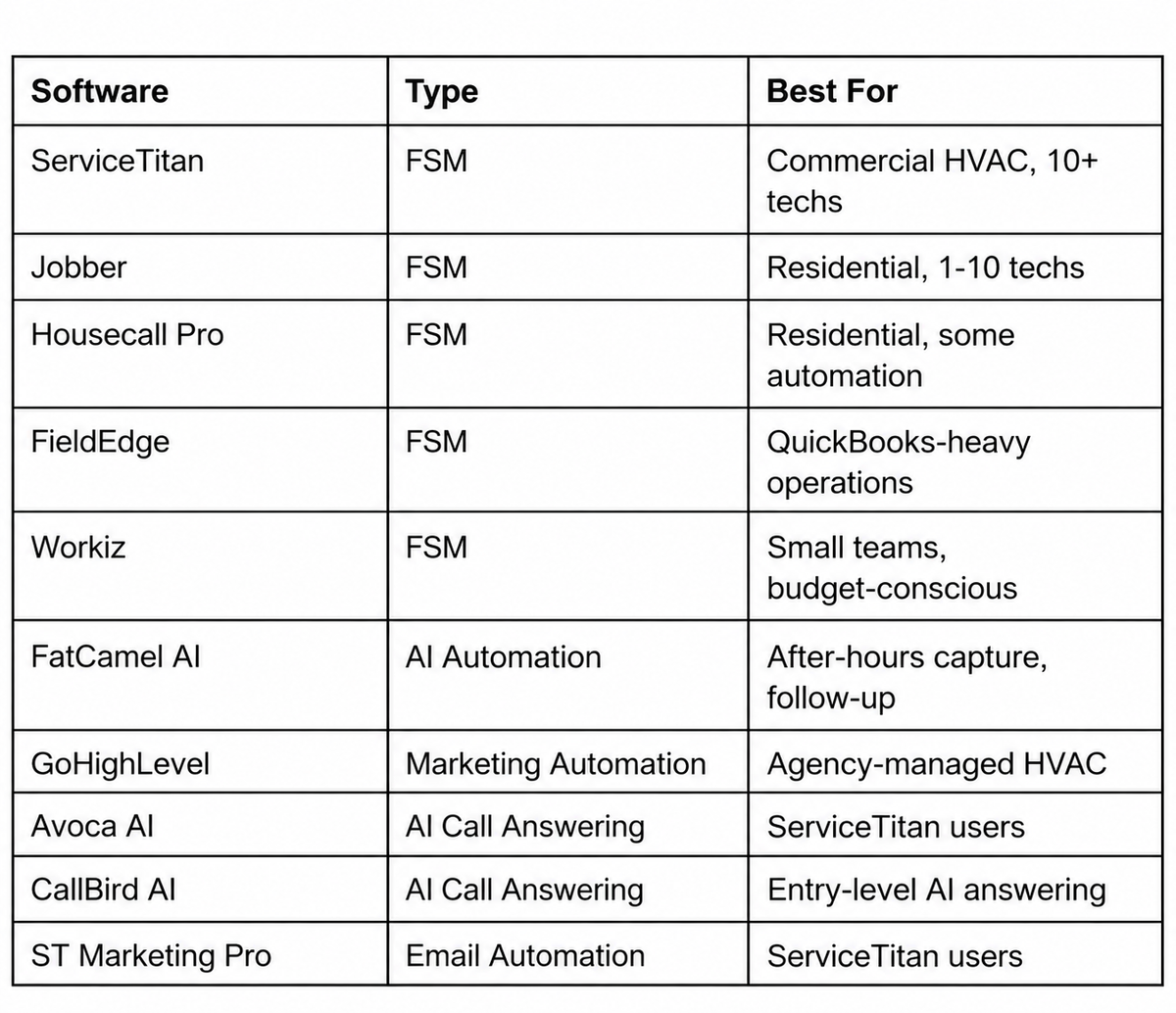
2026 Pricing Comparison
How FatCamel AI Fits Into the HVAC Software Stack
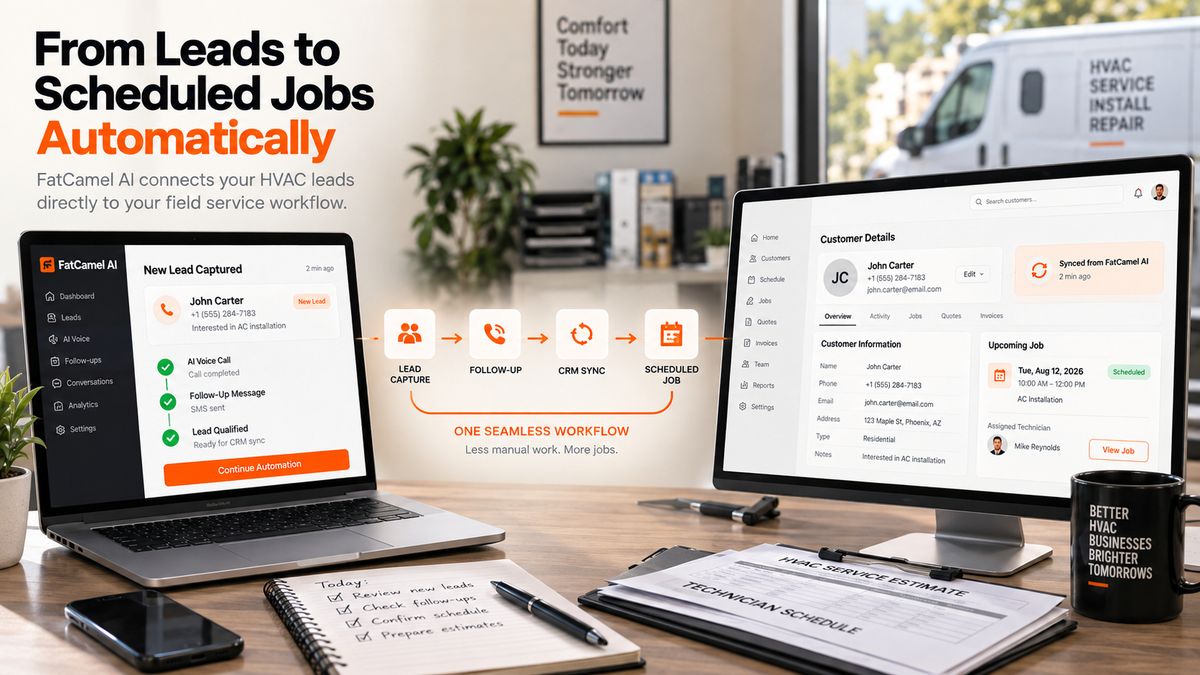
FatCamel AI sits in Category 2 the AI automation and revenue automation layer that works on top of whatever FSM platform an HVAC business is already running. It doesn't compete with ServiceTitan, Jobber, or Housecall Pro. It connects to them.
The integration means the FSM platform stays as the operational backbone dispatch, work orders, job costing, invoicing while FatCamel AI handles the revenue workflows those platforms don't: answering calls after hours, following up on estimates, reactivating dormant contacts, generating reviews, and building the marketing presence that fills the top of the funnel.
For HVAC businesses that have the FSM platform in place and are now looking at the next layer the automation that fills their pipeline, follows up on their estimates, and retains their customers FatCamel AI is designed for exactly that position in the technology stack.
Get a Free AI Revenue Audit for Your HVAC Business at https://www.fatcamel.ai/contact
FAQ
1. What is HVAC automation software?
HVAC automation software covers two categories: field service management platforms that manage active job operations (scheduling, dispatch, invoicing), and AI automation tools that handle the revenue workflows between jobs (lead capture, follow-up, estimate chasing, CRM automation, review generation). Most HVAC businesses need both rather than one instead of the other.
2. What's the best HVAC software for small contractors?
Jobber is the most practical starting point for residential HVAC businesses with 1 to 10 technicians. It covers the core FSM requirements at an accessible price point, offers API access for AI automation integrations on higher plans, and is significantly easier to implement than ServiceTitan. Housecall Pro is a close alternative with some built-in automation features that reduce the need for a separate marketing tool at earlier stages.
3. How much does HVAC automation software cost in 2026?
FSM platforms range from $49 per month (Jobber Core) to $398+ per month (ServiceTitan) plus per-user fees. AI automation tools range from $97 per month (GoHighLevel) to $149 per month (CallBird AI) for subscription options, or $3,000 to $8,000 for custom AI voice agent builds with HVAC-specific configuration. Full AI automation stacks covering after-hours call capture, follow-up, CRM automation, and marketing typically run $400 to $1,500 per month in operating costs after implementation.
4. Does HVAC automation software replace the need for a dispatcher?
No. FSM platforms and AI automation tools both complement the dispatcher's role rather than replacing it. AI dispatch optimization surfaces better technician assignment recommendations the dispatcher confirms rather than manually constructs every schedule. AI call answering captures after-hours leads that the dispatcher couldn't handle overnight the dispatcher works those leads the next morning from a pre-organized queue. The tools make the dispatcher more productive, not unnecessary.
5. How does FatCamel AI fit into the HVAC software stack?
FatCamel AI is an AI automation and revenue automation layer that connects to the existing FSM platform ServiceTitan, Jobber, Housecall Pro, or FieldEdge through API integrations. It handles the revenue workflows those platforms don't: after-hours call answering through RealtorVoiceAI, multi-touch follow-up and estimate chasing through the Lead Activation Engine, real-time CRM logging through CRM Automation, and content marketing and review generation through ContentFlow. The FSM platform stays. FatCamel AI fills the gaps it leaves open.
References
https://buildops.com/resources/hvac-software-buying-guide
https://www.getjobber.com/pricing/
https://www.housecallpro.com/pricing/
https://www.servicetitan.com/blog/hvac-ai
https://locus.sh/blogs/best-hvac-software/
https://www.callrail.com/blog/missed-calls-stats
https://www.capterra.com/hvac-software/
https://www.fatcamel.ai/services/voice-assistant