
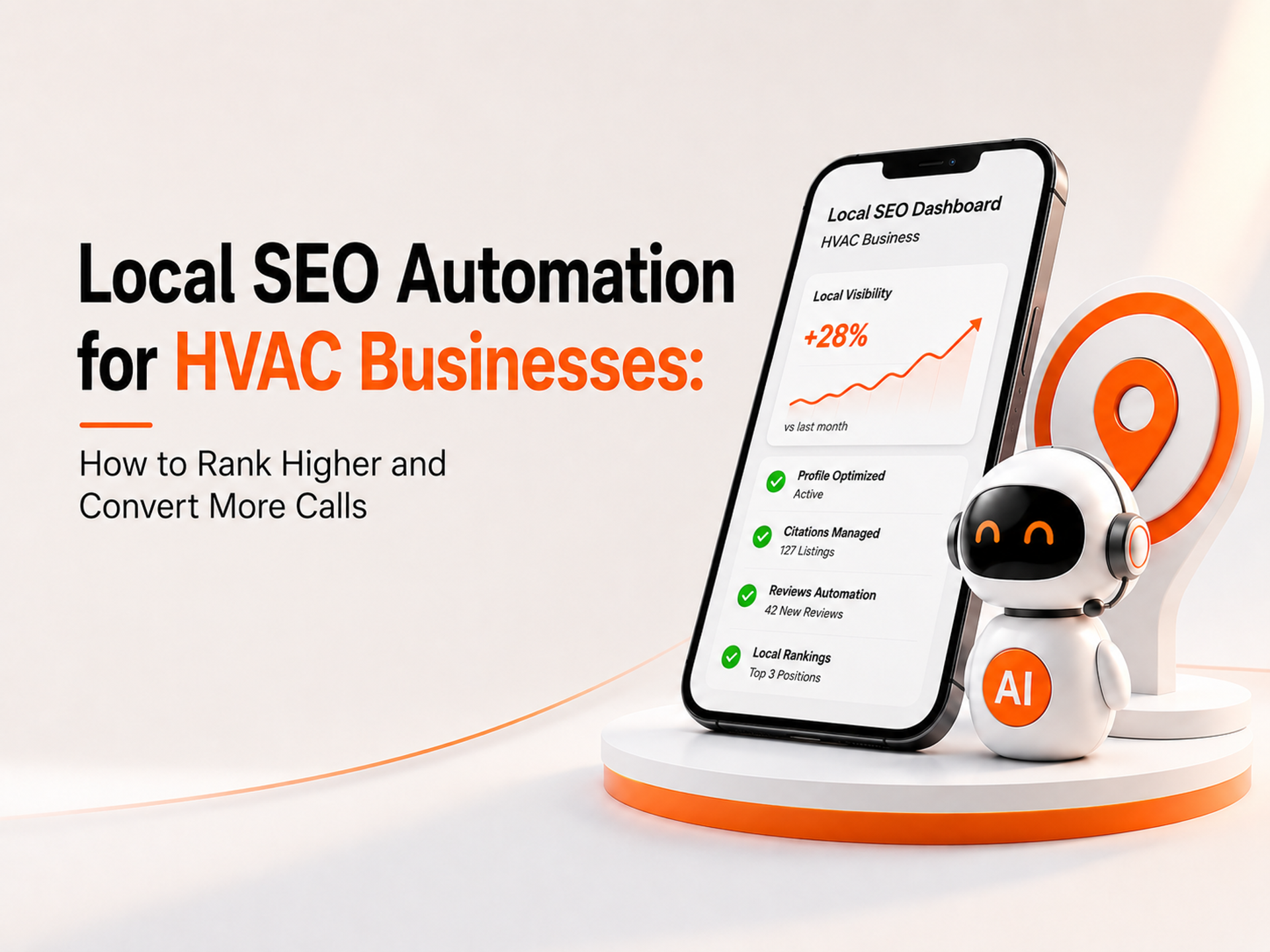
When an HVAC business owner types "HVAC near me" into Google, they're seeing the same thing their customers see and usually, they're not in the top three results. Those three spots in the local pack, the map listings that appear before any organic results, capture the vast majority of clicks from searchers who are ready to call. The businesses in those spots aren't necessarily the best in the market. They're the ones who've built and maintained the right local SEO foundation, and in many cases, kept it up more consistently than their competitors through automation.
This guide covers what local SEO for HVAC businesses actually requires, where most companies fall short, and how automation handles the ongoing maintenance work that manual processes can't sustain.
Table of Contents
Why Local SEO Is the Highest-ROI Marketing Channel for HVAC
The Three-Pack: What It Takes to Get There
Google Business Profile: The Foundation of HVAC Local SEO
NAP Consistency: Why Small Errors Cost Big Rankings
Local Citations: Which Directories Actually Matter for HVAC
Service Area Pages: How to Rank in Every City You Serve
Reviews: The Ranking Factor Most HVAC Companies Neglect
Content and Topical Authority for HVAC Local SEO
How AI Automation Maintains Your Local SEO Without Manual Work
How FatCamel AI Handles Local SEO Automation for HVAC Companies
FAQ
References
Why Local SEO Is the Highest-ROI Marketing Channel for HVAC
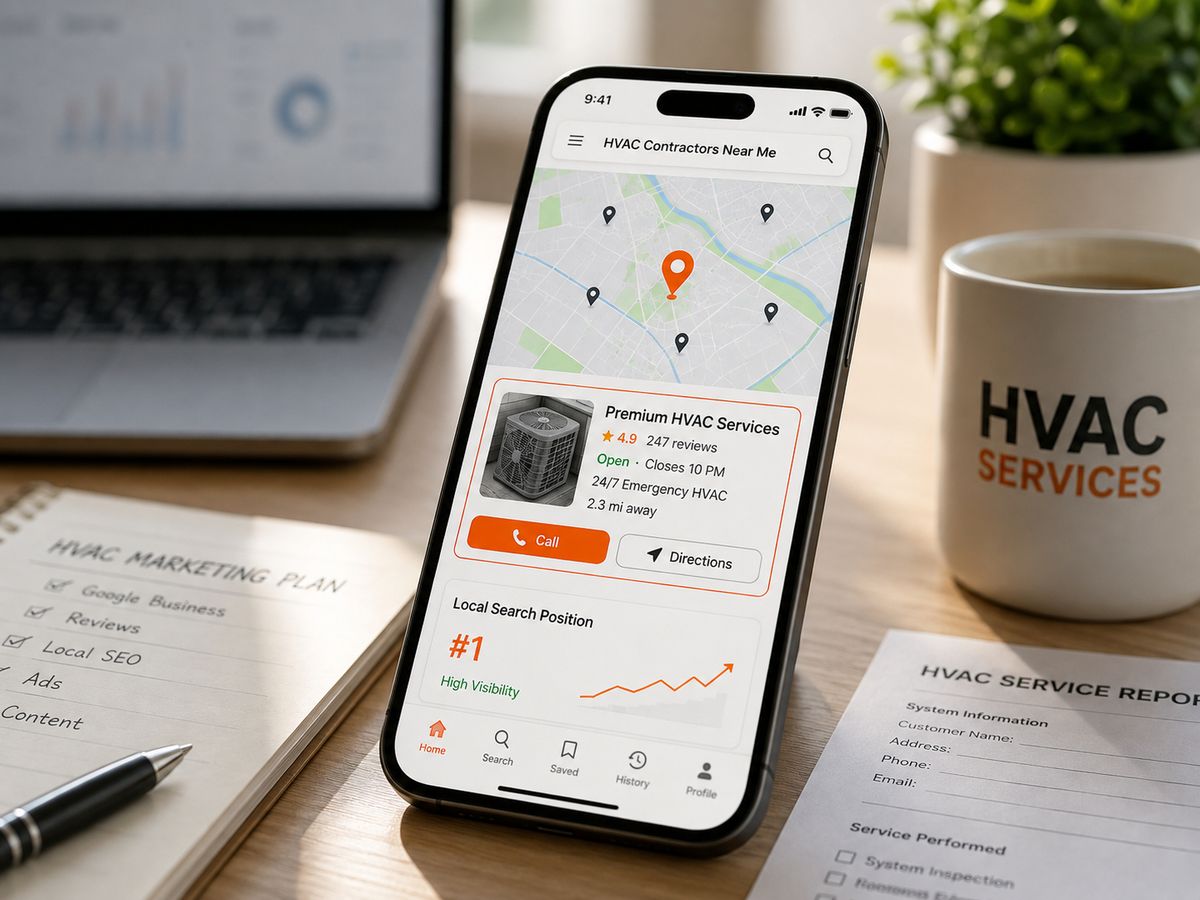
Google Ads for HVAC keywords cost between 15 and 50 dollars per click in most US markets, per WordStream's industry benchmarks. A single click doesn't produce a lead it produces a website visit, and most HVAC websites convert at 2 to 5%. At 30 dollars per click and a 3% conversion rate, that's 1,000 dollars in ad spend to generate one lead. And the moment the ad spend stops, the leads stop.
Local SEO works differently. The clicks from the Google Maps local pack and organic search results cost nothing once the rankings are achieved. A business ranking in the top three for "HVAC repair [city]" captures a consistent stream of high-intent traffic homeowners and facility managers who searched specifically for what the business offers, in the specific area it serves, at the exact moment they need it. The cost to maintain that ranking is the ongoing work of keeping the local SEO foundation current, which with automation, requires minimal manual input.
Per Blue Corona's data from HVAC campaigns, local SEO generates leads at a fraction of the cost of paid search for established HVAC businesses. 92% of searchers pick businesses on the first page of local results, and the local pack the three map listings at the top captures the majority of clicks. For an HVAC business not appearing in that pack for its core service area, the revenue impact of ranking there is significant and measurable from the first month of traffic.
The challenge is that local SEO isn't a one-time setup. It requires ongoing maintenance review responses, citation audits, Google Business Profile updates, fresh content, and performance monitoring that most HVAC businesses start doing well and gradually let slide as the team gets busy with operations. Automation solves this by handling the ongoing maintenance work automatically.
The Three-Pack: What It Takes to Get There
The Google local pack those three business listings with the map that appear above organic results for local service searches is where most HVAC lead generation happens. Research consistently shows that the top three local pack results capture 75 to 85% of all clicks for local service searches. Position four through ten, in the organic results below, share the remaining 15 to 25%.
Getting into the local pack for HVAC keywords comes down to three factors that Google has consistently identified as the most important for local rankings.
Relevance how well the business listing matches what the searcher is looking for. This is determined by how the Google Business Profile is set up, which categories are selected, and what the website content signals about the specific HVAC services offered.
Distance how close the business is to the searcher's location. This one is fixed by where the business is physically located, but it can be extended through service area pages and correctly configured service radius settings in the Google Business Profile.
Prominence how well-known and trusted the business is, as Google measures it. This is where the ongoing local SEO work lives: review volume and recency, citation consistency across directories, website authority, and engagement signals from the Business Profile.
Most HVAC companies have the relevance piece mostly right they've set up a Business Profile with the right categories. Where they fall short is prominence. Their reviews are six months old. Their citations have three different phone numbers across thirty directories. Their Business Profile hasn't been updated since it was created. And prominence is exactly where automation produces the most value, because it's the factor most dependent on consistent, ongoing activity.
Read More: Why Social Media Doesn't Work for HVAC Companies (And What Does)
Google Business Profile: The Foundation of HVAC Local SEO
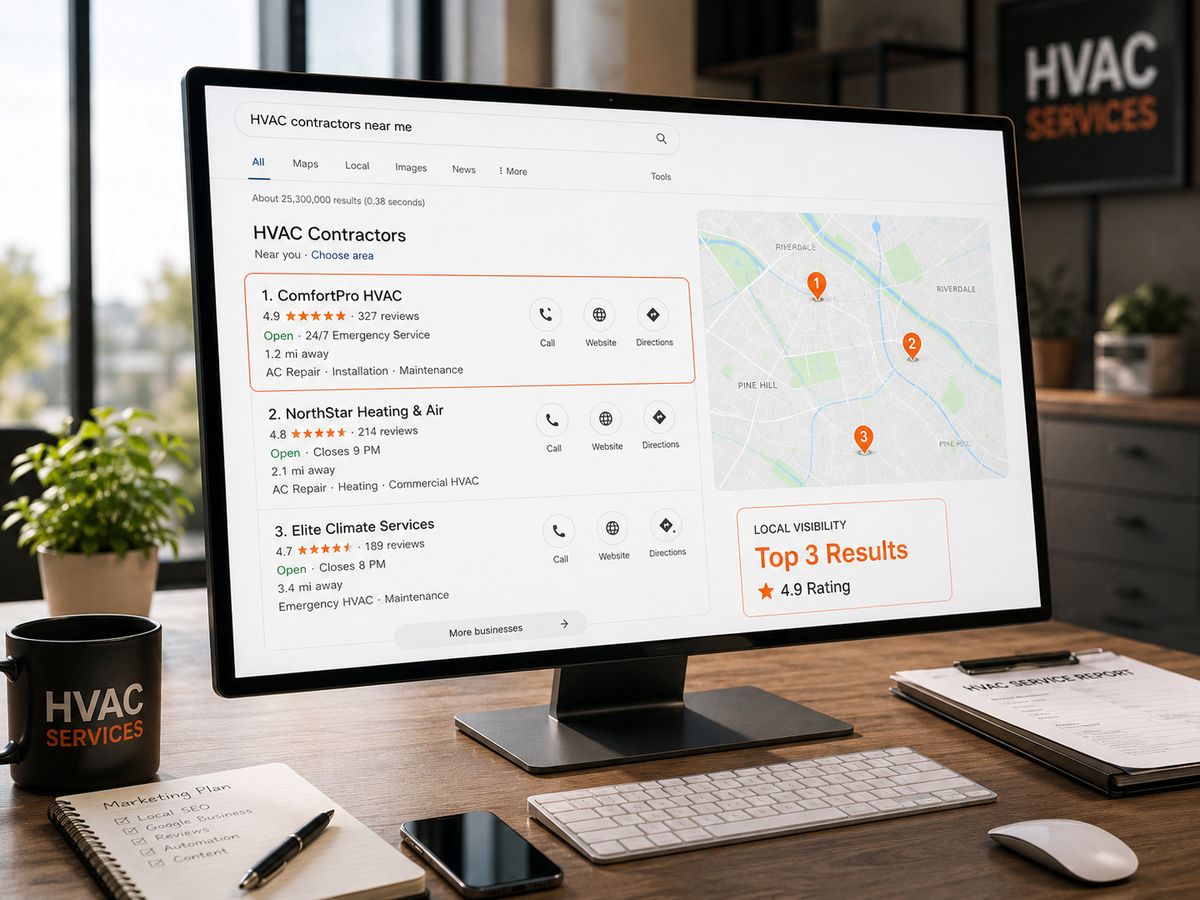
A Google Business Profile is not a set-it-and-forget-it asset. Google's algorithm rewards active profiles ones that receive regular posts, updated photos, timely review responses, and current service and hours information over dormant ones that were correctly set up and then never touched again.
For an HVAC business, the key setup elements are: correct primary category (HVAC Contractor), all relevant secondary categories (Air Conditioning Contractor, Heating Contractor, Furnace Repair Service), complete service listings with accurate descriptions, accurate service area settings covering the full geographic territory the business serves, and NAP information that exactly matches every other mention of the business name, address, and phone number anywhere on the internet.
Beyond setup, the ongoing activity signals that influence ranking include: regular Google Posts (service promotions, seasonal offers, emergency availability announcements), photo updates showing real jobs and real technicians, responses to every review received, Q&A responses to questions submitted through the profile, and periodic updates when services, hours, or contact information change.
Manually sustaining all of this is one of those things that most HVAC businesses intend to do and gradually stop doing when the team gets busy. Automated Google Business Profile management handles the posting schedule, the review response triggering, and the monitoring for unauthorized changes or suggested edits that could harm the listing.
NAP Consistency: Why Small Errors Cost Big Rankings
NAP Name, Address, Phone Number consistency across every online mention of an HVAC business is one of the most impactful and most commonly neglected local SEO factors. Google cross-references the NAP information on a business's website and Google Business Profile against every directory listing, citation, and online mention it can find. When discrepancies exist a different phone number in Yelp than in Google, a slightly different business name in Angi than in the Google Business Profile, an old address still showing on three directories after a move Google's confidence in the business's information drops, and rankings with it.
The problem compounds over time. An HVAC business that operated under a slightly different legal name, moved once in its history, or changed phone numbers at any point in its life has a trail of inconsistent citations scattered across dozens of directories. Each one is a small signal to Google that the business's information isn't reliable. Collectively, they suppress local rankings for businesses that should otherwise rank well based on their review volume and profile activity.
NAP audit and correction is a one-time cleanup task that most HVAC businesses never complete not because it's difficult, but because going through thirty directories and correcting variations in business name formatting, address format, and phone number presentation is tedious manual work. Automated citation management tools handle this audit, flag discrepancies, and push corrections across directories continuously, ensuring that new citations that appear over time are accurate and consistent from the start.
Local Citations: Which Directories Actually Matter for HVAC
Not all directory listings are equally valuable for HVAC local SEO. Generic business directories thousands of low-authority sites that accept any business listing produce minimal ranking impact and can actually harm a local SEO profile if the business has too many inconsistent ones. The citations that move the needle for HVAC local rankings are the ones on directories that Google recognizes as authoritative sources of business information.
For HVAC businesses specifically, the highest-value citation sources are: Google Business Profile (primary), Yelp, Angi (formerly Angie's List), HomeAdvisor, Houzz, Better Business Bureau, Facebook Business Page, Nextdoor Business, Thumbtack, and industry-specific directories like ACCA (Air Conditioning Contractors of America) member listings.
Beyond these primary citations, local citations carry additional weight a listing in the local chamber of commerce directory, a mention on the local news website, sponsorship of a local organization that results in a website link. These hyper-local signals tell Google that the business is genuinely embedded in the geographic community it claims to serve, which reinforces local relevance in ways that broad directory listings don't.
The citation-building strategy for an established HVAC business is less about adding new citations and more about auditing, correcting, and consolidating what already exists and then maintaining the accuracy of the most important ones as a continuous process rather than a periodic project.
Read More: Recover Cold HVAC Leads Using AI (And Turn Dead Contacts Into Booked Jobs)
Service Area Pages: How to Rank in Every City You Serve
An HVAC business that serves fifteen cities but has one website with one location doesn't appear prominently in local search results for fourteen of those cities. The Google Business Profile's service area settings help, but they're not sufficient on their own for HVAC companies trying to rank in cities where they don't have a physical presence.
Service area pages individual website pages optimized for specific geographic areas the business serves extend local search visibility beyond the immediate address of the business. A page titled "HVAC Repair in [City Name]" with relevant local content, the correct NAP for the service area, embedded map data, and genuine content about serving that specific community signals to Google that the business is genuinely relevant to searches from that location.
The content on service area pages needs to be genuinely location-specific to be effective. A page that simply replaces the city name in a template while keeping identical content across all pages doesn't produce ranking results and can actually trigger thin content penalties. Each page needs unique content local climate considerations, specific neighborhoods served, testimonials from customers in that area that makes the page genuinely useful to a searcher from that location rather than obviously templated.
For HVAC businesses serving large geographic territories, creating and maintaining fifteen to twenty service area pages with genuinely unique, regularly updated content is significant work. AI content automation handles initial page creation and ongoing content refresh for service area pages at a scale that manual content production can't sustain.
Reviews: The Ranking Factor Most HVAC Companies Neglect
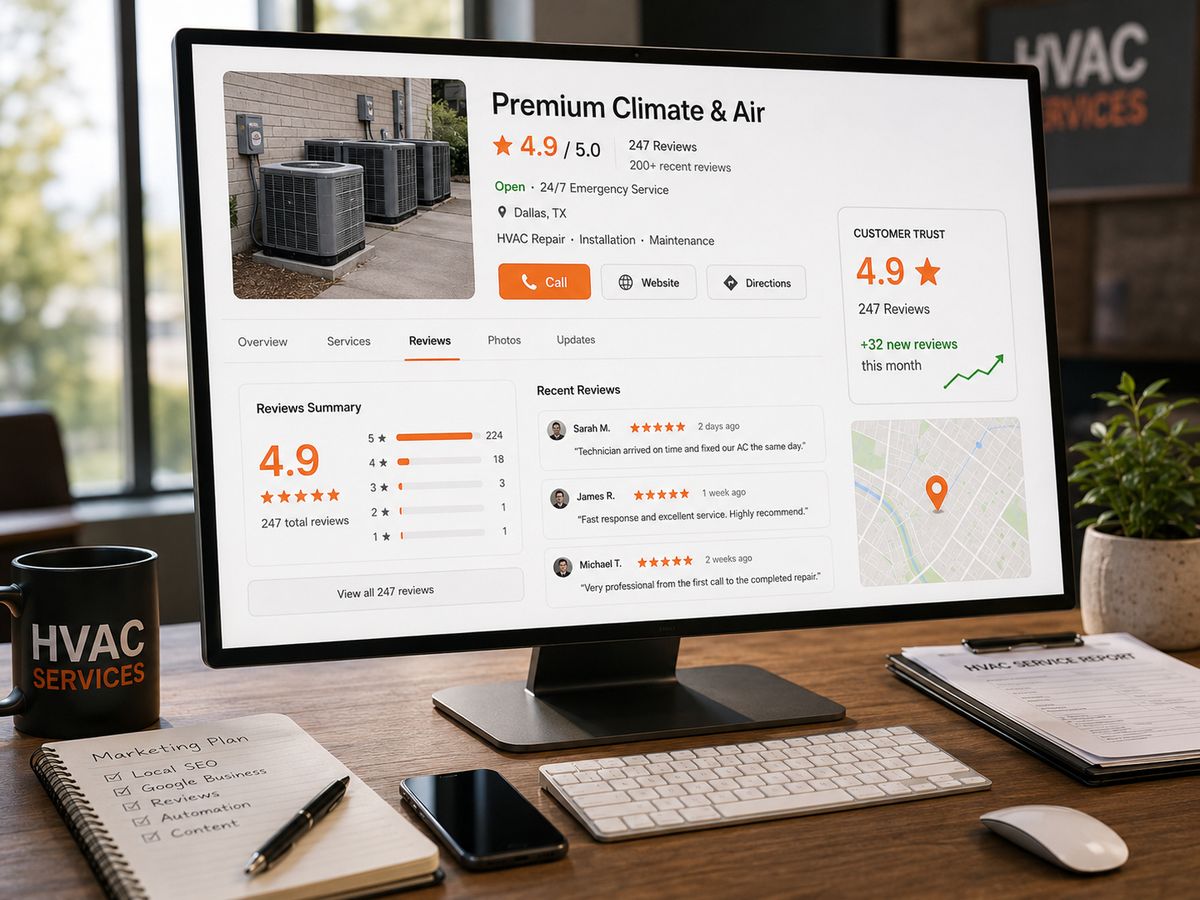
Google's local ranking algorithm treats review signals total review count, average rating, recency of reviews, and presence of keyword-rich review content as significant factors in local pack rankings. A business with 200 reviews averaging 4.8 stars, with the most recent received last week, ranks above a business with 50 reviews averaging 4.9 stars with the most recent received three months ago, all else being equal. Recency matters as much as volume.
This creates a specific problem for HVAC businesses that run review campaigns periodically rather than continuously. A push to collect 30 reviews in January produces a spike that provides a temporary ranking boost, and then review recency gradually declines over the following months as no new ones come in. A continuous automated review request system that fires within 24 hours of every completed job produces a steady stream of new reviews throughout the year, which is exactly what the local ranking algorithm rewards.
Beyond rankings, reviews directly influence click-through rates and conversion rates for HVAC businesses in the local pack. BrightLocal research shows that 87% of consumers read online reviews for local businesses. A business with 200 reviews and a 4.8 average rating generates significantly more call clicks from the local pack than a business with 20 reviews and a 4.5 average, regardless of their relative ranking position. The review volume signals trustworthiness before the homeowner has even clicked through to the website.
Automated review generation fires a personalized request within 24 hours of every completed job every time, without anyone on the team remembering to ask. The customer receives a direct link to the Google Business Profile review page. The friction between a satisfied customer and a completed review is minimized to a single tap.
Read More: 15 HVAC Tasks You Can Automate Using AI (And What Each One Is Worth)
Content and Topical Authority for HVAC Local SEO
Google's local search algorithm increasingly rewards businesses whose websites demonstrate genuine expertise in their service category what Google refers to as topical authority. For HVAC businesses, this means having comprehensive website content that covers the full range of HVAC topics a homeowner or facility manager might search for, from emergency repair advice to equipment selection guidance to seasonal maintenance tips.
This content serves two purposes. First, it signals to Google that the business is a genuine authority on HVAC topics rather than a thin website with only service landing pages. Second, it captures long-tail search traffic the specific questions homeowners type into Google when they're researching an HVAC issue and converts a portion of that research traffic into leads when the content clearly positions the business as the logical choice to solve the problem.
The challenge is that producing comprehensive HVAC content consistently blog posts, service page updates, FAQ content, seasonal guides requires either significant time investment from someone with HVAC expertise or a system that automates content production while maintaining accuracy and relevance. FatCamel AI's ContentFlow handles the content production layer for HVAC businesses, generating blog posts, service page content, and seasonal updates that build topical authority without requiring the business owner or team to write content manually.
How AI Automation Maintains Your Local SEO Without Manual Work
The common thread across every element of HVAC local SEO is that the initial setup is manageable most HVAC businesses have done some version of it but the ongoing maintenance is where the work compounds and where manual processes consistently fall short. Google Business Profile posts go weeks without updates. Review requests stop going out when someone gets busy. Citation corrections never get made because nobody has time to go through thirty directories. Service area page content stays the same for years.
AI automation handles the ongoing maintenance layer that manual processes can't sustain. Automated Google Business Profile management schedules regular posts, monitors for unauthorized changes, and triggers review response workflows when new reviews appear. Automated review generation fires a personalized SMS and email request within 24 hours of every completed job, ensuring a continuous flow of new reviews without any team member initiating each request. Automated citation monitoring checks NAP consistency across directories and flags discrepancies for correction. And AI content automation produces fresh blog posts, service page updates, and seasonal content on a regular schedule that builds topical authority over time.
Individually, each of these maintenance tasks is straightforward. Together, they represent several hours of ongoing work per week work that gets prioritized below active operations and customer service in virtually every HVAC business that tries to do it manually.
How FatCamel AI Handles Local SEO Automation for HVAC Companies
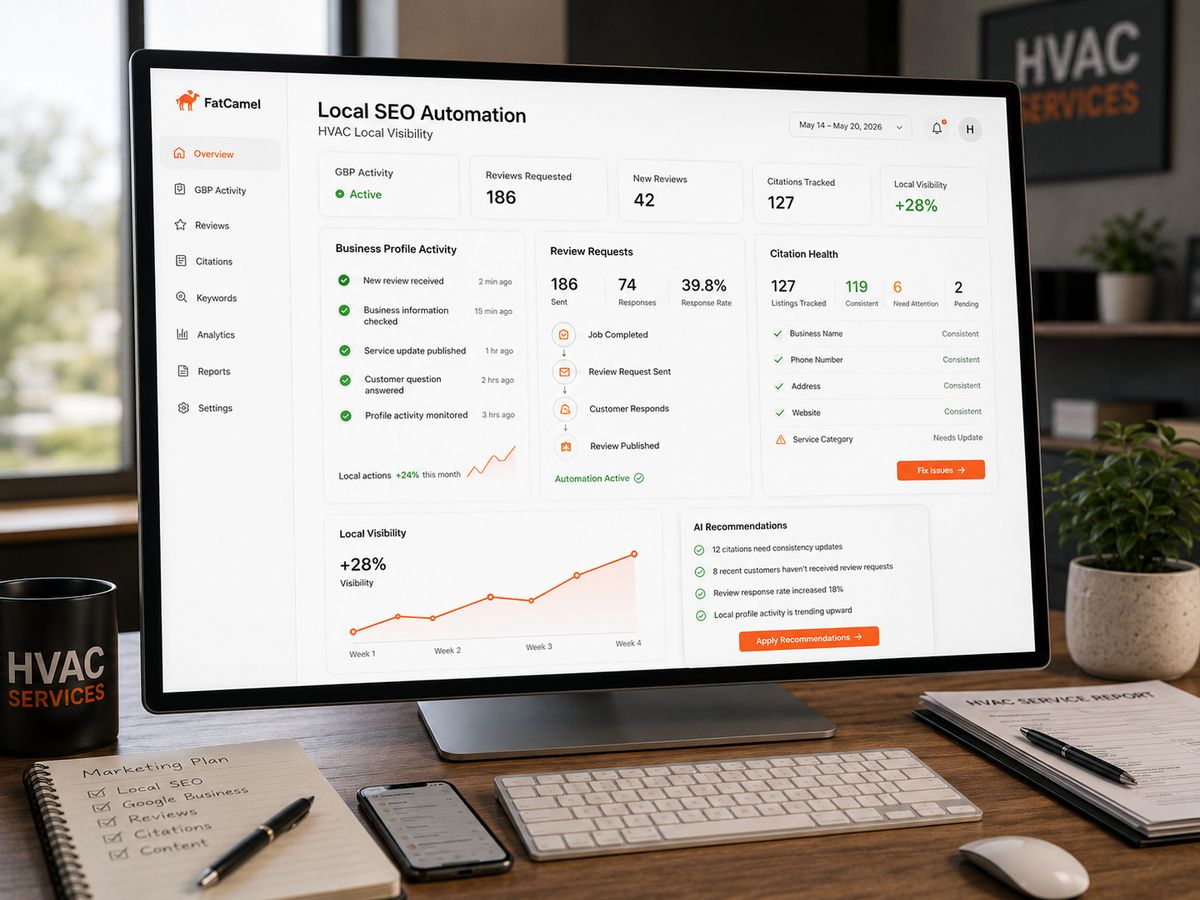
FatCamel AI approaches local SEO automation for HVAC businesses as a connected system rather than a collection of separate tools, because the components that drive local rankings review volume, content freshness, citation consistency, and Business Profile activity are more powerful when they're coordinated than when each runs independently.
The review generation layer fires automatically after every completed job, drawing the customer's name and job details from the CRM to personalize the request before it goes out. The ContentFlow component produces blog posts and service page updates on a set schedule, feeding the website's topical authority signals with fresh, relevant HVAC content without requiring manual writing. The CRM Automation layer ensures that every customer interaction is logged accurately, which supports the review and follow-up workflows with complete, current data.
RealtorVoiceAI's role in local SEO is less obvious but genuinely important by capturing every inbound call immediately, it ensures that the phone number connected to the Google Business Profile is answered at all times, which reduces the bounce rate from searchers who call directly from the local pack and hear voicemail. A listing that answers every call converts at a higher rate from local pack traffic than one that sends callers to voicemail, and that engagement signal feeds back into the local ranking algorithm over time.
For HVAC businesses that have set up their local SEO foundation but struggle to maintain it consistently, this is the practical solution not more manual effort, but a system that handles the maintenance automatically while the team focuses on delivering the service that earns the reviews that drive the rankings that generate the calls.
👉 Get a Free AI Revenue Audit for Your HVAC Business at https://www.fatcamel.ai/contact
FAQ
1. What is local SEO for HVAC companies?
Local SEO for HVAC companies is the process of making the business appear when homeowners and facility managers search for HVAC services in a specific geographic area in Google Maps, in the local pack (the three business listings above organic results), and in organic search results. It involves optimizing the Google Business Profile, maintaining consistent NAP information across directories, building and managing local citations, generating reviews steadily, and creating location-specific website content that signals relevance to local searches.
2. What's the most important local SEO factor for HVAC businesses?
Google Business Profile optimization and review generation are consistently the highest-impact starting points for HVAC local SEO. A complete, actively maintained Business Profile with accurate category settings and regular posts, combined with a steady flow of recent reviews, moves the needle faster than any other factor for businesses that haven't yet established strong local rankings. NAP consistency is also critical even small discrepancies across directories suppress rankings in ways that are invisible without an audit.
3. How long does it take for local SEO to show results for HVAC companies?
For HVAC businesses that are starting from a weak local presence, meaningful improvement in local pack rankings typically appears within 60 to 90 days of implementing a consistent local SEO program. The specific timeline depends on the competition level in the service area, how many reviews the business starts with, and how consistently the optimization activities are maintained. Markets with weaker competition respond faster. Google Business Profile optimization and review generation improvements often show within 30 days.
4. How do reviews affect local SEO rankings for HVAC companies?
Reviews affect HVAC local rankings in two ways. First, Google's algorithm treats review signals total count, average rating, and recency as ranking factors in the local pack. A business with more recent, higher-rated reviews ranks above competitors with equal relevance and distance signals. Second, reviews affect click-through rates from the local pack homeowners comparing three listings in the local pack will disproportionately click the one with more reviews, even when the star ratings are similar.
5. What are service area pages and why does an HVAC company need them?
Service area pages are individual website pages optimized for specific geographic areas the business serves beyond its primary location. An HVAC company serving fifteen cities but having only one location page misses organic search traffic for fourteen of those cities. Each service area page with genuinely unique, location-specific content rather than templated copy extends local search visibility into the full service territory and signals to Google that the business is genuinely relevant to searchers in each location.
6. How does AI automation help with HVAC local SEO?
AI automation handles the ongoing maintenance layer of HVAC local SEO that manual processes consistently fail to sustain automated review generation that fires after every completed job, Google Business Profile posting on a regular schedule, citation monitoring and discrepancy flagging, and content production for blogs and service area pages. Each of these tasks is manageable individually but compounds into several hours of weekly work when done manually, work that gets deprioritized when the team is busy with active operations.
7. How does FatCamel AI automate local SEO for HVAC businesses?
FatCamel AI automates the key ongoing local SEO maintenance tasks for HVAC businesses through connected components. Review generation fires automatically after every completed job using CRM data to personalize each request. ContentFlow produces regular blog posts and service page updates that build topical authority without manual writing. CRM Automation keeps all customer data current to support downstream workflows. And RealtorVoiceAI ensures every call to the Business Profile phone number is answered immediately, maintaining the engagement signals that influence local ranking over time.
References
https://www.bluecorona.com/digital-marketing/seo/local-seo/hvac/
https://dagmarmarketing.com/guides/local-seo-guide-hvac-company/
https://www.nopio.com/blog/hvac-local-seo-guide/
https://valveandmeter.com/trades/hvac/local-seo/
https://www.homerankads.com/blog/mastering-local-seo-for-hvac-companies
https://www.brightlocal.com/research/local-consumer-review-survey/
https://www.wordstream.com/blog/ws/2016/02/29/google-ads-industry-benchmarks
https://www.simprogroup.com/blog/hvac-marketing-strategies
https://www.fatcamel.ai/services/crm-automation
https://www.fatcamel.ai/