
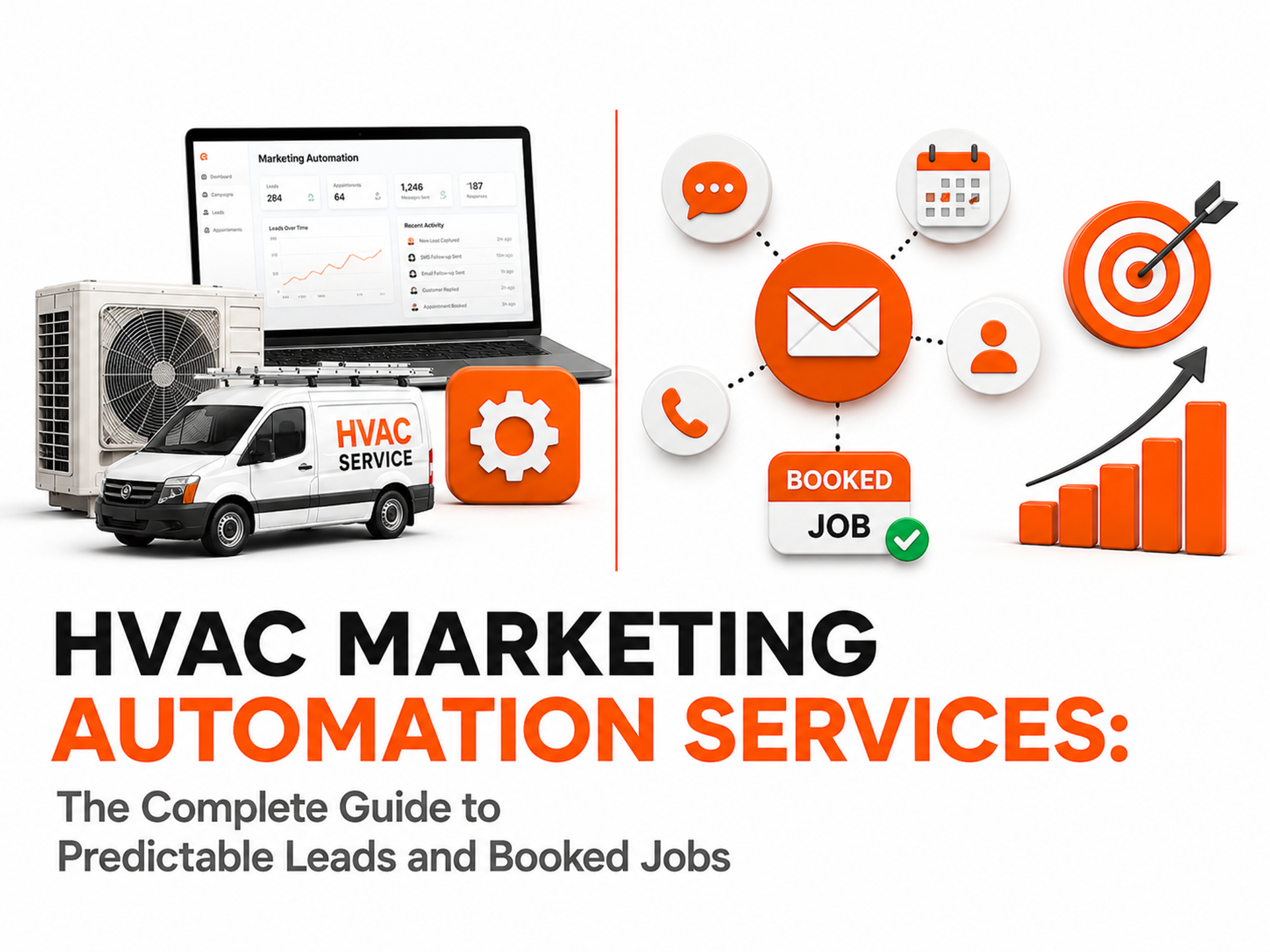
There's a version of HVAC marketing that most business owners know isn't working. They post on social media occasionally. They send a seasonal email when they remember. They follow up on estimates when the week isn't too busy. And at the end of the month, they look at the revenue and wonder why the busy season didn't produce what they expected.
The issue usually isn't the quality of the marketing. It's that marketing in a service business is almost impossible to do consistently when the same people responsible for it are also dispatching technicians, managing active jobs, and handling customer complaints. Things fall through the cracks not because nobody cares, but because there aren't enough hours.
Marketing automation for HVAC businesses fixes this by running the consistent, repeatable parts of the marketing process automatically so the work that needs to happen at 9 PM on a Tuesday still happens, even when everyone's off the clock.
Table of Contents
What HVAC Marketing Automation Actually Is
The 7 Core Automation Services Every HVAC Business Needs
Service 1: Lead Capture and Instant Response
Service 2: Multi-Touch Follow-Up Sequences
Service 3: Estimate Follow-Up Automation
Service 4: Seasonal Campaign Automation
Service 5: Review Generation Automation
Service 6: Dormant Customer Reactivation
Service 7: Commercial Outreach Sequences
What Good HVAC Marketing Automation Looks Like in Practice
Pricing: What These Services Actually Cost in 2026
How FatCamel AI Delivers the Complete HVAC Marketing Automation Stack
FAQ
References
What HVAC Marketing Automation Actually Is
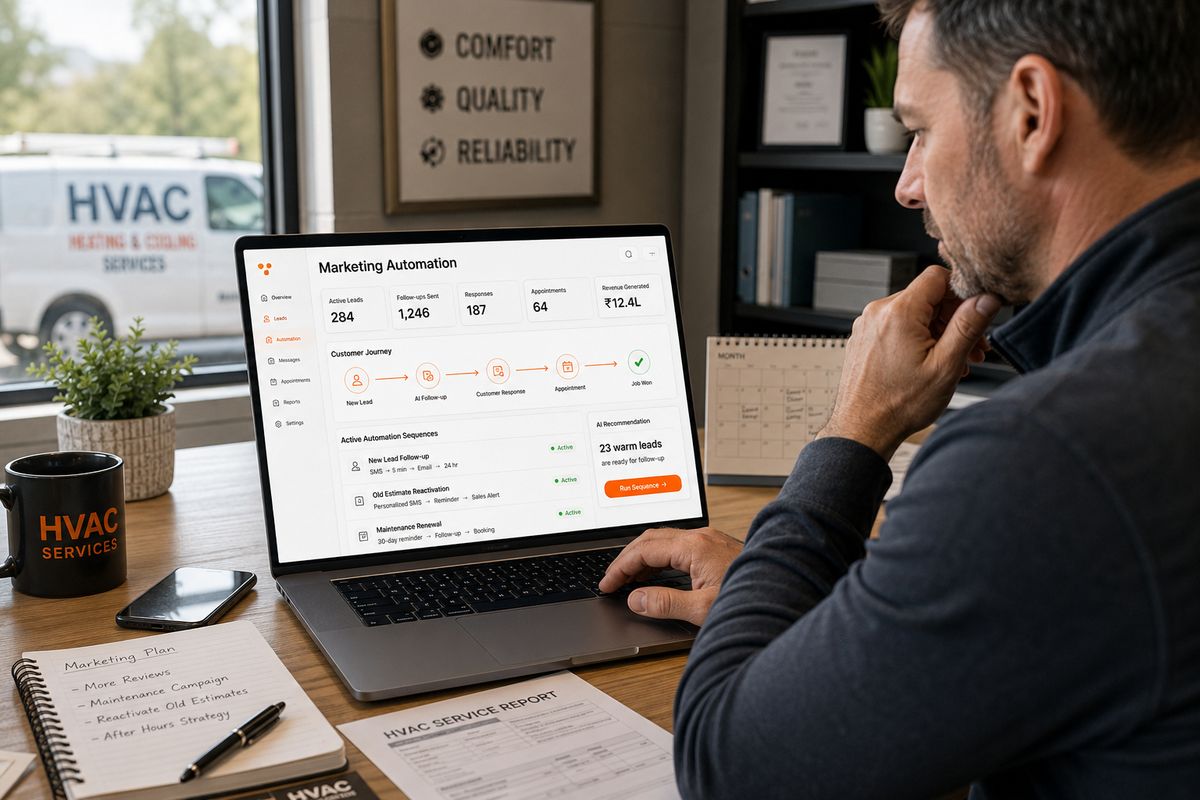
Marketing automation for HVAC businesses is a connected set of systems that handle specific marketing tasks automatically, based on triggers from customer behavior, CRM data, or time intervals. It's not a single tool. It's not just email software. And it's not something that replaces the thinking that goes into a good marketing strategy it's what executes that strategy consistently, even when the team is too busy to.
The difference between a business running marketing automation and one relying on manual processes shows up most clearly during peak season. When the team is managing 40 active jobs and incoming calls are coming in faster than they can be answered, the manual marketing process collapses. Nobody has time to send the estimate follow-up from last Tuesday. Nobody remembers to request a review from the job completed Thursday morning. The three leads who submitted forms overnight are still sitting in an inbox.
A business running marketing automation handles all of this in the background, regardless of how busy the team is. The estimate follow-up goes out on schedule. The review request fires within 24 hours of job completion. The overnight form submissions get an immediate response. And the dispatchers focus on what they're actually supposed to be doing dispatching.
This is the practical value of HVAC marketing automation. Not technology for its own sake, but operational consistency that manual processes can't provide at scale.
The 7 Core Automation Services Every HVAC Business Needs
Service 1: Lead Capture and Instant Response
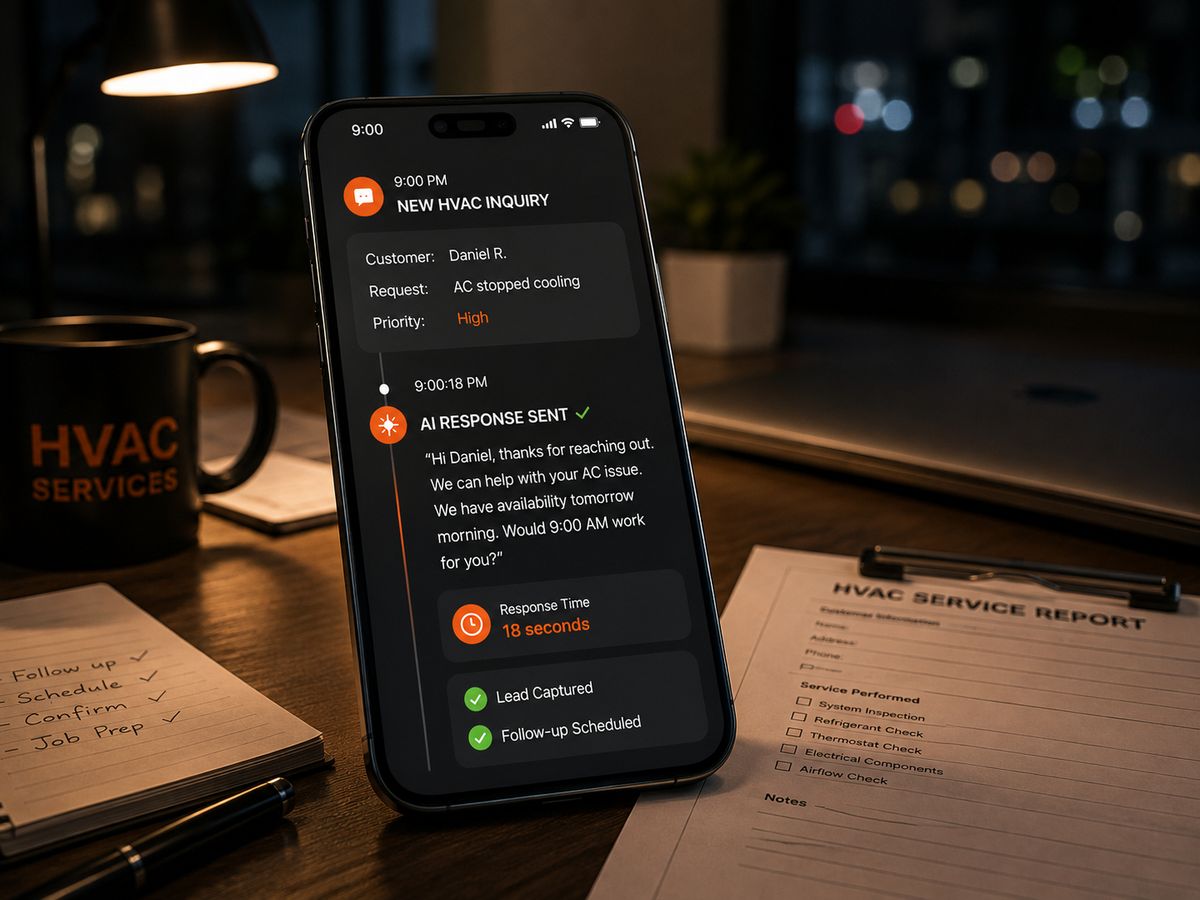
The single most impactful automation service for most HVAC businesses is the one that handles what happens in the first 60 seconds after a lead comes in.
Research from the MIT Lead Response Management Study showed that responding within five minutes of an enquiry produces contact rates 100 times higher than responding after 30 minutes. Only 11% of HVAC businesses respond within an hour, per SearchLight's 2026 benchmark. That gap between what the data says matters and what most businesses actually do is where the majority of lead conversion opportunity sits.
Instant response automation means every lead from every channel phone call, web form submission, missed call, social media DM receives a meaningful, personalized reply within 60 seconds of making contact. Not an acknowledgment that a callback will follow. A real response that references the specific service requested, confirms the enquiry was received, and provides a direct next step.
For phone calls, FatCamel AI's RealtorVoiceAI answers immediately, qualifies the caller's situation, and books the appointment in real time. For web form submissions, an automated email and SMS goes out within 60 seconds. For missed calls, an immediate text-back reaches the caller before they've decided to try the next contractor on the list.
Read More: Build an HVAC Lead Generation System That Works 24/7
Service 2: Multi-Touch Follow-Up Sequences
Most HVAC businesses follow up on leads once, maybe twice. After that, the lead gets marked as cold and the team moves on. The problem is that most buyers particularly for larger jobs like system replacements need five to eight touchpoints before making a decision. The gap between two follow-ups and eight is where most follow-up revenue disappears.
Automated follow-up sequences run the entire touchpoint schedule without anyone on the team initiating each message. Day one, day three, day seven, day fourteen SMS and email running in coordination, each message different from the last, each one referencing the specific service the lead enquired about. The sequence runs whether the team is managing a heat wave response or a quiet Wednesday. It stops automatically the moment the lead books or responds.
FatCamel AI's Lead Activation Engine manages this entire layer building the sequences, triggering them based on CRM pipeline data, and escalating warm responses to the team with the full conversation history already attached. The dispatcher doesn't need to remember to follow up. The system handles it.
Service 3: Estimate Follow-Up Automation
An estimate represents the maximum investment the business has made in a lead the site visit, the technician's time, the detailed scope and pricing work. Less than 40% of HVAC businesses have any systematic process for following up after an estimate goes out. That's the most expensive gap in most HVAC marketing pipelines.
Estimate follow-up automation triggers the moment an estimate status is updated to "sent" in the CRM. Day three brings a check-in asking if the customer has questions about the scope. Day seven adds context what's included, why the approach reflects quality. Day fourteen is a low-pressure message that makes re-engagement easy. The whole sequence runs without any estimator having to manually track each outstanding quote.
HVAC businesses running structured estimate follow-up see acceptance rates improve by 15 to 25 percentage points compared to informal manual follow-up. On a system replacement quote worth 10,000 dollars, that improvement is the difference between losing the job and closing it.
Service 4: Seasonal Campaign Automation
HVAC demand is cyclical in a way that few other service industries match. Pre-summer AC tune-ups. Pre-winter furnace checks. Post-storm system inspections. The businesses that fill their calendars before each peak season do it because they're reaching customers early before the rush, when technician availability is still flexible and customer urgency is building rather than peaking.
Seasonal campaign automation schedules outreach to the full customer database at the right intervals before each seasonal transition. The spring AC campaign goes to every customer whose system was last serviced more than a year ago, with messaging that references their specific equipment. The winter furnace campaign goes to maintenance agreement holders with renewal reminders alongside the service prompts.
This isn't a mass blast it's segmented, personalized outreach that pulls relevant customer data from the CRM to make each message feel specific rather than templated. And it runs on schedule regardless of how busy the team is in the weeks before each campaign triggers.
Service 5: Review Generation Automation
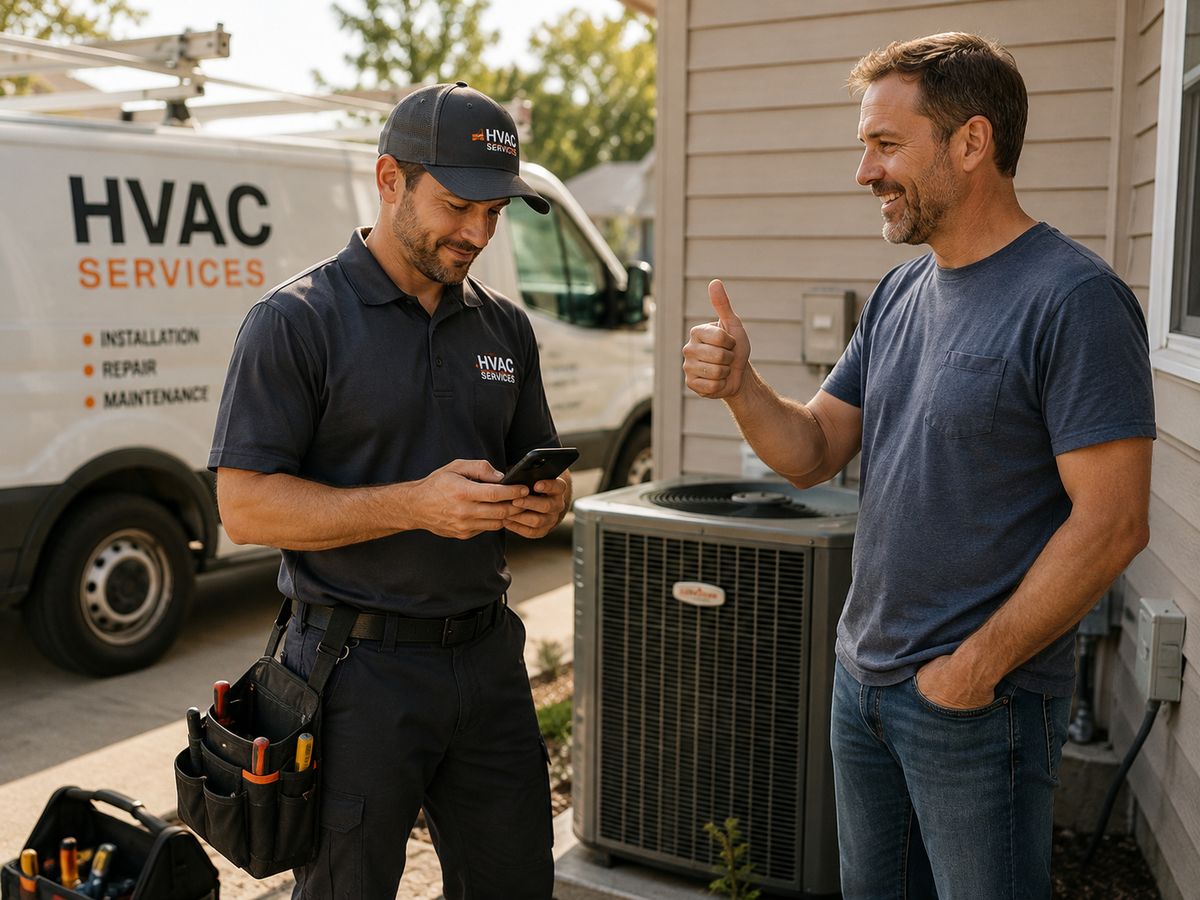
Online reviews directly affect how many new customers find and choose an HVAC business. A consistent flow of recent, positive reviews improves Google Business Profile ranking for local searches and builds the social proof that converts a search result into a call. Yet most HVAC businesses only ask for reviews occasionally when someone remembers which means inconsistently and usually not at the moment when customer satisfaction is highest.
Review generation automation sends a review request within 24 hours of every completed job, to every customer, every time. The timing is deliberate — customer satisfaction is highest immediately after a positive service experience, and response rates drop significantly after a few days. A direct link to the Google Business Profile or preferred review platform removes the friction that stops many customers from following through.
A business completing 15 jobs per week that captures 30% of customers as reviewers generates over 200 new reviews per year without any team member sending a single request manually. Over 12 months, that compounds into a review profile that looks meaningfully more credible than competitors who review by exception.
Read More: AI Automation for HVAC Companies: Benefits, Process, Pricing & ROI
Service 6: Dormant Customer Reactivation
Every HVAC business with any real operating history has a CRM full of past customers who haven't had service in 12 months or more. These aren't strangers they've already trusted the business with their home. They just haven't heard from it in a while.
Dormant customer reactivation identifies these contacts automatically based on last service date and initiates personalized outreach referencing their equipment history. A message that says "Hi Marcus, it's been about 14 months since we serviced your Carrier system at 847 Riverside wanted to check if you're due for a tune-up before summer" converts at a completely different rate than a generic seasonal promotion blast, because it's clearly personal and clearly relevant.
The acquisition cost for these customers is already paid. Reactivating even a fraction of them generates revenue at effectively zero additional marketing cost and the relationship is already established, which makes the conversion significantly easier than winning a brand new customer.
Service 7: Commercial Outreach Sequences
Most HVAC businesses pursue residential work reactively the customer has a problem, they call, the business responds. Commercial HVAC contracts work differently. A facility manager evaluating contractors for a multi-building maintenance agreement doesn't call you when the system fails. They research, they compare, and they eventually reach out to the businesses that have been visible and professional in their professional sphere over time.
Automated commercial outreach sequences reach property managers, facility directors, and commercial real estate operators with targeted, personalized email campaigns on a set schedule introducing the company's commercial capabilities, sharing a relevant case study, making a specific ask for a site visit or conversation. This runs without a dedicated business development hire, which is what makes it accessible to HVAC businesses that can't yet justify that headcount.
FatCamel AI's outreach automation builds and manages these sequences for HVAC contractors pursuing commercial growth, connecting warm responses directly to the sales team with full conversation history attached.
What Good HVAC Marketing Automation Looks Like in Practice
Here's a real picture of what a Monday morning looks like for an HVAC business running proper marketing automation versus one relying on manual processes.
Without automation: The dispatcher arrives to find three missed calls from Sunday evening sitting in voicemail. Two form submissions from Saturday night are in the email inbox, unread. Six outstanding estimates from last week haven't been followed up on. Two customers who completed jobs last Thursday haven't been asked for reviews. One past customer whose maintenance agreement lapsed in March hasn't heard from the business since.
With automation: The dispatcher arrives to find a CRM that already reflects everything that happened over the weekend. Sunday's three missed calls each received an immediate text-back within minutes of hanging up two of those led to web form bookings that came in overnight, already in the calendar. The Saturday form submissions received automated responses within 60 seconds and both are in the follow-up sequence. The six outstanding estimates each received their scheduled Day 7 follow-up on Sunday morning one of them replied asking to proceed. The two Thursday job completions each received review requests Friday morning. The lapsed maintenance customer received a reactivation SMS on Saturday as part of the monthly dormant campaign.
Same team. Same marketing budget. Different system.
Pricing: What These Services Actually Cost in 2026
HVAC marketing automation services are priced across a range depending on scope and provider type.
Subscription-based platforms that cover some automation functions typically email sequences, review requests, and basic CRM triggers run from 150 to 500 dollars per month. These platforms are accessible and easy to start with, but they often require significant manual configuration and don't include the AI voice answering layer that handles after-hours calls.
Full-stack marketing automation implementations covering AI voice answering, multi-touch follow-up, estimate sequences, seasonal campaigns, review automation, and commercial outreach typically cost 15,000 to 40,000 dollars for a complete custom build, with monthly operating costs that scale based on contact volume and interaction volume. Most businesses at this level see positive ROI within 60 to 90 days through a combination of recovered after-hours revenue, improved estimate acceptance rates, and dormant customer reactivation.
The right starting point depends on where the biggest revenue gap is. For most HVAC businesses, that's after-hours lead capture which means the AI voice answering layer comes first, delivers measurable results in week one, and funds the next phase of automation from the revenue it recovers.
How FatCamel AI Delivers the Complete HVAC Marketing Automation Stack
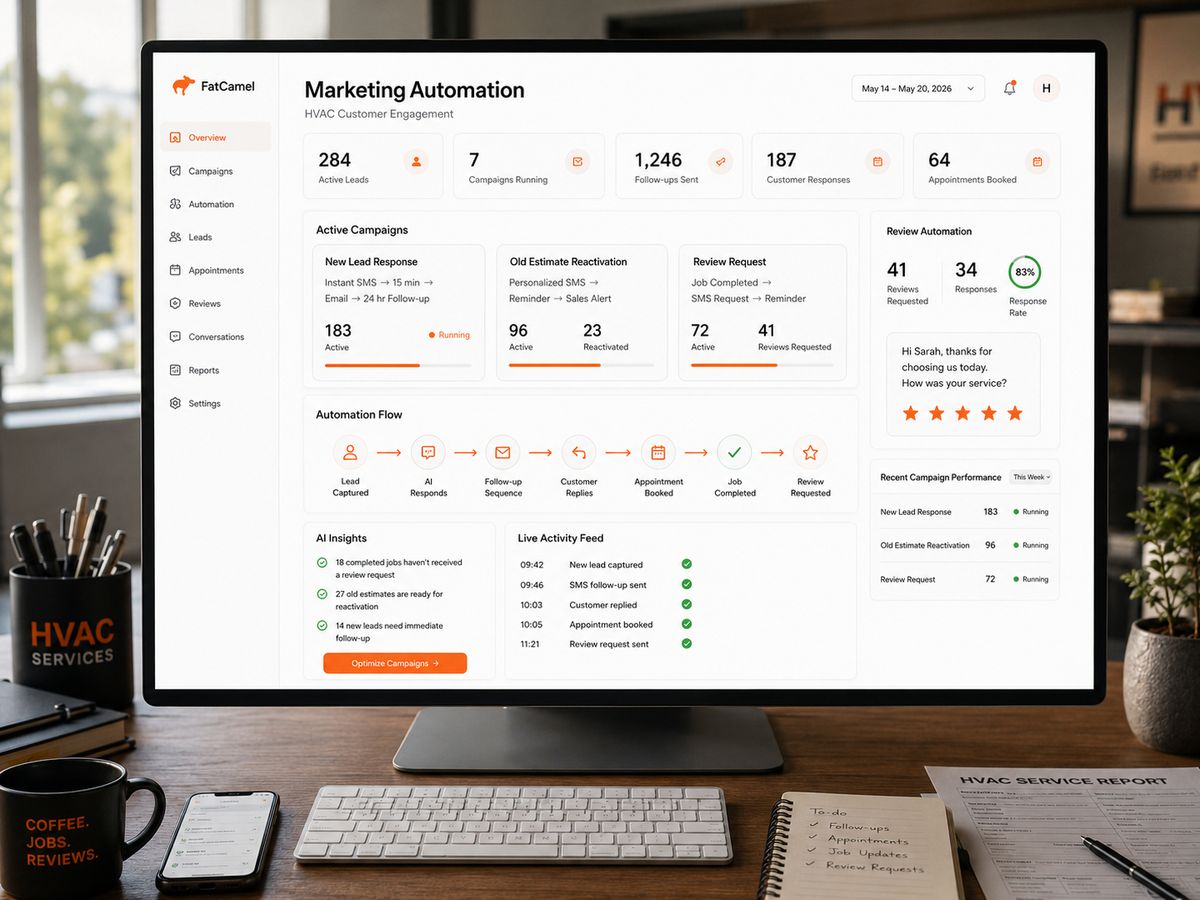
Each of the seven services described in this guide is more powerful when it's connected to the others than when it runs as a standalone tool. A follow-up sequence that doesn't know a customer already received a review request sends the wrong message. A seasonal campaign that doesn't check whether a customer is already in an active estimate follow-up sequence looks disorganized. The value of marketing automation compounds when the components share data and coordinate timing.
FatCamel AI builds and operates the complete HVAC marketing automation stack as a connected system not as seven separate tools requiring separate logins and manual coordination. RealtorVoiceAI handles lead capture and instant response across phone calls and after-hours inquiries. The Lead Activation Engine manages follow-up sequences, estimate chasers, dormant reactivation, and commercial outreach. CRM Automation keeps every record current and triggers the right campaign to the right contact at the right time. Review generation fires after every completed job. Seasonal campaigns go out on schedule, segmented by service history and equipment age.
Every component reads from and writes to the existing CRM. The team doesn't change how they use their field service platform. The marketing automation layer runs underneath, handling the consistent, time-sensitive work that manual processes can't sustain through a busy season and the results appear as a booking calendar that fills itself, a review profile that grows without anyone asking, and a revenue pipeline that reflects the full opportunity available to the business rather than just the fraction that happened to call during staffed hours.
👉 Get a Free AI Revenue Audit for Your HVAC Business at https://www.fatcamel.ai/contact
FAQ
1. What is HVAC marketing automation? HVAC marketing automation is a connected set of systems that handle specific marketing tasks automatically lead capture and instant response, follow-up sequences, estimate chasing, review requests, seasonal campaigns, and dormant customer reactivation based on CRM triggers, customer behavior, or scheduled intervals. It runs these tasks consistently regardless of team capacity, which is the core of its value for HVAC businesses where the marketing process is the first thing to break down during peak season.
2. Why do HVAC businesses need marketing automation specifically? HVAC businesses need marketing automation because the service is urgency-driven, the team is always occupied with active operations, and manual marketing processes are structurally incapable of operating at the speed and consistency that HVAC lead conversion requires. Only 11% of HVAC businesses respond to a new lead within an hour. An automated system responds within 60 seconds, at any hour, every time. That gap is the difference between converting a lead and losing it to the competitor who answered first.
3. What's the most important HVAC marketing automation service to start with? Lead capture and instant response is almost always the highest-ROI starting point. Between 35 and 45% of HVAC calls arrive after hours, and 85% of callers who reach voicemail don't call back. At a 650 dollar average job value, recovering even three missed calls per week through instant AI response produces over 100,000 dollars in annual revenue recovery. No other marketing automation service produces that kind of immediate, measurable return in week one.
4. How does HVAC marketing automation differ from just using email marketing software? Email marketing software handles one channel outbound email. HVAC marketing automation covers the full customer journey across multiple channels: AI voice answering for phone calls, SMS for immediate text-based follow-up, email for longer nurture sequences, CRM triggers for automated job-based communications, and reporting that connects marketing activity to actual booked revenue. Email software is one component of marketing automation, not the whole thing.
5. Does marketing automation work for smaller HVAC businesses, or is it only for large companies? Smaller HVAC businesses benefit more from marketing automation in many cases, because they have less capacity to absorb the cost of manual process failures. A small contractor missing five after-hours calls per week loses proportionally more revenue than a large operation with a full office team. The entry-level cost of AI voice answering 200 to 400 dollars per month is accessible for businesses of any size, and the ROI calculation is straightforward from week one.
6. How long does it take to see results from HVAC marketing automation? AI voice answering and instant lead response produce measurable results within the first week every call answered, every lead captured from day one. Estimate follow-up automation typically produces visible improvement in acceptance rates within 30 to 45 days as the sequences work through the existing pipeline. Dormant customer reactivation generates revenue from the first campaign. Seasonal campaigns and commercial outreach produce results over a longer window 60 to 90 days because they work on longer decision cycles.
7. How does FatCamel AI's HVAC marketing automation stack work? FatCamel AI delivers the complete HVAC marketing automation stack as a connected system RealtorVoiceAI for instant lead capture and after-hours call answering, Lead Activation Engine for follow-up sequences, estimate chasers, and dormant reactivation, CRM Automation for real-time data logging and campaign triggering, review generation for post-job outreach, and commercial outreach sequences for B2B pipeline building. Every component connects to the existing field service CRM rather than requiring a platform migration. The team continues using their existing tools. The automation layer runs underneath, handling the consistent marketing work that drives predictable revenue.
References
https://marketingear.com/marketing-automation-hvac-businesses/
https://www.powerchord.com/blog/hvac-marketing-guide
https://www.simprogroup.com/blog/hvac-marketing-strategies
https://www.omnifunnelmarketing.com/blog/marketing-automation-home-services-hvac-plumbing-electrical-lead-generation
https://www.leadhub.net/news/complete-hvac-marketing-guide/
https://www.callrail.com/blog/missed-calls-stats
https://www.artifactaisolutions.com/blog/hvac-revenue-lost-from-missed-calls
https://www.simprogroup.com/resources/ebooks/trades-outlook-report-2025
https://www.fatcamel.ai/services/crm-automation
https://www.fatcamel.ai/services/voice-assistant
https://www.fatcamel.ai/