
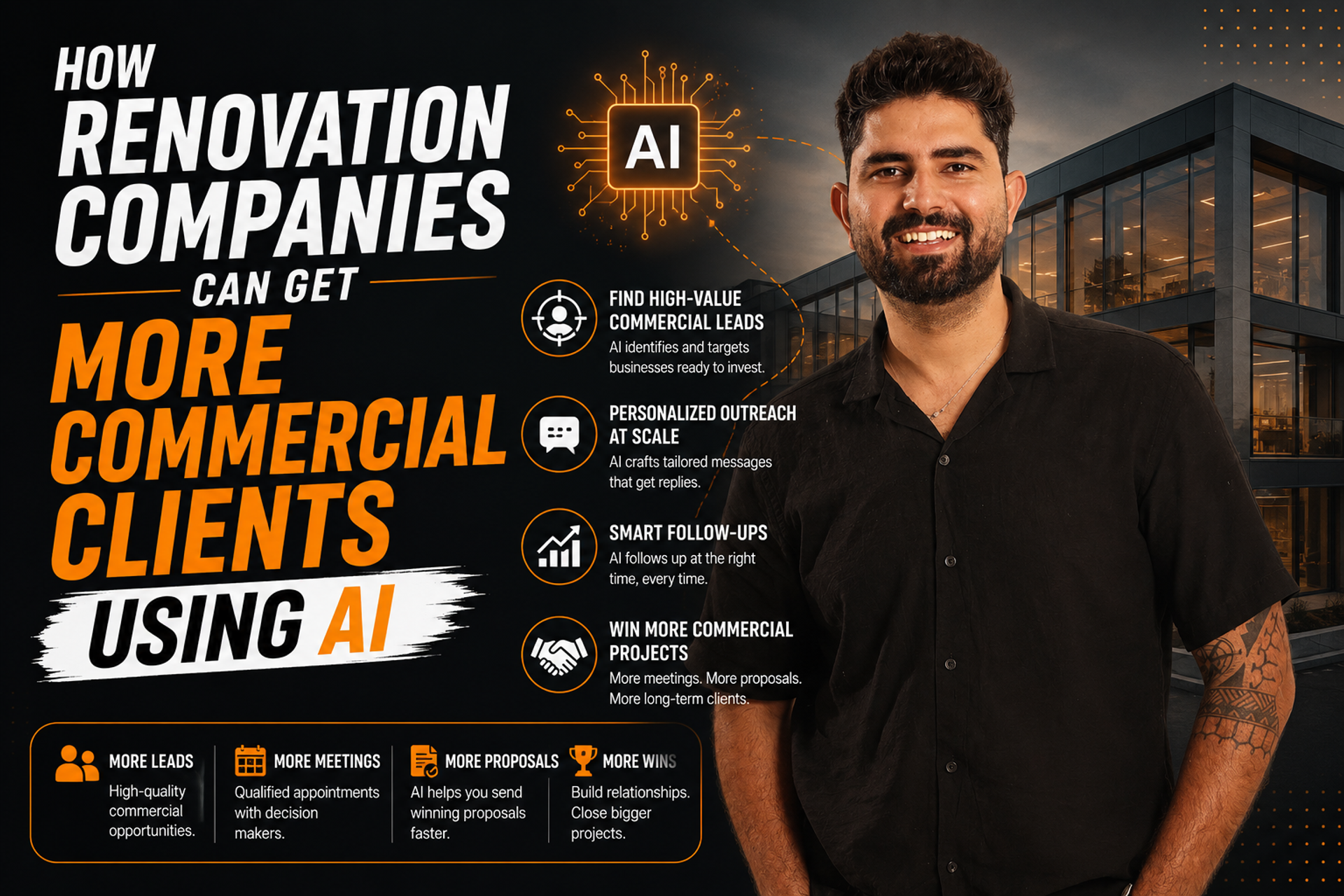
Most renovation companies build their business on residential work. Kitchen remodels, bathroom updates, basement finishes, and additions. It is a reliable revenue base, but it comes with a ceiling. Each project is sold one homeowner at a time, the deal sizes are limited, and the competition on Google and through review sites is intense and price-driven.
Commercial renovation work operates on a completely different scale. A single contract for an office build-out, a retail fit-out, a hospitality renovation, or a multi-unit property upgrade can be worth more than a dozen residential projects combined. And once a renovation company builds a relationship with a commercial property owner, developer, or facility manager, that relationship often produces repeat contracts for years.
The challenge has never been that commercial renovation contracts are unavailable. It is that most renovation companies have no system for reaching the people who award them. Commercial decision makers are not searching Google for renovation contractors the way homeowners are. They are hiring through professional networks, relationships, and vendors they have already encountered in their professional world.
That professional world is LinkedIn. And in 2026, AI makes it possible for a renovation company to run a serious B2B outreach operation on LinkedIn without hiring a dedicated business development team. This guide explains exactly how that works.
Table of Contents
Why Commercial Renovation Work Is Different From Residential
Who Actually Awards Commercial Renovation Contracts
Why LinkedIn Is the Right Channel for B2B Contractor Leads
The AI-Powered LinkedIn System for Commercial Renovation
Building Authority With Commercial Decision Makers
From LinkedIn Connection to Signed Commercial Contract
How FatCamel AI Runs the Full Commercial Outreach System
FAQ
References
Why Commercial Renovation Work Is Different From Residential
Treating commercial renovation leads the same way as residential leads is one of the most common reasons renovation companies struggle to break into the commercial market, even when they have the skill and capacity to deliver the work.
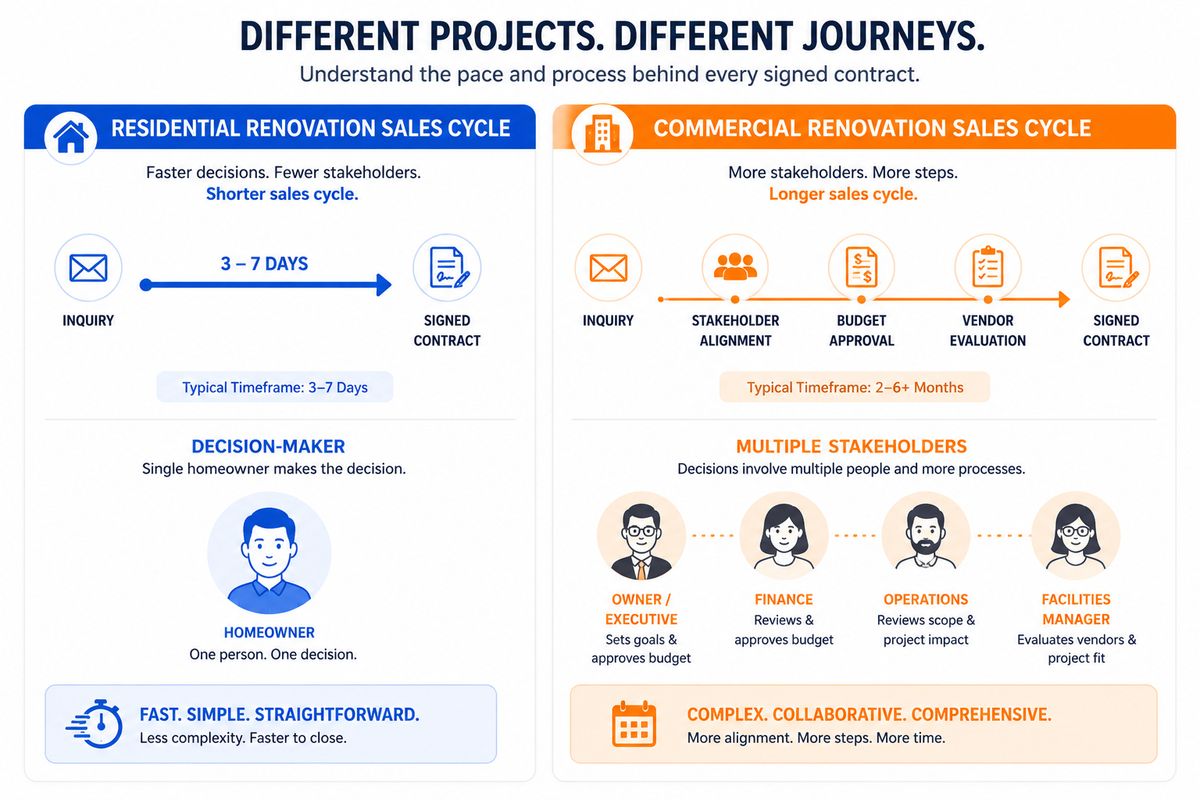
Residential renovation decisions are made quickly, usually by one or two people, and are driven heavily by personal taste, trust, and price comparison. The sales cycle from initial inquiry to signed contract often takes days or a few weeks. Commercial renovation decisions move at an entirely different pace. A property manager or facility director evaluating a contractor for an office renovation is often coordinating with multiple stakeholders, working within an annual budget cycle, and weighing factors like project management capability, certifications, insurance coverage, and the contractor's track record with similar properties.
This longer, more deliberate process means commercial clients are rarely won through a single touchpoint or a fast-moving sales pitch. They are won through visibility and credibility built over time, so that by the time a renovation project comes up, your company is already a known, trusted name rather than an unfamiliar one competing purely on price.
This is precisely why a different lead generation approach is required for commercial work. Google ads and yard signs, which work reasonably well for residential leads, do almost nothing to reach a commercial property manager who is not actively searching but will need a renovation contractor sometime in the next twelve months. Reaching that audience requires a presence in the professional spaces where they already operate, which is exactly what LinkedIn provides.
Who Actually Awards Commercial Renovation Contracts
Before building any outreach system, a renovation company needs absolute clarity on exactly who within a commercial organization is responsible for hiring renovation contractors. Targeting the wrong person, even within the right company, wastes the entire effort.
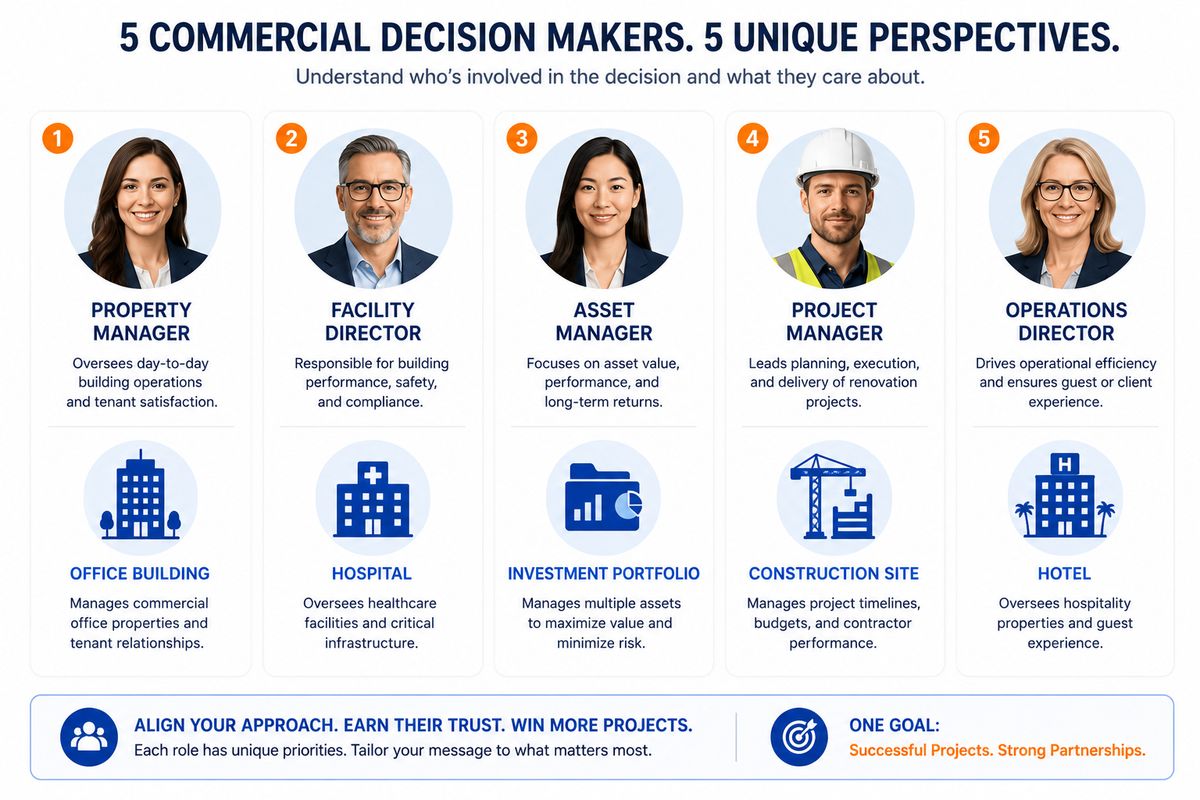
Property Managers oversee the day-to-day operations and maintenance of commercial buildings, ranging from single-office properties to large multi-building portfolios. They are frequently responsible for sourcing and managing renovation and improvement contractors for the spaces they manage.
Facility Directors at larger organizations, hospitals, corporate campuses, school districts, and government facilities manage capital improvement projects and renovation work as part of their operational responsibilities. They often control significant budgets for facility upgrades.
Commercial Real Estate Asset Managers manage property portfolios on behalf of investors or ownership groups. Renovation and improvement work directly affects property value and tenant retention, making it a recurring priority in their role.
Construction and Development Project Managers oversee new commercial builds, tenant improvements, and major renovation projects from the development side, frequently bringing in renovation contractors for specific phases of larger projects.
Hospitality and Retail Operations Directors are responsible for maintaining and periodically renovating branded spaces, hotels, restaurants, and retail locations, to keep them aligned with brand standards and guest or customer expectations.
Each of these roles represents a distinct buyer with different priorities, different budget cycles, and a different language they use to describe their needs. A LinkedIn outreach system built around vague messaging that does not speak to these specific roles will significantly underperform compared to one built with this level of targeting precision.
Why LinkedIn Is the Right Channel for B2B Contractor Leads
LinkedIn is structurally different from every other channel available to a renovation company pursuing commercial work, and that difference is what makes it the right foundation for a B2B contractor lead generation strategy.
The audience is already there in a professional capacity. Property managers, facility directors, and asset managers use LinkedIn specifically for professional purposes, vendor discovery, industry news, and networking. When they encounter your company's content or outreach there, they are mentally positioned to evaluate it as a professional opportunity, not an unwanted sales interruption.
The targeting precision is unmatched. LinkedIn's search and filtering capabilities allow a renovation company to identify exactly the right job titles, industries, company sizes, and geographic regions, building a precise list of the actual decision makers who award commercial renovation contracts in your service area, something no other marketing channel offers with comparable accuracy.
The relationship compounds over time. Unlike a paid ad that disappears the moment you stop paying for it, a LinkedIn connection and the content history attached to your profile remain permanently. A property manager who connects with you today and is not ready to discuss a project for another eighteen months still sees your content and remains reachable when their timing changes.
And critically, almost no renovation companies are using LinkedIn with any real strategy. This is a channel where the audience is exactly right, and the competition is nearly absent. For a renovation company willing to build a presence here in 2026, the opportunity to establish itself as a known, trusted name in the eyes of commercial decision makers is significant and currently uncontested in most markets.
The AI-Powered LinkedIn System for Commercial Renovation
Building a serious LinkedIn presence and outreach operation manually requires hours of daily effort: finding the right profiles, engaging with content, sending connections, and managing follow-up conversations. For a renovation company owner already running active projects, that level of manual effort is not sustainable. AI automation makes the entire system achievable without adding headcount.
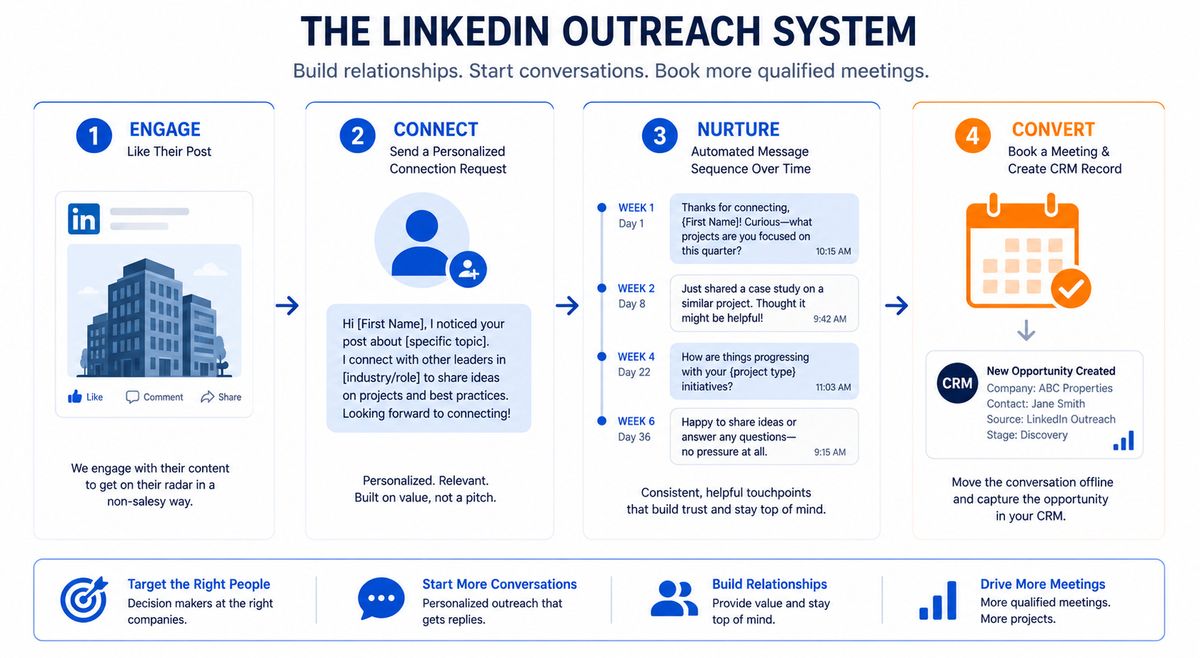
The system runs across four connected stages.
Daily engagement with target decision makers. Before any direct outreach happens, the AI automation engages daily with content posted by property managers, facility directors, and other target roles in your service area, building familiarity through consistent visibility before you ever send a message.
Targeted, personalized connection requests. Once familiarity has been established through engagement, personalized connection requests go out to a carefully built list of decision makers matching your ideal commercial client profile. Each request references something specific about the recipient's role or organization rather than using a generic template.
Automated outreach sequence after connection. Once a connection is accepted, a structured sequence of messages builds the relationship over several weeks. An initial warm introduction. A value-focused message sharing a relevant insight or case study. A soft ask for a brief conversation about their upcoming renovation or improvement needs.
Meeting booking and CRM logging. When a prospect responds with interest, a booking link goes out automatically, the meeting is confirmed, and the contact is logged into your CRM with the full conversation history, ready for your sales team to walk into a warm, informed first conversation.
This system runs continuously in the background, generating commercial relationships and conversations every week without requiring the renovation company owner or a salesperson to spend their limited time on manual prospecting.
Building Authority With Commercial Decision Makers
Outreach alone is not enough to win commercial renovation contracts. Because the buying cycle is long and involves trust-building over time, the content a renovation company shares on LinkedIn plays a critical role in shaping how decision makers perceive the business long before any direct conversation happens.
Effective content for this audience falls into a few clear categories. Project showcases that highlight specific commercial renovation work, an office build-out, a retail fit-out, a multi-unit upgrade, with real details about scope, timeline, and outcome, demonstrate direct, relevant experience rather than generic capability claims.
Educational content addressing the specific concerns commercial property decision makers actually have, how to plan renovation work around tenant occupancy, what drives renovation timelines and costs in commercial spaces, and how to evaluate contractor proposals for larger projects, positions the company as a knowledgeable partner rather than just another vendor seeking work.
Industry-relevant commentary, on topics like changing commercial space utilization, sustainability requirements affecting renovation specifications, or shifts in tenant expectations driving renovation decisions, signals that the company understands the broader business context its commercial clients operate within, not just the construction work itself.
Published consistently, this content does two things simultaneously. It strengthens the response rate of the direct outreach sequence, because prospects who have already seen relevant, credible content from your company respond more readily to a connection request or message than they would to a completely unknown sender. And it builds a form of passive, compounding visibility, where decision makers who were never part of your direct outreach list begin recognizing your company through their broader LinkedIn network over time.
From LinkedIn Connection to Signed Commercial Contract
Understanding the full journey from a cold LinkedIn profile to a signed commercial renovation contract makes clear why this system works, and why patience and consistency matter more than any single clever message.
A facility director at a regional healthcare network sees a post from your company about a recent medical office renovation, showing the project completed on schedule without disrupting clinic operations. They do not engage, but they notice the name.
Over the following weeks, they see two more posts: an educational piece about minimizing disruption during occupied-space renovations, and a project showcase from a similar healthcare facility. Your company's automation has also been engaging with its own LinkedIn posts during this period, so your name has appeared in their notifications a few times.
A personalized connection request arrives, referencing their role overseeing facility operations for the healthcare network specifically. Because the name is already familiar, they accept.
A warm introduction message follows, with no pitch attached. A week later, a message shares a brief case study relevant to healthcare facility renovations. Another week passes, and a message asks whether their network has any upcoming renovation or improvement projects planned, framed as a genuine question rather than a sales push.
The facility director responds that they do have a clinic renovation planned for the following quarter and would be open to a conversation. A meeting link goes out, a call is booked, and your sales team walks into that conversation already knowing the facility director's role, their organization, and the specific project context, rather than starting completely cold.
This entire journey, from first content exposure to a qualified sales conversation, often spans six to twelve weeks for commercial clients. That timeline is exactly why an automated system matters so much. No individual salesperson could sustain that level of patient, consistent engagement across dozens of prospects simultaneously, but an automated system maintains it effortlessly across an entire pipeline of commercial relationships at once.
How FatCamel AI Runs the Full Commercial Outreach System
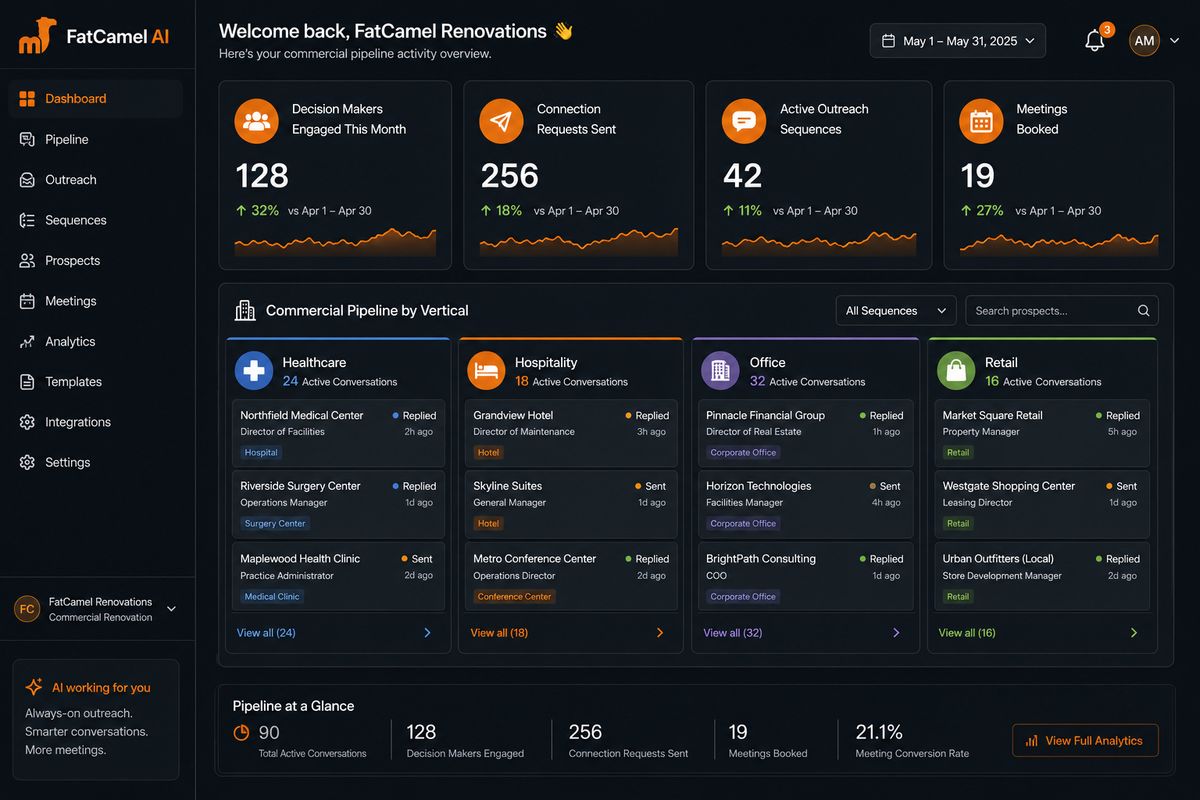
Every element described in this guide, the daily engagement, the targeted connection requests, the multi-week outreach sequences, the content strategy, the meeting booking, and the CRM logging, needs to operate as one connected system to produce the kind of compounding results commercial renovation lead generation requires.
FatCamel AI is built specifically to run this complete system for renovation companies and trade contractors pursuing commercial clients. The platform identifies and engages daily with the right decision makers in your target verticals, whether that is commercial real estate, healthcare, hospitality, or retail, building visibility before any direct contact begins.
Personalized connection requests go out automatically to a continuously updated list of property managers, facility directors, and other relevant roles matching your ideal commercial client profile. Once connections are accepted, FatCamel AI manages the full outreach sequence, personalizing each message using real data from the prospect's profile and adjusting the content based on their specific industry and role.
When a prospect shows interest, FatCamel AI sends a booking link, confirms the meeting, and logs the contact into your CRM with the complete conversation history attached, so your sales team can walk into every commercial conversation fully prepared.
Throughout the entire process, a reporting dashboard shows exactly how many decision makers have been engaged, how many connections have been made, how many conversations are active, and how many meetings have been booked, giving you clear visibility into the health of your commercial pipeline at any time.
For a renovation company looking to move beyond residential volume and into the larger, more profitable world of commercial contracts, this is the most reliable and cost-effective system available in 2026, building real relationships with the people who actually award commercial renovation work, without requiring a dedicated business development team to run it.
👉 Get a Free AI Revenue Audit for Your Renovation Business at https://www.fatcamel.ai/contact
FAQ
1. How can a renovation company get more commercial clients?
The most effective way for a renovation company to get more commercial clients is through consistent, targeted LinkedIn outreach combined with content that demonstrates relevant commercial project experience. Unlike residential leads, commercial clients are rarely found through Google searches or paid ads. They are won through visibility and relationship-building with property managers, facility directors, and other decision makers over an extended period.
2. How do I get construction contracts from commercial property owners?
Getting construction contracts from commercial property owners and managers typically requires building familiarity and trust before a project opportunity arises, since these decisions are rarely made quickly or in response to a single sales pitch. A structured approach involving consistent LinkedIn engagement, relevant content showcasing commercial project experience, and a patient, multi-touch outreach sequence to the right decision makers produces significantly better results than one-off cold outreach.
3. What makes B2B contractor leads different from residential leads?
B2B contractor leads involve longer sales cycles, multiple decision makers, formal budget and approval processes, and a greater emphasis on credentials, track record, and project management capability rather than price alone. Residential leads are typically decided quickly by one or two people based on personal preference and cost comparison. This difference means B2B leads require a relationship-building approach rather than a fast-moving sales process.
4. Why is LinkedIn effective for finding commercial renovation leads?
LinkedIn is effective because the exact decision makers who award commercial renovation contracts, property managers, facility directors, and asset managers are active there in a professional capacity. The platform also allows precise targeting by job title, industry, and company size, and because almost no renovation companies use LinkedIn strategically, the channel remains largely uncontested, giving early adopters a significant visibility advantage.
5. How long does it take to win a commercial renovation contract through LinkedIn outreach?
The journey from initial LinkedIn engagement to a signed commercial renovation contract typically spans several months, often six to twelve weeks just to reach a qualified sales conversation, with the full sales cycle extending further depending on the client's budget and approval process. This longer timeline is why consistent, automated outreach matters, since no individual salesperson could sustain that level of patient engagement manually across an entire pipeline.
6. What kind of content works best for attracting commercial clients on LinkedIn?
The most effective content for attracting commercial renovation clients includes specific project showcases with real scope and outcome details, educational posts addressing the practical concerns of property managers and facility directors, and industry commentary that demonstrates an understanding of the broader business context commercial clients operate within. This content builds credibility and familiarity that improves the response rate of direct outreach.
7. How does FatCamel AI help renovation companies win commercial contracts?
FatCamel AI automates the complete LinkedIn outreach system for renovation companies, including daily engagement with target decision makers, personalized connection requests, multi-week follow-up sequences, and automatic meeting booking with full CRM logging. This allows renovation companies to run a consistent, professional commercial outreach operation without needing to hire a dedicated business development team, generating warm conversations with property managers and facility directors continuously in the background.
REFERENCES:
https://theonlinegroup.com.au/ai-automation/how-can-home-renovation-companies-use-ai
https://boldentity.com/ai-in-construction-marketing-power-tools-need-skilled-hands/
https://www.gushwork.ai/blog/seo-for-construction-companies
https://www.pdbgroup.com/post/how-ai-platforms-are-transforming-commercial-design-preconstruction
https://nari.org/nari-blog-main/how-remodelers-can-harness-ai-to-boost-efficiency-and-growth/