
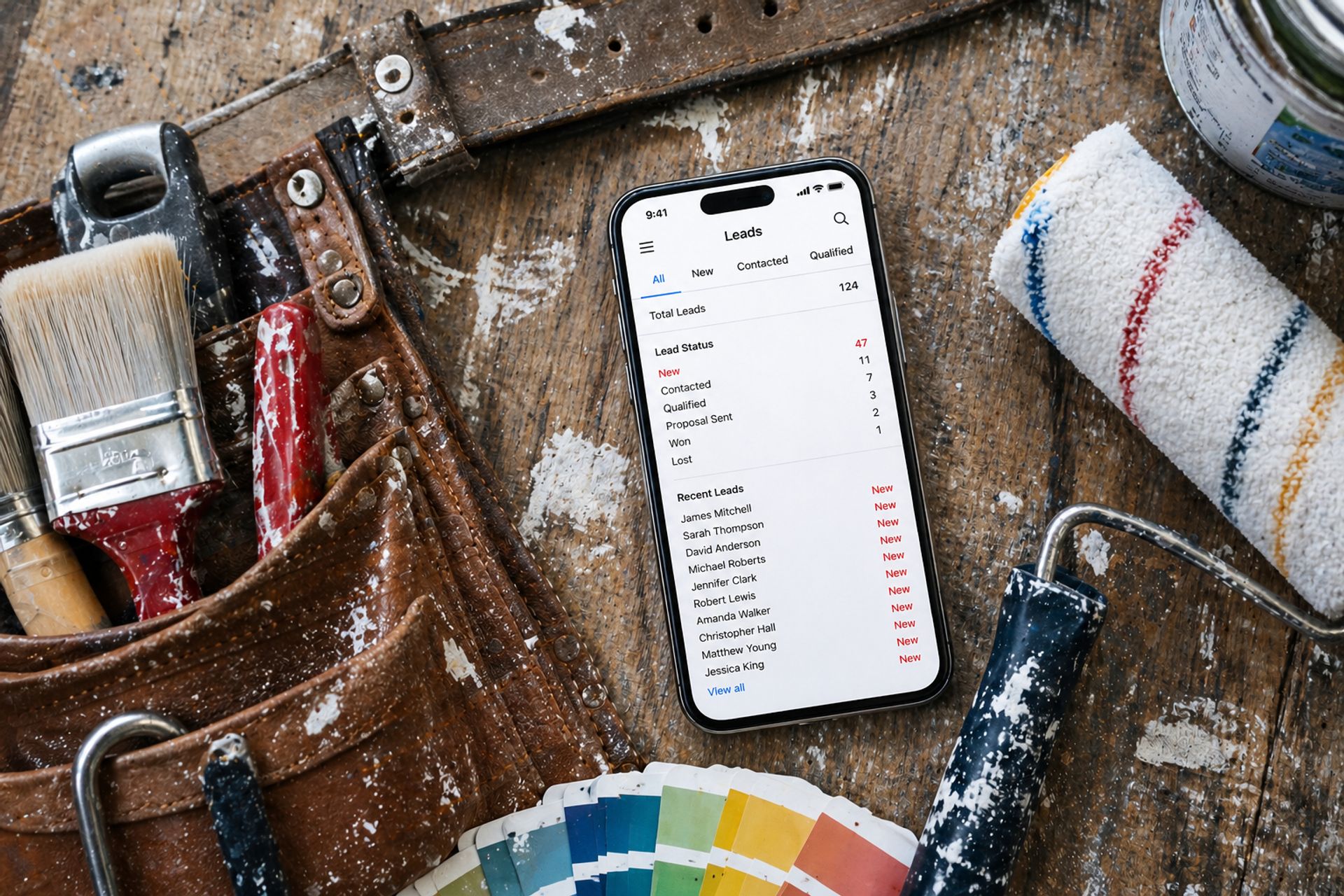
There is a number sitting inside your CRM right now that most painting business owners never calculate.
Take your total leads from the last six months. Now subtract the ones that actually converted into jobs. What remains are the estimates that went cold, the "I'll get back to you" conversations that never resumed, the leads that came in during a busy week and never got a proper follow-up; that gap represents revenue you already paid to generate and never collected.
For a painting business doing reasonable volume, that number is often $40,000 to $70,000 or more. Not hypothetically. Actually sitting in the pipeline, attached to real people who had a real need.
The reason it never converted is not that the leads were bad. It is that the follow-up system was not reliable enough to keep those conversations alive until they were ready to book.
This blog covers exactly how to fix that using automated follow-ups across SMS, email, and AI calls, the three channels that, when working together, turn a leaky follow-up process into a consistent conversion system.
Table of Contents
Why Painting Businesses Lose Leads They Already Have
Why Manual Follow-Up Always Breaks Down
What Automated Follow-Up for Painting Leads Actually Looks Like
Step 1: SMS Automation for Painting Contractors
Step 2: Email Automation for Painting Lead Nurturing
Step 3: AI Calls for Leads That Go Silent
How SMS, Email, and AI Calls Work as One System
A Real Numbers Example
Common Follow-Up Mistakes That Kill Conversions
How OutreachAI by FATCAMEL AI Automates All Three Channels
FAQs
Why Painting Businesses Lose Leads They Already Have?
Most painting contractors respond to low conversion by increasing their ad budget. More Google Ads. More Facebook campaigns. More lead generation spend.
But the math rarely works out the way they expect, because the problem is not upstream. It is downstream.
According to research by Invesp, companies lose between 25% and 50% of their leads simply due to inadequate follow-up, not poor lead quality, not price, not competition. Just follow-up failure.
For a painting business generating 80 leads a month at an average job value of $2,500, a 30% follow-up failure rate means 24 lost leads per month. Even if only half of those would have converted with proper nurturing, that is 12 jobs and $30,000 in monthly revenue walking out the door before anyone noticed.
The more important insight is this: those leads already exist. You do not need to generate new ones to recover that revenue. You need a better system to handle the ones already in your pipeline.
Read More: Best CRM for Painting Contractors: 7 Tools to Boost Client Satisfaction In 2026
Why Manual Follow-Up Always Breaks Down
The failure of manual follow-up is not a discipline problem. It is a systems problem.
Here is what the typical follow-up process looks like in most painting businesses. A lead comes in. Someone on the team responds when they have a moment, usually within a few hours. If there is no reply, they might follow up once more a day or two later. Then a new job starts, the schedule fills up, and that lead quietly disappears from everyone's attention.
Nobody made a deliberate decision to abandon it. The business simply did not have a system keeping track of where every lead was in the conversation and what needed to happen next.
The problem compounds as volume grows. At 20 leads a month, a motivated person can manage follow-up manually. At 80 or 120 leads, the same approach creates a backlog that never clears. The busiest growth periods are exactly when the most leads get dropped.
Research from the National Sales Executive Association shows that 80% of sales require five or more follow-up attempts, yet the majority of service businesses stop after one or two. The leads that would have converted with one more touchpoint simply never receive it.
This is the gap that automated follow-up for painting leads is designed to close.
Know more: How Painting Businesses Can Grow Faster Using AI in 2026 Without Changing Their CRM
What Automated Follow-Up for Painting Leads Actually Looks Like
Before covering each channel specifically, it is worth clarifying what good follow-up automation actually is, because the word "automation" often brings to mind generic spam messages or robotic scripts that feel nothing like a real business.
A properly built automated follow-up system for painting contractors does three things well.
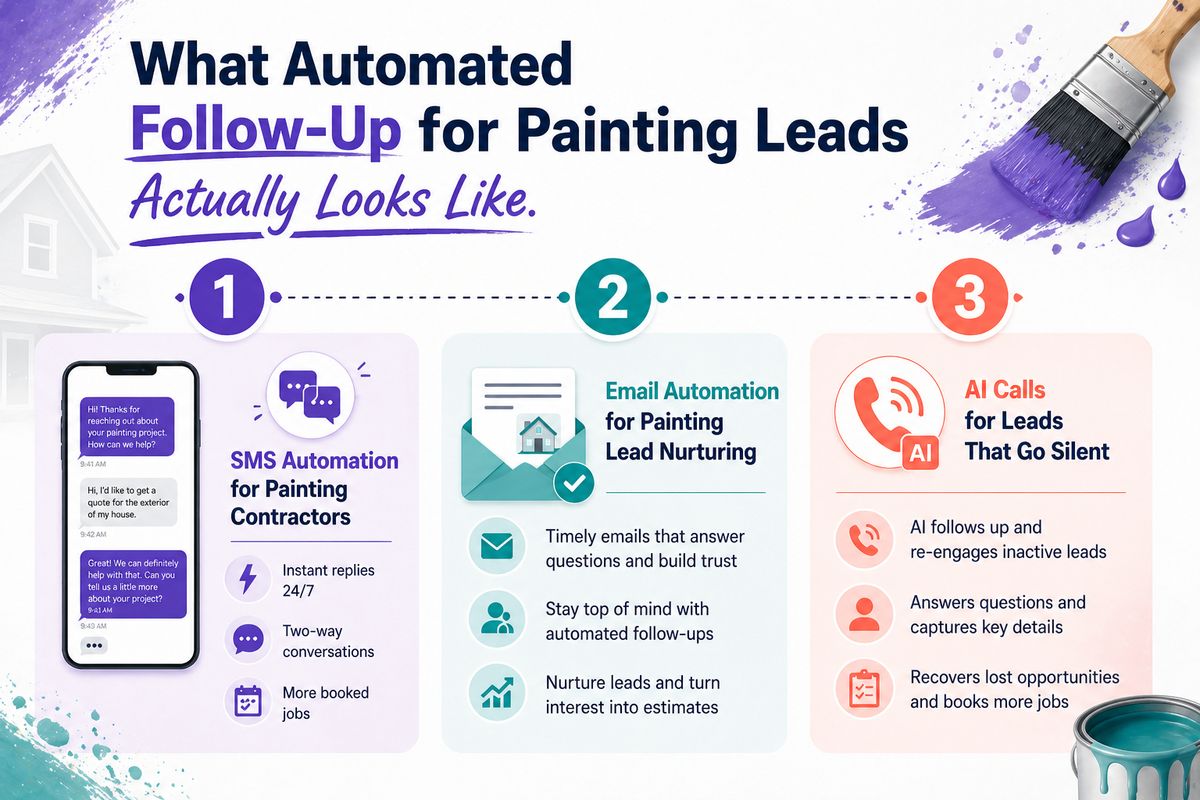
It is timely, meaning messages go out at the right moment in the customer's decision journey, not just whenever a timer runs out. It is relevant, meaning the content of each message reflects where the lead is in the process, since a fresh inquiry gets a different message than a three-week-old estimate. And it is multi-channel, meaning it reaches people through the medium they are most likely to respond to.
When those three things are in place, automation does not feel robotic. It feels attentive. And attentiveness is exactly what converts leads into booked jobs.
Step 1: SMS Automation for Painting Contractors
SMS is the fastest and highest-engagement channel available for painting lead follow-up. According to SimpleTexting, SMS messages have an open rate of 98%, compared to around 20% for email. More importantly, the average response time to a text message is 90 seconds.
For a painting business, that speed is a competitive advantage. When a homeowner submits a quote request, they are almost certainly contacting two or three other contractors at the same time. The first business to respond professionally wins the first impression, and first impressions convert.
Here is how SMS automation works in practice for painting lead follow-up.
Instant first response. The moment a lead submits a form, the system sends an automatic SMS confirming receipt, setting expectations for next steps, and often including a direct link to book a site visit. This happens in under 60 seconds, even if the inquiry came in at 9 pm on a Sunday.
Estimate reminder sequences. After a quote is sent, automated SMS reminders follow up at Day 2, Day 5, and Day 10. Each message takes a slightly different angle. The first is a simple check-in. The second addresses a common objection around timing or scope. The third creates gentle urgency around scheduling availability.
Re-engagement of cold leads. For leads that went silent after initial contact, a well-timed SMS sent three to four weeks later, especially one referencing a seasonal angle like upcoming summer availability or pre-winter prep, reactivates a significant percentage of prospects who were not ready at the time but have since made a decision.
Post-visit follow-up. After a site assessment, an automated SMS the following morning keeps momentum going when the lead is most likely to be actively thinking about their decision.
The key principle across all of these is brevity and relevance. SMS messages should be two to four sentences, direct in their ask, and always connected to something specific about the lead's situation rather than a generic "just checking in."
Step 2: Email Automation for Painting Lead Nurturing
Where SMS wins on speed, email wins on depth. Email automation for painting contractors serves a different purpose in the follow-up sequence. It is the channel for building trust, providing detail, and staying present over a longer decision window.
Homeowners making a painting decision, especially for larger exterior or commercial jobs, often take two to four weeks to commit. During that window, a well-structured email sequence keeps your business visible and credible without requiring any manual effort from your team.
Here is what an effective email follow-up sequence for painting leads looks like.
Day 1: The professional estimate email. Not just a PDF attachment dropped into a message, but a full email that introduces your company, explains what is included in the quote, highlights your process and standards, and makes it easy to ask questions or schedule the next step. The first email sets the tone for the entire relationship.
Day 4: The social proof email. A short, focused email featuring two or three customer testimonials, before and after photos from comparable projects, or a brief case study from a similar job in the same area. This addresses the unspoken concern every prospect carries: "Can I actually trust these people with my home?"
Day 9: The value email. Rather than another version of "just checking in," this email provides something genuinely useful to the homeowner. Tips on choosing the right paint finish for different surfaces, what to look for when evaluating painting contractors, or how to prepare a home for exterior painting. This positions your business as a knowledgeable authority rather than just another vendor trying to close a sale.
Day 15: The direct follow-up. A concise, personal-feeling email that simply asks whether they are still considering the project and whether there is anything they need clarified before making a decision. Short, honest, and easy to reply to.
Day 30: The re-engagement email. A final email referencing current availability, upcoming seasonal demand, or a relevant angle specific to the time of year. Many leads that did not respond to earlier messages convert at this stage simply because their circumstances or timeline have changed.
Email automation works best when each message serves a distinct purpose and genuinely moves the relationship forward, rather than repeating the same ask in slightly different words.
Step 3: AI Calls for Leads That Go Silent
Some prospects simply do not engage through text or email. They prefer a phone conversation, or they need a more direct prompt to re-engage. Manual calling can handle this at low volume, but as lead numbers grow, it becomes inconsistent, time-consuming, and the first thing to get deprioritized when the team gets busy.
AI calls solve this specific problem. They are not robocalls, and they are not scripted recordings. A properly configured AI call system can initiate a natural, relevant conversation with a lead, answer basic questions about the service, collect information about the project, and guide the prospect toward the next step, all without requiring anyone from your team to be available.
In a painting business, AI calls add the most value in three specific situations.
The first is missed call recovery. When a lead calls your number and no one answers, the AI system calls them back within minutes, ensures they feel attended to, and captures their information and intent before they move on to the next contractor on their list.
The second is silent lead re-engagement. When a lead has not responded to two or three SMS or email touchpoints, an AI call creates a different kind of contact that often prompts a response where text-based outreach did not.
The third is long-dormant pipeline revival. For leads that went cold 60 to 90 days ago and were never formally closed out, a targeted AI call campaign can recover a meaningful percentage of jobs that would otherwise never be revisited.
The goal of the AI call is not to close the job on the call itself. It is to restart the conversation, qualify the lead's current intent, and hand off a warm, interested prospect to your team at exactly the right moment.
Read More: he Real Cost of Self-Hosting n8n
How SMS, Email, and AI Calls Work as One System
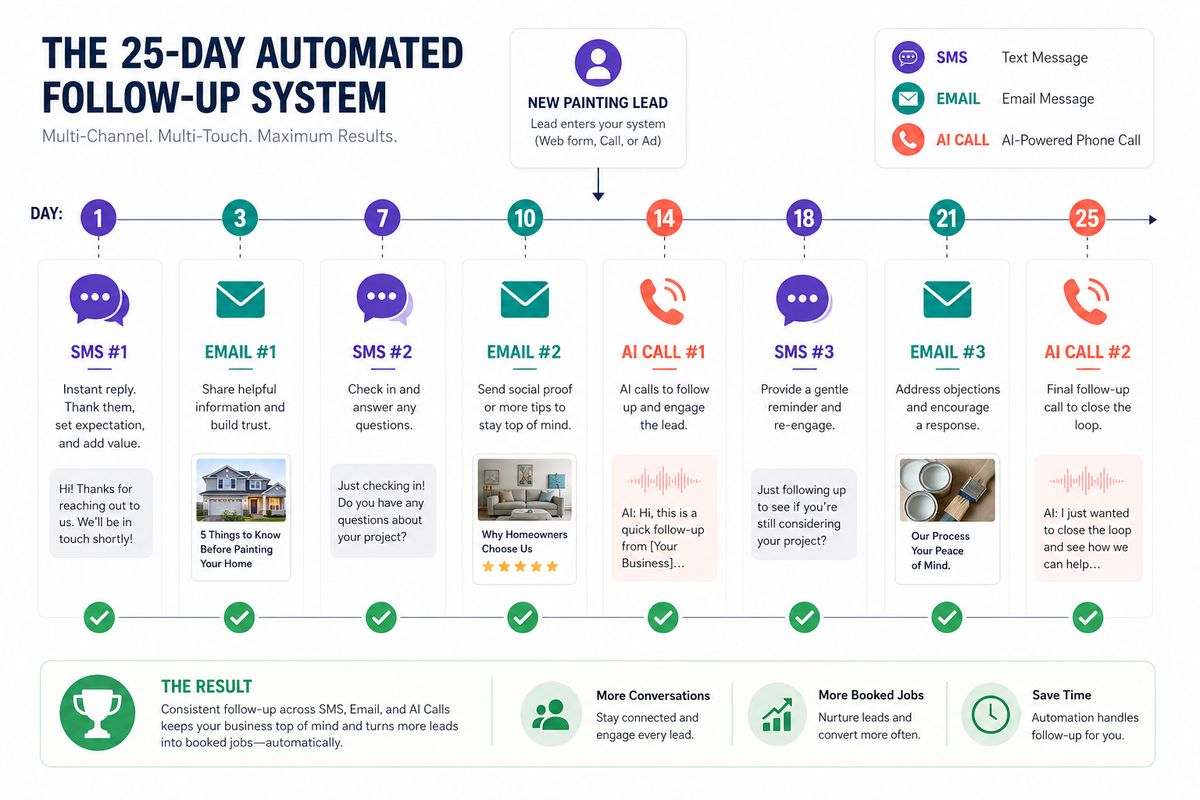
Each channel has its own strengths, but the real power of automated follow-up for painting leads comes from combining all three into a single coordinated sequence. When they operate together, no lead falls through the cracks, regardless of how they prefer to communicate.
Here is what that looks like as a practical flow.
A homeowner submits a quote request through your website on a Tuesday evening. Within 60 seconds, they receive an SMS from your business confirming their inquiry and outlining the next steps. On Wednesday morning, a professional estimate email arrives in their inbox with your full proposal and company background.
They open the email but do not reply.
On Friday, a follow-up SMS checks in with a direct and friendly message. On the following Monday, the social proof email arrives with testimonials and project photos. By Day 10, if there is still no response, an AI call is triggered. The call reaches the prospect, reintroduces the business, and asks a simple qualifying question about their timeline.
The prospect says they are planning to start in about three weeks.
That information is logged automatically. A follow-up SMS is scheduled for Day 18. An email goes out on Day 22. By the time your team makes a direct call on Day 25, the prospect has already been nurtured through seven touchpoints, remembers your business clearly, and is ready to have a serious conversation.
This is the difference between a manual follow-up process and a system. The manual process depends on someone remembering to make the right contact at the right time. The system does it automatically, every time, for every lead, regardless of how busy the business is.
A Real Numbers Example
Abstract claims about improved conversion rates are easy to dismiss. Concrete numbers are harder to ignore.
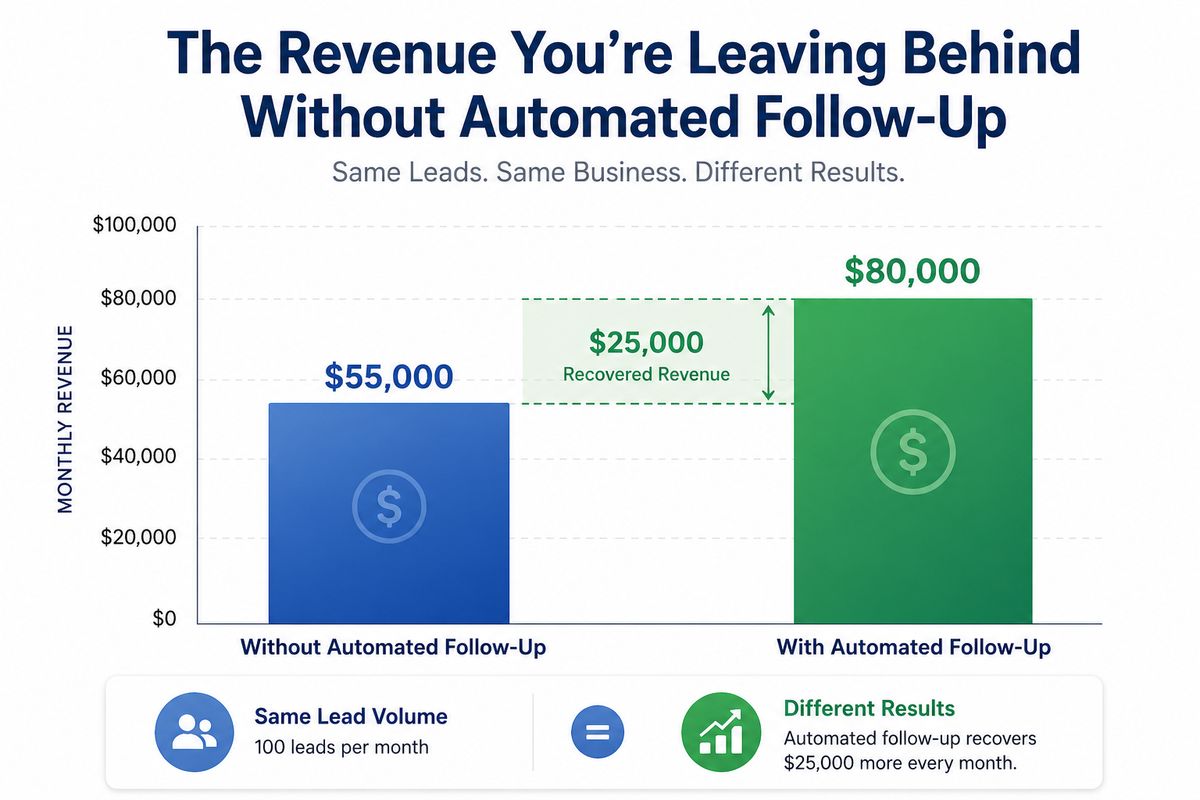
Consider a painting business generating 100 inbound leads per month with an average job value of $2,500. Without a structured follow-up system, their conversion rate sits at 22%, meaning they close 22 jobs and generate $55,000 in monthly revenue.
After implementing automated follow-ups across SMS, email, and AI calls, their effective conversion rate moved to 32%. That is 32 jobs closed from the same 100 leads, generating $80,000 in monthly revenue.
The difference is $25,000 in additional monthly revenue from the same marketing spend. Over 12 months, that is $300,000 in recovered revenue that was previously walking out of the pipeline uncaptured.
The marketing budget did not change. The lead volume did not change. The team size did not change. What changed is that the system now captures the conversations that were previously being dropped after one or two attempts.
Common Follow-Up Mistakes That Kill Conversions
Even with automation in place, certain mistakes consistently reduce its effectiveness. Understanding them helps ensure the system performs at its best.
Messaging too frequently in the first 48 hours. Sending three or four messages within the first two days signals desperation rather than professionalism. Leads need space to review their options. A single strong first response followed by a well-timed second touchpoint performs significantly better than a rapid-fire follow-up.
Using identical messaging across every touchpoint. If every SMS and every email makes the same ask in slightly different words, leads recognize the pattern and disengage. Each touchpoint should serve a distinct purpose, whether that is providing information, addressing an objection, building credibility, or creating urgency.
Stopping follow-up too early. The most common and most expensive mistake. As the research shows, the majority of conversions happen between the fifth and eighth touchpoints. A system that stops at three is leaving a substantial percentage of closeable deals unfinished.
Not tracking which channel produced a response. Without knowing whether leads are converting from SMS, email, or AI calls, it is impossible to refine the sequence over time. Good automation includes tracking that shows which touchpoints are working and which need adjustment.
Treating re-engagement the same as initial outreach. A lead that went cold three months ago needs a different message than a fresh inquiry. Re-engagement messages should acknowledge the time that has passed, reference something new or seasonal, and make it easy to re-enter the conversation without pressure.
Frequently Asked Questions
How do I automate follow-ups for painting leads using SMS and email?
The most effective approach is a multi-channel sequence where SMS handles instant responses and time-sensitive check-ins, email handles detailed nurturing over a longer window, and AI calls re-engage leads that go silent. Tools like OutreachAI by FATCAMEL AI connect all three channels into one automated workflow that runs without manual input.
What is the best follow-up sequence length for painting leads?
Most painting leads make a decision within 30 days of their initial inquiry. A well-structured sequence should run for at least 21 to 30 days with touchpoints spaced at increasing intervals. Stopping follow-up before Day 15 means missing a large percentage of leads that would have converted with one or two more contacts.
How many follow-up attempts should a painting contractor make before moving on?
Research consistently shows that 80% of sales require five or more touchpoints. Most painting businesses stop at two. A minimum of six to eight follow-up attempts across SMS, email, and calls is recommended before formally closing a lead as unresponsive.
Does SMS automation for painting businesses feel spammy to customers?
Not when it is done correctly. Messages that are timely, brief, relevant to the customer's specific inquiry, and spaced appropriately feel like good customer service, not spam. The key is personalization and purpose. Every message should have a clear reason for being sent and a clear action for the customer to take.
Can AI calls replace real sales calls for painting leads?
AI calls are not designed to replace your team on high-stakes conversations. They are designed to handle the initial re-engagement and qualification layer so that when your team does get on a call, they are speaking with a lead who is already warm, informed, and further along in the decision process.
How quickly does automated follow-up show results for a painting business?
Most businesses see measurable improvement in response consistency and lead re-engagement within two to three weeks of implementation. Conversion rate improvements typically become visible within 30 to 60 days as the full follow-up sequences run their course on the existing pipeline.
Does OutreachAI work with the CRM I already use?
Yes. OutreachAI integrates with existing CRM systems rather than replacing them. The goal is to enhance the workflow you already have, not require you to rebuild your setup from scratch.