
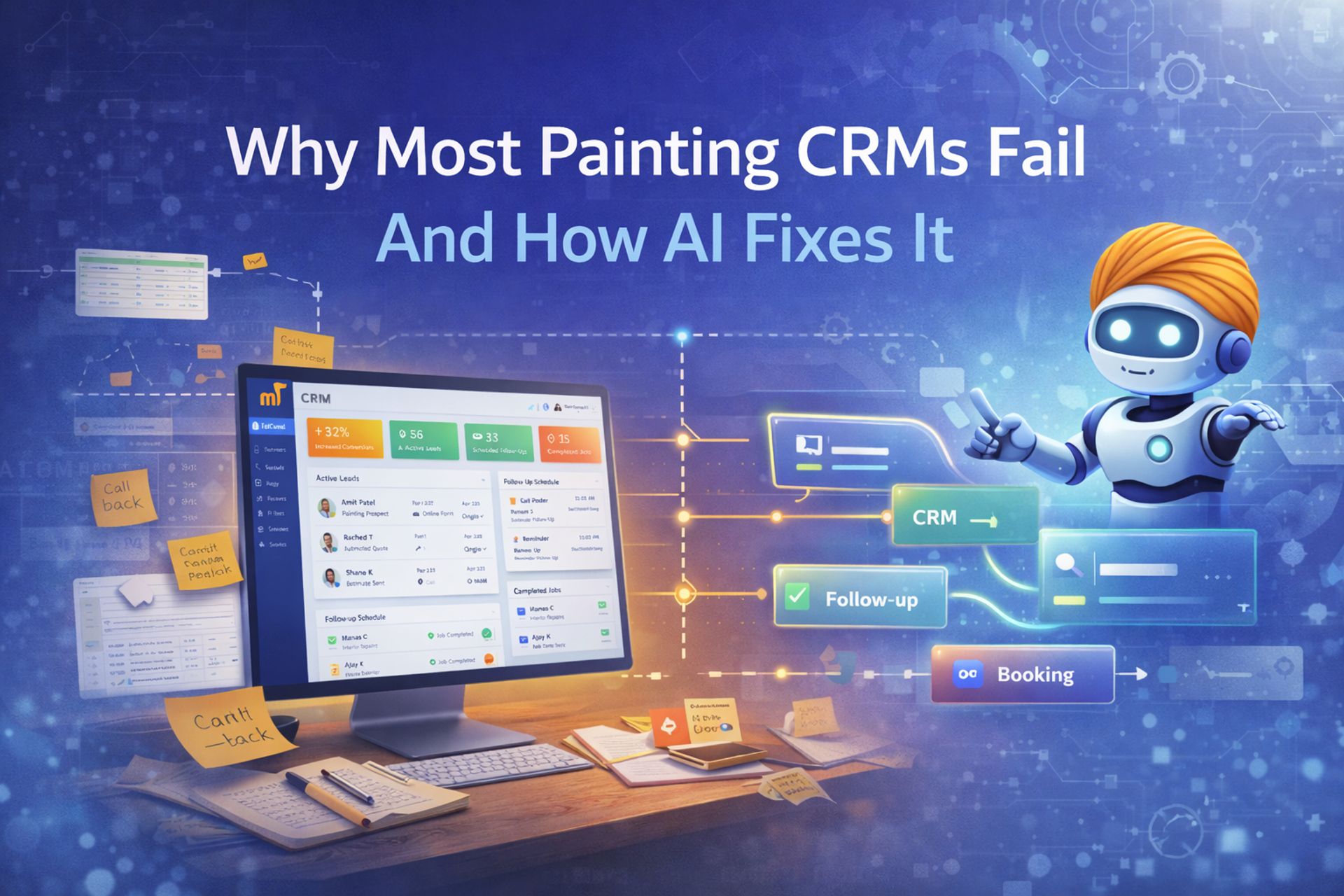
The majority of painting companies don't face difficulties due to a lack of equipment.
They suffer because, as their firm expands, their tools become ineffective.
The CRM seems useful at first. It keeps things reasonably organized, maintains a track of employment, and stores contacts. But eventually, the fissures become apparent. Follow-ups are overlooked. Leads become chilly. To keep things going, teams start utilizing spreadsheets, notes, and WhatsApp outside of the CRM.
And gradually, the CRM stops being a system and turns into a storage box.
The real issue is that.
This article explains the actual CRM issues that contractors face, the reasons why most systems don't work for small painting companies, and how AI can solve issues that traditional CRMs can't.
The Real Problem: Your CRM Was Not Built for How You Actually Work
The majority of CRMs utilized by painting contractors were not created with painting companies in mind.
They were either:
- designed for huge franchises
- generic sales teams
- simple job tracking
None of them accurately reflects the operations of a developing painting company.
Painting businesses have a unique flow: lead → estimate → follow up → job → completion → repeat work
Furthermore, that flow is rarely linear.
Consumers put off making decisions. Estimates require several follow-ups. Work shifts are determined by priorities, crew availability, and the weather. Calls, messages, and in-person meetings are all used for communication.
This is too much for a strict CRM to handle.
Teams begin operating outside of the system for this reason.
And the CRM becomes useless after that.
Read More: How Painting Businesses Can Grow Faster Using AI in 2026 Without Changing Their CRM
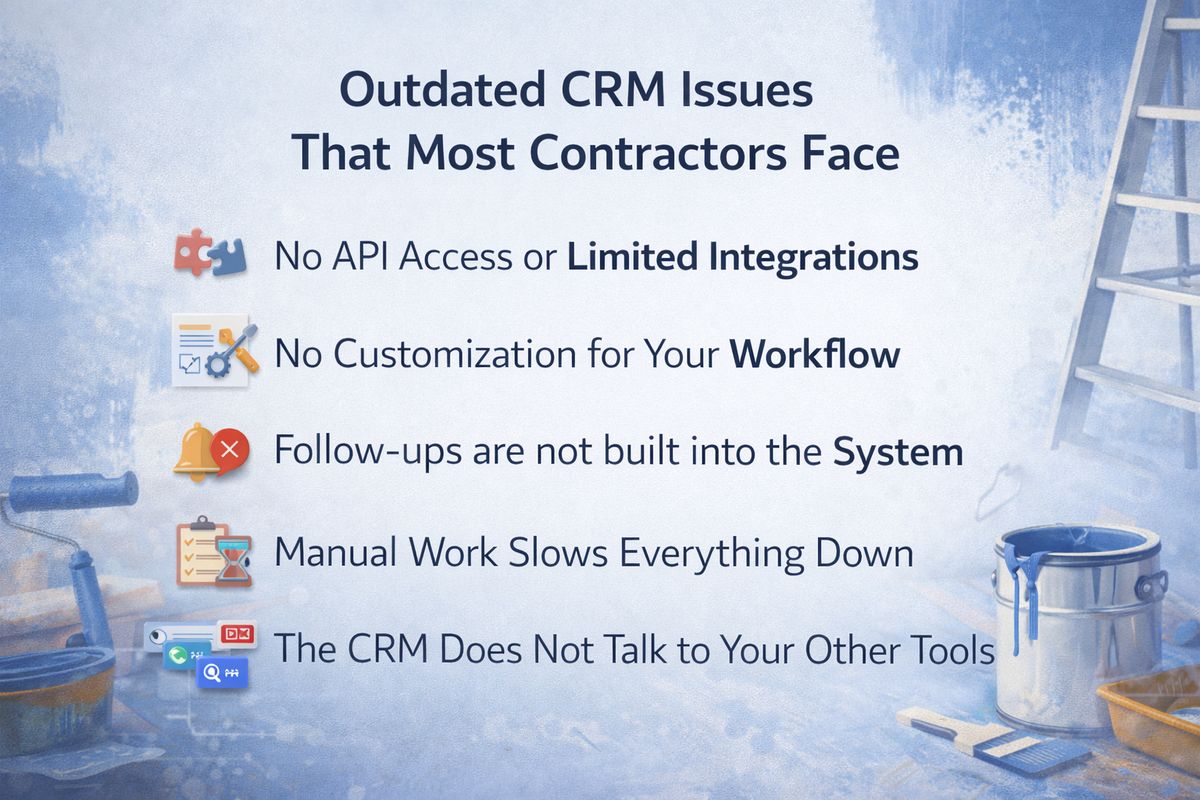
Outdated CRM Issues That Most Contractors Face
Let’s talk about the actual problems.
Not theory. Not features. Real day-to-day issues.
1. No API Access or Limited Integrations
Many painting companies, particularly franchise-based ones, are still using outdated CRMs that prevent the use of appropriate interfaces.
In other words:
- You are unable to fully automate procedures
- Link contemporary tools
- Create systems centered around your company.
Franchise CRMs may purposefully limit API access. Individual branches find it more difficult to modify or enhance their systems as a result.
Therefore, you are unable to modernize your workflow, even if you wish to.
There is a ceiling as a result.
2. No Customization for Your Workflow
Every painting business runs slightly differently.
Some concentrate more on homes.
Some concentrate on advertising.
Some people rely a lot on recommendations.
Some rely on sponsored advertisements.
However, the majority of CRMs handle every company equally.
Pipelines are fixed for you. steps that are fixed. logic that is fixed.
Additionally, your team begins to circumvent the system when your actual workflow does not align with that structure.
That leads to:
- Inconsistent data
- Missed follow-ups
- Confusion between the office and the field
This is one of the biggest reasons why CRM fails small businesses.
Because the system does not adapt to the business.
Read More: Best AI Tools for Painting Contractors in 2026
3. Follow-ups are not built into the System
Most CRMs track activity.
They do not drive action.
That means:
- A quote gets sent
- Nothing happens after
- No reminders are triggered
- No follow-up sequence exists
It all hinges on someone remembering to take action.
And it seldom occurs regularly in a busy painting business.
The majority of revenue is lost here.
Not in the lead phase.
Not at the estimation phase.
But in the quiet that followed.
4. Manual Work Slows Everything Down
A lot of painting businesses still rely on manual processes inside their CRM.
- Adding contacts manually
- Updating job status manually
- Sending follow-ups manually
- Tracking estimates manually
This leads to two issues.
It takes time to start.
It also leads to inconsistency.
Things are skipped when all input is done by hand.
Additionally, opportunities are wasted when things are neglected.
5. The CRM Does Not Talk to Your Other Tools
This is among the most prevalent out-of-date CRM problems.
Your CRM is located in one location.
Your leads originate from other sources.
You communicate with each other somewhere else.
There is no connection.
As a result, your staff repeats tasks, copies data between systems, and loses track of actual events.
This is not merely ineffective.
It costs a lot of money.
Read More: How to Add AI to Your Painting CRM Without Replacing It in 2026
Why This Problem Gets Worse as You Grow
You can get by with a shoddy system in the beginning.
You recall stuff.
You manually follow up. You deal with fewer leads.
However, the volume rises as the company expands.
More leads, more approximations, more employment, and more discussions.
And the same mechanism that had functioned before begins to malfunction.
Most painting companies reach a dead end at that point.
Not because there isn't a need for them.
However, the demand is too much for their system to handle.
How AI Fixes What Traditional CRMs Cannot
This is the point at which things begin to shift.
Your CRM is not replaced by AI.
It fills in the spaces surrounding it.
You create processes that complement your CRM rather than relying on it to accomplish everything.
This is how something actually appears.
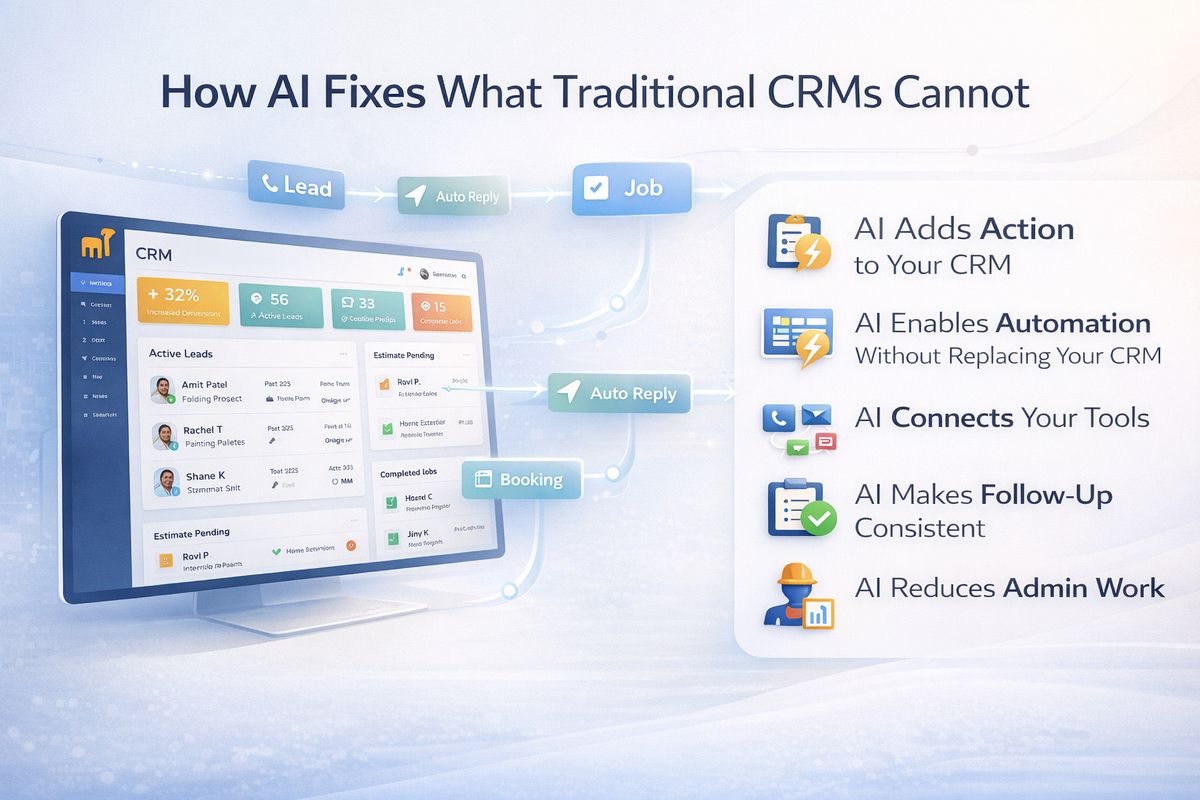
1. AI Adds Action to Your CRM
A traditional CRM stores data.
AI helps you act on it.
For example:
- a lead comes in → instant response is triggered
- a quote is sent → follow-ups are scheduled automatically
- a customer goes silent → re-engagement sequence starts
This removes dependency on memory.
And that alone changes a lot.
2. AI Enables Automation Without Replacing Your CRM
The idea that utilizing AI necessitates a new CRM is one of the most prevalent misunderstandings.
You don't.
You can integrate automation and AI into your existing system.
In other words:
- Your current CRM stays
- Your data stays
- Your team workflow stays
However, the pace of labor has improved.
Businesses that are stuck with legacy or franchise CRMs will find this extremely helpful.
3. AI Connects Your Tools
AI and automation tools can connect your CRM with:
- lead sources
- messaging platforms
- scheduling tools
- internal systems
So instead of disconnected tools, you get a connected workflow.
That reduces manual work and improves visibility.
4. AI Makes Follow-Up Consistent
This is one of the biggest wins.
AI ensures:
- Every lead gets a response
- Every estimate gets a follow-up
- Every customer stays in a communication loop
Not now and then.Every single time.
Additionally, conversions are directly improved by that consistency.
5. AI Reduces Admin Work
Instead of your team doing repetitive tasks, AI can handle:
- basic data entry
- reminders
- notifications
- status updates
- communication triggers
This gives your team more time to focus on customers, not systems.
A Real Example: How CertaPro Painters Uses AI
A good example of this shift can be seen with CertaPro Painters, one of the largest painting companies.
They have started using AI to improve how their business operates, especially in areas like:
- customer communication
- scheduling
- estimating support
- operational efficiency
Replacing individuals is not the aim.
It's to help them.
They can handle more volume, react more quickly, and provide a more uniform client experience across locations by utilizing AI.
The true lesson is that.
Even big, well-established businesses aren't entirely overhauling their systems.
They are becoming more intelligent.
The Smarter Approach: Fix the System, Not Just the Tool
The majority of painting companies attempt to use different technologies to address CRM issues.
However, that is rarely effective in the long run.
Because the tool is not the only problem.
It is the surrounding system.
The smarter approach is:
- Identify where leads are getting lost
- Identify where time is being wasted
- Identify where follow-up is breaking
Then build automation and AI around those gaps.
That is what creates real improvement.
Final Thoughts

Most painting CRMs do not fail because they are bad software.
They fail because they were never designed to handle the real complexity of a growing painting business.
That leads to:
- missed follow-ups
- disconnected tools
- manual work overload
- lost revenue
This is altered by AI.
Not by swapping out everything.
However, by improving the functionality of your current system.
It increases speed.
It makes things more consistent.
Friction is decreased.
Most significantly, it helps your company seize already-existing possibilities.
Read More: AI Marketing Automation for Roofing Companies
FAQs
1. Why do most painting CRMs fail?
Most painting CRMs fail because they are too rigid, lack customization, and do not support real business workflows. They track data but do not help drive action.
2. What are the biggest CRM problems for contractors?
Common problems include a lack of automation, poor integrations, limited customization, manual work, and inconsistent follow-ups.
3. Can I use AI without replacing my CRM?
Yes. AI can be layered on top of your existing CRM to improve workflows, automate tasks, and connect different tools without replacing your system.
4. How does AI improve CRM performance?
AI improves CRM performance by automating follow-ups, improving response time, reducing manual work, and ensuring consistent communication with leads and customers.
5. Are outdated CRM systems still usable?
Yes, but they often need automation layers to become effective. Without that, they can slow down operations and limit growth.
6. Why does CRM fail small businesses more often?
Small businesses rely more on manual processes and have fewer resources. When the CRM does not support automation or flexibility, inefficiencies grow faster.
7. What is the first step to fixing a broken CRM system?
Start by identifying where leads are getting lost and where manual work is slowing the business down. Then introduce automation and AI to fix those specific gaps.