
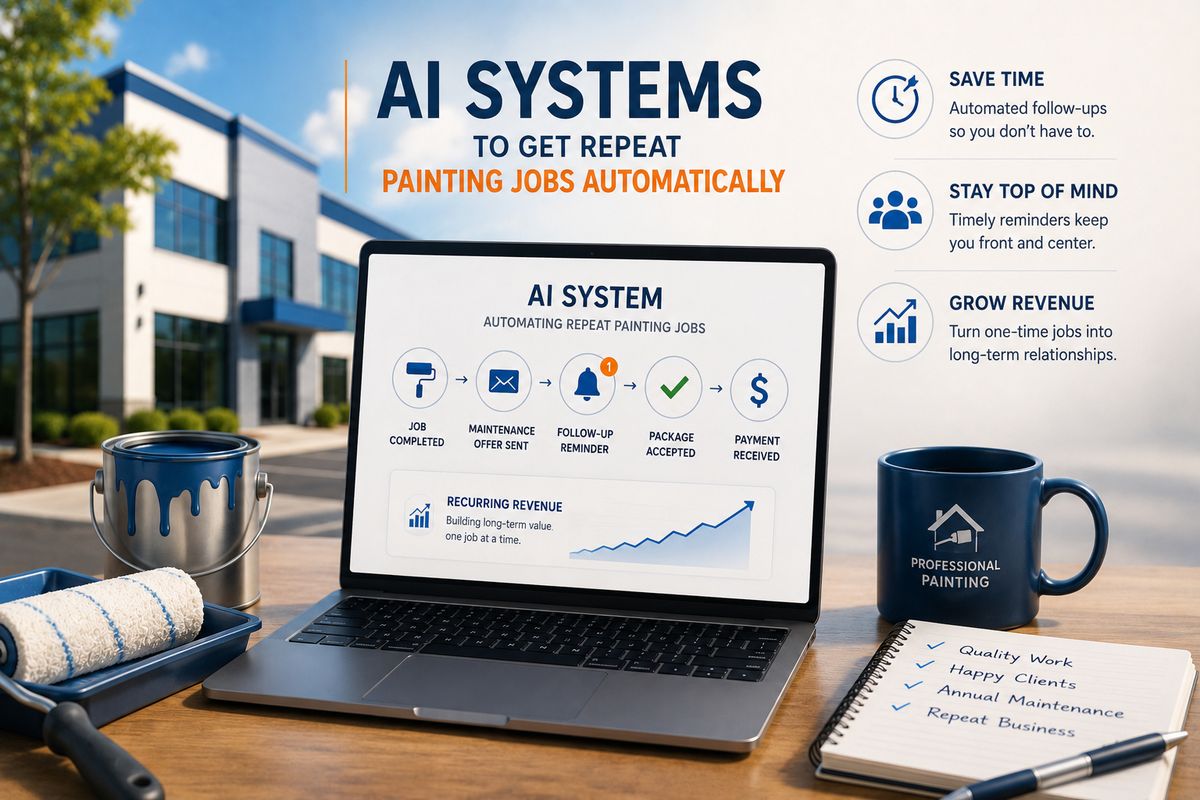
Every painting job you complete is a future job waiting to happen. Paint fades. Surfaces wear. Properties need refreshing. The client who hired you two years ago will need a painter again, and the only question is whether they call you or someone else.
Most painting businesses leave that decision entirely to chance. They finish the job, move on, and hope the client remembers them when the time comes. No follow-up. No reminder. No system keeps the relationship alive between jobs.
The painting businesses that consistently win repeat work are not luckier or better at relationships. They have a system. An automated follow-up and repaint reminder system that tracks every past client, knows when their paint is likely due for a refresh, and reaches out at exactly the right moment with the right message, without anyone on the team having to remember to do it.
This guide breaks down exactly how that system works, how to set it up, and how AI makes it run on autopilot so your painting business keeps generating repeat jobs in the background while your team focuses on the work.
Table of Contents
Why Repeat Jobs Are the Most Profitable Jobs in a Painting Business
The Problem With Manual Follow-Up
How a Repaint Reminder System Works
The Automated Follow-Up Sequence: Step by Step
Segmenting Past Clients for Smarter Outreach
Multi-Channel Follow-Up: Email, SMS, and More
How FatCamel AI Runs the Full Repeat Job System
What This Does for Your Pipeline Long Term
FAQ
References
Why Repeat Jobs Are the Most Profitable Jobs in a Painting Business
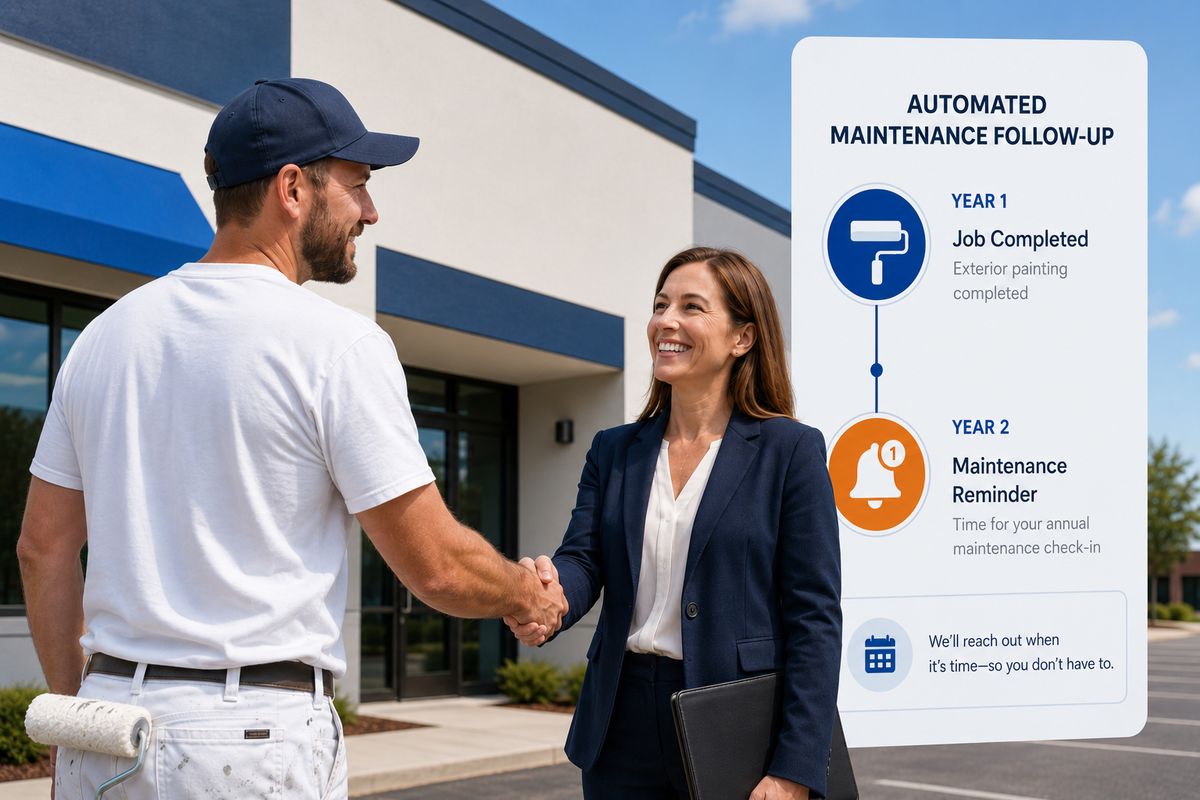
Winning a job from a past client costs a fraction of what it costs to win a job from a new one. No ad spend. No competitive quoting process. No trust to build from scratch. The client already knows your work, already trusts your team, and already has a positive experience with your business.
Repeat jobs are also faster to close. A past client does not need three quotes and two weeks to decide. They need a reminder that it is time and a reason to say yes. When your system provides both at the right moment, the conversion rate is significantly higher than any cold outreach you could run.
Here is what repeat job automation does for a painting business:
- Reduces customer acquisition cost because you are re-engaging people who already know you
- Increases close rate because past clients are already sold on your quality
- Generates a predictable pipeline because paint cycles are consistent and forecastable
- Strengthens client relationships because regular contact keeps you top of mind between jobs
- Frees up sales time because the system does the outreach without human effort
The economics are straightforward. A past client base is one of the most valuable assets a painting business has. An automated repeat job system turns that asset into a reliable revenue stream.
Read More: Best AI Tools for Painting Contractors in 2026
The Problem With Manual Follow-Up
Most painting businesses know they should follow up with past clients. The intention is there. But between managing active jobs, handling new leads, dealing with supplier issues, and running day-to-day operations, following up with someone who hired you eighteen months ago never makes it to the top of the list.
The result is that past clients drift. They forget about you. When their paint starts looking tired, and they finally decide to do something about it, they search Google and get three new quotes. Your business is not even in the conversation, not because you did a bad job, but because you disappeared.
Manual follow-up has three fundamental problems:
It depends on someone remembering. If the follow-up lives in someone's head or on a sticky note, it will not happen consistently. People get busy, priorities shift, and past clients fall through the cracks.
It does not scale. A painting business with 200 past clients cannot have a salesperson personally tracking the repaint cycle for every single one. The math does not work without automation.
The timing is almost always wrong. Even when manual follow-up does happen, it is rarely timed to the moment a client is actually thinking about repainting. A random call in the wrong month gets brushed off. A perfectly timed reminder when the paint is visibly fading gets a yes.
Automation solves all three problems. The system remembers. It scales to any number of past clients. And it reaches out at the right time because it is built around the actual repaint cycle of each property.
Know More: How to Build Recurring Revenue in a Painting Business
How a Repaint Reminder System Works
A repaint reminder system is built on one simple insight: paint has a predictable lifespan. Interior commercial spaces typically need repainting every three to five years. Exterior surfaces in most climates need attention every five to seven years. High-traffic areas like lobbies, corridors, and stairwells need touch-ups every one to two years.
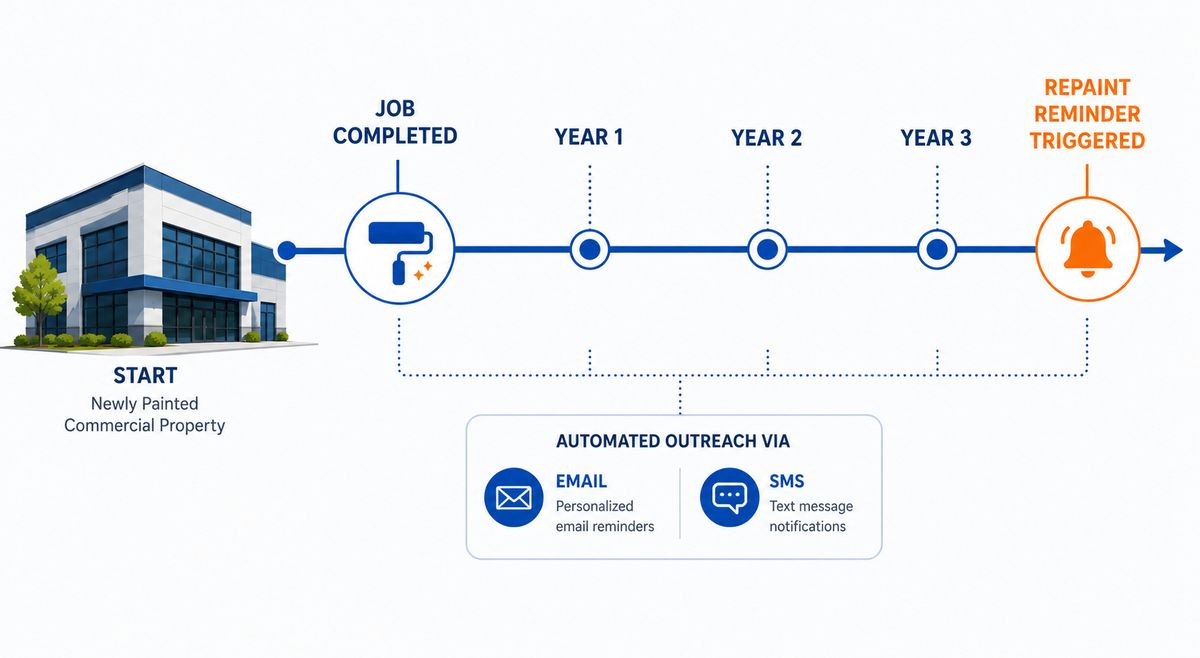
When you log the completion date, surface type, and paint product used at the end of every job, you have everything the system needs to calculate when that client is likely to need painting again.
Here is the basic logic the system runs on:
Job completion date + repaint cycle for that surface type = target outreach date
When the target outreach date approaches, the system automatically triggers a follow-up sequence for that client. The message is relevant, timely, and personalized to the specific job that was done. It does not feel like a mass marketing email. It feels like a contractor who remembered them and reached out at exactly the right moment.
This is the difference between a repaint reminder system and generic email marketing. The outreach is triggered by real data from the job, not by a calendar date someone picked arbitrarily.
Read More: Why Your Painting Business Is Losing Jobs - And How AI Fixes the Lead Leakage Problem
The Automated Follow-Up Sequence: Step by Step
When the repaint reminder is triggered, a multi-step follow-up sequence runs automatically. Here is exactly how it works:
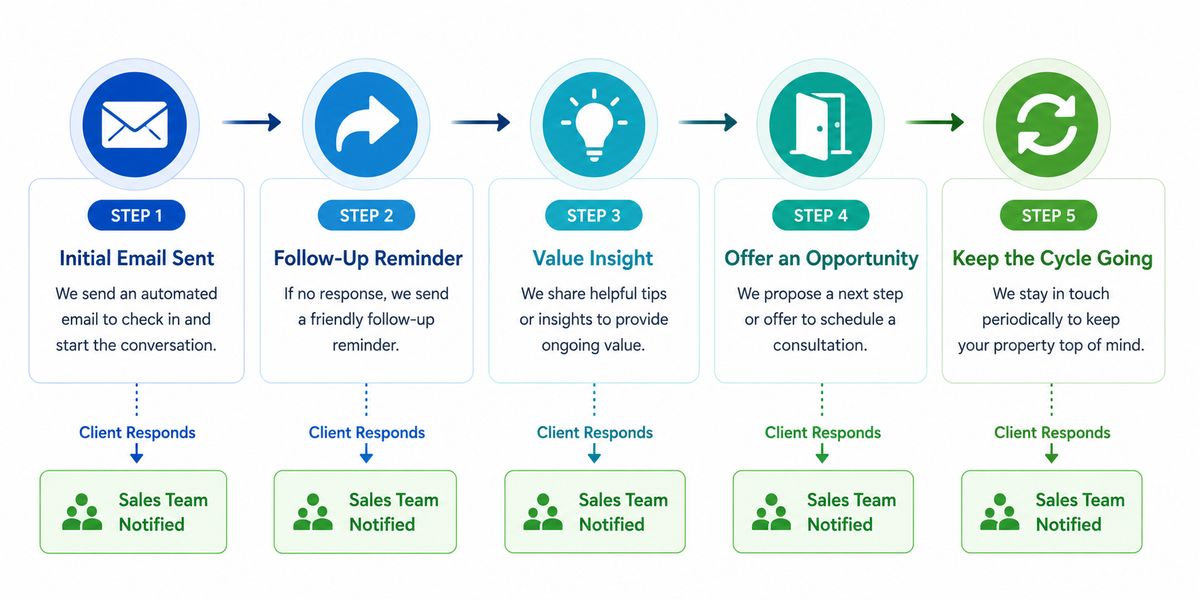
Step 1: Initial Repaint Reminder (Trigger Date)
The first message goes out on the calculated reminder date. It is personalized with the client's name, the property address, and a reference to the original job. Something like: "It has been three years since we completed the exterior repaint on your building on [street name]. Based on the coating we used, this time of year is typically when a fresh inspection makes sense."
The message is not a hard sell. It is a helpful reminder from a contractor who knows their work. It includes a soft call to action: a link to book a quick assessment call or reply to express interest.
Step 2: Follow-Up Message (Day 5, No Response)
If the client has not responded within five days, a second message goes out. This one is shorter and more direct. It references the first message, acknowledges they are likely busy, and makes the next step as easy as possible. A single link to book a call or confirm interest.
Step 3: Value Message (Day 12, No Response)
If there is still no response, a third message goes out focused on value rather than the ask. It might include a brief note about what happens when exterior paint is left too long: moisture damage, surface degradation, higher cost to repair versus maintain. The message is educational and positions your business as a knowledgeable partner, not just another contractor chasing work.
Step 4: Final Reminder (Day 20, No Response)
A short, friendly final message that lets the client know this is the last reminder for now. It keeps the door open warmly: "If the timing is not right, no problem at all. We will check back in with you in a few months. In the meantime, feel free to reach out any time."
Step 5: Re-Entry (90 Days After No Response)
Clients who did not respond to the initial sequence are automatically re-entered into a lighter follow-up three months later. Sometimes the timing was simply wrong. A second reminder cycle three months later often catches clients who have since moved into their budget planning period and are now actively thinking about painting.
If the client responds at any point in the sequence:
The automation immediately stops the sequence and notifies your sales team with the client's full history, the property details, and the conversation context. The sales team picks up from there with a warm handoff and all the information they need to close the job.
Segmenting Past Clients for Smarter Outreach
Not every past client should receive the same reminder. A property manager overseeing a portfolio of commercial buildings has different needs and a different buying process than a small business owner who had their shopfront painted once. Sending the same message to both produces worse results than tailoring the outreach to each segment.
Smart segmentation makes the reminder system significantly more effective. Here are the key segments to build:
By property type:
- Commercial properties: office buildings, retail centers, industrial facilities
- Hospitality: hotels, restaurants, event venues
- Residential: homeowners, landlords, property investors
Each segment receives messaging written for its specific context. A property manager cares about minimizing disruption to tenants and staying within maintenance budgets. A hotel operator cares about guest experience and the appearance of common areas. A homeowner cares about curb appeal and protecting their investment.
By job size:
- High-value past clients who spent above a certain threshold receive a more personalized outreach, sometimes a direct call from a salesperson, rather than an automated email
- Mid-range clients receive the standard automated sequence
- Smaller one-off jobs receive a lighter sequence focused on referrals as much as repeat work
By time since last job:
- Clients within the normal repaint cycle receive the standard reminder sequence
- Clients who are overdue for a repaint receive a more urgent message that emphasizes the cost of waiting
- Clients who had work done very recently receive a satisfaction check-in rather than a repaint reminder
By engagement history:
- Clients who opened previous emails but did not respond receive a different follow-up than those who never opened anything
- Clients who responded to a previous reminder but did not convert receive a sequence that references that prior conversation
Segmentation is what turns a generic email blast into a system that feels personal and relevant to every client it touches. And when outreach feels relevant, response rates go up dramatically.
Multi-Channel Follow-Up: Email, SMS, and More
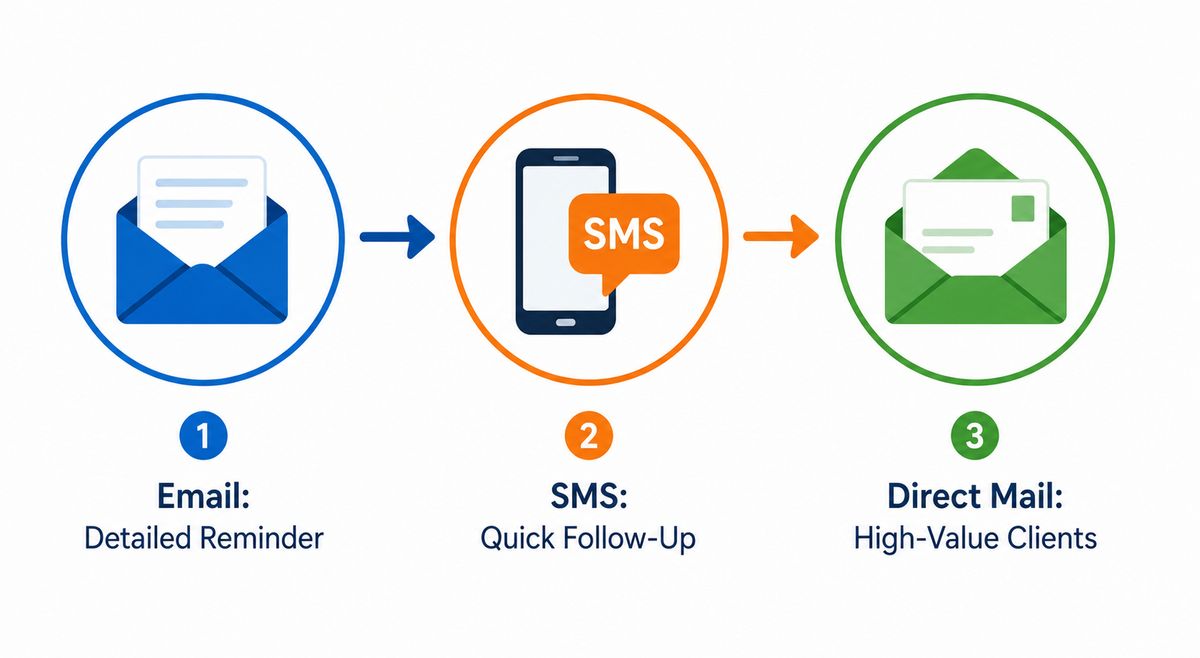
Email is the backbone of the follow-up system, but relying on email alone means missing clients who are not heavy email users. A multi-channel approach reaches past clients wherever they are most likely to engage.
Email: The primary channel for detailed repaint reminders and value messages. Email gives you space to include property-specific details, photos of the original work, and a clear call to action. It works best for commercial clients who manage communications through their inbox.
SMS: Short, direct, and harder to ignore than email. SMS works exceptionally well for the follow-up touchpoints in the sequence where you just need a quick response. A simple text that says "Hi [Name], just following up on our email about your property on [street]. Would it be worth a quick call this week?" gets responses that a longer email would not.
Direct mail for high-value clients: For commercial clients above a certain contract value, a physical letter or a brief professionally printed reminder card adds a level of professionalism and personal attention that digital outreach cannot replicate. It also stands out in a world where every competitor is doing email.
The multi-channel system does not bombard clients with the same message on every channel simultaneously. It uses each channel strategically across the sequence, leading with email, following up with SMS, and reserving direct mail for the highest-value relationships.
How FatCamel AI Runs the Full Repeat Job System
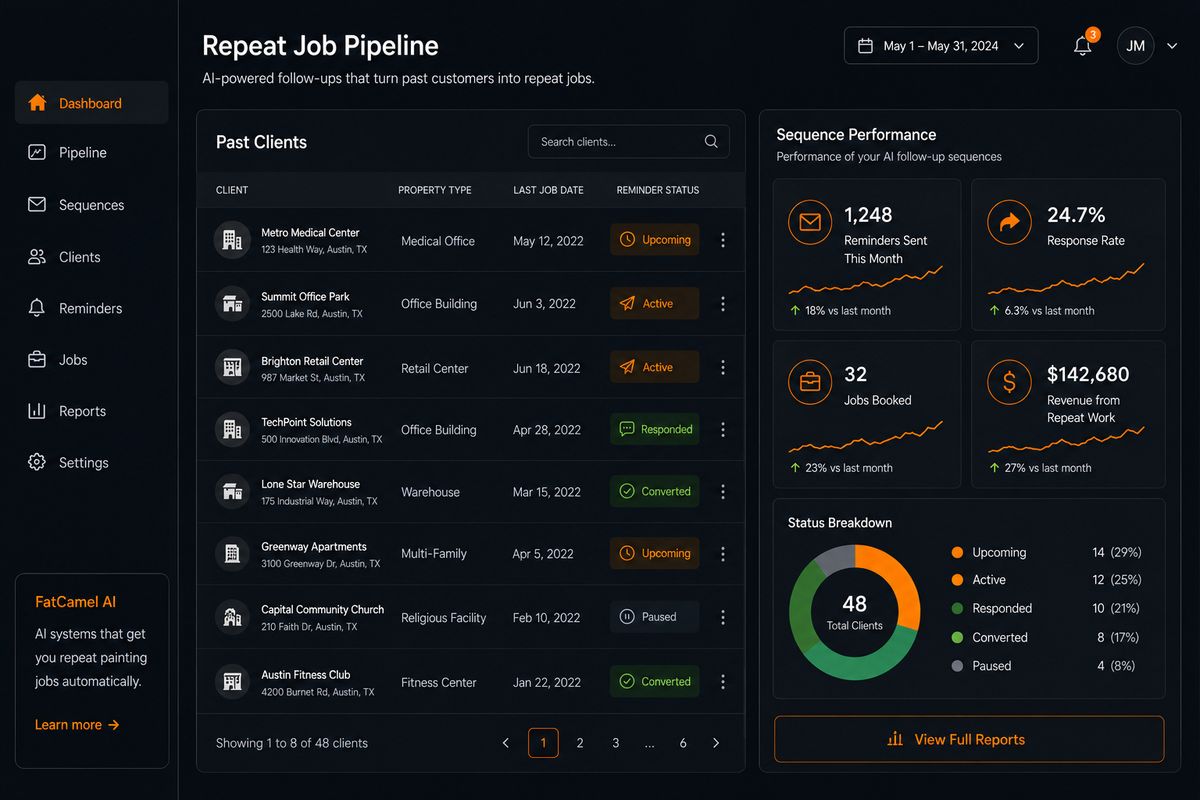
The repeat job automation system has a lot of moving parts. Job data needs to be tracked. Repaint cycles need to be calculated. Sequences need to trigger at the right time. Clients need to be segmented correctly. Sales team handoffs need to happen seamlessly. Without the right AI tying it all together, the system breaks down at the edges.
FatCamel AI is built to run the complete repeat job automation system for painting businesses, from job completion tracking through to closed repeat work.
Here is what FatCamel AI manages:
Job completion tracking and cycle calculation. When a job is marked complete, FatCamel AI logs the surface type, coating used, and completion date, and automatically calculates the target reminder date for that property. No manual data entry. No spreadsheet to update. The clock starts automatically.
Automated sequence triggering. When the reminder date arrives, FatCamel AI triggers the full follow-up sequence without any action required from your team. The right message goes to the right client at the right time, every time.
Intelligent segmentation. FatCamel AI segments past clients based on property type, job value, engagement history, and time since last job, and adjusts the messaging and channel mix accordingly. High-value commercial clients get a different experience than smaller residential accounts.
Multi-channel coordination. FatCamel AI manages the email, SMS, and direct mail components of the sequence as a single coordinated workflow. It knows which channel each client has engaged with previously and adjusts the approach based on that data.
Sales team handoff. When a client responds with interest, FatCamel AI immediately notifies the sales team with the client's full history, the original job details, and the conversation context. The handoff is warm, informed, and instant.
Pipeline reporting. A FatCamel AI dashboard shows every past client in the system, which sequence they are in, how many have responded, how many jobs have been booked from the system, and the total revenue generated from repeat work. You can see the value of your past client base in real numbers at any time.
FatCamel AI does not require your team to manage the system day to day. Once it is set up and your past client data is loaded, it runs continuously in the background, generating repeat job conversations and handing them off to your sales team at exactly the right moment.
👉 See how FatCamel AI automates repeat jobs for painting businesses
What This Does for Your Pipeline Long Term
In the first month the repeat job system is running, you might book two or three jobs from past clients who were already close to needing a repaint. The immediate impact is real but modest.
The long-term impact is compounding.
Every job you complete this month becomes a future automated reminder in twelve, twenty-four, or thirty-six months. The system builds on itself. As your past client base grows, the number of reminders going out each month grows with it. The repeat job pipeline becomes a predictable, growing source of revenue that runs in parallel with your new business development, not instead of it.
Painting businesses that have run this system for two or more years report that repeat job revenue becomes one of their most consistent monthly income sources. Not because they work harder at client relationships. Because they built a system that maintains those relationships automatically.
Your past clients are your warmest asset. This system makes sure you never leave that asset sitting idle.
FAQ
1. What is repeat job automation for a painting business?
Repeat job automation is a system that tracks past clients and automatically sends follow-up messages when their paint is likely due for a refresh. Instead of relying on clients to remember you or your team to manually follow up, the system calculates when each property needs attention and triggers a personalized outreach sequence at exactly the right time.
2. How does a repaint reminder system work?
A repaint reminder system logs the completion date, surface type, and coating used at the end of every job, then calculates when that surface is likely to need repainting based on standard paint lifespan data. When that date approaches, the system automatically sends a sequence of personalized follow-up messages to the client across email and SMS.
3. How often should painting contractors follow up with past clients?
The follow-up frequency depends on the surface type and the scope of the original job. For commercial interiors, a reminder sequence typically starts around the two to three-year mark. For exterior work, three to five years is standard, depending on the climate and the coating used. High-traffic interior areas, such as lobbies and corridors, warrant a lighter annual check-in.
4. What is the best way to get repeat painting jobs from past clients?
The most reliable way to get repeat painting jobs is to reach out at the right moment with a relevant, personalized message that references the original work done. A repaint reminder system does this automatically. Combined with a multi-step follow-up sequence across email and SMS, it consistently converts past clients into repeat jobs at a higher rate than any other outreach method.
5. Can customer follow-up automation work for both residential and commercial painting clients?
Yes. The system works for both segments, but the messaging, timing, and channel mix differ. Commercial clients typically respond better to email outreach with detailed property-specific context. Residential clients often respond well to a combination of email and SMS with a more personal, conversational tone. Segmenting the two groups and tailoring the approach to each yields significantly better results than treating them equally.
6. How does FatCamel AI help painting businesses get more repeat jobs?
FatCamel AI automates the entire repeat job system from job completion tracking through to sales team handoff. It calculates repaint cycles, triggers follow-up sequences at the right time, segments clients for personalized outreach, coordinates email and SMS channels, and notifies the sales team when a client is ready to book. The system runs continuously without manual management.
7. How long does it take to set up a repeat job automation system?
With the right AI tool, most painting businesses can have the system live within one to two weeks. The setup involves loading past client data, defining repaint cycles for different surface types, configuring the message sequences, and connecting the email and SMS channels. Once live, the system runs without ongoing management.
References
https://hbr.org/2014/10/the-value-of-keeping-the-right-customers
https://www.salesforce.com/research
https://www.hubspot.com/marketing-statistics
https://www.campaignmonitor.com/resources/guides/email-marketing-benchmarks
https://www.forbes.com/business-council
https://www.mckinsey.com/capabilities/growth-marketing-and-sales/our-insights
https://www.paintcontractormag.com