
Quick Answer
Commercial pressure washing costs vary depending on the property size, surface type, cleaning requirements, and site conditions. Published pricing guides commonly show rates of around $0.08 to $0.30 per square foot for many commercial building projects. Parking lots may be priced by square footage or parking space, depending on the contractor.
These figures are starting points for budgeting, not fixed market rates. Oil and grease buildup, difficult access, after-hours scheduling, hot-water equipment, traffic control, and wastewater management can all affect the final quote.
For an accurate estimate, compare written proposals that cover the same surfaces, cleaning methods, and service requirements.
Table of Contents
Why Commercial Quotes Are Priced Differently
What Published Commercial Rates Say
Budgeting by Property Type
What Moves a Commercial Bid
Why Wastewater Belongs in the Budget
Illustrative Commercial Budget Example
How to Write a Bid Scope So Quotes Compare
How FatCamel Helps Contractors Follow Up on Commercial Bids
Frequently Asked Questions
Why Commercial Quotes Are Priced Differently

A residential house wash may involve a handful of related surfaces. A commercial property is usually a collection of separate work areas that happen to share an address.
Commercial contractors may price work by square foot, hour, project, parking space, or drive-thru lane. That matters when comparing bids. A vendor quoting per parking space and another quoting per square foot may not be disagreeing; they may simply be using different units.
Before comparing prices, convert each proposal into the same list of surfaces, methods, frequency, and exclusions. A bid for a parking lot alone is not comparable to one that includes sidewalks, dumpster pads, and storefront entrances.
What Published Commercial Rates Say
Published commercial pressure-washing rates vary across sources because contractors use different pricing methods, property categories, and service assumptions. The following figures offer a general budgeting reference rather than a standard industry rate.
The Business Cleaning Company’s 2026 guide lists many commercial building projects at approximately $0.08–$0.30 per square foot and whole-building projects at $500–$5,000 or more. It gives examples of concrete at $0.08–$0.20, brick at $0.10–$0.25, sidewalks at $0.08–$0.15, and roofs at $0.20–$0.90 per square foot. Its parking-lot examples range from $0.03–$0.20 per square foot or $8–$20 per space. 1
FieldCamp presents different ranges for contractors setting rates: office buildings at $0.15–$0.35 per square foot, retail storefronts at $0.25–$0.45, warehouses at $0.10–$0.25, and parking lots at $0.05–$0.15. 2
The sources overlap in some areas and differ in others. Neither is an independent market survey. Use the figures to establish a broad planning range, then replace them with written bids after a site walk.
For related quote variables, see Pressure Washing Cost: What Changes a Quote?.
Budgeting by Property Type
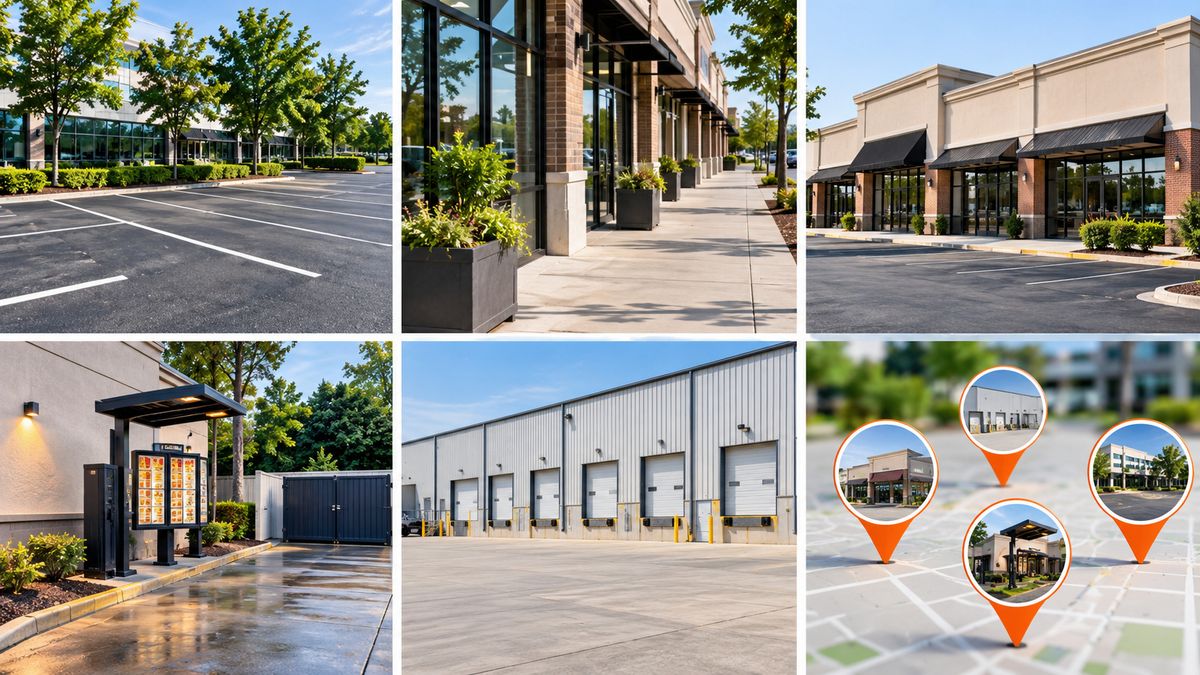
Parking lots and garages
Published parking-lot ranges span roughly $0.03–$0.20 per square foot, with per-space examples around $8–$20.For example, applying the published range of 0.03–0.20 per square foot to a 20,000-square-foot parking lot produces an illustrative estimate of 600–4,000. This calculation is intended for early budgeting only. The actual quote may differ based on surface condition, access, cleaning requirements, and local pricing.
Oil stains, gum, heavy traffic lanes, after-hours work, traffic control, and wastewater recovery can move the bid upward. Walk the lot with the contractor and mark problem areas rather than asking for a price based only on total area.
Storefronts and sidewalks
Published examples place sidewalk cleaning at approximately 0.08–0.15 per square foot. For a 1,500-square-foot area, this works out to an illustrative estimate of 120–225. However, small jobs may be subject to a contractor's minimum service charge, which can affect the final price. A 1,500-square-foot sidewalk area would produce illustrative arithmetic of $120–$225, but a contractor’s minimum visit charge may matter more for a small site.
Building fronts are priced differently from flat concrete. Ask whether entrances, awnings, exterior walls, and storefront glass are included or quoted separately.
Multi-tenant retail and office properties
The price may reflect coordination as much as cleaning. Tenant access, delivery schedules, customer traffic, security requirements, and working hours can determine whether the work happens during the day or overnight.
An after-hours schedule may carry a premium because it requires different labor planning and restricts the usable work window. Put tenant notifications, access arrangements, and working hours in the scope rather than handling them informally on the day of service.
Restaurants, drive-thrus, and dumpster areas
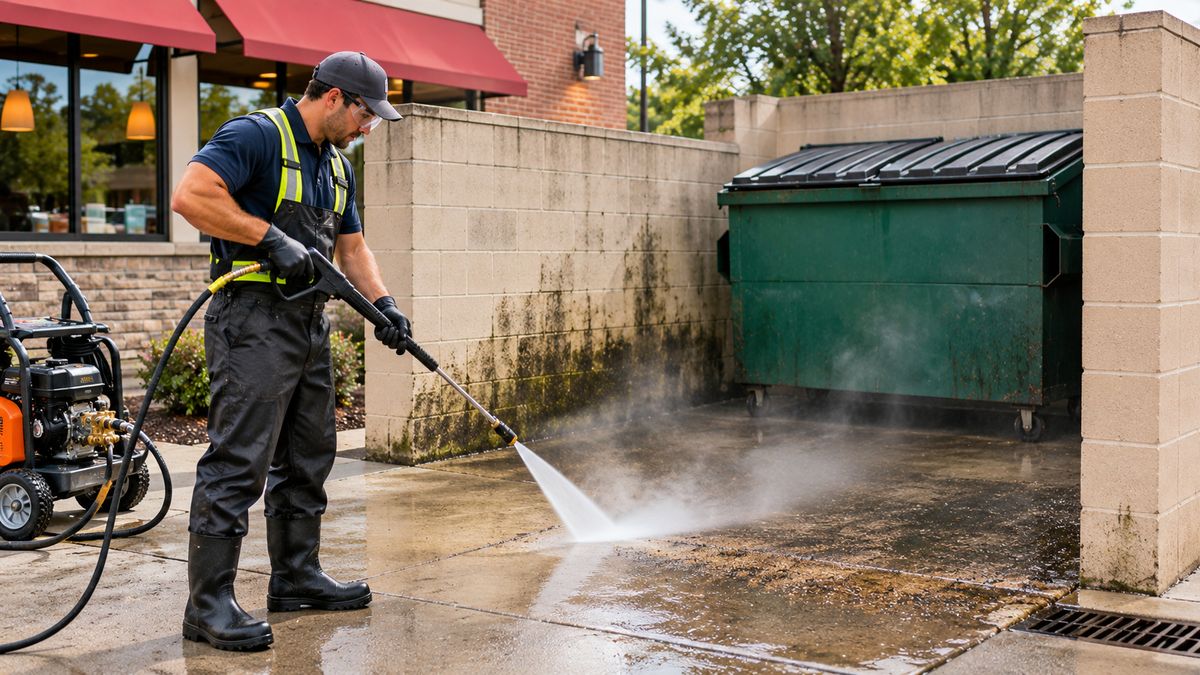
Grease and oil often require hot-water equipment and additional treatment. Hot-water cleaning can increase operating costs because of fuel use, equipment requirements, and additional setup. FieldCamp reports examples of a 30%–50% premium over cold-water cleaning, although the actual difference depends on the contractor, equipment, and site conditions.
Warehouses and industrial sites
FieldCamp lists warehouses around $0.10–$0.25 per square foot. Large, open, uniform surfaces may have a lower effective rate because equipment and labor move efficiently. Complex access, height, safety controls, or contaminated surfaces can offset that efficiency.
Multi-location portfolios
For several sites, use one written scope and a consistent pricing format. A recurring maintenance contract may reduce long-term cost, but compare the number of visits, surfaces per visit, renewal terms, and change-order rules before signing.
What Moves a Commercial Bid
The most common cost drivers include:
- Condition: Oil, grease, gum, graffiti, mold, and embedded staining require more time or treatment.
- Access: Lifts, scaffolding, long hose runs, blocked areas, and limited water supply add labor or equipment.
- Working hours: Night work, customer traffic, tenant schedules, and lane closures complicate the job.
- Equipment: Hot water, surface cleaners, recovery vacuums, lifts, cones, and barricades affect the bid.
- Surface mix: Several small areas may take longer to set up than one continuous surface.
- Frequency: Regular maintenance can be priced differently from a heavily neglected first cleaning.
- Wastewater: Capture, transport, treatment, or approved disposal may be required.
Ask each bidder to identify which factors are included in the quoted number. Be cautious of a proposal that claims precision without inspecting the site.
Why Wastewater Belongs in the Budget
Commercial wash water can carry oil, grease, cleaning chemicals, organic material, and surface residue. Local stormwater programs may restrict or prohibit discharge into storm drains, particularly near restaurants, parking lots, waterways, and contaminated surfaces. Requirements vary by city, county, and state.
The practical questions are straightforward:
How will runoff be prevented from entering storm drains?
Does the job require drain covers, containment, recovery, or disposal?
Is wastewater handling included in the bid?
Who is responsible for permits or local compliance?
This is not legal advice. Property owners and managers should confirm local requirements with the relevant stormwater authority. A low bid that ignores wastewater may not be a true low-cost option if the scope is incomplete.Wastewater handling should be discussed before work begins, especially when cleaning areas exposed to oil, grease, detergents, or other contaminants. The contractor and property manager should agree on the runoff-control approach and confirm which party is responsible for any required collection or disposal arrangements.
Read More: Best HVAC Automation Software (2026): Buyer's Guide
Illustrative Commercial Budget Example
Consider a small retail center with a 30,000-square-foot parking lot and 3,000 square feet of sidewalks. Using the published pricing examples in this guide, the parking lot could produce an illustrative estimate of 900–6,000, while the sidewalk area could add approximately 240–450.
Together, these figures suggest an early budgeting range of around 1,140–6,450. This does not include building-front cleaning, dumpster areas, after-hours scheduling, traffic control, or wastewater management. A site inspection and written proposal are needed to establish the actual project cost.
How to Write a Bid Scope So Quotes Compare
Write the scope before asking contractors to bid. Include:
- Approximate square footage for each surface.
- Parking-space or drive-thru-lane counts where relevant.
- Number of visits and preferred months.
- Allowed working hours and tenant-notification responsibilities.
- Cleaning method for each surface.
- Whether hot water is expected for grease or oil.
- Water access, traffic control, and safety requirements.
- Wastewater capture, recovery, and disposal plan.
- Proof of insurance.
- Required before-and-after photos.
- Exclusions such as windows, graffiti removal, sealing, or repairs.
- How unexpected conditions will be handled through a written change order
A clear scope makes vague bids easier to spot and allows the property manager to compare proposals on the same basis.
Read More: Driveway Pressure Washing Cost by Size and Condition (2026)
How FatCamel Helps Contractors Follow Up on Commercial Bids

Commercial pressure-washing businesses often manage multiple quotes, property managers, and follow-up conversations at the same time. Some commercial bids also involve longer approval cycles, making consistent communication important.
FatCamel AI helps service businesses explore CRM automation and customer follow-up workflows. Depending on the business's requirements and existing systems, automation can help organize lead information, manage follow-up activities, and maintain more consistent communication with potential customers.
For contractors handling commercial projects, a structured follow-up process can make it easier to keep track of open proposals, revisit previous opportunities, and stay connected with customers without relying entirely on manual reminders.
The goal is to reduce repetitive administrative work while keeping communication relevant and timely. Follow-up messages should stop when a prospect replies, declines, books, or opts out.
Get a Free AI Revenue Audit for Your Pressure-Washing Business.
FAQ
1.How much does commercial pressure washing cost per square foot?
Published guides place many commercial building projects around $0.08–$0.30 per square foot, while some office and retail examples run higher. Surface, condition, access, region, schedule, and wastewater requirements determine the actual bid.
2. How much does parking-lot pressure washing cost?
Published examples range from about $0.03–$0.20 per square foot or $8–$20 per parking space. Oil, gum, traffic control, after-hours work, and wastewater recovery can increase the price.
3. How often should a commercial property be pressure washed?
Some published guidance suggests once or twice a year, but frequency should follow traffic, grease, tree cover, climate, and surface condition. Ask for a maintenance recommendation after a site walk.
4. Why does hot-water pressure washing cost more?
Hot-water equipment costs more to operate and is commonly used for grease and oil. FieldCamp cites a 30%–50% premium, but the actual amount depends on the job and local market.
5. Is wastewater recovery included?
Not always. Ask the contractor how runoff will be managed and whether capture, recovery, transport, or disposal is included in the proposal.
6. Is an annual maintenance contract worth considering?
It can simplify scheduling and may reduce long-term cost, but compare the scope per visit, frequency, renewal pricing, change-order rules, and cancellation terms before signing.
7. What should a commercial pressure-washing bid include?
It should list surfaces, measurements, methods, frequency, working hours, access needs, wastewater planning, insurance, exclusions, and how condition-related changes will be priced.
References
https://tbcccorp.com/the-cost-of-commercial-pressure-washing-services/
https://fieldcamp.ai/blog/how-much-to-charge-for-pressure-washing/
https://www.fatcamel.ai/blog/pressure-washing-cost-what-changes-a-quote
https://www.fatcamel.ai/blog/roof-cleaning-cost
https://www.fatcamel.ai/blog/soft-washing-vs-pressure-washing