
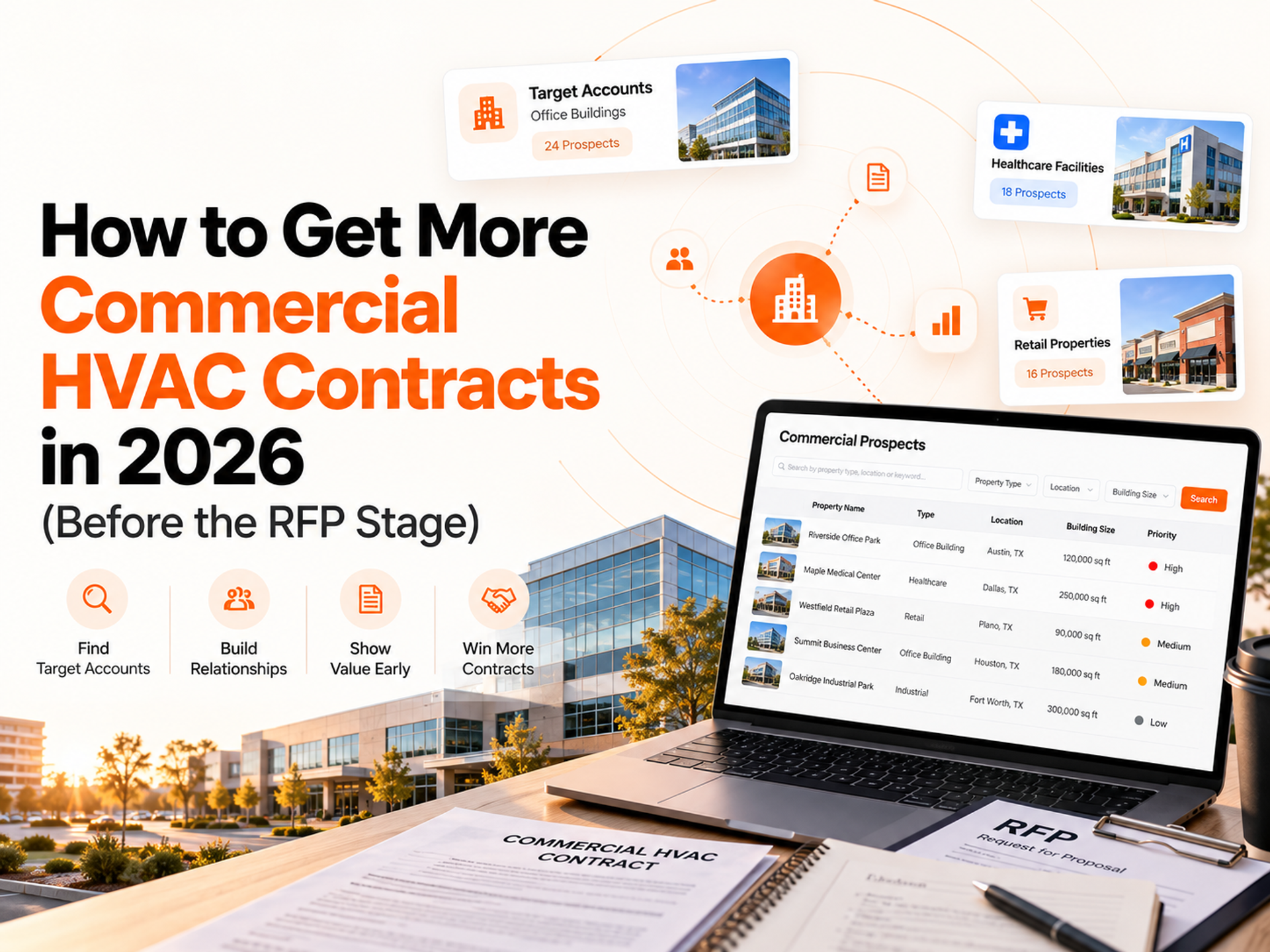
Quick Answer:Commercial HVAC contracts are often influenced by relationships built before the formal bidding process starts. Contractors who identify the right accounts early, reach the relevant decision-makers, and follow up consistently have more opportunities to be considered when a contract comes up for renewal.Commercial HVAC work often starts before an RFP is published. A contractor may already have an advantage if they have spoken with the facilities team, understand the property's needs, and know when a maintenance agreement is coming up for review.
This guide covers the full pipeline: finding commercial prospects worth pursuing, reaching the right decision-makers, presenting a clear service offer, and following up throughout the buying process.
Table of Contents
- Why Most HVAC Contractors Struggle to Win Commercial Work
- Step 1: Define the Commercial Accounts Worth Pursuing
- Step 2: Find Prospects Before They Issue an RFP
- Step 3: Reach Commercial Decision-Makers Directly
- Step 4: Present Like a Commercial Contractor, Not a Residential One
- Step 5: Follow Up Until the Contract Is Signed or Declined
- How AI Automation Supports the Commercial HVAC Sales Pipeline
- How FatCamel AI Helps HVAC Companies Win Commercial Contracts
- FAQ
Why Most HVAC Contractors Struggle to Win Commercial Work
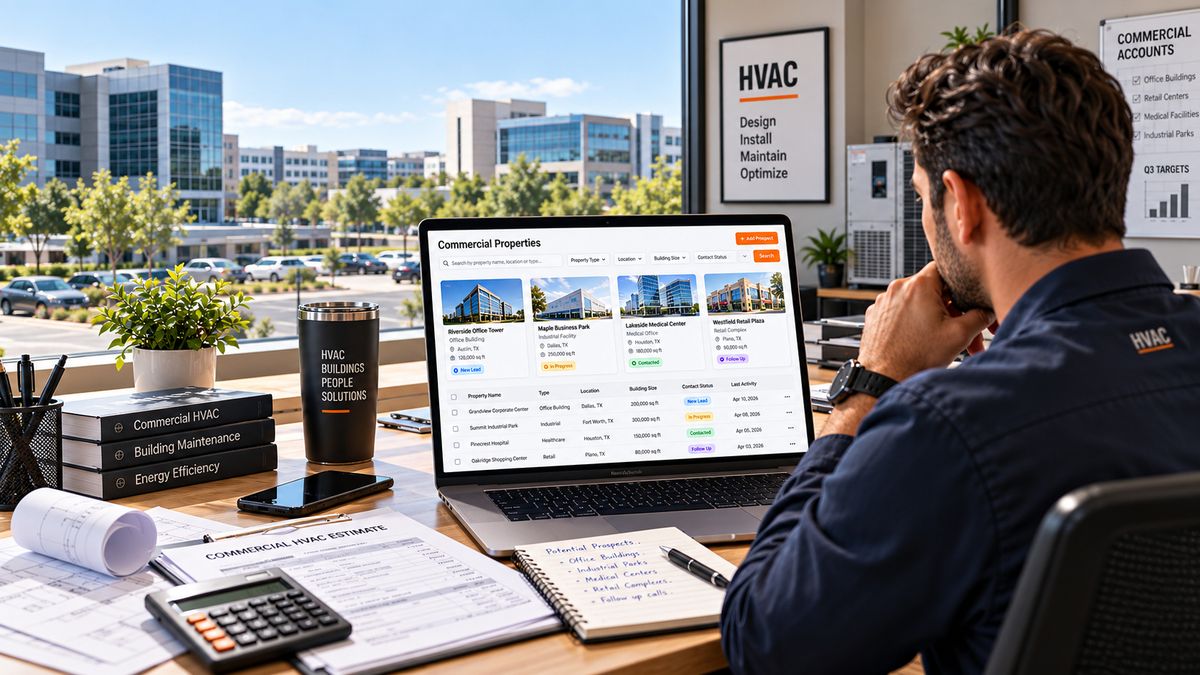
The commercial HVAC sales cycle is usually more involved than residential work. A homeowner may make a decision quickly when something breaks. A commercial buyer may need to work through budgets, internal approvals, procurement requirements, and comparisons with other contractors before signing an agreement.
Some HVAC businesses approach commercial work much like residential work: wait for an enquiry, respond, and submit a proposal. That approach works in residential because homeowners actively search when they have a problem. Commercial buyers operate differently. They have existing vendor relationships, they procure through formal processes, and they rarely search Google when their current contract is up for renewal. By the time an RFP is published, the buyer may already have existing vendor relationships or a shortlist of contractors.
That makes early relationship-building an important part of commercial HVAC business development.
Step 1: Define the Commercial Accounts Worth Pursuing
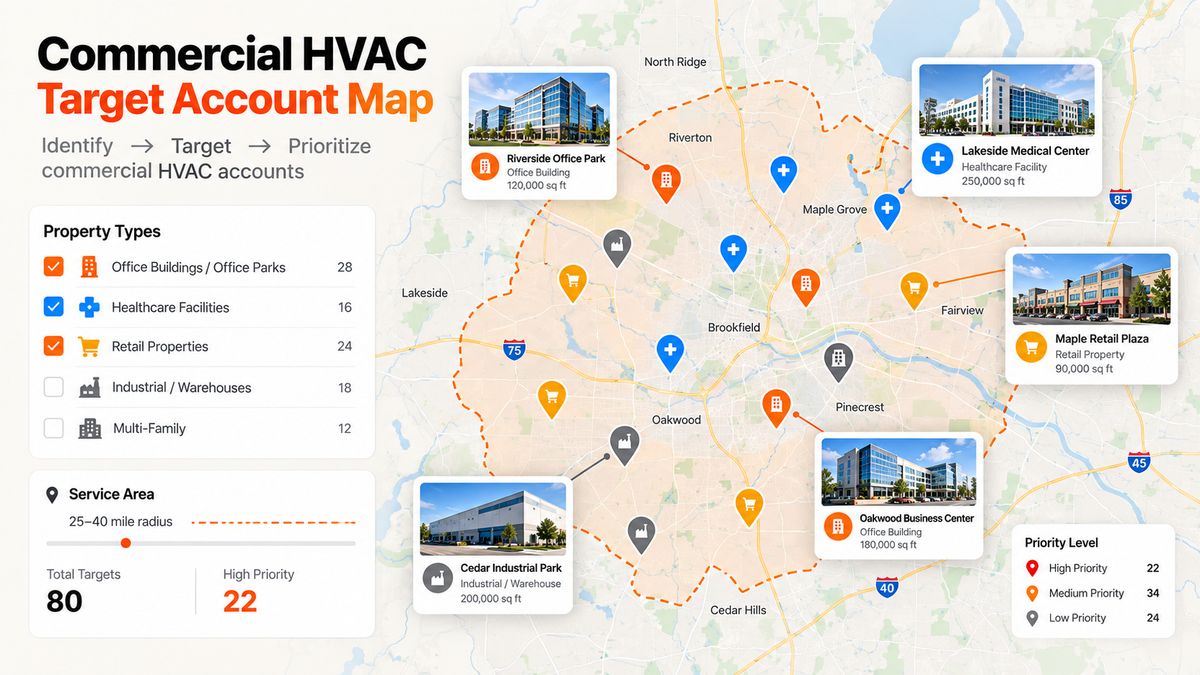
Before prospecting, be specific about which commercial accounts your business can actually serve profitably. Not every commercial property is the right fit.
Commercial accounts worth considering:
- Commercial real estate portfolios — property management companies overseeing multiple office buildings or retail properties can be useful targets because one relationship may lead to opportunities across several properties.
- Healthcare-adjacent properties — medical office buildings, outpatient clinics, and specialty care facilities can have specific HVAC, maintenance, and compliance requirements.
- Hospitality — hotels, extended-stay properties, and conference centers can benefit from planned maintenance and defined response arrangements.
- Industrial and warehouse — equipment-intensive sites where planned maintenance and reliable HVAC operation are important.
- Retail chains — operators with multiple locations may prefer working with a contractor who can support several sites consistently.
Define your target by property type, building size, and geographic service radius before building the prospect list. A commercial maintenance agreement that requires a two-hour drive each way will erode margin on every visit, regardless of the contract value.
Step 2: Find Prospects Before They Issue an RFP
Commercial HVAC opportunities can come from both formal bidding platforms and relationships developed before a project reaches the bidding stage.
Where to find commercial HVAC prospects early:
Building permit records. Most municipalities publish commercial building permits, including HVAC installations and major equipment replacements. A building that has recently installed or replaced commercial HVAC equipment may become a useful maintenance prospect. Permit records can help identify these projects and give contractors a reason to start a conversation with the property owner or manager.
Property management company portfolios. Large property management companies list their managed properties publicly or through real estate databases. A property management firm managing multiple commercial buildings may be a useful target because one relationship can create opportunities across several properties.
LinkedIn. LinkedIn can be useful for identifying facility managers, operations leaders, and property management professionals involved in commercial building decisions. A targeted connection approach referencing their specific property type and a relevant challenge reaches decision-makers directly before they've started any formal procurement process. This is covered in detail in our LinkedIn outreach guide for commercial HVAC.
General contractors. GCs completing commercial tenant improvement projects need HVAC contractors to hand off maintenance relationships when the construction work ends. Building referral relationships with active commercial GCs in your market can create opportunities for introductions to new commercial clients.
Current commercial clients. The most overlooked source of new commercial contracts is the portfolio of clients who are already satisfied. A facility manager happy with your work at one property who also manages or knows of other properties is a direct referral opportunity but only if you ask. Most contractors never do.
Read More: LinkedIn Marketing for Commercial HVAC Companies
Step 3: Reach Commercial Decision-Makers Directly
Finding the right prospect is half the work. Reaching them in a way that actually gets a response is the other half.
Commercial decision-makers such as facility managers, property management leaders, and asset managers receive plenty of vendor outreach. A generic pitch is easy to ignore.
What works in commercial HVAC outreach:
A first message can reference the property type or a relevant issue such as energy costs, compliance requirements, or emergency response. Keep the initial ask simple. The goal is to start a conversation rather than immediately push a quote.
A follow-up sequence should add value rather than simply repeat the ask. After the first outreach, a second message could share a brief case study from a similar property type, an observation about seasonal HVAC challenges, or a question related to the prospect's situation. The point is to stay relevant without creating unnecessary pressure.
Timing also matters. If you know when a maintenance agreement is due for review, start the conversation early enough for the buyer to consider alternatives. The exact timing will vary by contract and organization, so avoid treating one follow-up schedule as universal.
Step 4: Present Like a Commercial Contractor, Not a Residential One
When a commercial decision-maker agrees to a meeting or a proposal, the way that proposal is structured determines whether you're taken seriously or dismissed as a residential contractor trying commercial work.
Commercial buyers, particularly facility managers at institutional properties, are held accountable for the performance of their vendors. They need to justify their decisions internally. A proposal they can defend is more useful than a low price they can't explain.
What commercial HVAC proposals need:
A clear scope document that specifies exactly what's included and what isn't. Task frequency by equipment type. Response time commitments for emergency calls.Reporting deliverables what the client receives after each maintenance visit and at what intervals.
Tiered options give commercial buyers flexibility. A full-coverage agreement that includes parts and emergency labor is a different product from a preventive-maintenance-only agreement where repairs are billed separately. Presenting both with clear pricing and scope differences converts a yes-or-no decision into a scope conversation. A preventive-only tier can also give buyers an option when full coverage is outside their budget.
References from comparable commercial properties are worth more than any amount of marketing copy. A facilities director evaluating HVAC contractors wants to know you've maintained similar buildings successfully, not just that you exist and are interested in their business.
Read More: HVAC Sales Funnel Explained for Contractors (And Why Most Leak Revenue at Every Stage)
Step 5: Follow Up Until the Contract Is Signed or Declined
The commercial HVAC sales cycle doesn't close on the first proposal. Budget approvals take time. Stakeholder reviews take time. The incumbent contractor may have the relationship inertia of several years. Commercial deals often require multiple conversations between the first meeting and the signed agreement.
Manual follow-up can become difficult when the team gets busy with active work. A lead that needed another conversation may go cold simply because nobody followed up.
A structured follow-up sequence keeps the opportunity visible without sending the same message repeatedly. Follow up after the proposal, then add something useful when you contact the prospect again a relevant case study, an answer to a question, a seasonal maintenance point, or an update to the proposal. The exact timing should depend on the buyer's decision process.
Consistent follow-up can also keep a contractor in the conversation when a buyer is comparing several options. A useful follow-up gives the prospect a reason to respond rather than simply asking whether they have made a decision.
How AI Automation Supports the Commercial HVAC Sales Pipeline
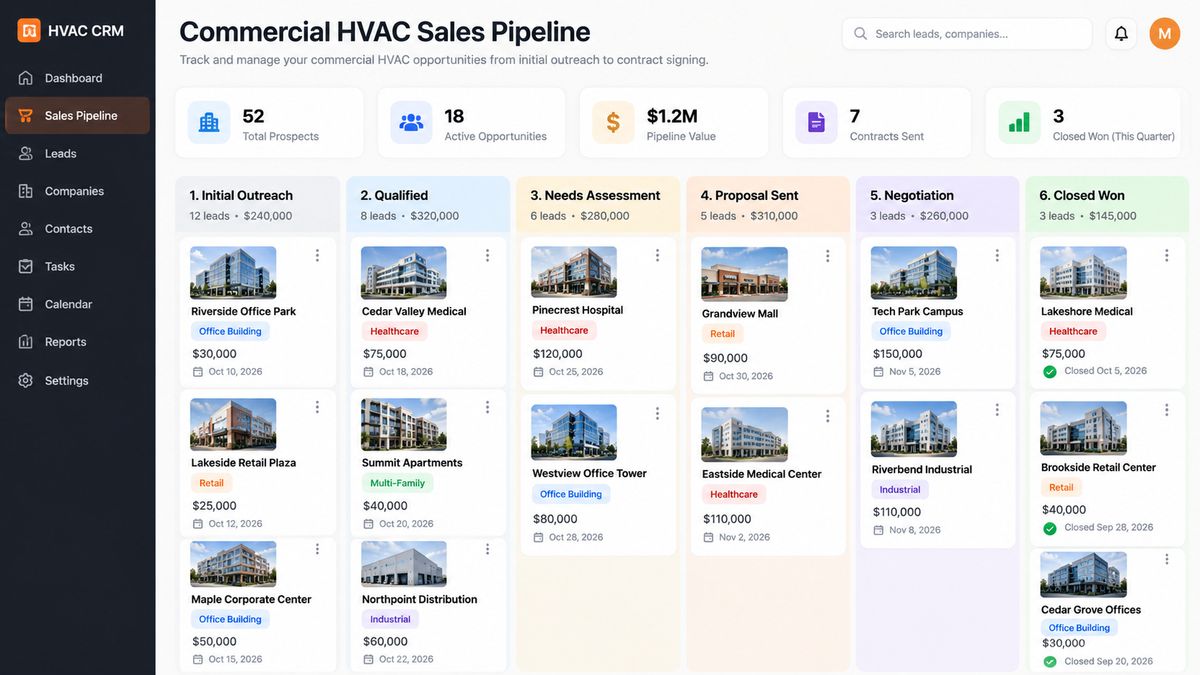
Follow-up can become difficult to manage when a sales team is handling many commercial prospects at different stages. Follow-up can become difficult to manage when a sales team is handling many commercial prospects at different stages. One prospect may need a follow-up call, another may be waiting on a proposal, while another may have a maintenance agreement coming up for renewal. Keeping track of all of that manually becomes harder when the team is busy.
Automation can handle parts of the follow-up process automatically. When a commercial prospect enters the CRM pipeline, a follow-up sequence starts automatically messages triggered at configured intervals, each referencing the specific property type and stage of the conversation, stopping automatically when the prospect responds or the contract is signed.
The same automation can track maintenance contract renewal dates for existing commercial clients and trigger re-engagement sequences ahead of renewal. This gives the contractor an opportunity to start the renewal conversation before it becomes urgent. Proactive renewal outreach gives the contractor an opportunity to start that conversation before the renewal becomes urgent.
Dormant commercial leads prospects who received a proposal and went quiet without a clear decision are reactivated through personalized outreach campaigns that reference the original conversation and ask whether the timing is better now. How FatCamel AI Helps HVAC Companies Win Commercial Contracts
FatCamel AI can support parts of the commercial HVAC sales process through LinkedIn prospecting, follow-up automation, and CRM workflows.
LinkeBuddy supports the LinkedIn outreach component of commercial business development helping configure connection sequences that reach facility managers and property management decision-makers directly, with messages built around the specific property type and relevant challenge rather than generic outreach.
Follow-up automation can help keep commercial prospects visible in the CRM and trigger relevant messages at the appropriate stage of the sales process. For a commercial deal with a 90-day decision timeline, automated follow-up ensures consistent, professional contact across every stage without requiring a dispatcher or sales lead to manually initiate each touchpoint.
For a commercial deal with a longer decision timeline, automated follow-up ensures consistent, professional contact across every stage without requiring a dispatcher or sales lead to manually initiate each touchpoint.
FatCamel has also used reactivation automation to help businesses reconnect with dormant contacts. The same approach can be relevant to HVAC companies that already have past leads, previous customers, or older commercial opportunities in their CRM.
👉 Book a Free Consultation with FatCamel AI
FAQ
1. How do I get commercial HVAC maintenance contracts?
Start by defining the property types and account sizes your business can serve profitably, then identify prospects through building permit records, property management company portfolios, LinkedIn outreach to facility managers, and referrals from general contractors.Reaching commercial decision-makers before the RFP stage can give contractors more time to build familiarity before a formal bid begins.
2. What's the difference between winning residential and commercial HVAC contracts?
Commercial maintenance decisions often take longer than residential service decisions because budgets, multiple stakeholders, procurement requirements, and existing vendor relationships may all be involved.
3. How do I find commercial HVAC prospects before they issue an RFP?
Commercial building permit records, property management company portfolios, LinkedIn outreach to facility managers and directors of property management, referral relationships with commercial general contractors, and expansion conversations with existing commercial clients are all sources of commercial HVAC opportunities before they reach the bidding stage. Relationship-building can create commercial opportunities before they reach the bidding stage, alongside opportunities found through formal bidding platforms.
4. How much is a commercial HVAC maintenance contract worth?
Contract values vary widely based on property size, equipment, number of locations, service frequency, response requirements, and the scope of coverage. A small single-site agreement will have very different economics from a multi-building portfolio. Recurring maintenance agreements can also create longer-term customer relationships when the service scope and renewal terms are clearly defined.
5. How long does it take to close a commercial HVAC contract?
The commercial HVAC sales cycle can take several months, depending on the account size, procurement process, budget cycle, and whether the prospect is replacing an existing vendor. Institutional buyers and publicly funded facilities often have formal procurement timelines that extend even longer. Consistent, professional follow-up through the full evaluation period is required to stay competitive through a decision process of this length.
6. How does FatCamel AI help HVAC companies win more commercial contracts?
FatCamel AI supports the commercial HVAC sales pipeline through LinkedIn prospecting automation via LinkeBuddy, multi-touch follow-up sequences for commercial prospects via the Lead Activation Engine, and CRM automation that tracks maintenance contract renewal dates and triggers proactive renewal outreach. These tools handle the consistent, time-sensitive follow-up that commercial HVAC sales requires without depending on a dispatcher or sales lead to manually initiate each touchpoint through a months-long decision cycle.
References
https://www.simprogroup.com/blog/how-to-win-commercial-hvac-maintenance-contracts
https://servicetrade.com/resources/guides/sell-hvac-service-contracts/
https://www.bluecorona.com/blog/commercial-hvac-leads-online/
https://www.bdrco.com/blog/hvac-service-agreements/
https://startbusinessbystate.com/how-to-get-commercial-hvac-maintenance-contracts/
https://rev-empire.com/blog/commercial-hvac-business-development/
https://oxmaint.com/industries/hvac/how-build-recurring-revenue-hvac-service-agreements