
LinkedIn gives commercial HVAC companies a direct way to reach facility managers, property management directors, and commercial real estate operators the decision-makers who award maintenance contracts. A three-touch connection sequence that leads with a relevant insight rather than a sales pitch tends to perform better than generic cold outreach for commercial HVAC prospecting, and it can run automatically once the sequences are configured.
Most HVAC businesses pursue commercial clients the same way they've always done it referrals, cold calls, and waiting for facility managers to find them on Google. Referrals are slow. Cold calls to facility directors get screened by front desks. And Google Ads for commercial HVAC keywords are competitive and expensive.
LinkedIn is different. Facility managers, property management directors, commercial real estate operators, and building owners are active on LinkedIn specifically for professional purposes. They're evaluating vendors. They're researching contractors. And a connection request from a credible commercial HVAC company that leads with something useful not "we'd love to earn your business" reaches them directly, without gatekeepers, at a fraction of the cost of paid advertising.
This guide covers exactly how to build and run that outreach.
Table of Contents
- Why LinkedIn Works for Commercial HVAC (And What Most Contractors Get Wrong)
- Who to Target: Building the Right Commercial HVAC Prospect List
- Optimizing Your LinkedIn Profile Before You Reach Out
- The Three-Touch LinkedIn Outreach Sequence for Commercial HVAC
- Automating Commercial HVAC LinkedIn Outreach With AI
- What Response Rates to Realistically Expect
- How FatCamel AI's LinkeBuddy Runs Commercial HVAC LinkedIn Outreach
- FAQ
Why LinkedIn Works for Commercial HVAC (And What Most Contractors Get Wrong)
The commercial HVAC sales cycle is long. A facility manager evaluating contractors for a multi-building maintenance agreement isn't making that decision after one cold call. They're researching over weeks or months, asking colleagues for referrals, and watching which contractors show up consistently and professionally in their professional sphere before they ever request a quote.
LinkedIn puts your business in that sphere. A contractor who appears in a facility manager's feed with relevant commercial HVAC content a post about reducing HVAC downtime in commercial buildings, a case study about a recent installation, a practical insight about commercial refrigerant compliance is building familiarity before any sales conversation begins. That familiarity is what makes the outreach message that follows feel like a natural continuation rather than a cold pitch.
What most HVAC contractors get wrong on LinkedIn is treating it like a broadcast channel. They set up a company page, post occasional service promotions, and wonder why nothing converts. LinkedIn's commercial value for HVAC comes from direct, one-to-one outreach from the business owner or sales lead not from company page posts.
A connection request from a person is fundamentally different from a company advertisement. Facility managers who would scroll past an HVAC ad will accept a connection from someone who references their specific building type, mentions a relevant pain point, and doesn't open with a price. That's the outreach model more likely to open a commercial HVAC conversation.
Who to Target: Building the Right Commercial HVAC Prospect List
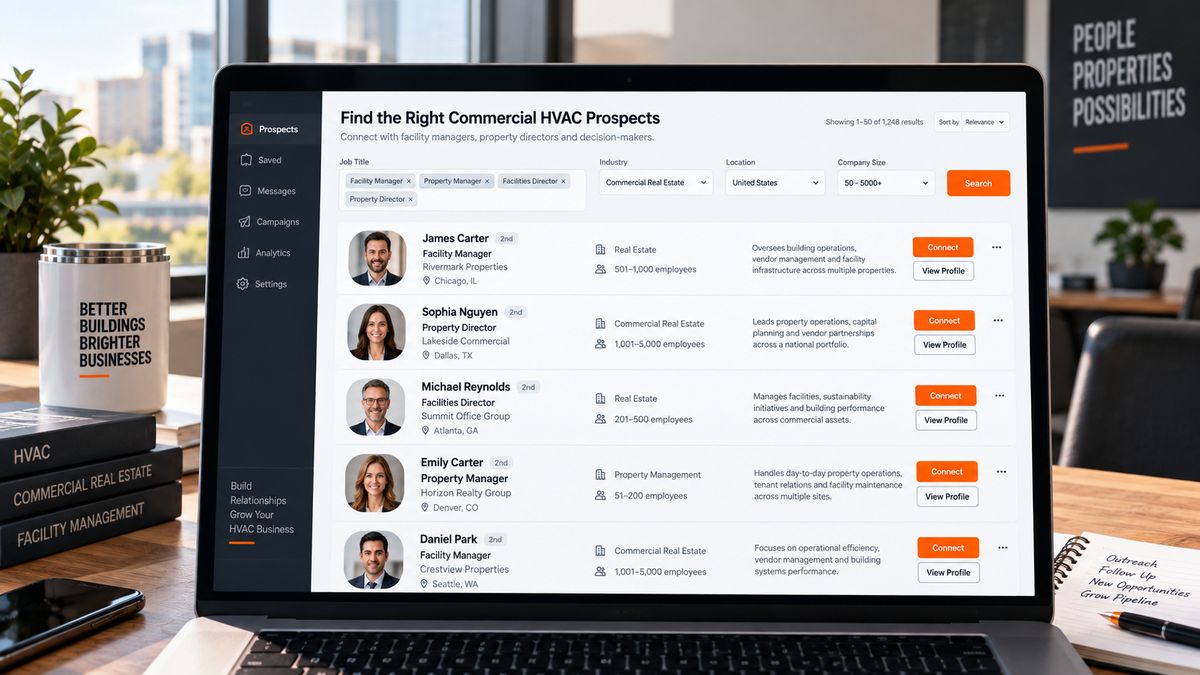
LinkedIn's search filters make it possible to build a precise prospect list of commercial decision-makers without any third-party data tool. The people who award commercial HVAC contracts hold predictable job titles.
Primary targets: Facilities Manager, Director of Facilities, VP of Facilities, Building Manager, Property Manager, Building Engineer, Director of Property Management, Commercial Real Estate Director, Asset Manager.
Secondary targets: Chief Operating Officer (for mid-sized commercial businesses where the COO handles facilities decisions), Office Manager (for smaller commercial tenants responsible for their own HVAC), General Manager (for hospitality and retail locations where the GM manages vendor relationships).
Filter by geography first your service area defines who's worth targeting. Then filter by industry. The commercial HVAC sectors with the highest contract values and longest client relationships are healthcare facilities, commercial real estate, hospitality (hotels and extended-stay properties), retail chains with multiple locations, and manufacturing or warehouse facilities with significant HVAC infrastructure.
A list of 200 qualified commercial prospects in a service area is enough to run a meaningful LinkedIn outreach campaign. This isn't a numbers game where more contacts automatically mean better results. A well-targeted list of 200 decision-makers at genuinely relevant commercial properties will consistently outperform a broad list of 1,000 loosely matched contacts.
Read More: How to Increase HVAC Lead Conversion Rate (From First Call to Booked Job)
Optimizing Your LinkedIn Profile Before You Reach Out
Before sending a single connection request, the profile needs to answer the question a facility manager asks when they receive a connection request from someone they don't know: "Why should I connect with this person?"
The profile headline should state specifically what the business does and who it serves. Not "Owner at ABC HVAC" something like "Commercial HVAC Contractor | Maintenance Agreements for Office Buildings, Healthcare, and Retail | [City/Region]." This tells the prospect immediately whether you're relevant to them before they click through to read anything else.
The About section should be written for a commercial client, not a residential homeowner. What types of commercial properties does the business serve? What size of maintenance agreement is the typical engagement? What does the business do differently from the three other HVAC contractors the facility manager has already contacted? One specific result "we reduced emergency call-outs by 40% for a 12-building commercial portfolio in [city]" is worth more than three paragraphs of generic service description.
Featured posts should include content that's relevant to commercial HVAC clients: a case study from a commercial installation, a post about refrigerant compliance changes affecting commercial buildings, a practical guide to commercial HVAC maintenance scheduling. This content library is what a facility manager looks through when they're deciding whether to accept a connection request and it's what determines whether the name means anything to them when the outreach sequence eventually reaches them.
The Three-Touch LinkedIn Outreach Sequence for Commercial HVAC
The sequence that works for commercial HVAC LinkedIn outreach is three touches over approximately ten days. More than three touches in a short window comes across as aggressive to professional buyers. Fewer than three means not enough contact to build familiarity before the conversation closes.
Touch 1 - Connection request (300 characters max)
The connection note should reference something specific about the prospect's company or role not a generic "I'd love to connect." Facility managers at commercial properties get enough connection requests from people who've read no further than their job title.
Example for a facilities director at a healthcare property:
"Hi [Name] saw you manage facilities at [Property/Company]. We work with several healthcare-adjacent commercial properties in [City] on HVAC maintenance and compliance. Would be good to connect with someone managing similar challenges."
The reference to their specific property type and a shared relevant challenge (compliance) distinguishes this from a mass outreach message. It's short, specific, and doesn't ask for anything except the connection.
Touch 2 - Follow-up message after connection (sent 3-4 days after acceptance)
This message adds value rather than opening a sales pitch. A relevant insight, a link to a useful resource, or a question that demonstrates genuine familiarity with their likely situation.
Example:
"Thanks for connecting, [Name]. We've been doing a lot of commercial maintenance work this year and noticed a pattern facilities teams managing multiple properties often spend significantly more on reactive emergency calls than planned maintenance would cost. We put together a short framework for calculating the breakeven point. Happy to share if it's useful, or just a good connection to have either way."
This message establishes expertise without claiming anything, offers something genuinely useful, and ends with a low-pressure framing. The goal is a reply, not a meeting at this stage, any response opens the conversation.
Touch 3 - Final message (sent 6-7 days after Touch 2, regardless of response)
The closing touch should be short, acknowledge the one-sided nature of the outreach so far, and make it easy to either engage or close the loop.
Example:
"[Name] one final note. If planned HVAC maintenance for [Company/Property] isn't a current priority, no problem at all. If it is or if it comes up in the next few months I'm happy to walk through what a maintenance agreement typically covers for a property like yours, no commitment needed. Either way, good to have you in the network."
The phrase "no commitment needed" is important. Commercial facility managers have been burned by vendors who treat a 30-minute conversation as an implicit agreement to proceed. Making the low-stakes nature explicit reduces the friction to saying yes to a conversation.
Read More:AI Voice Agent for HVAC Companies: Features, Pricing & Benefits
Automating Commercial HVAC LinkedIn Outreach With AI
Running a LinkedIn outreach campaign manually across 200 contacts tracking who's been sent what message, when to send the next touch, who's responded is a full-time job in itself. For an HVAC business owner or sales lead already managing active operations, it doesn't get done consistently. The campaign starts strong, slows down when things get busy, and produces inconsistent results because the follow-through is inconsistent.
AI-powered LinkedIn outreach automation handles the sequencing, timing, and tracking automatically. Connection requests go out on schedule. Follow-up messages send at the configured intervals for contacts who accepted but haven't responded. The sequence stops automatically the moment a prospect replies so warm conversations are never accidentally sent another automated message. And the pipeline of new prospects entering the sequence each week keeps the outreach running as a continuous background activity rather than a sporadic campaign.
The key to automation that doesn't feel automated is personalization at scale. An outreach sequence that references the prospect's specific industry, property type, and relevant challenge pulled from the contact data in the CRM or prospect list reads as a thoughtful individual message even when it's part of a larger automated campaign. Generic automation tends to produce generic response rates. Personalized automation gives each message a better chance of opening a real commercial conversation.
What Response Rates to Realistically Expect
LinkedIn outreach for commercial HVAC isn't a high-volume numbers game. The expectation should be calibrated for a long sales cycle where each booked meeting represents significant potential contract value.
Response rates for LinkedIn outreach vary significantly depending on targeting quality, message relevance, and how well the sender's profile is optimized for a commercial audience. Well-targeted outreach with a specific connection note and a credible profile performs meaningfully better than generic mass campaigns but there's no universal benchmark, and results depend heavily on the service area, industry vertical, and how the messages are written.
What's consistent across most B2B outreach on LinkedIn: tighter targeting tends to outperform broader lists, personalized messages tend to outperform templates, and a credible profile that speaks to commercial clients makes every message land better. A list of 200 well-filtered decision-makers is a reasonable starting point to run a first campaign and calibrate expectations for a specific market.
The variables worth tracking: connection acceptance rate, reply rate per touch, and ultimately how many conversations progress to a site visit or quote request. Commercial HVAC contracts can represent significant recurring revenue so even a modest number of converted conversations from a well-run campaign can justify the investment. Seasonality matters too budget cycles vary by industry and organization, so testing timing across different periods often reveals when a specific target audience is most receptive.
Read More:How to Choose the Best HVAC Automation Agency (+ Real Costs, ROI & Case Studies)
How FatCamel AI's LinkeBuddy Runs Commercial HVAC LinkedIn Outreach
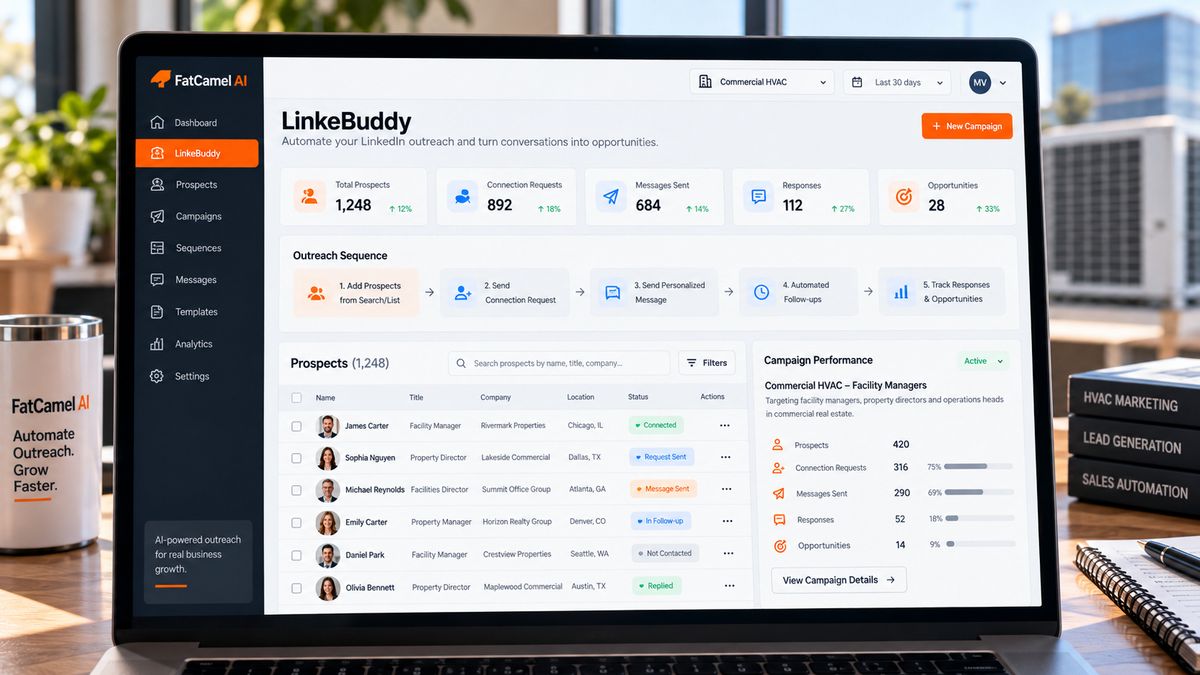
FatCamel AI's LinkeBuddy is designed to support commercial LinkedIn outreach for contractors helping with sequence configuration, automated sending, and response tracking so the business owner or sales lead doesn't have to manually manage each touch.
The process starts with building the target list: facility managers, property directors, and commercial decision-makers in the HVAC company's service area and target industry verticals. LinkeBuddy configures the three-touch sequence with personalization fields that reference each prospect's specific property type and relevant challenge, making the outreach feel specific rather than automated. The sequence runs automatically connection requests go out on the configured schedule, follow-up messages send at the right intervals, and warm responses are flagged immediately for personal follow-up by the sales team.
Because LinkeBuddy connects to the broader FatCamel automation stack, commercial leads that progress from LinkedIn conversation to site visit enter the same CRM pipeline managed by the Lead Activation Engine with follow-up sequences, estimate tracking, and contract renewal reminders running automatically throughout the relationship lifecycle. The LinkedIn outreach generates the commercial conversation. The automation stack manages the relationship through close and beyond.
For HVAC businesses with strong residential operations that want to build a commercial pipeline without hiring a dedicated business development resource, this is the practical mechanism automated, consistent, and built around the commercial HVAC decision-maker's actual communication preferences.
👉 Book a Free Consultation with FatCamel AI
FAQ
1. Does LinkedIn actually work for commercial HVAC lead generation?
Yes but only when used correctly. LinkedIn's value for commercial HVAC isn't in company page posts or ads. It's in direct one-to-one outreach from the business owner or sales lead to facility managers, property directors, and commercial decision-makers who are active on LinkedIn for professional networking. A three-touch sequence from a credible commercial HVAC profile that leads with a relevant insight not a sales pitch tends to open commercial conversations that are harder to start through cold calling alone.
2. Who should an HVAC company target on LinkedIn for commercial contracts?
The highest-value targets for commercial HVAC LinkedIn outreach are Facilities Manager, Director of Facilities, Property Manager, Building Manager, and VP of Facilities at commercial real estate companies, healthcare facilities, hospitality groups, retail chains with multiple locations, and manufacturing or warehouse operators. These are the people with budget authority over HVAC maintenance contracts. Filter by geography first your service area then by industry to match the commercial verticals where your business has the strongest case studies.
3. What should a commercial HVAC LinkedIn connection message say?
The connection note should be under 300 characters and reference something specific about the prospect's company or property type not a generic "I'd love to connect." A note that mentions their specific industry and a relevant challenge ("we work with several healthcare-adjacent commercial properties on HVAC compliance") distinguishes outreach from a mass campaign. The goal of the connection note is only to get the connection accepted the value proposition comes in the follow-up messages after acceptance.
4. How many LinkedIn touches should a commercial HVAC outreach sequence have?
A practical starting framework for commercial HVAC outreach is three touches over approximately ten days. Touch one is the connection request note. Touch two, sent three to four days after acceptance, adds a relevant insight or offers a useful resource. Touch three, sent six to seven days after touch two, is a short closing message that makes it easy to either engage or close the loop without pressure. Too many touches in a short window can come across as aggressive to professional buyers but the right cadence will vary depending on the audience and how the earlier messages land.
5. How does FatCamel AI automate commercial HVAC LinkedIn outreach?
FatCamel AI's LinkeBuddy builds the commercial prospect list, configures the three-touch sequence with personalization fields referencing each prospect's specific industry and property type, sends connection requests and follow-up messages on the configured schedule, stops the sequence automatically when a prospect replies, and escalates warm responses to the sales team immediately. Because LinkeBuddy connects to the broader FatCamel automation stack, commercial leads that progress to site visits enter the same CRM pipeline with follow-up, estimate tracking, and contract renewal automation running throughout the relationship.
References
https://origami.chat/blog/linkedin-outreach-hvac-company-owners-revenue-2026
https://firstsales.io/sales-guide/hvac-linkedin-outreach/
https://hookagency.com/blog/linkedin-marketing-for-home-service-businesses/
https://builtrightdigital.com/hvac-linkedin-ads/
https://www.callrail.com/blog/missed-calls-stats
https://www.simprogroup.com/blog/ai-hvac
https://www.fatcamel.ai/services/crm-automation
https://www.fatcamel.ai/