
There are two ways to get painting clients in 2026. The first is to chase them. Cold calls, door knocking, undercutting competitors on price, and hoping referrals come in. It works just enough to stay busy but never enough to build something predictable.
The second way is to attract them. Show up where your ideal clients are spending their professional time. Post content that speaks directly to their problems. Reach out in a way that feels relevant rather than intrusive. Build familiarity before you ask for anything. And do all of it consistently, whether your team is on a job site or not.
The second approach is what this guide is about. And in 2026, it will be more accessible than it has ever been because AI handles the heavy lifting that used to require a full marketing and sales team.
The combination of AI-generated content and automated LinkedIn outreach gives painting businesses a system that builds authority, generates commercial leads, and books meetings without constant manual effort from the business owner. This guide breaks down exactly how that system works and how to build it for your painting business.
Table of Contents
Why Content and Outreach Work Better Together
The Role of LinkedIn in a Painting Business Content Strategy
What AI Content Actually Means for a Painting Business
Building a Content Strategy That Attracts Commercial Clients
The AI Content Creation System for Painting Businesses
Automated LinkedIn Outreach: How It Connects to Your Content
The Full Content and Outreach Funnel Explained
Turning Content Engagement Into Booked Meetings
How FatCamel AI Runs the Full System
What to Do First
FAQ
References
Why Content and Outreach Work Better Together
Most painting businesses treat content and outreach as separate activities. They post occasionally on social media and separately try to reach out to potential clients through calls or emails. The two never connect. The content does not support the outreach. The outreach does not benefit from the content. Both produce weaker results than they should.
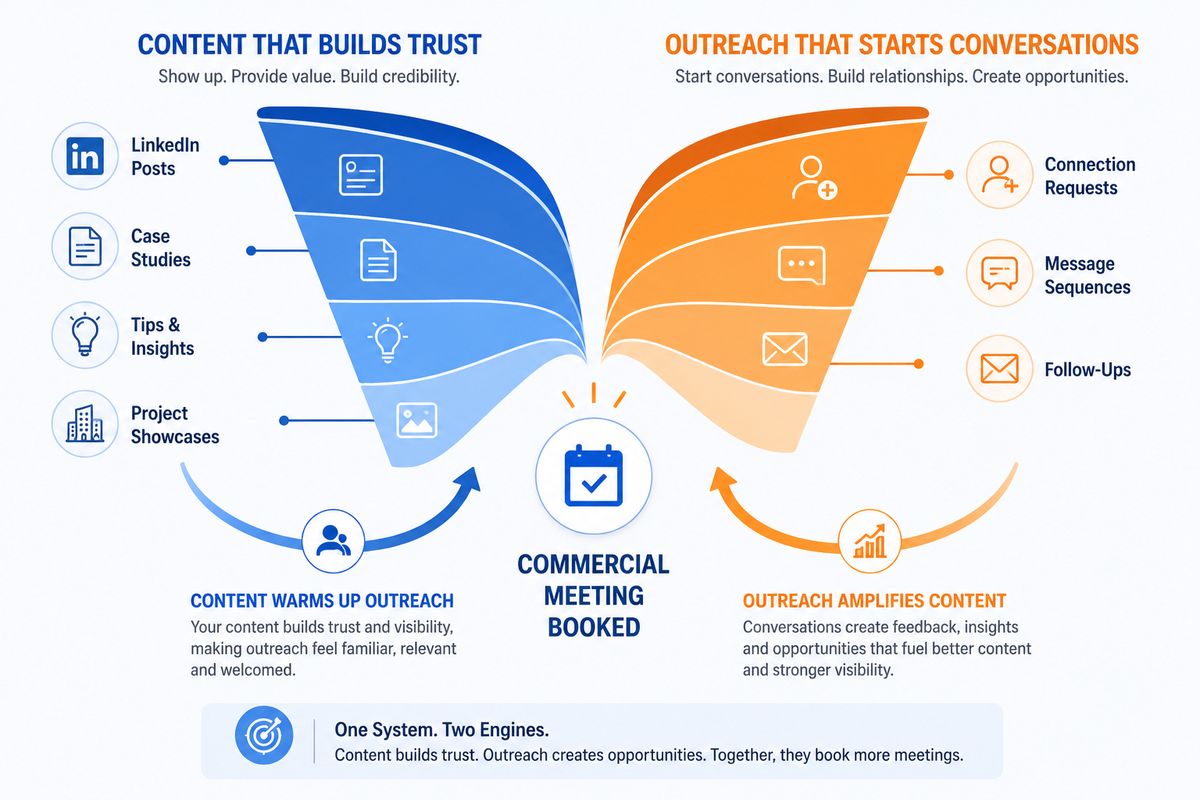
When content and outreach are built as a single integrated system, everything changes.
Your content does the warming up. A property manager sees your LinkedIn post about planning commercial repaints around tenant schedules. They see another post about the cost of delaying exterior maintenance. They see a before and after from a commercial office building job. By the time your connection request arrives, they already have a sense of who you are and what you do. You are not a cold stranger. You are a painting professional whose content they have seen before.
Your outreach does the converting. Once familiarity is established through content, a well-timed outreach message moves the relationship toward a conversation. The message lands differently because the groundwork has already been laid. Response rates are higher. Conversations are warmer. Meetings are easier to book.
Content without outreach builds an audience that never converts. Outreach without content hits cold contacts with no context. Together, they create a system where every piece of content strengthens every outreach message, and every outreach conversation extends the reach of your content.
Read More: Why Social Media Doesn't Work for Painters (And How to Fix It)
The Role of LinkedIn in a Painting Business Content Strategy
Every social platform has a different audience and a different content behavior. Instagram rewards visual entertainment. Facebook rewards community engagement. TikTok rewards viral short-form video. LinkedIn rewards professional insight and industry expertise.
For a painting business targeting commercial clients, LinkedIn is the only platform where content and outreach can work together in the way this guide describes. Here is why.
The audience is your buyer. Property managers, facility directors, asset managers, and commercial real estate professionals are active on LinkedIn in a professional mindset. When they see your content, they are thinking about their buildings, their vendors, and their operational challenges. They are primed to recognize relevance in a way they never would be scrolling Instagram for entertainment.
Content and outreach happen in the same space. On LinkedIn, the same person who sees your post in their feed can receive your connection request and read your outreach message without leaving the platform. The transition from content viewer to direct conversation happens naturally and without friction.
Professional credibility compounds. Every post you publish, every comment you leave, every connection you make adds to a professional profile that becomes more credible over time. A property manager who visits your LinkedIn profile six months from now will see a consistent record of commercial painting expertise. That credibility is built post by post, and it does not disappear when you stop paying for an ad.
The channel is uncontested. Almost no painting businesses have a content and outreach strategy on LinkedIn. The ones who build one now will have an authority position in their market that latecomers will find very difficult to displace.
What AI Content Actually Means for a Painting Business
When most people hear AI content, they think of generic, robotic text that reads like it was written by a machine. That is not what this guide is describing. Done correctly, AI content for a painting business is specific, relevant, and written in a voice that reflects the business and speaks directly to the commercial audience it is targeting.
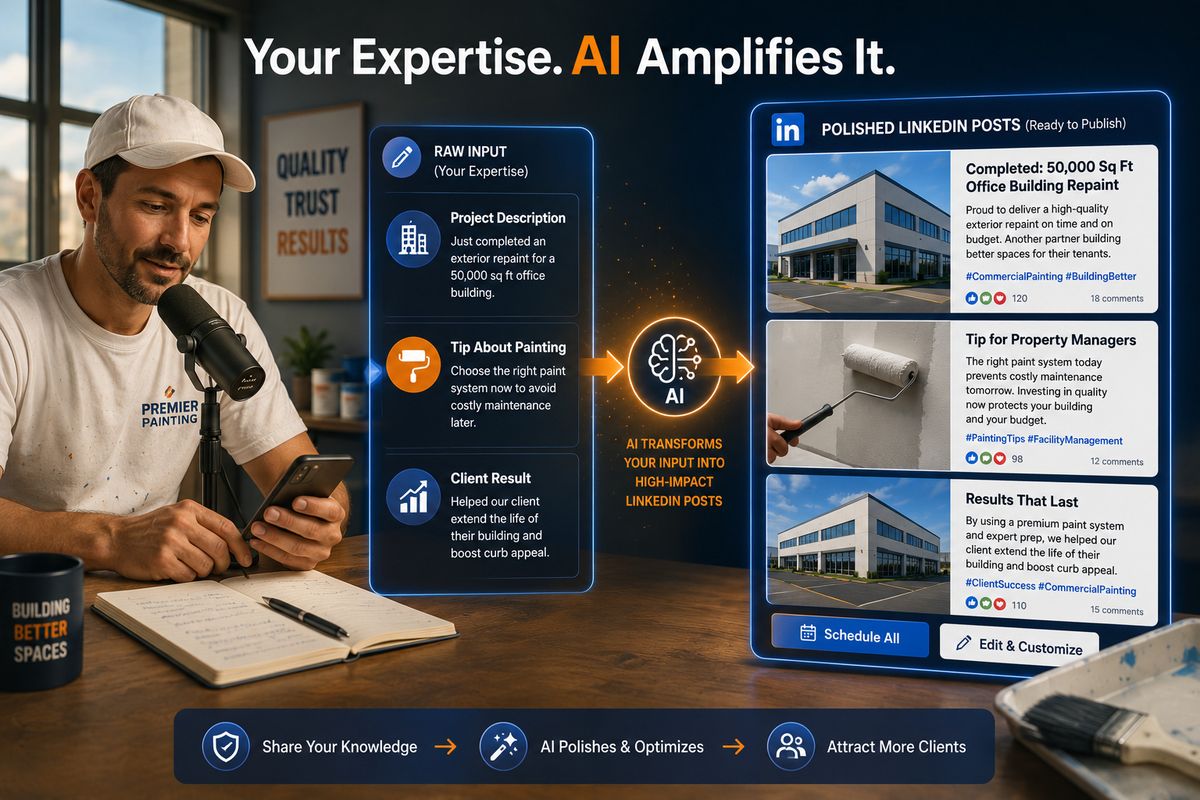
AI content means using AI tools to handle the parts of content creation that slow most painting business owners down: coming up with ideas, structuring posts, writing first drafts, and maintaining consistency week after week. The business owner provides the expertise, the industry knowledge, and the real-world experience. The AI turns that input into polished, publishable content without the hours of writing and editing that would otherwise be required.
For a painting business, AI content typically covers:
LinkedIn posts written around topics that matter to commercial property decision makers. Tips, insights, project showcases, industry observations, and case studies. Two to four posts per week, consistently published.
Outreach message sequences that sound professional and personal without anyone spending hours crafting individual messages for each prospect.
Follow-up messages that continue conversations intelligently based on where each prospect is in the sequence.
Email content for nurturing leads who are not yet ready to book a meeting but need to stay engaged with the business over time.
The common thread is that AI handles the production work. Your business provides the substance. The output is content that represents your expertise accurately and consistently without consuming your entire week.
Read More: AI Systems to Get Repeat Painting Jobs Automatically
Building a Content Strategy That Attracts Commercial Clients
A content strategy for attracting commercial painting clients is not about posting whatever comes to mind. It is about consistently publishing content that answers the questions your ideal clients are asking and positions your business as the obvious choice when they are ready to hire.
Here is the content framework that works for painting businesses targeting commercial clients on LinkedIn.
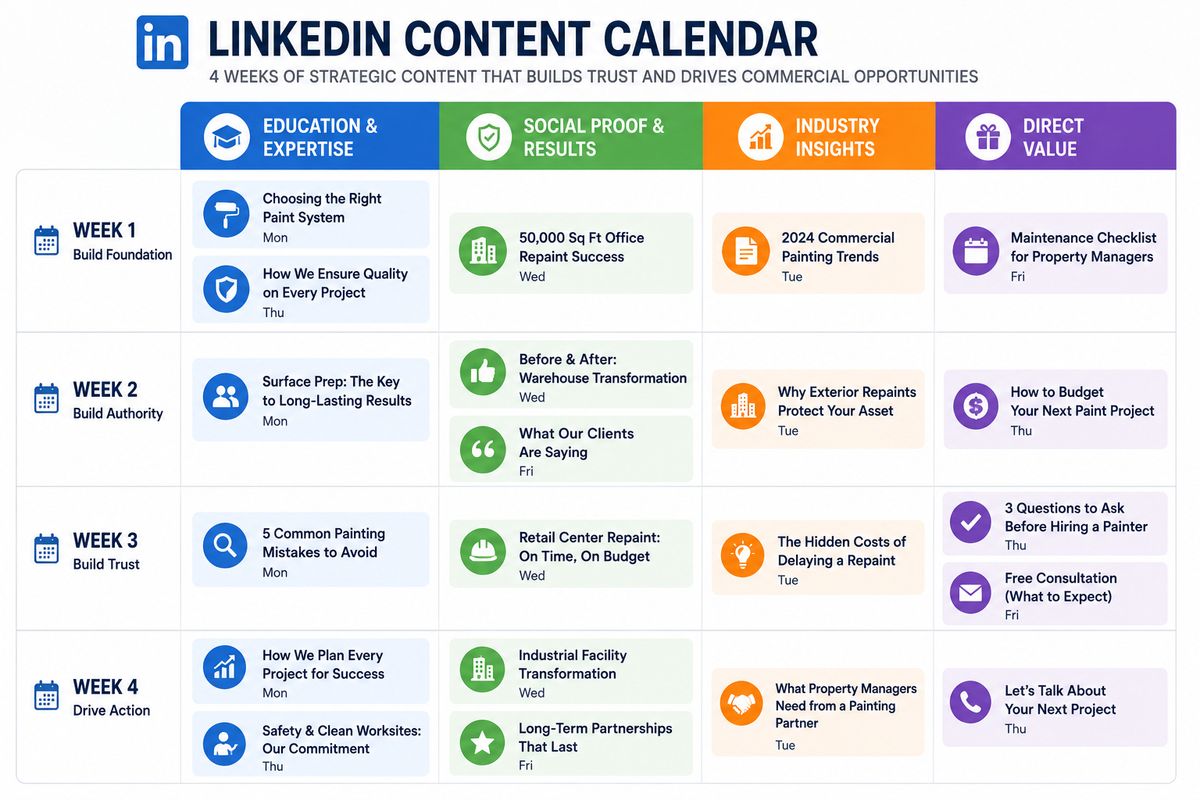
Content pillar 1: Education and expertise
Posts that teach property managers and facility directors useful insights into commercial painting. How to plan a repaint around tenant schedules without disrupting operations. What coating types work best for high-traffic commercial interiors? The difference between a three-year and a seven-year exterior paint lifespan and what drives it. How to evaluate a painting quote and know if it is realistic.
This type of content builds authority. When a property manager reads your post and learns something they did not know, you become the painting contractor who knows their business. That is a position no competitor can take from you without building their own content.
Content pillar 2: Social proof and results
Before-and-after posts from commercial jobs. Not just photos, but the story. The building, the challenge, the timeline, the result. Property managers respond to evidence that you have done this type of work before and done it well. A case study from a commercial office building repaint that was completed on schedule without disrupting tenants is worth more to a facility director than any sales message you could write.
Content pillar 3: Industry insights and observations
Commentary on trends and developments in commercial property maintenance. How rising material costs are affecting repaint timing decisions. What the shift to hybrid work has meant for office building maintenance schedules. How sustainability requirements are changing coating specifications in commercial construction. These posts demonstrate that you understand the broader world your clients operate in, not just the painting trade.
Content pillar 4: Direct value for your target audience
Posts specifically addressed to property managers, facility directors, or commercial real estate professionals. Checklists, frameworks, and practical tools they can use. A five-point checklist for evaluating whether a commercial building exterior needs repainting this season. A framework for budgeting annual painting maintenance across a property portfolio. This content gets saved, shared, and remembered.
Rotating through these four content pillars consistently produces a LinkedIn profile that commercial decision makers find genuinely useful. And a profile they find useful is one they follow, engage with, and eventually reach out to or respond to when you make contact.
Read More: How to Increase Conversion Rate for Painting Leads Using AI
The AI Content Creation System for Painting Businesses
Knowing what to post is one challenge. Actually producing it consistently is another. Most painting business owners start a content strategy with good intentions and abandon it within three weeks because the content creation itself becomes another job on top of an already full schedule.
AI solves the production problem. Here is how a systematic AI content creation process works for a painting business.
Step 1: Input collection
Once a week, the business owner or a team member answers five to ten simple questions about recent work, observations, and ideas. What job did you complete this week? What challenge did the client have? What did you learn? What would you tell a property manager who asked about this topic? What mistake do you see other contractors make? These inputs take ten to fifteen minutes to provide and contain all the raw material the AI needs.
Step 2: AI drafting
The AI takes those inputs and drafts a week's worth of LinkedIn posts across the four content pillars. Each post is written in the voice and style defined for the business. Each one is specific to the painting industry and the commercial client audience. None of them read like generic AI content because they are built from real, specific inputs about real work.
Step 3: Review and approval
The business owner or a team member reviews the drafts, makes any adjustments, and approves them. This takes twenty to thirty minutes per week rather than the two to three hours that writing from scratch would require.
Step 4: Scheduled publishing
Approved posts are scheduled to publish automatically across the week at the optimal times for LinkedIn engagement. No one needs to remember to post. The content goes out consistently whether the team is on a job site or not.
The result is a painting business with a consistent, high-quality LinkedIn presence that builds authority with commercial clients week after week without the content creation becoming a burden on the team.
Automated LinkedIn Outreach: How It Connects to Your Content
Content builds the audience. Outreach converts it. The two work together through a simple but powerful mechanism: people who have seen your content are far more receptive to your outreach than people who have never heard of you.
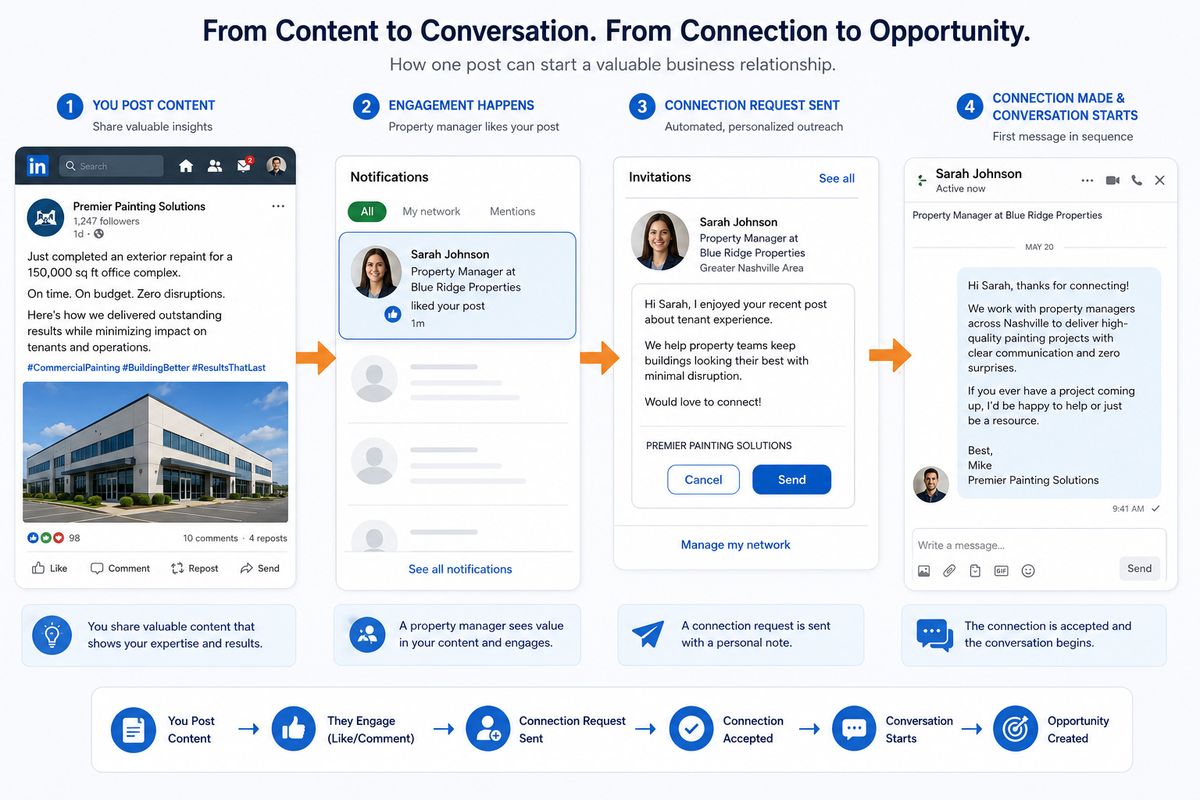
Here is how the automated outreach system connects to your content strategy.
Daily ICP engagement
Every day, the system identifies posts from your ideal commercial clients on LinkedIn and engages with their content automatically. When a property manager in your area posts about a maintenance challenge, your account likes and comments on that post. This puts your name in their notifications and starts building familiarity before any direct outreach begins.
Targeted connection requests
After several days of engagement with a profile, a personalized connection request goes out. The request references something specific about their role or industry. Because they have seen your content and your name in their notifications, the acceptance rate is significantly higher than a cold request from an unknown account.
Outreach sequence after connection
Once a connection is accepted, an automated message sequence begins. The sequence is built around the content pillars: it adds value, references relevant insights, and moves gradually toward asking for a meeting. Each message is personalized using real data from the prospect's profile.
Content-informed personalization
The outreach messages reference the content themes that are most relevant to each prospect. A message to a facility manager at a hospital references different content angles than a message to an asset manager at a commercial real estate firm. The AI tailors the outreach to each audience segment based on their professional context.
Read More: Why Your Painting Business Is Losing Jobs - And How AI Fixes the Lead Leakage Problem
The Full Content and Outreach Funnel Explained
When content and outreach run as a connected system, every commercial client goes through the same journey from stranger to booked meeting. Here is the full funnel from start to finish.
Stage 1: Awareness through content
A property manager in your target area sees one of your LinkedIn posts in their feed. It might be a tip about planning commercial repaints, a before-and-after from a relevant project, or an insight about exterior coating longevity. They do not take any action. They scroll past. But they have seen your name and your content for the first time.
Stage 2: Familiarity through repeated exposure
Over the following weeks, the same property manager sees more of your content in their feed. They also notice that your account has liked a couple of their posts. Your name is becoming familiar without any direct contact having been made.
Stage 3: Connection
A personalized connection request arrives from your account. Because your name is already familiar, the acceptance rate is high. They accept. You are now directly connected.
Stage 4: Outreach sequence
The first message in your outreach sequence goes out. It is warm, specific, and references something relevant to their role. It does not pitch. It opens a conversation. Over the following weeks, additional messages go out, each one adding value and moving the relationship forward.
Stage 5: Meeting booking
At the right point in the sequence, a soft ask for a meeting goes out. Because the relationship has been built through content and a gradual outreach sequence, the response rate is significantly higher than cold outreach. The prospect agrees to a call. The booking link goes out automatically. The meeting is confirmed.
Stage 6: Sales conversation and conversion
Your sales team shows up to a call with a prospect who already knows your name, has seen your work, and has had a warm introduction through the outreach sequence. The conversation starts in a completely different place than a cold call. Conversion rates are higher. Deal cycles are shorter.
Stage 7: Long-term nurture for non-converters
Prospects who are not ready to book a meeting enter a longer-term nurture track. Your content continues to build familiarity. A light-touch follow-up sequence keeps the door open. When their timing changes, your business is the first one they think of.
Turning Content Engagement Into Booked Meetings
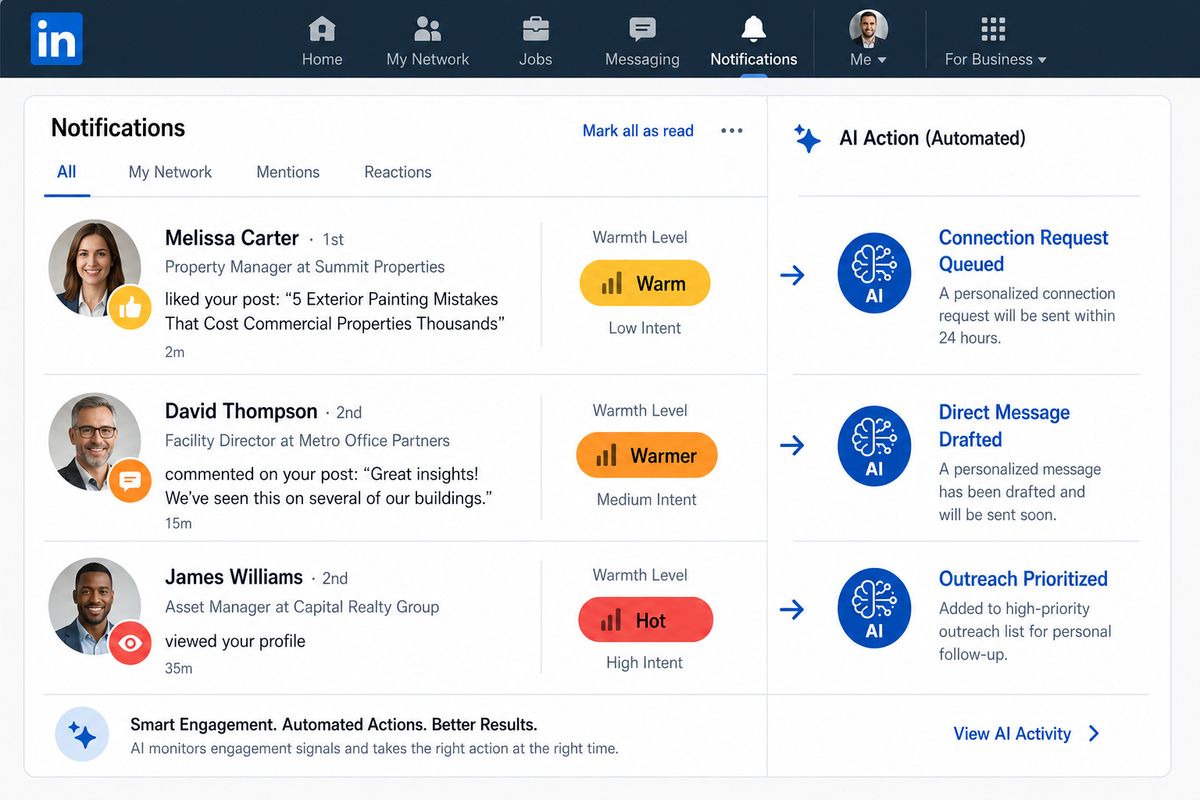
One of the most powerful but underused features of a LinkedIn content and outreach system is the ability to identify and act on engagement signals in real time.
When a property manager likes your post, that is a warm signal. They found your content relevant enough to engage with. When someone comments on your post, that is a very warm signal. They are actively engaged with what you are saying.
Most painting businesses see these engagement signals and do nothing with them. The AI outreach system uses them as triggers.
Like on your post: The account that liked your post is flagged as a warm prospect. If they are within your ICP, they move to the front of the connection request queue with a message that specifically references the post they engaged with.
Comment on your post: A comment triggers an even more personalized response. The AI acknowledges the comment and moves the conversation toward a direct message exchange, which is a natural and non-intrusive way to deepen the relationship.
Profile view after your post: When someone views your profile after seeing your content, it is a clear signal of interest. The system identifies these profile viewers and prioritizes them for outreach.
By treating every content engagement as a potential outreach opportunity, the system converts passive content viewers into active outreach conversations with a level of personalization and relevance that generic cold outreach can never match.
How FatCamel AI Runs the Full System
The content strategy, the AI drafting process, the engagement monitoring, the connection requests, the outreach sequences, the meeting booking, and the CRM logging all need to work together as a single system to produce the results described in this guide. Managing all of those pieces manually or across multiple disconnected tools defeats the purpose.
FatCamel AI is built to run the complete AI content and outreach system for painting businesses, connecting every stage from content creation through to booked commercial meetings in one unified platform designed specifically for trade contractors.
Here is what FatCamel AI manages across the full system:
AI content creation and scheduling. FatCamel AI takes your weekly inputs and produces a full week of LinkedIn content across the four content pillars. Posts are written in your voice, specific to your commercial audience, and scheduled to publish automatically at the optimal times. Your LinkedIn profile stays active and authoritative without your team managing it.
ICP identification and engagement. FatCamel AI identifies your ideal commercial clients on LinkedIn daily and engages with their content automatically. Property managers, facility directors, and asset managers in your target market see your name consistently before you ever make direct contact.
Engagement signal monitoring. FatCamel AI tracks who is engaging with your content and flags warm prospects for prioritized outreach. Likes, comments, and profile views from ICP profiles trigger automatic actions that capitalize on the interest while it is fresh.
Personalized connection requests. FatCamel AI sends targeted, personalized connection requests to your ICP list on a consistent daily schedule, managing volume to stay within LinkedIn's acceptable usage guidelines.
Automated outreach sequences. Once connections are accepted, FatCamel AI manages the full message sequence, personalizing each message using the prospect's profile data and adjusting the content angle based on their industry and role.
Meeting booking and CRM entry. When a prospect shows interest in a meeting, FatCamel AI sends the booking link, confirms the appointment, and creates the CRM entry with full conversation history attached. Your sales team receives a notification with everything they need to walk into the call prepared.
Performance reporting. A live FatCamel AI dashboard shows content performance, outreach activity, engagement rates, meeting bookings, and pipeline value generated from the LinkedIn system. You always know exactly what the system is producing.
FatCamel AI does not require your team to manage the system day to day. It is configured for your painting business, your target market, and your commercial client profile, and then it runs continuously in the background, generating commercial leads and booking meetings while your team focuses on painting.
👉 See how FatCamel AI builds your commercial pipeline through content and outreach
What to Do First
The system described in this guide is comprehensive. Building all of it at once is not realistic for most painting business owners. Here is the sequence that produces results fastest.
Week 1: Fix your LinkedIn profile. Update your headline, about section, and featured section to speak directly to commercial painting clients. Add project photos from commercial jobs. Make sure your profile communicates clearly what you do and who you do it for.
Week 2: Start your content engine. Define your four content pillars for your specific market. Publish your first two posts. Begin engaging manually with the property manager and facility director content in your area for ten minutes each morning.
Week 3: Launch targeted outreach. Start sending ten to fifteen personalized connection requests per day to ICP profiles in your target market. Set up your initial outreach sequence for new connections.
Week 4: Automate the system. Bring FatCamel AI in to automate the content scheduling, daily engagement, connection requests, outreach sequences, and meeting booking. What you have been doing manually for three weeks now runs automatically.
From week four onwards, the system runs in the background. Your team focuses on painting. FatCamel AI handles the content and outreach. Commercial meetings come in consistently.
The painting contractors who start this process today will have a LinkedIn presence, a growing network of commercial decision makers, and a content library that builds authority month after month. The ones who wait six months will be starting from scratch in a market where the early movers have already established themselves.
The window is open right now. The question is whether you walk through it.
FAQ
1. What is AI content marketing for painting contractors?
AI content marketing for painting contractors means using AI tools to consistently create and publish content that attracts commercial clients, particularly on LinkedIn. The AI handles the production work, turning your expertise and real project experience into polished posts, case studies, and insights that build authority with property managers and facility directors without consuming your team's time.
2. How does automated outreach work alongside content on LinkedIn?
Automated outreach uses the familiarity built by your content to increase the effectiveness of every direct contact you make. Prospects who have seen your posts are more likely to accept connection requests and respond to outreach messages because they already have a sense of who you are. The outreach system runs automatically in the background, connecting with ICP profiles, running message sequences, and booking meetings while your content builds the warm audience that makes all of it work better.
3. What type of content works best for generating painting leads on LinkedIn?
The most effective content for generating commercial painting leads on LinkedIn falls into four categories: educational posts that teach property managers something useful about commercial painting, social proof posts showing real commercial project results, industry insight posts that demonstrate you understand the broader property management world, and direct value posts like checklists and frameworks specifically for commercial property decision makers.
4. How many LinkedIn posts should a painting business publish per week?
Two to four posts per week is the optimal range for building consistent visibility on LinkedIn without overwhelming your audience or making content creation unsustainable. Consistency matters more than volume. Two high-quality posts per week published consistently for six months will outperform five posts per week published for three weeks and then abandoned.
5. How long does it take for AI content and outreach to generate painting leads?
Most painting businesses start seeing LinkedIn engagement, profile visits, and connection acceptances within the first two weeks of launching the system. Outreach replies and meeting bookings typically start coming in during weeks three to six. The system compounds over time, so the results in month six are significantly stronger than the results in month one as your network grows and your content builds authority.
6. Can a small painting business afford AI content and outreach automation?
Yes. The cost of AI content and outreach automation is significantly lower than the alternative, which is either hiring a marketing and sales team or missing out on the commercial leads the system generates. Most small painting businesses see a positive return on investment within the first 60 to 90 days as the booked meetings from the system convert into commercial jobs.
7. How does FatCamel AI differ from hiring a marketing agency for a painting business?
A marketing agency typically manages your social media presence and runs paid advertising campaigns. FatCamel AI runs a fully automated content and outreach system that directly generates commercial leads and books meetings. The difference is between brand awareness activities that may or may not convert and a pipeline generation system that produces measurable commercial opportunities. FatCamel AI is also built specifically for trade contractors, which means the targeting, messaging, and content are designed for your specific market rather than adapted from a general marketing template.
References
https://business.linkedin.com/sales-solutions/sales-navigator
https://www.linkedin.com/business/marketing-solutions/blog/linkedin-b2b-marketing
https://www.hubspot.com/marketing-statistics
https://www.salesforce.com/research
https://www.forbes.com/business-council
https://www.paintcontractormag.com