
Running an HVAC business in 2026 means managing more complexity with the same or fewer people. Calls coming in after hours, leads that need five follow-ups before they book, estimates that go out and never get chased, CRM records that are always two days behind reality. Every one of these is a task that either costs revenue when it fails or costs staff time when it's done manually. Most of them can be automated.
This guide covers 15 specific HVAC tasks that AI handles better than a manual process what each one does, what it's worth to the business, and what the fix actually looks like in practice.
Table of Contents
Task 1: After-Hours Call Answering
Task 2: Lead Qualification
Task 3: Appointment Booking and Confirmation
Task 4: Lead Follow-Up Sequences
Task 5: Estimate Follow-Up
Task 6: Dispatch and Scheduling
Task 7: Route Optimization
Task 8: CRM Data Entry and Logging
Task 9: Dormant Lead Reactivation
Task 10: Maintenance Agreement Reminders
Task 11: Invoice Generation and Follow-Up
Task 12: Post-Job Customer Communication
Task 13: Review Requests
Task 14: Commercial Outreach Sequences
Task 15: Reporting and Pipeline Visibility
How FatCamel AI Automates the Full HVAC Business
FAQ
References
Task 1: After-Hours Call Answering
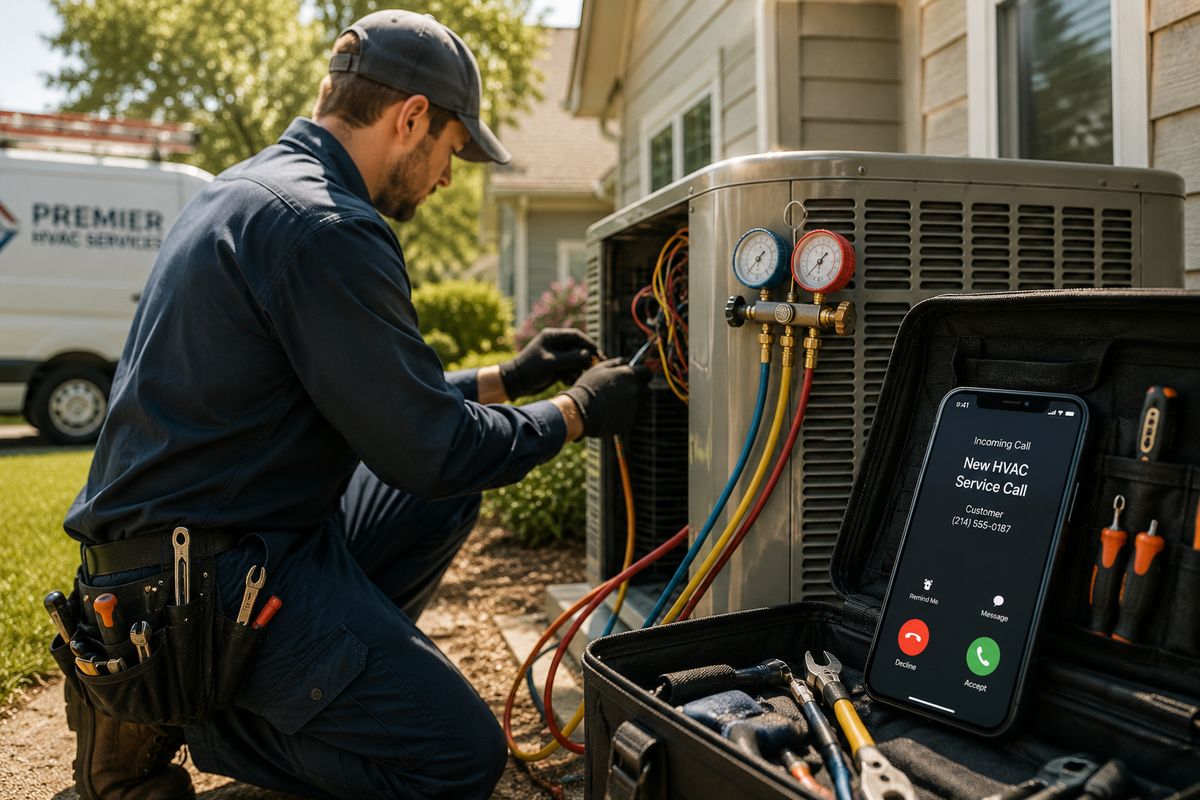
Between 35 and 45% of HVAC inbound calls arrive outside standard business hours, per Epiphany Dynamics data. Most of them go to voicemail. And per CallRail research, 85% of callers who reach voicemail don't call back they move to the next contractor on the list.
An AI voice agent answers every call immediately, at any hour, conducts a real conversation, qualifies the issue, and books the appointment before the caller has a reason to look elsewhere. For a business missing five after-hours calls per week at a 650 dollar average job value, that's a weekly revenue loss of over 1,600 dollars that answering every call eliminates.
The fix: FatCamel AI's RealtorVoiceAI answers every inbound call immediately, handles the full qualification conversation, books directly into the scheduling system, and logs the call to the CRM automatically at 11 PM on a Saturday the same as 10 AM on a Tuesday.
Read More: Build an HVAC Lead Generation System That Works 24/7
Task 2: Lead Qualification
Not every incoming lead deserves the same amount of dispatcher time. A homeowner with a 20-year-old system that stopped working in a heat wave is a different situation from someone asking about a filter change. An emergency commercial rooftop failure is a different situation from a residential tune-up inquiry.
AI qualification gathers the relevant information system type, issue description, urgency, property type, service address through the initial automated interaction and routes accordingly. Emergencies get flagged immediately. High-value commercial leads go to the commercial workflow. Routine maintenance goes to standard booking. All of this happens before any human time is spent on the lead.
The fix: Every lead entering the pipeline through any channel phone, web form, missed call gets automatically qualified and routed based on criteria defined for the specific HVAC business. The dispatcher sees a pre-sorted queue, not a pile of unprocessed inquiries.
Task 3: Appointment Booking and Confirmation
Most HVAC businesses turn qualified leads into callback obligations. The conversation ends with "we'll call you to schedule" and then the lead sits warm for a few hours before cooling off. If the callback takes until the next business day, a real percentage of those leads have already booked with someone else.
Automated booking removes that gap entirely. The AI books the appointment during the same interaction as the qualification offers available slots, confirms the time, sends an SMS confirmation, and logs the booking to the scheduling system before any human has been involved. The customer gets confirmation in real time. The dispatcher sees a booked appointment in the morning.
The fix: Direct booking capability built into the call and web form response flows, with automatic SMS confirmation sent to the customer and automatic calendar entry created in the dispatch system simultaneously.
Read More: AI Automation for HVAC Companies: Benefits, Process, Pricing & ROI
Task 4: Lead Follow-Up Sequences
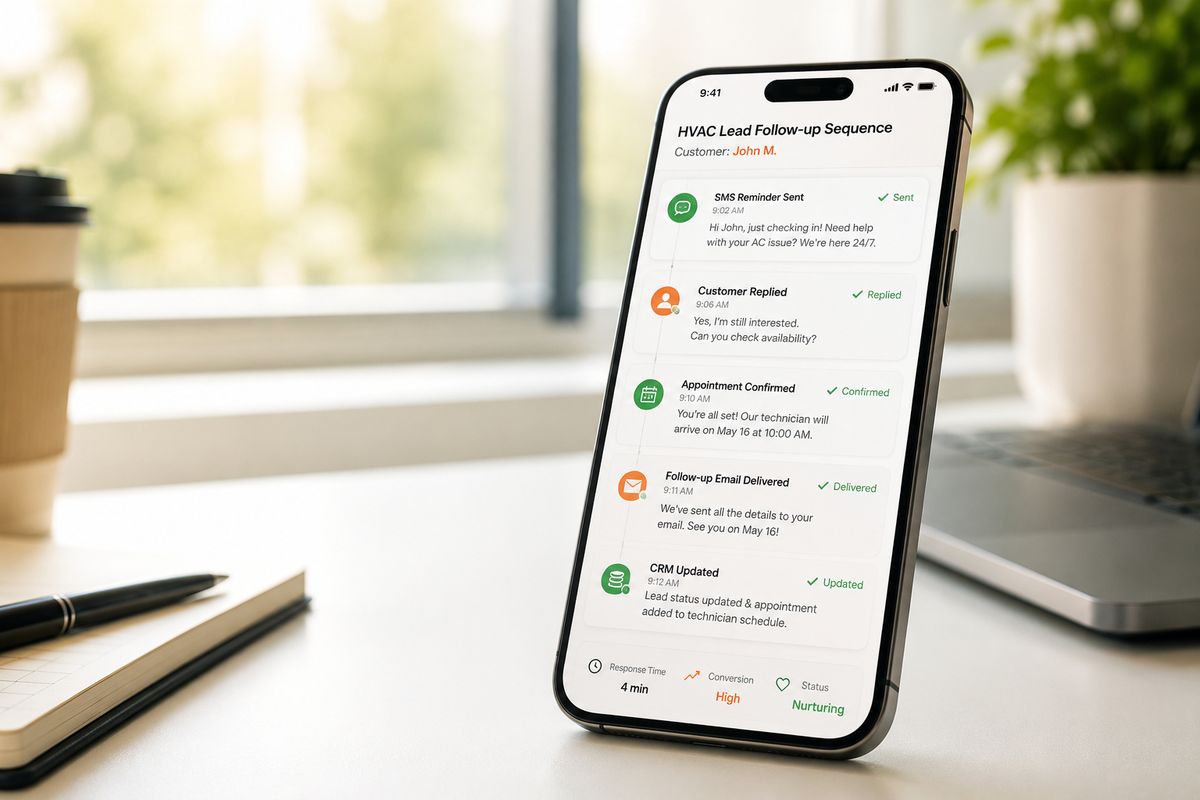
Industry research shows most HVAC buyers need five to eight touchpoints before making a decision. Most HVAC businesses deliver one or two because manual follow-up breaks down the moment a busy season hits. The gap between those numbers is where most follow-up revenue disappears.
Automated follow-up sequences deliver every touchpoint on a fixed schedule across every lead simultaneously, without anyone managing them. Day one, day three, day seven, day fourteen SMS and email running in coordination, each message referencing the specific service the lead enquired about, each one adding something rather than just repeating the same ask.
The fix: FatCamel AI's Lead Activation Engine triggers multi-touch follow-up sequences the moment a lead enters the pipeline, runs them automatically across SMS and email, and stops the sequence the moment the lead responds or books. The sales team focuses their time on the conversations that are already warm.
Task 5: Estimate Follow-Up
An estimate represents the maximum investment the business has made in a lead the site visit, the technician's time, the full scope and pricing work. Everything before the estimate is already sunk cost. And yet less than 40% of HVAC businesses have any systematic process for following up after the estimate goes out.
A structured estimate follow-up automation triggers the moment an estimate is sent. Day three: a check-in asking if there are any questions. Day seven: context about what's included and why the approach reflects quality. Day fourteen: a soft message that makes re-engagement easy. HVAC businesses running structured estimate follow-up consistently see acceptance rates improve by 15 to 25 percentage points. On a system replacement quote worth 10,000 dollars, that's meaningful individual deal recovery.
The fix: CRM-triggered estimate follow-up sequences that start automatically when an estimate status is updated, run for 21 days across SMS and email, and stop the moment the estimate is accepted or declined.
Task 6: Dispatch and Scheduling
Manual dispatch gets complicated fast. At five technicians it's manageable. At fifteen technicians handling 40 jobs a day each with different certifications, different parts on hand, different locations manual scheduling creates mismatches that cost money. The wrong technician sent to a job they're not certified for. A technician driving past another job that should have been theirs. Service windows missed because the schedule didn't account for drive time.
AI-assisted dispatch analyzes technician availability, skill set, location, parts inventory, and job requirements simultaneously and recommends the optimal assignment. Dispatchers make better decisions faster, with better information rather than managing assignments by memory and a whiteboard.
The fix: Dispatch automation that integrates with existing field service platforms (ServiceTitan, Jobber, Housecall Pro) and surfaces AI-recommended assignments rather than requiring dispatchers to build every schedule from scratch.
Task 7: Route Optimization
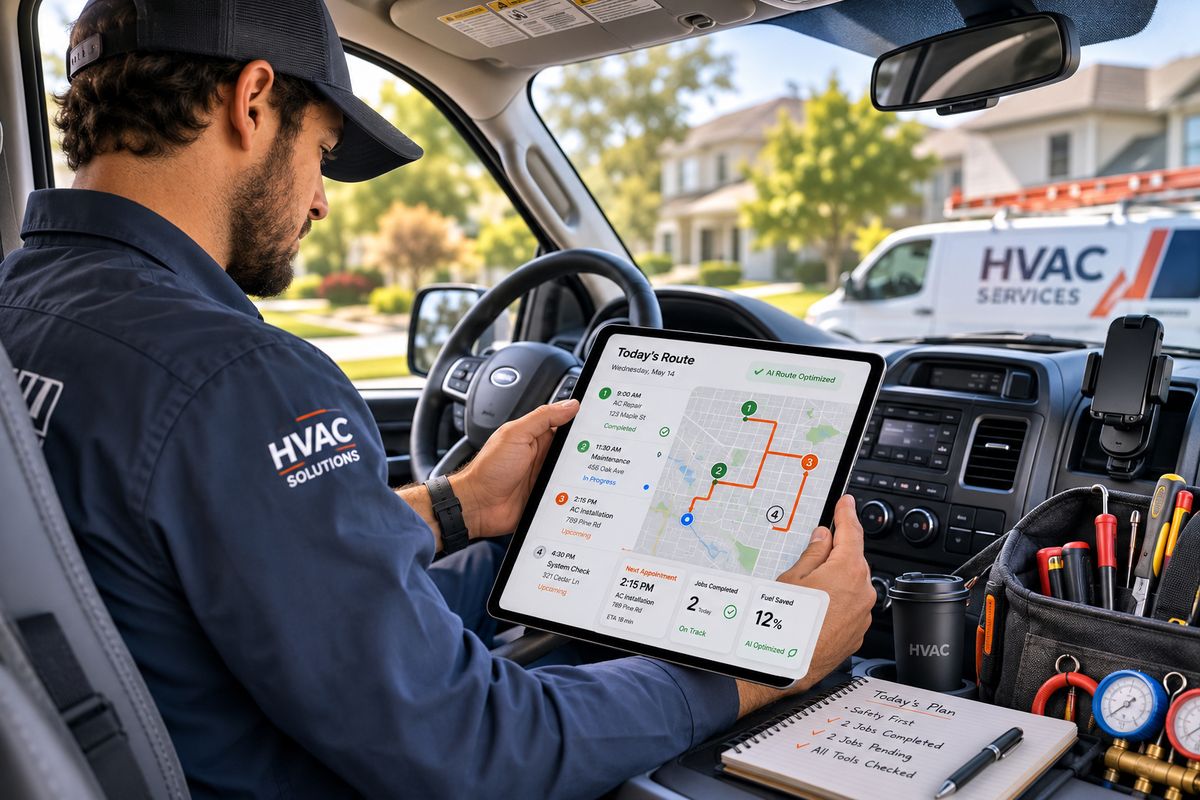
Windshield time is unpaid time. Technicians in busy markets can easily lose 1.5 to 2.5 hours per day to suboptimal routing backtracking, traffic delays, poor job sequencing. At 75 dollars per billable hour, two lost hours per technician per day across a team of ten is 1,500 dollars in daily billable capacity that's going to driving instead of work.
AI route optimization works from real-time traffic data, estimated job duration, parts pickup locations, and customer service windows to sequence the day more efficiently. The fuel savings and additional jobs that fit into an optimized schedule both contribute to the bottom line.
The fix: Route optimization connected to the dispatch system, running automatically each morning based on the day's confirmed schedule, and adjusting in real time as jobs are added, cancelled, or delayed.
Task 8: CRM Data Entry and Logging
Manual CRM data entry is consistently the last priority when the team is busy which in HVAC, is most of the time. Calls get logged hours later, job outcomes get recorded the next morning, customer details get entered inconsistently. When the CRM is two days behind reality, every downstream process that relies on it dispatching, follow-up, reporting runs on inaccurate information.
AI-powered CRM automation logs every call, every message, every job status change in real time, automatically. The operational picture the CRM reflects is always current, which means every decision made from it is based on what's actually happening rather than what someone remembered to type in.
The fix: Automatic CRM logging triggered by every call outcome, every form submission, every job status change with no manual entry required from any team members.
Task 9: Dormant Lead Reactivation
Every HVAC business with any real history has a CRM full of contacts who enquired, got a quote, and went quiet. Not because they said no because the timing wasn't right, the budget wasn't there yet, or the follow-up just stopped. These contacts represent acquisition costs that are already paid. The marketing spend, the initial call, sometimes a site visit.
AI identifies dormant contacts based on inactivity thresholds and sends personalized reactivation outreach referencing the original inquiry the specific system, the original quote, the service address. A message that clearly remembers the original context converts significantly better than a generic check-in blast. Converting 10% of a CRM with 200 dormant contacts at a 2,500 dollar average quote value is 25,000 dollars in recovered revenue from a list that was previously sitting idle.
The fix: FatCamel AI's Lead Activation Engine identifies dormant contacts automatically, segments them by inquiry type and value, and runs personalized SMS and email reactivation sequences without any manual input from the team.
Read More: How to Automate Follow-Ups for Renovation Leads (SMS, Email & AI Calls)
Task 10: Maintenance Agreement Reminders
Maintenance agreements are recurring revenue but only if they actually renew. Most HVAC businesses lose a meaningful percentage of agreements every year not because customers chose to leave, but because nobody sent a renewal reminder at the right time.
Automated maintenance reminders trigger based on agreement expiry dates and equipment service intervals pulled from the CRM. Customers get a personalized reminder before their agreement lapses, with an easy path to renewal. No dispatcher has to remember to send it. No customer falls through the cracks because someone was busy during peak season.
Fieldproxy data shows HVAC companies running automated maintenance agreement management see renewal rates 15 to 20% higher than industry averages. On a portfolio of 100 agreements at 400 dollars average annual value, a 15% improvement in renewal rate is 6,000 dollars in retained recurring revenue.
The fix: CRM-triggered reminder sequences that fire automatically based on agreement expiry dates, with renewal confirmation captured through a direct booking or payment link embedded in the message.
Task 11: Invoice Generation and Follow-Up
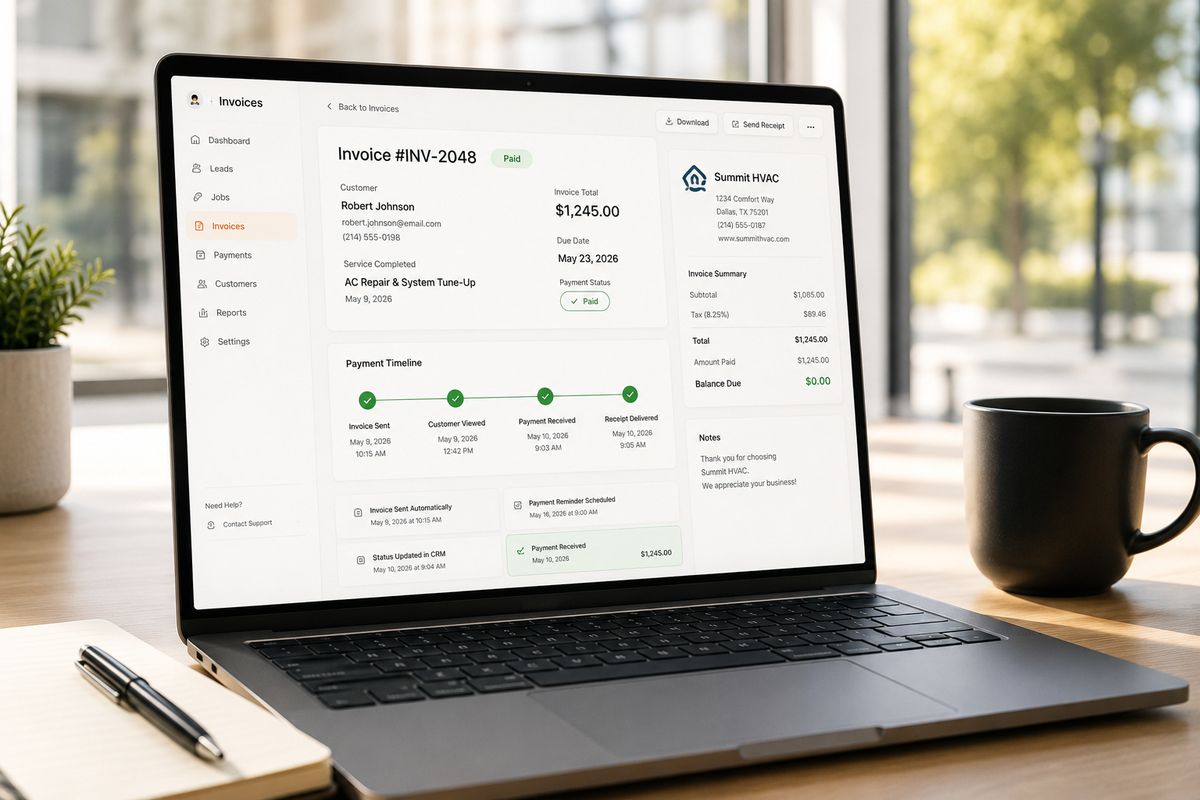
Late invoices and unpaid invoices are a cash flow problem that most HVAC businesses manage manually someone has to remember to generate the invoice when the job closes, and then remember to follow up when payment doesn't arrive. Both steps fall through the cracks regularly during busy periods.
AI invoice automation triggers the moment a work order is marked complete, generates the invoice automatically, sends it to the client with a payment link, and follows up with automated reminders if payment doesn't arrive within the agreed terms. Simpro's data shows AI-powered job documentation tools accelerate payment cycles by 15 to 20 days and cut billing disputes by up to 40%. For a business with 200,000 dollars in monthly revenue, accelerating collection by 15 days meaningfully improves available cash flow.
The fix: Automatic invoice generation triggered by job completion status, with structured follow-up sequences for outstanding payments that run without any team member having to manually track them.
Task 12: Post-Job Customer Communication
Most HVAC businesses intend to follow up after every completed job. Very few do it consistently. A post-job satisfaction check within 24 hours of completion, a note about what was serviced and what to watch for, a reference to the next recommended service all of this builds customer loyalty and drives repeat bookings. But it requires someone to remember to send it for every job, every day.
Automated post-job communication triggers based on job completion status in the CRM. The customer gets a personalized message referencing their specific job not a generic "thanks for your business" within 24 hours of the technician marking the work complete. No dispatcher involvement required.
The fix: Post-job sequences triggered automatically by job status updates, personalized using the customer's name, equipment type, and job notes from the completed work order.
Task 13: Review Requests
Online reviews directly affect how many new customers find and choose your HVAC business. A consistent flow of recent, positive reviews improves Google ranking for local searches and builds the social proof that converts a search result into a call. But most HVAC businesses only ask for reviews when they remember to which means inconsistently, and usually only from the customers who were exceptionally easy to work with.
Automated review requests go out within 24 to 48 hours of every completed job, to every customer, every time. The timing is deliberate satisfaction is highest immediately after a good experience, and response rates drop significantly after a few days. A business completing 15 jobs per week that captures even 30% of customers as reviewers generates 200+ new reviews per year without anyone on the team sending a single request manually.
The fix: Automated SMS or email review requests triggered by job completion, sent within 24 hours, with a direct link to the Google Business Profile or preferred review platform.
Task 14: Commercial Outreach Sequences
Winning commercial HVAC contracts requires consistent, multi-touch outreach over an extended period the kind that's extremely difficult to sustain manually alongside running an active service business. A facility manager evaluating contractors for a multi-building maintenance agreement needs to encounter the business multiple times across a professional sequence before they're ready to engage.
AI-powered commercial outreach sequences reach property managers, facility directors, and commercial real estate operators with targeted, personalized emails on a set schedule introducing the company's commercial capabilities, sharing a relevant case study, making a specific ask for a conversation without requiring a dedicated business development hire to manage the process.
The fix: FatCamel AI's outreach automation builds and runs targeted commercial email sequences to defined lists of commercial prospects, personalized by property type and role, and escalating warm responses to the sales team automatically.
Task 15: Reporting and Pipeline Visibility
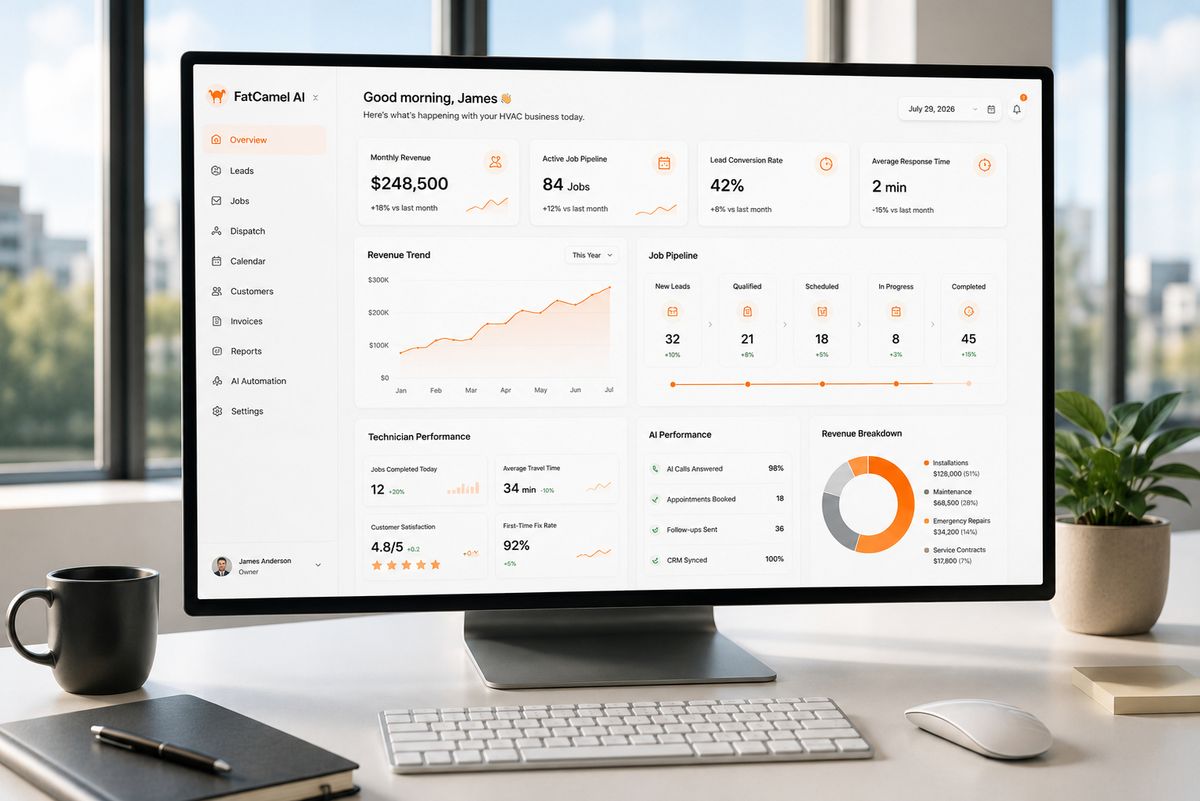
Most HVAC businesses track revenue and gross margin. What most don't track is where revenue is being lost which leads dropped after one follow-up, which estimates were never chased, which technicians have the highest callback rates, which service lines are actually profitable versus which ones look okay on a blended basis.
AI-powered reporting surfaces this data automatically without someone building a manual report. The pipeline shows every lead at every stage. Conversion rates appear by source, by service type, by technician. Margin data shows up at the job level. The information needed to make better decisions is visible without anyone having to extract and compile it.
The fix: Automated pipeline tracking that reads from CRM data in real time and surfaces conversion rates, follow-up completion rates, estimate acceptance rates, and revenue by source in a single dashboard updated continuously without manual report building.
How FatCamel AI Automates the Full HVAC Business
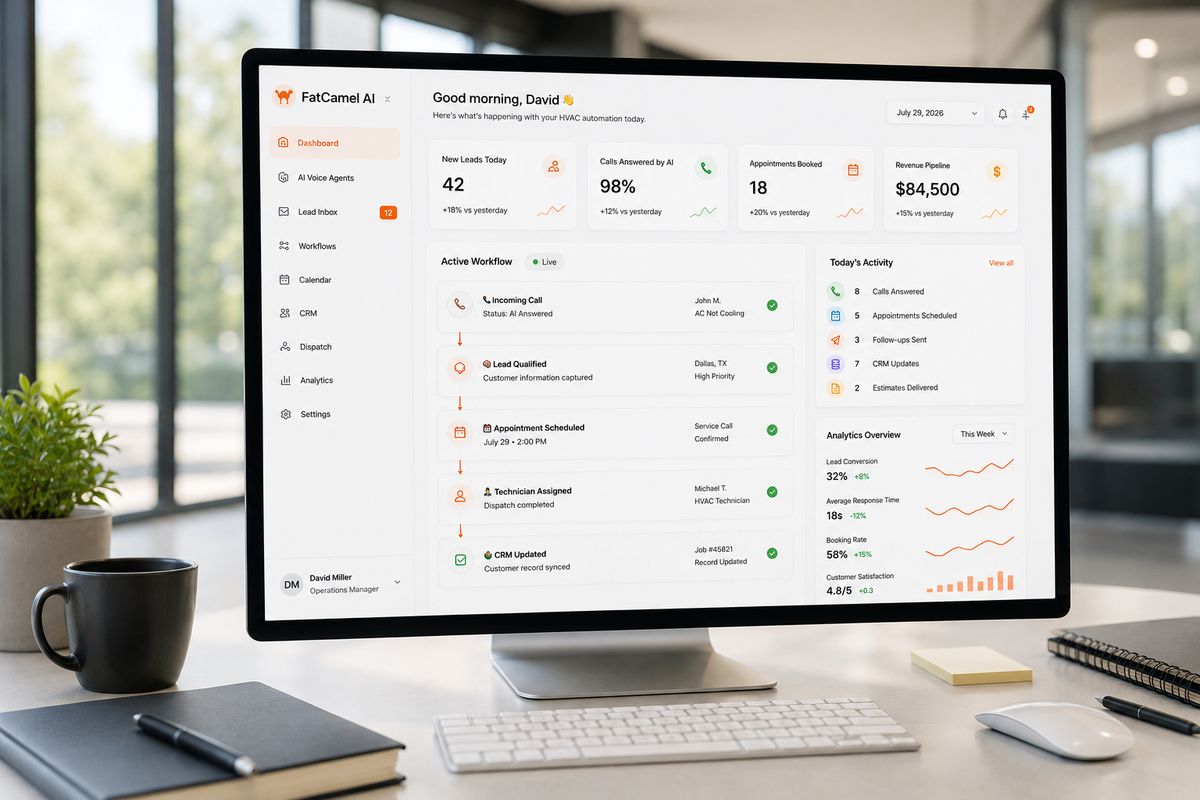
Most of the 15 tasks above share a common dependency: they need to connect to the same CRM, share the same customer data, and trigger based on the same pipeline events otherwise you end up with five disconnected tools that each automate one thing and create new manual work to keep them in sync.
FatCamel AI is built to run the full automation stack for HVAC contractors as a connected system not as separate tools requiring separate logins and separate maintenance. RealtorVoiceAI handles tasks 1 through 3 after-hours answering, qualification, and booking. The Lead Activation Engine handles tasks 4, 5, 9, and 14 follow-up sequences, estimate follow-up, dormant reactivation, and commercial outreach. CRM Automation handles tasks 8 and 15 real-time data logging and pipeline visibility. And customer communication automation covers tasks 10, 12, and 13 maintenance reminders, post-job messages, and review requests.
Every component reads from and writes back to the existing field service platform. No CRM migration. No new system for the team to learn. The 15 tasks run in the background, and the results appear as current, organized data in the system the team already uses.
The HVAC businesses pulling ahead right now aren't the ones with the biggest budgets. They're the ones that stopped doing manually what a system can handle automatically and applied the recovered time and captured revenue to actually growing the business.
👉 Get a Free AI Revenue Audit for Your HVAC Business at https://www.fatcamel.ai/contact
FAQ
1. What HVAC tasks can actually be automated using AI? The 15 tasks with the clearest ROI in HVAC automation are: after-hours call answering, lead qualification, appointment booking, lead follow-up, estimate follow-up, dispatch and scheduling, route optimization, CRM data entry, dormant lead reactivation, maintenance agreement reminders, invoice generation and follow-up, post-job communication, review requests, commercial outreach, and pipeline reporting. Most of these connect to the CRM already in use rather than requiring new software.
2. Where should an HVAC business start with automation? Start with the task that's costing the most revenue right now. For most HVAC businesses, that's after-hours call answering between 35 and 45% of inbound calls arrive after hours and most go to voicemail, with 85% of those callers never calling back. Fixing that gap first produces a return fast enough to validate the broader automation investment and fund the next implementation.
3. How much does HVAC task automation actually cost? A single automation such as an AI voice agent for after-hours calls typically costs 3,000 to 8,000 dollars to build and configure, with monthly operating costs of 200 to 500 dollars. A full automation stack covering all 15 tasks ranges from 15,000 to 40,000 dollars for a complete implementation. Most businesses recover the cost of the voice agent alone within the first month through captured revenue that was previously going to competitors who answered.
4. Does HVAC automation require replacing existing software? No. The most effective HVAC automation tools connect to the field service platforms already in use ServiceTitan, Jobber, Housecall Pro, FieldEdge through standard API integrations. The CRM stays. The team keeps using the same system. The automation layer runs on top, handling what it handles, and logging outcomes back to the existing system automatically.
5. How quickly do automated HVAC tasks produce results? After-hours call capture produces measurable results within the first week every call answered, every lead qualified, every booking captured from day one. Follow-up automation and estimate chasers produce improvement in conversion rates within 30 to 60 days. Dormant lead reactivation generates revenue from the first campaign run. Route optimization and dispatch improvements show up in fuel costs and completed jobs per day within the first month.
6. Can small HVAC companies afford automation, or is it just for large businesses?Small HVAC contractors actually benefit more from automation than large ones in many cases because they have less capacity to absorb the cost of manual inefficiencies. A small contractor missing five after-hours calls per week loses proportionally more revenue than a large one with a full call center. Subscription-based automation tools are available from 200 to 500 dollars per month, making the entry point accessible for businesses of any size.
7. How does FatCamel AI handle the full 15-task HVAC automation stack? FatCamel AI runs the complete automation stack as a connected system RealtorVoiceAI for call answering, qualification, and booking; Lead Activation Engine for follow-up, estimate chasers, dormant reactivation, and commercial outreach; CRM Automation for real-time data logging and pipeline visibility; and customer communication automation for maintenance reminders, post-job messages, and review requests. Every component connects to the existing field service platform and logs outcomes back automatically.
References
https://www.simprogroup.com/blog/ai-hvac
https://www.achrnews.com/articles/165647-5-realistic-ways-ai-can-empower-your-hvac-business-in-2026
https://www.servicetitan.com/blog/hvac-ai
https://www.fieldproxy.ai/resources/blog/best-hvac-software-ai-scheduling-dispatch-2026
https://www.callrail.com/blog/missed-calls-stats
https://www.artifactaisolutions.com/blog/hvac-revenue-lost-from-missed-calls
https://www.housecallpro.com/resources/ai-in-the-trades/
https://fieldcamp.ai/blog/hvac-industry-trends/
https://www.simprogroup.com/resources/ebooks/trades-outlook-report-2025
https://www.fatcamel.ai/services/voice-assistant
https://www.fatcamel.ai/services/crm-automation