
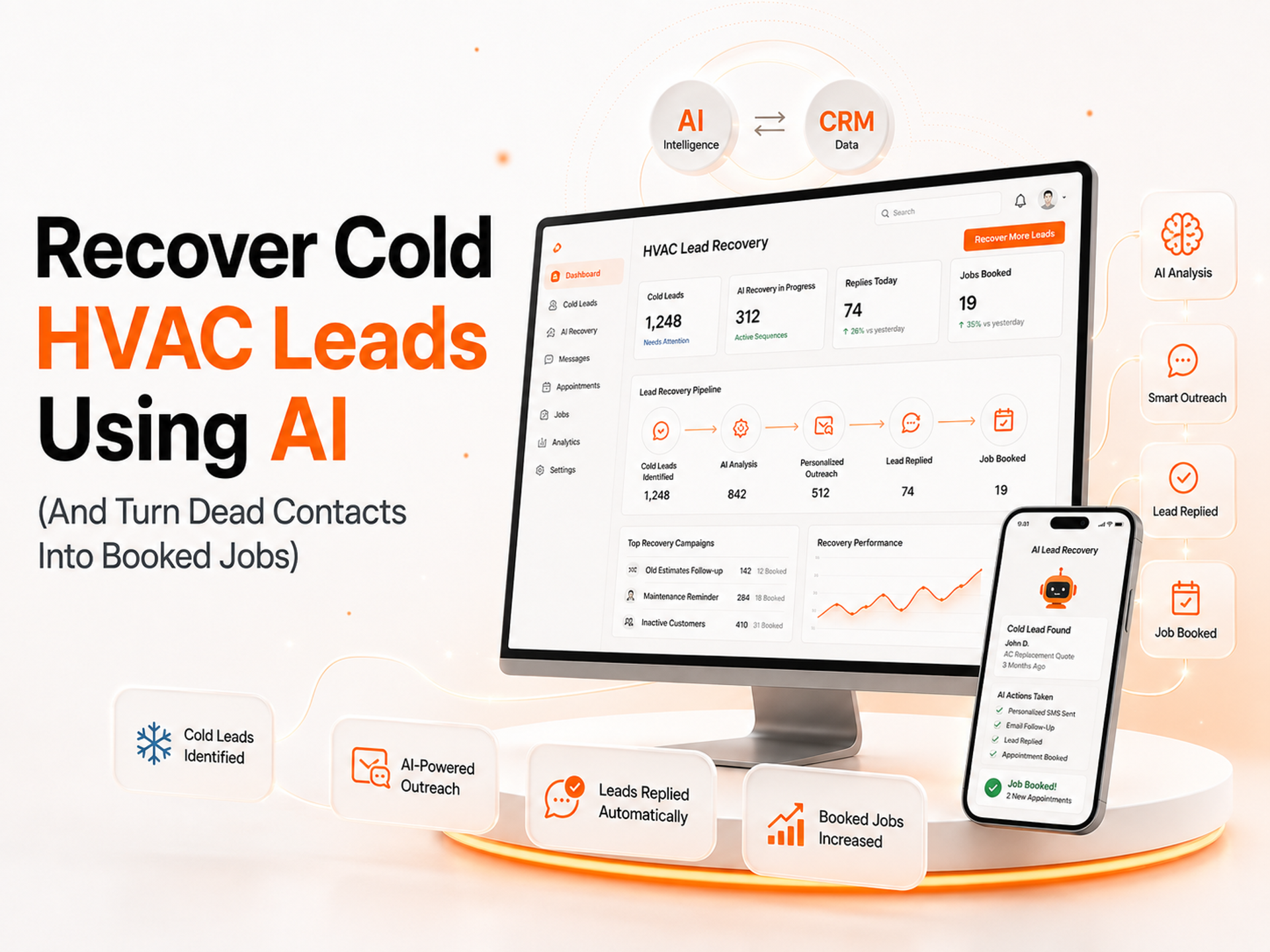
Cold HVAC leads contacts who enquired, received a quote, and went quiet aren't gone. In most cases they went quiet because the timing wasn't right, not because they decided against the service. AI reactivation systems identify these dormant contacts automatically, send personalized outreach referencing the original inquiry, and convert a meaningful percentage into booked jobs at zero additional marketing cost. The acquisition cost for these leads is already paid. The only investment is the automation to reach back out at the right moment.
Every HVAC company has the same problem sitting in their CRM. Hundreds of contacts who called, got a quote, maybe even had a site visit and then disappeared. The team followed up once or twice, heard nothing, and moved on. Those contacts got marked as cold or just stayed in whatever pipeline stage they'd last been updated to, and slowly the list grew.
Most HVAC owners look at that list and see dead weight. What it actually is, is the highest-ROI opportunity in the business. This guide breaks down exactly why, and exactly how AI turns those dormant contacts into booked jobs without spending another dollar on advertising.
Table of Contents
Why Cold HVAC Leads Aren't Actually Dead
The Real Value Sitting in Your HVAC CRM
Why Manual Reactivation Never Gets Done
How AI Lead Reactivation Works for HVAC
The Reactivation Sequence: What Gets Sent, When, and Why
A Real Case Study: What Happens When You Reach Back Out
The Different Types of Cold HVAC Leads (And How to Handle Each)
How FatCamel AI's Lead Activation Engine Recovers Cold HVAC Leads
FAQ
References
Why Cold HVAC Leads Aren't Actually Dead
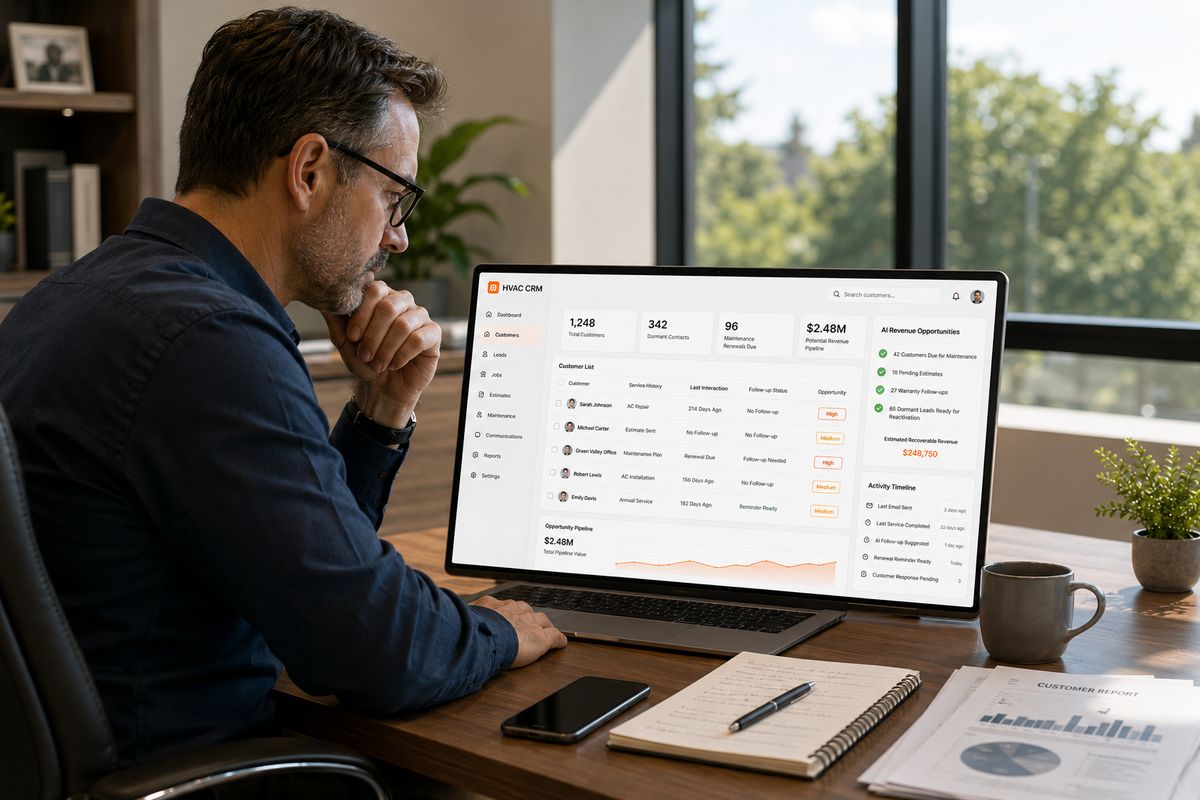
When a lead goes quiet after receiving a quote, most HVAC businesses assume the same thing: they went with a competitor, or they decided not to do the work. Sometimes that's true. But the data tells a more nuanced story.
Research from Salesforce found that 80% of sales require at least five follow-up attempts before closing. Most service businesses deliver two. The leads that go quiet after the second follow-up aren't necessarily gone they're often just at a point in their decision cycle where the timing isn't right yet. The budget hasn't been approved. The spouse needs to be consulted. The system is still working well enough that it doesn't feel urgent. Life is busy.
Three months later, one of those conditions changes. The system finally fails completely. The budget cycle resets. The homeowner gets a tax refund. And at that moment the moment when they're actually ready to move they reach out to whoever is still in their inbox. If that's not you, it's whoever last contacted them.
HVAC leads have a longer decision window than most service categories. A homeowner getting quotes on a new system replacement in March might not be ready to pull the trigger until June. A commercial facility manager who enquired about a maintenance contract in Q1 might be waiting for Q2 budget approval. These aren't dead leads. They're leads whose timing hasn't arrived yet.
Read More: AI Automation for HVAC Companies: Benefits, Process, Pricing & ROI
The Real Value Sitting in Your HVAC CRM
The math on dormant lead reactivation is compelling, and it starts from a simple observation: the acquisition cost for every contact in the CRM is already paid.
Every lead in that database came from somewhere. A Google ad at 80 to 200 dollars per click. A Local Services Ad at 50 to 150 dollars per lead. A referral that required years of relationship-building to generate. A site visit that cost the technician's time and the truck's fuel. Whatever the source, the cost of getting that lead into the CRM was real and already spent.
When a lead goes cold and the business never reaches back out, that acquisition cost produces zero revenue. It's not recouped from other leads it's just gone. Every dormant contact represents a sunk cost that has generated no return.
Reactivating even a small percentage of those contacts changes the math dramatically. An HVAC company with 200 dormant contacts leads who enquired, received quotes, and went quiet over the past 18 months at an average quote value of 2,500 dollars, reactivating 10% at a 50% close rate produces 25,000 dollars in revenue. That number doesn't require a single new ad dollar. It requires reaching back out to people who already said they were interested.
Per Astola's documented case study of an HVAC contractor, an AI SMS reactivation system reduced lead response time to under 60 seconds and recovered leads from all three inbound sources Google Ads, Facebook Ads, and website forms that had previously gone cold during 20 to 40 minute response windows. The owner described waking up each morning to find calendar appointments already confirmed from contacts who had reached out the night before.
Why Manual Reactivation Never Gets Done
If the ROI is this clear, why don't more HVAC businesses reactivate their cold leads?
Because doing it manually is genuinely difficult to sustain. A proper reactivation outreach isn't just a mass email blast to everyone who didn't convert. That approach produces low response rates and can actively damage how the contact perceives the business a generic "we haven't heard from you in a while" message from a company they got one quote from nine months ago is easy to ignore.
Effective reactivation requires personalizing every message to the specific contact referencing the original system type, the quote amount, the service address, the technician who visited. It requires sending through the right channel (SMS for urgency, email for context) at the right time (not during a heat wave when the team is already overwhelmed). It requires a structured follow-up if the first message doesn't get a response. And it requires doing all of this across hundreds of contacts simultaneously without mixing up anyone's details.
That's not something a dispatcher can do manually on top of running the day's operations. It either gets done poorly a generic blast that produces minimal results or it doesn't get done at all. Which is why most HVAC businesses look at their cold lead list, recognize the opportunity, and then never act on it.
Read More: Why HVAC Companies Lose Leads After Hours (And How to Fix It With an AI Answering Service)
How AI Lead Reactivation Works for HVAC
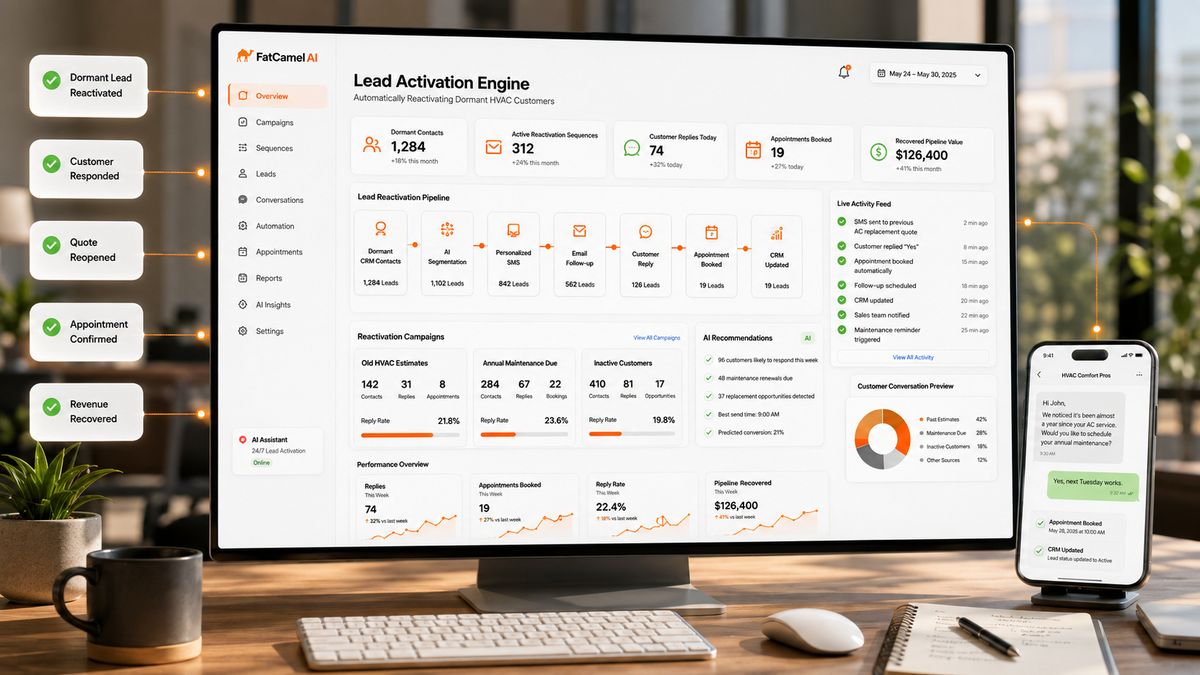
AI reactivation works by connecting to the HVAC CRM, identifying contacts that have passed a defined inactivity threshold, and sending personalized outreach that references the specific details of the original inquiry.
The inactivity threshold is configurable typically 90 days for leads who enquired but never booked, 6 months for leads who received a quote but didn't accept it, and 12 months for past customers who haven't had a return service visit. The system identifies these contacts automatically, segments them by type and value, and initiates the appropriate outreach sequence for each segment.
The personalization is what makes this work at a fundamentally different response rate than a mass email blast. When the system sends a reactivation message, it pulls the relevant data from the CRM record the caller's name, the specific system they asked about, the service address, the quote amount if one was sent, and the date of the last interaction. The message references all of this explicitly.
A reactivation SMS that says "Hi Marcus, we quoted you a Lennox 3-ton heat pump installation at 847 Riverside Drive back in February wanted to check if you're still considering it before summer hits" will get a response rate that is multiple times higher than "Hey, just checking in to see if you still need HVAC service." The information is the same in both cases. Only one of them feels personal enough to merit a reply.
When a contact responds, the automated sequence stops immediately and the lead is flagged for the sales team with the full conversation history attached. Human engagement takes over from there. The automation's job is to get the conversation reopened closing happens in the same way it always has.
The Reactivation Sequence: What Gets Sent, When, and Why
A properly structured HVAC lead reactivation sequence runs across SMS and email, with each channel playing a different role.
Day 1 - The SMS check-in. Short, specific, low pressure. References the original inquiry by name. Asks one easy question whether the project is still on their radar. The goal is a single reply, not a booking. Any reply counts as re-engagement and triggers the next step.
Day 4 - The email with context. If no response to the SMS, an email goes out that provides more room for the value case. This might be a seasonal urgency angle (summer is coming and booking windows are filling), a relevant case study from a similar job recently completed, or additional information about what the quote included that the contact might not have fully understood from the original conversation.
Day 10 - The second SMS. A different angle than the first. Perhaps referencing a change in circumstances a new promotion, a change in installation lead times, or simply a check-in framed as making sure the contact has everything they need to make a decision.
Day 18 - The final low-pressure message. A short email that makes it easy to re-engage without any pressure. No urgency, no countdown. Just an open door and a direct booking link if they're ready.
After the four-message sequence, non-responsive contacts don't get dropped. They enter a quarterly nurture track a useful seasonal reminder or maintenance tip that keeps the business visible at low frequency until circumstances change. Because some HVAC leads take six to twelve months to become ready, and being present when that moment arrives is what wins the job.
Read More: 15 HVAC Tasks You Can Automate Using AI (And What Each One Is Worth)
A Real Case Study: What Happens When You Reach Back Out
Astola.io documented an HVAC contractor who was spending 2,500 dollars per month on Google Ads but losing qualified leads who waited 20 to 40 minutes for a response long enough to find and call a competitor. After deploying an AI SMS system that responded to every new lead within 60 seconds and followed up with three automated messages at timed intervals, the results were measurable within the first week.
Response time to new leads dropped from 20 to 40 minutes to under 60 seconds. The three-touch follow-up sequence recovered leads who had ignored the first message a segment that had been completely lost under the manual process. Many of those leads responded to the second or third message after cooling down from the missed initial window.
The owner now opened his calendar each morning to find appointments already confirmed from leads who had submitted forms the night before. The system ran completely in the background intake, qualification, follow-up, and booking with no daily input required from him or his staff.
This is exactly the pattern that applies to dormant lead reactivation. The leads who went quiet after one follow-up weren't necessarily gone. Many of them were just waiting for someone to reach out again, at the right moment, with the right message. The business that does that automatically, consistently, for every contact in the CRM is the one that converts them.
The Different Types of Cold HVAC Leads (And How to Handle Each)
Not all dormant contacts are the same. Different contact types require different reactivation approaches.
Leads who enquired but never booked. These contacts made initial contact, got some information, and went quiet without ever receiving a quote or scheduling a visit. The reactivation message should reference what they asked about and make it easy to take the next step typically a booking link for a site visit or diagnostic call.
Leads who received a quote but didn't accept. These contacts represent the highest reactivation ROI because the business has already invested in a site visit and quote preparation. The reactivation approach should reference the specific quote, address the most common objections for that job type, and provide a clear path back to accepting or rescheduling the conversation.
Past customers with no return visit in 12+ months. These contacts already know the business, already trust the technicians, and have equipment that's another year older than when they last had service. The reactivation angle is maintenance a reminder that their system is due for a check-up, ideally referencing the specific equipment on file and the date of the last service.
Lapsed maintenance agreement holders. These contacts represent recurring revenue that has been lost without any explicit decision on their part. A reactivation message that makes renewal easy a direct payment link, an offer to reinstate at the same rate converts at higher rates than new agreement sales because the relationship is already established.
How FatCamel AI's Lead Activation Engine Recovers Cold HVAC Leads
FatCamel AI's Lead Activation Engine is built to run the complete HVAC lead reactivation operation identifying dormant contacts, segmenting them by type and value, running personalized SMS and email sequences, and escalating responses to the sales team as a connected system that reads from and writes back to the existing CRM.
The setup starts with mapping the contact segments in the existing CRM enquiries, unaccepted quotes, past customers, lapsed agreement holders and defining the inactivity thresholds and reactivation sequences for each. From there, the Lead Activation Engine runs automatically, identifying new dormant contacts as they cross the thresholds and initiating the appropriate sequence without any manual input from the team.
Every message sent references the specific data from the CRM record name, system type, service address, quote details, last service date. The personalization happens automatically because the data is already there. The automation just uses it consistently, at scale, for every contact simultaneously.
When a contact responds through any channel a reply to an SMS, a click on a booking link, a direct callback the sequence stops and the lead is routed to the sales team with the full reactivation conversation history attached. The team picks up the conversation knowing exactly what was discussed, what was offered, and how the contact responded.
The result is an HVAC business where the value sitting in the CRM leads already paid for, relationships already established is systematically worked rather than left idle. The contacts who went cold six months ago aren't lost. They're just waiting for the right message at the right moment. The Lead Activation Engine makes sure they get it.
👉 Get a Free AI Revenue Audit for Your HVAC Business at https://www.fatcamel.ai/contact
FAQ
1. What does it mean to recover cold HVAC leads?
Recovering cold HVAC leads means reaching back out to contacts who previously enquired, received a quote, or had a site visit but never converted with personalized, timed outreach that references the original interaction. Most cold leads went quiet because the timing wasn't right, not because they made a firm decision against the service. Reactivation reaches them again when circumstances may have changed, at a fraction of the cost of generating a new lead from advertising.
2. How do you know which HVAC leads are worth reactivating?
The highest-value reactivation targets are leads who received a quote but didn't accept it because the acquisition cost for these contacts already includes a site visit and the quote preparation work. Past customers with no return visit in 12 or more months are the next priority, because the existing relationship makes conversion significantly easier than with a cold prospect. Leads who enquired but never booked have the lowest acquisition investment and the broadest opportunity.
3. What's the best way to reach out to cold HVAC leads?
SMS produces the highest immediate response rates open rates around 98% and average response times under three minutes. But email provides more space for the value case a case study, a seasonal urgency angle, a breakdown of what the quote included. Running both channels in a coordinated sequence reaches contacts through whichever channel they're most likely to respond to, and produces significantly higher overall response rates than either channel alone.
4. How long after a lead goes cold can you still reactivate them?
The reactivation window is longer than most HVAC businesses assume. Leads who received a quote and went quiet are worth reactivating for up to 18 to 24 months after the original inquiry for high-ticket items like system replacements, because the decision timeline on a 10,000 dollar purchase is genuinely long. Past customers are worth keeping in a nurture sequence indefinitely equipment ages, circumstances change, and the business that's still occasionally visible when the next need arises gets the call.
5. What kind of response rates can HVAC businesses expect from lead reactivation?
Response rates vary based on the quality of personalization and the time elapsed since the original contact. Well-personalized reactivation sequences referencing the specific system, quote, or service history from the CRM typically produce response rates of 15 to 30% for leads reactivated within 12 months of the original inquiry, and 8 to 15% for leads in the 12 to 24 month range. Generic mass outreach produces much lower rates. The specificity of the message is the primary driver of response rate.
6. How much revenue can HVAC lead reactivation actually recover?
The calculation depends on the size of the dormant contact database and average quote values. An HVAC company with 200 dormant contacts at a 2,500 dollar average quote value, reactivating 10% at a 50% close rate, recovers 25,000 dollars. For contacts with unaccepted estimates at higher values system replacements, commercial contracts the revenue impact of individual reactivations is significantly larger. Because the acquisition cost is already paid, the ROI on reactivation is typically the highest of any lead generation activity in the business.
7. How does FatCamel AI's Lead Activation Engine handle HVAC lead reactivation?
FatCamel AI's Lead Activation Engine connects to the existing HVAC CRM, identifies dormant contacts based on configurable inactivity thresholds, and runs personalized SMS and email reactivation sequences for each contact segment automatically. Every message references the specific data from the CRM record name, system type, quote details, last service date. Every response stops the automated sequence and routes the lead to the sales team with full conversation history attached. Non-responsive contacts enter a quarterly nurture track rather than being dropped permanently.
References
https://astola.io/case-studies/hvac-sms-lead-followup
https://www.simprogroup.com/blog/ai-hvac
https://www.callrail.com/blog/missed-calls-stats
https://simpletexting.com/blog/sms-marketing-statistics/
https://www.artifactaisolutions.com/blog/hvac-revenue-lost-from-missed-calls
https://ai.boxplot.com/hvac-lead-reactivation-bot-ai/
https://www.avoca.ai/industries/hvac
https://www.leadtruffle.co/blog/complete-guide-hvac-lead-generation-2026/
https://www.housecallpro.com/resources/ai-in-the-trades/
https://www.fatcamel.ai/services/crm-automation
https://www.fatcamel.ai/