

A painting contractor in Phoenix spends three weeks evaluating CRM software. He watches demo videos, attends a webinar, and signs up for a platform that promises to transform how he manages leads. Six months later, the CRM is open in a tab he never clicks. His leads are back in a spreadsheet. His follow-ups are back in his head.
This is not a story about one contractor making a bad decision. It is a pattern that plays out across the construction and renovation industry constantly. Industry research consistently puts CRM failure rates between 50 and 70 percent, and in construction, the numbers skew toward the higher end of that range. The technology is not bad. The fit is wrong.
The problem is not that contractors don't want better systems. They do. The problem is that most CRMs were built for an entirely different kind of business, then sold to contractors with a light coat of industry-specific paint. And that mismatch has real consequences: leads go cold, proposals get forgotten, client relationships that took years to build slip away between software tabs.
Contractor CRM problems are structural, not superficial. This post breaks down the three root causes that make most CRMs fail for contractors, and explains how AI is fixing them in ways that traditional software never could.
Table of Contents
The Core Problem: CRMs Built for the Wrong Business
Problem One: Limited Customization That Doesn't Fit How Contractors Work
Problem Two: No API Flexibility, No Real Integration
Problem Three: Franchise Limitations That Handcuff Growing Businesses
Why Outdated Construction CRMs Keep Getting Bought Anyway
What an AI-Powered CRM Actually Does Differently
What Contractors Should Look for Instead
The Role of fatcamel.ai in This Shift
1. The Core Problem: CRMs Built for the Wrong Business
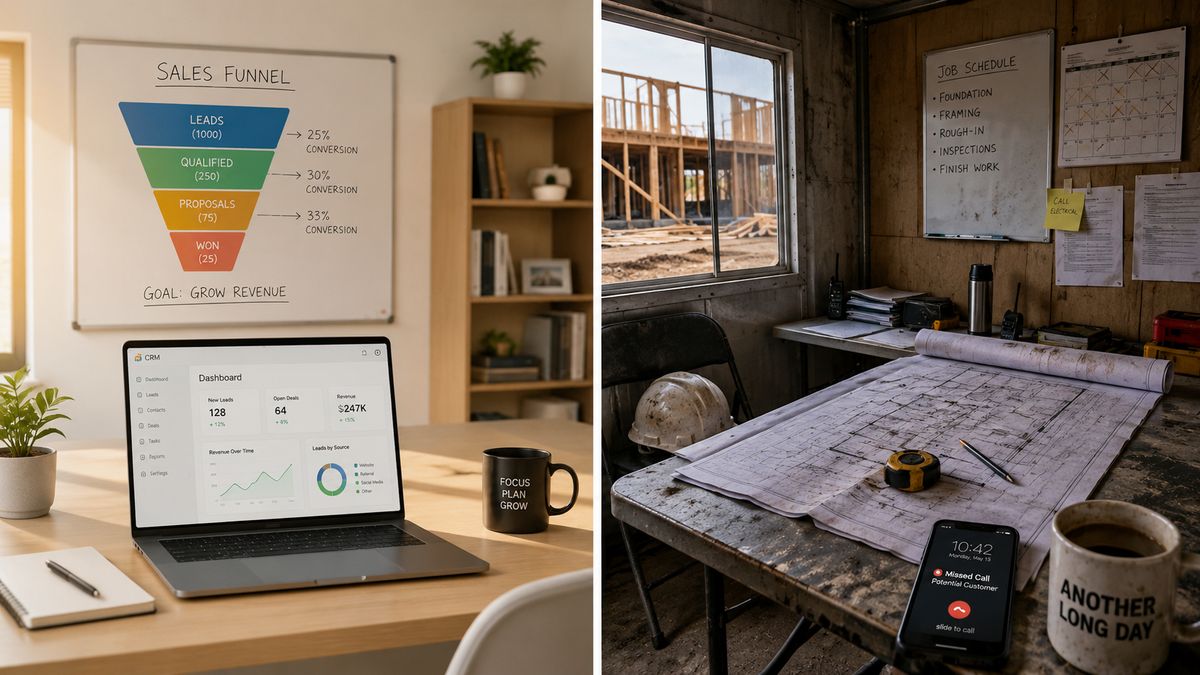
To understand why CRM fails contractors, you have to understand how different the construction sales cycle is from the industries that shaped CRM software.
A typical B2B SaaS sale works like this: a lead enters a funnel, gets nurtured over a few weeks, receives a proposal, and either signs or goes dark. The whole cycle might take sixty to ninety days. The data model is clean. One contact, one company, one deal, one outcome.
Construction doesn't work like that. A relationship in construction might begin with a conversation at a trade show in 2022, warm up through two projects the owner isn't ready to fund, and land a significant contract four years later. The relationship lifecycle is long, non-linear, and involves multiple stakeholders at once: the property owner, the general contractor, the architect, the subcontractors, and the project manager. A single opportunity might have eight or ten contacts attached to it, each playing a different role at a different stage.
Only 32 percent of general contractors currently use a CRM for sales management or client communication, compared to adoption rates as high as 72 percent in industries like real estate. That gap is not because contractors are behind technologically. It is because most CRMs have not earned their adoption by fitting the way construction businesses actually operate.
The three structural problems driving that failure are limited customization, poor API flexibility, and franchise limitations that restrict growing businesses. Each one deserves a direct look.
Read More: AI Receptionist for Painting Companies: Never Miss a Painting Lead Again
2. Problem One: Limited Customization That Doesn't Fit How Contractors Work
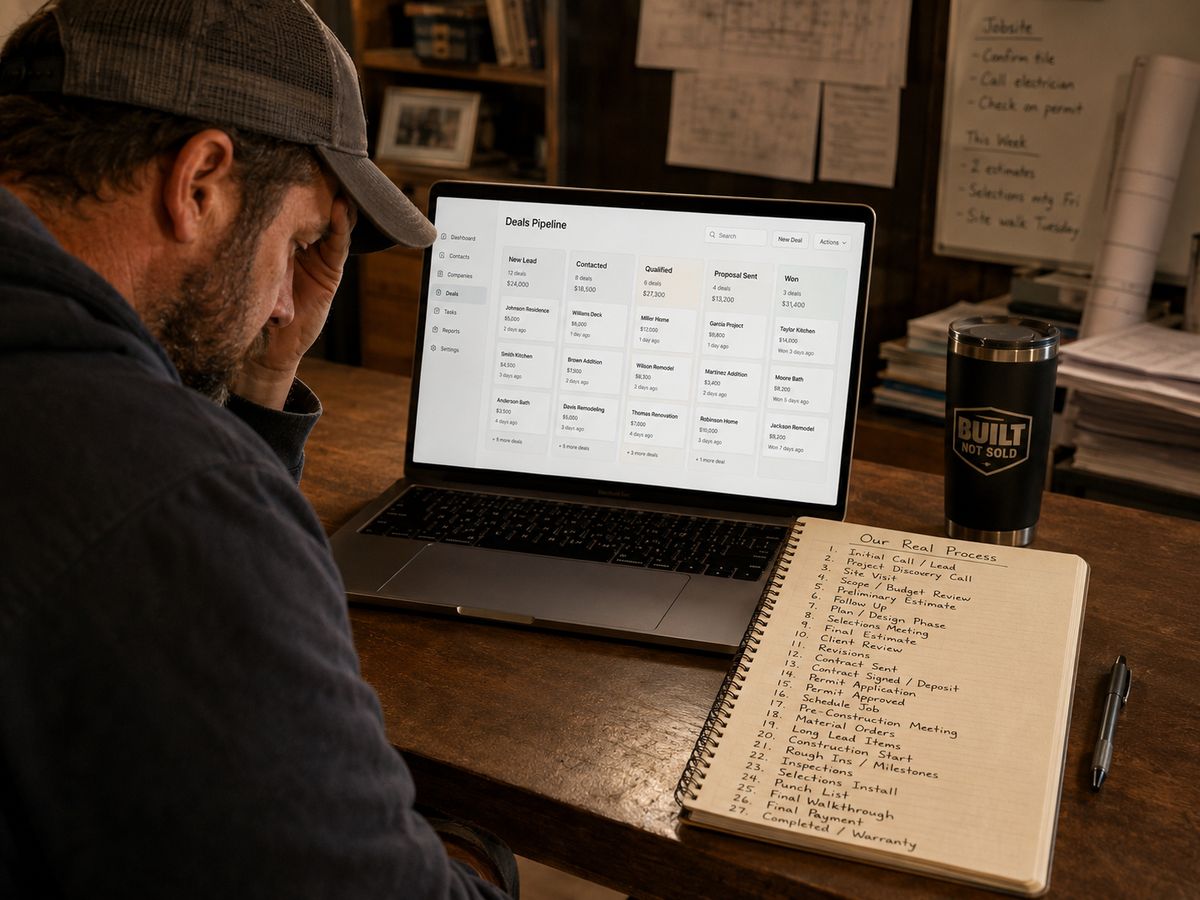
The most common complaint contractors have about CRM software is that it forces them to work the way the software works rather than the way their business works.
A standard CRM pipeline has stages like Lead, Qualified, Proposal, Negotiation, Closed Won, and Closed Lost. That model works well for subscription software or product sales. For a renovation contractor, the reality is more like: Inquiry Received, Site Visit Scheduled, Site Visit Completed, Estimate in Progress, Estimate Sent, Follow-Up One, Follow-Up Two, Deposit Received, Materials Ordered, Job Scheduled, Job Started, Punch List, Final Payment, Review Requested. And that's a simplified version.
Most outdated construction CRMs offer surface-level customization: you can rename a stage, add a custom field, maybe upload your logo. What they don't offer is the ability to restructure the underlying data model to match how a construction job actually flows from inquiry to completion. The pipeline logic, the contact relationships, the document attachment model, and the reporting structure are all built for a different kind of business.
The result is that contractors adopt the CRM as a cosmetic layer on top of their existing process rather than as a genuine operational tool. They enter leads in the CRM to satisfy a requirement, then manage the actual job in email threads, spreadsheets, and text messages. The CRM becomes a reporting dashboard nobody trusts rather than a system anybody uses.
This is a primary reason why CRM fails contractors: the customization ceiling is hit within weeks of onboarding, and the gap between the software's model and the business's reality never closes.
3. Problem Two: No API Flexibility, No Real Integration
The second structural failure is integration, or more accurately, the lack of it.
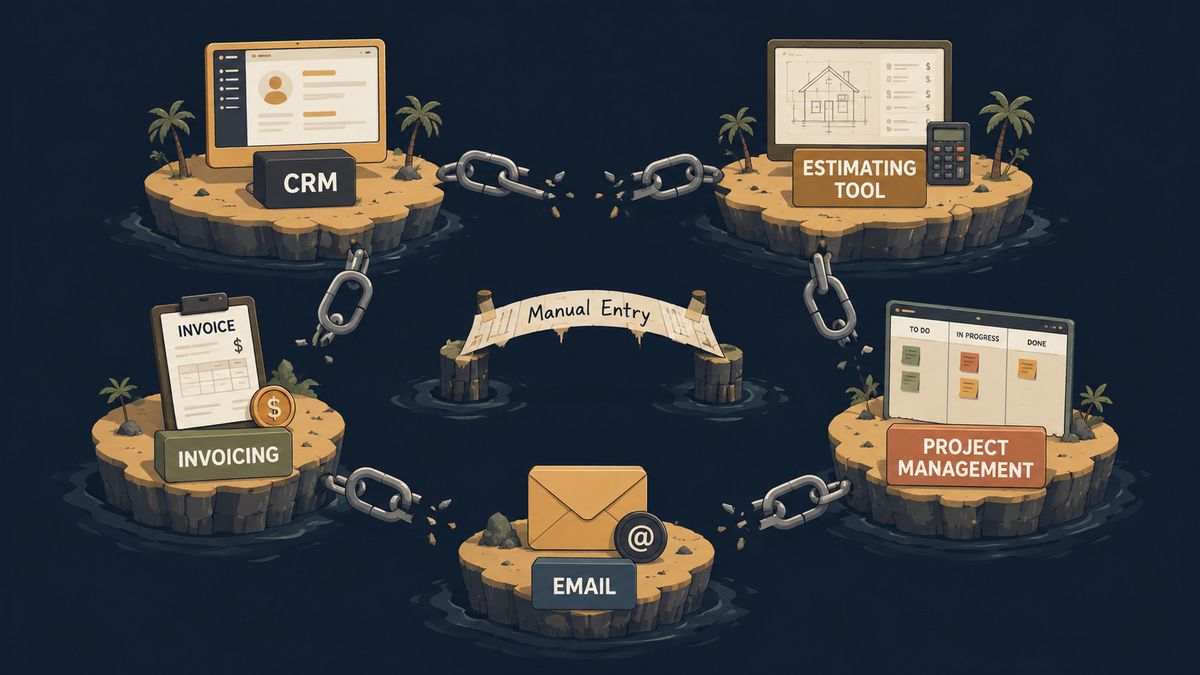
A contractor's business runs across multiple tools simultaneously. Estimates come out of one platform. Invoices come out of another. Project schedules live in a third. Subcontractor communication happens in text and email. Material orders run through supplier portals. And the CRM, supposedly the central hub, connects to none of these without significant manual effort or expensive custom development.
Most outdated construction CRMs offer a short list of native integrations: QuickBooks for accounting, maybe a calendar sync, and possibly a DocuSign connector. Beyond that, the API documentation is thin, the webhook support is limited, and any custom integration requires a developer who understands both the CRM's data structure and the contractor's other tools. For small and mid-sized renovation businesses, that development cost is prohibitive.
The practical consequence is data duplication. A lead gets entered in the CRM. When the estimate is sent, it gets entered again in the estimating tool. When the project is approved, it gets entered again in the project management platform. Every manual data transfer is an opportunity for an error, and every system running its own version of the truth is a gap waiting to become a problem.
Modern construction operations need API flexibility that allows data to flow automatically between systems: when a quote is accepted in the estimating tool, the CRM should update automatically, the project management platform should create a new job record, and the billing system should generate a deposit invoice. That level of connectivity requires real API infrastructure, not a curated list of approved integrations.
The contractors who have solved this problem have typically done it by adding automation tools like n8n, Make, or Zapier to bridge the gaps their CRM can't close natively. That works, but it adds complexity, ongoing maintenance, and another subscription to an already stretched stack.
Read More: How AI Can Eliminate Manual Work in Painting Businesses
4. Problem Three: Franchise Limitations That Handcuff Growing Businesses
The third failure gets far less attention than customization or integration but affects a significant portion of the contractor market: franchise limitations built into CRM platforms.
Many painting companies, restoration businesses, landscaping contractors, and home service operators work within franchise systems. When they invest in software, they're often required or strongly encouraged to use the franchisor-approved platform, or they're locked into a CRM for which the franchise system has negotiated a group license.
The problem is that the franchisor negotiated that CRM contract based on the average franchisee's needs, which may have nothing to do with the specific market, workflow, or growth stage of an individual location. A franchise operator in a high-density urban market with three crews and complex commercial clients is using the same software configuration as a solo franchise operator in a rural market handling residential repaints. The system is tuned for neither of them particularly well.
Beyond the fit problem, franchise CRM arrangements often come with data ownership concerns. Client lists, job histories, and communication records built inside a franchisor-controlled CRM may not fully belong to the franchisee if the relationship ends. The business owner may have spent years building a customer database that lives entirely within a platform they don't control.
Customization is also typically locked. Because the franchisor manages the platform configuration, individual franchisees often can't modify pipelines, add integrations, or adjust workflows to match their local operation. They're handed a system and told to use it as configured.
For ambitious franchise operators who want to build a genuinely competitive local business, these constraints are a significant drag on operational efficiency.
Read More: AI Marketing Automation for Roofing Companies
5. Why Outdated Construction CRMs Keep Getting Bought Anyway
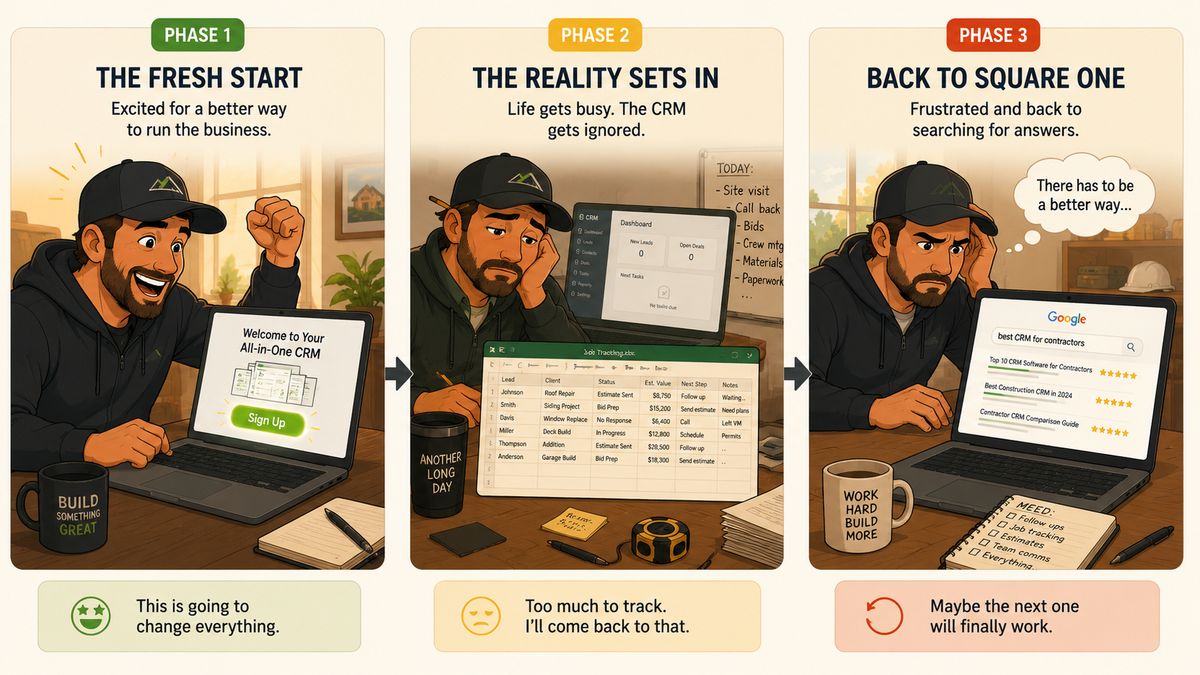
If contractor CRM problems are this consistent and this well-documented, why do contractors keep buying the same category of software that has disappointed them before?
Three reasons.
First, the marketing is built around the pain of not having a CRM rather than the specific limitations of particular platforms. Contractors buy based on the promise of organization and efficiency, which is real, rather than a rigorous evaluation of whether this specific software fits this specific business. By the time the fit problems emerge, the contract is signed, and the onboarding is done.
Second, the alternatives have historically been worse. The choice has often been between a generic CRM with limited customization and a specialty construction platform with even worse usability and an enterprise price tag. Contractors pick the lesser of two unsatisfying options.
Third, construction businesses are notoriously under-resourced when it comes to technology evaluation. The owner is managing crews, chasing invoices, and selling the next job. A thorough software evaluation requires time they don't have. They go with what a peer recommends or what shows up first in a search, which tends to be whatever platform has the largest marketing budget.
The result is a revolving door of CRM adoption and abandonment that costs contractors money, time, and accumulated client data every few years when they switch platforms or give up on the category entirely.
6. How AI Changes the Equation
The reason AI represents a genuine break from this pattern rather than just another technology layer is that it addresses the root causes of CRM failure rather than adding features on top of a broken foundation.
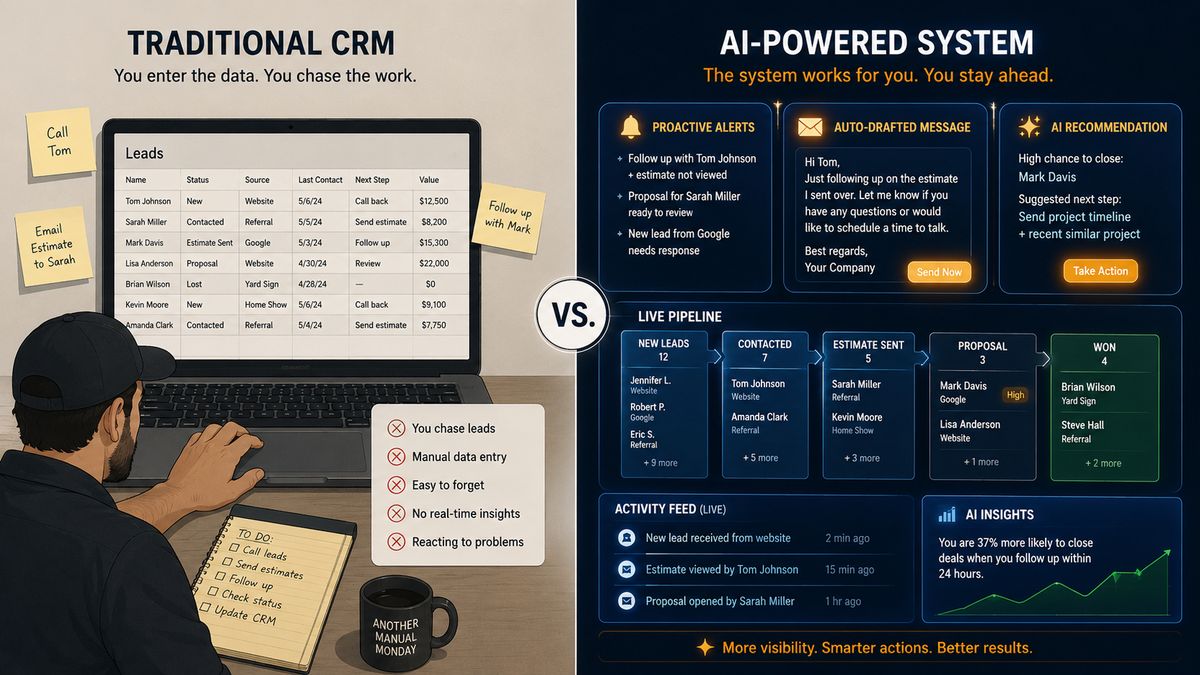
On customization: AI-powered systems can adapt to the way a specific contractor works rather than requiring the contractor to adapt to the system. Natural language interfaces allow contractors to describe what they need in plain English and have the system configure itself accordingly. Instead of navigating a settings menu to build a custom pipeline, a contractor describes the stages their jobs move through, and the system structures itself around that description.
On integration: AI automation tools have fundamentally changed what integration requires. Platforms like n8n, Make, and purpose-built AI workflow tools can connect virtually any two software systems through API calls without custom development, bridging the gaps that traditional CRM integrations never addressed. The automation layer that used to require a developer now requires configuration, and configuration is something an operations-minded business owner can manage.
On franchise limitations: AI tools can sit outside the franchisor-controlled CRM layer, capturing and organizing data in a system the contractor controls while still feeding required information into the franchise platform. The AI becomes the intelligence layer on top of the mandated system, adding the flexibility that the franchise CRM can't provide.
More fundamentally, AI changes what a CRM is capable of doing. A traditional CRM is a record-keeping system with some automation attached. An AI-powered system is an active participant in business operations: it notices when a lead has gone cold, drafts a follow-up without being asked, flags a proposal that should have been responded to, and surfaces the client most likely to book additional work this season. That shift from passive record to active tool is what makes AI worth discussing separately from the CRM category it's improving.
7. What an AI-Powered CRM Actually Does Differently
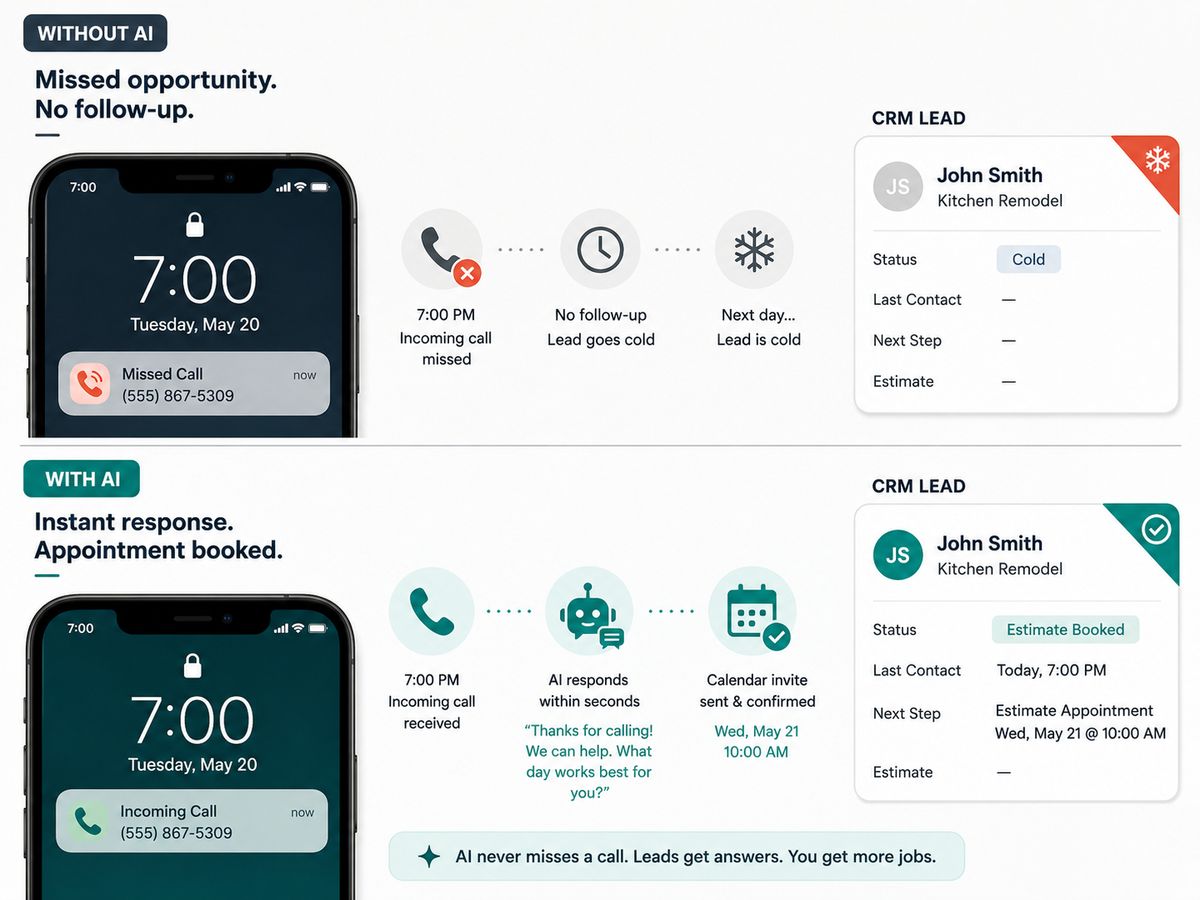
The distinction between a traditional CRM and an AI-augmented system is not primarily about features on a checklist. It is about the direction of effort.
In a traditional CRM, the contractor puts data in and gets reports out. The system is passive. It records what you tell it and shows you what you entered. Every follow-up, every pipeline update, every status change requires a human action.
In an AI-powered system, the relationship is inverted. The system monitors your pipeline and flags what needs attention. It drafts the follow-up message and waits for your approval before sending. It notices that a high-value lead went quiet after a site visit and suggests a re-engagement message tailored to what was discussed. It generates a weekly summary of where revenue opportunities stand without you running a report.
For contractors dealing with contractor CRM problems rooted in adoption, this matters enormously. The reason most CRMs end up abandoned is that keeping them current requires consistent manual effort that competes with the demands of running an active job site. An AI system that updates itself based on email activity, call records, and calendar data dramatically reduces the maintenance burden that kills CRM adoption.
The other dimension in which AI meaningfully outperforms traditional CRM is the gap between inquiry and estimate. Most construction leads are lost not after a quote is rejected but before a quote is ever sent. A prospect calls, the owner is on a job, the message doesn't get followed up on until two days later, and the prospect has already booked someone else. AI voice and communication tools that capture leads, respond within minutes, and automatically book an estimate slot recover jobs that a traditional CRM never even had the chance to record.
8. What Contractors Should Look for Instead
Given these structural problems with traditional CRMs, what should a contractor actually look for when evaluating their options in 2026?
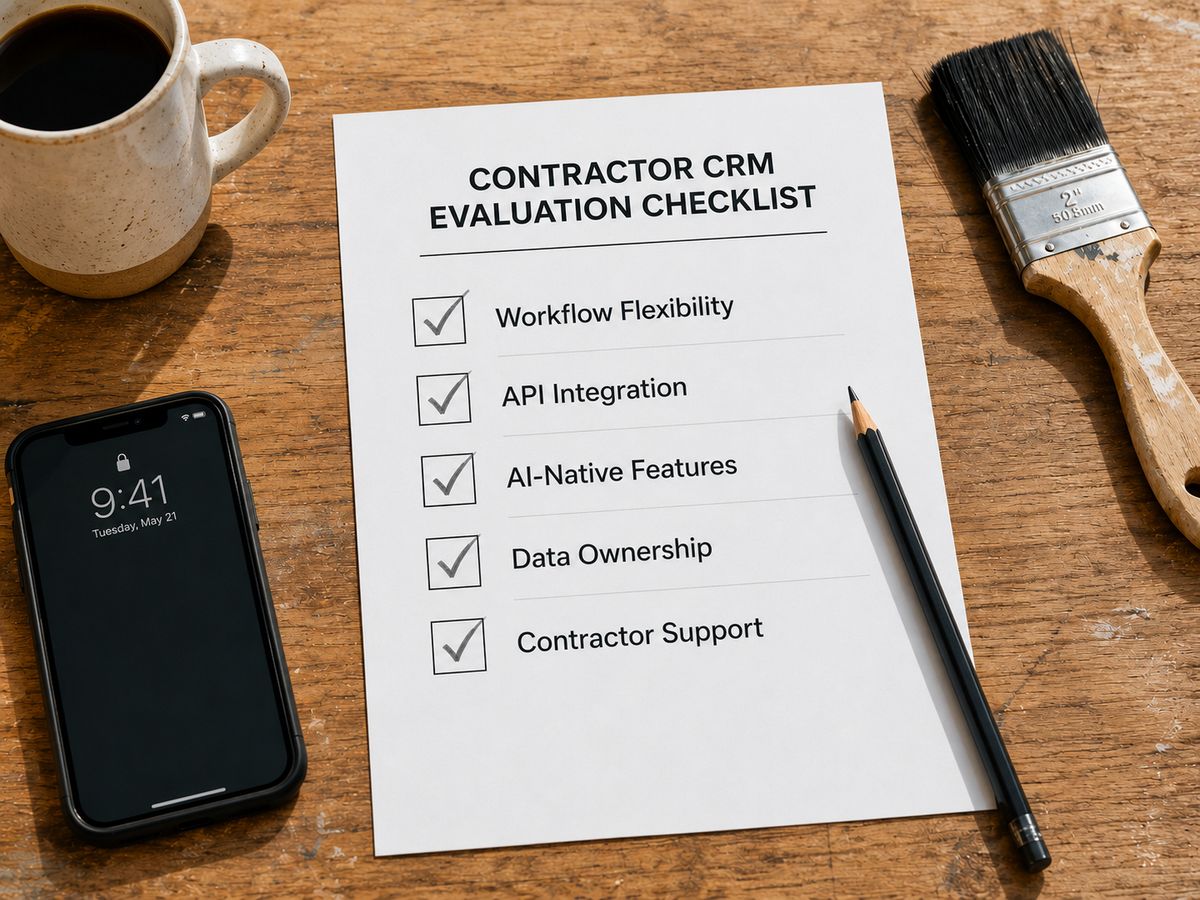
Workflow flexibility, not just field customization. The ability to rename a pipeline stage is not customization. Real flexibility means being able to restructure the entire workflow, define custom data relationships, and connect the CRM logic to the way your specific jobs flow from inquiry to completion.
Open API or native automation support. If a CRM can't connect to your estimating tool, your invoicing software, and your project management platform without manual data entry, it is not solving your integration problem. It is just adding another silo. Evaluate integrations before evaluating features.
AI-native features, not AI as an add-on. Many established CRM platforms are bolting AI features onto software architectures that were never designed to support them. Look for systems where AI is embedded in the core workflow: automatic lead follow-up, proactive pipeline alerts, intelligent scheduling, and communication drafting that learns from your business patterns over time.
Data ownership clarity. Before signing any CRM contract, understand who owns the client data, what happens to it if you leave the platform, and whether you can export a complete, structured copy of your records at any time. This matters especially for franchise operators.
Contractor-specific onboarding and support. Generic CRM support is not built for the questions a painting contractor or renovation business actually needs answered. Platforms that specialize in the contractor market, or have specific experience with trade businesses, will get you operational faster and with fewer dead ends.
9. The Role of fatcamel.ai in This Shift
fatcamel.ai is built around a specific thesis: that the contractor market deserves software designed for the way trade businesses actually operate, not software designed for enterprise sales teams and reskinned for the job site.
The platform focuses on the three layers where traditional CRM fails contractors most consistently. On customization, it allows contractors to configure workflows around their actual job stages rather than forcing them into a generic pipeline. On integration, it is built with an automation-first architecture so that data flows between tools rather than being re-entered manually. On the franchise problem, it is designed as an operational layer that can work alongside mandated franchise systems, giving local operators the intelligence and automation they need without requiring them to abandon their franchisor's required platform.
The AI layer in fatcamel.ai is not a chatbot or a reporting feature. It is woven into the operational logic of the platform: following up on cold leads automatically, flagging stalled proposals, capturing inbound inquiries through voice and text, routing them into the pipeline, and generating the communication contractors would otherwise have to draft themselves.
For contractors who have been through one or two CRM cycles that didn't stick, fatcamel.ai is worth examining not as another CRM but as an AI operations layer built to solve the specific problems that made previous tools fail.
Visit fatcamel.ai to see how the platform approaches contractor operations in practice.
10. Frequently Asked Questions
Why do contractor CRM problems happen even with purpose-built software?
Even software marketed specifically to contractors often inherits the structural assumptions of general-purpose CRM platforms. The interface may use construction terminology, but the underlying pipeline logic, data model, and integration architecture are frequently the same as those of any other CRM. Surface-level industry customization doesn't fix structural misfit.
What is the main reason why CRM fails contractors who adopt it with genuine effort?
The most common reason is the maintenance burden. Keeping a CRM current requires consistent manual data entry that competes directly with the demands of running active jobs. When updating the CRM takes time away from the job site, it gets deprioritized. AI systems that reduce manual entry by updating automatically based on call logs, emails, and calendar data dramatically improve adoption rates.
How does an outdated construction CRM hurt a contractor's bottom line?
The most direct financial impact is lost leads. Contractors lose roughly 30 percent of leads from slow follow-up alone, and traditional CRMs that require manual follow-up initiation can't reliably prevent that. Beyond lead loss, outdated systems contribute to proposal errors, missed upsell opportunities, and client communication gaps that erode repeat business.
Can AI actually fix the franchise CRM limitation problem?
Yes, with the right approach. AI automation tools can sit as an operational layer above a franchisor-mandated CRM, capturing data, triggering workflows, and providing intelligence that the base platform doesn't offer, while still feeding required information into the franchise system. This allows franchise operators to run a smarter local operation without violating their franchisor's technology requirements.
What is the difference between a CRM with AI features and an AI-native CRM?
A CRM with AI features has added AI as a module or add-on to an existing platform, often for specific tasks like email drafting or sentiment analysis. An AI-native system is designed from the ground up with AI embedded in the core workflow logic: it acts proactively, learns from patterns in your business data, and reduces the manual effort required to keep the system accurate and useful.
How long does it take a contractor to see ROI from an AI-powered CRM?
Contractors who configure automated lead follow-up and proposal tracking typically see measurable improvement within the first thirty days: fewer leads going cold, faster response times, and more estimates converting to booked jobs. Deeper operational benefits from AI scheduling, communication automation, and pipeline intelligence emerge over a full project cycle as the system learns the patterns specific to that business.
11. References
https://buildr.com/blog/construction-crm/
https://www.servicetitan.com/blog/best-construction-crm
https://projul.com/blog/crm-construction-guide/
https://pipelinecrm.com/blog/best-practices-crm-implementation-construction/
https://pipelinecrm.com/blog/best-crm-software-construction/
https://www.softr.io/blog/best-crm-for-construction
https://monday.com/blog/crm-and-sales/crm-for-construction/
https://www.projectmark.com/blog/common-challenges-in-construction-crm-implementation