
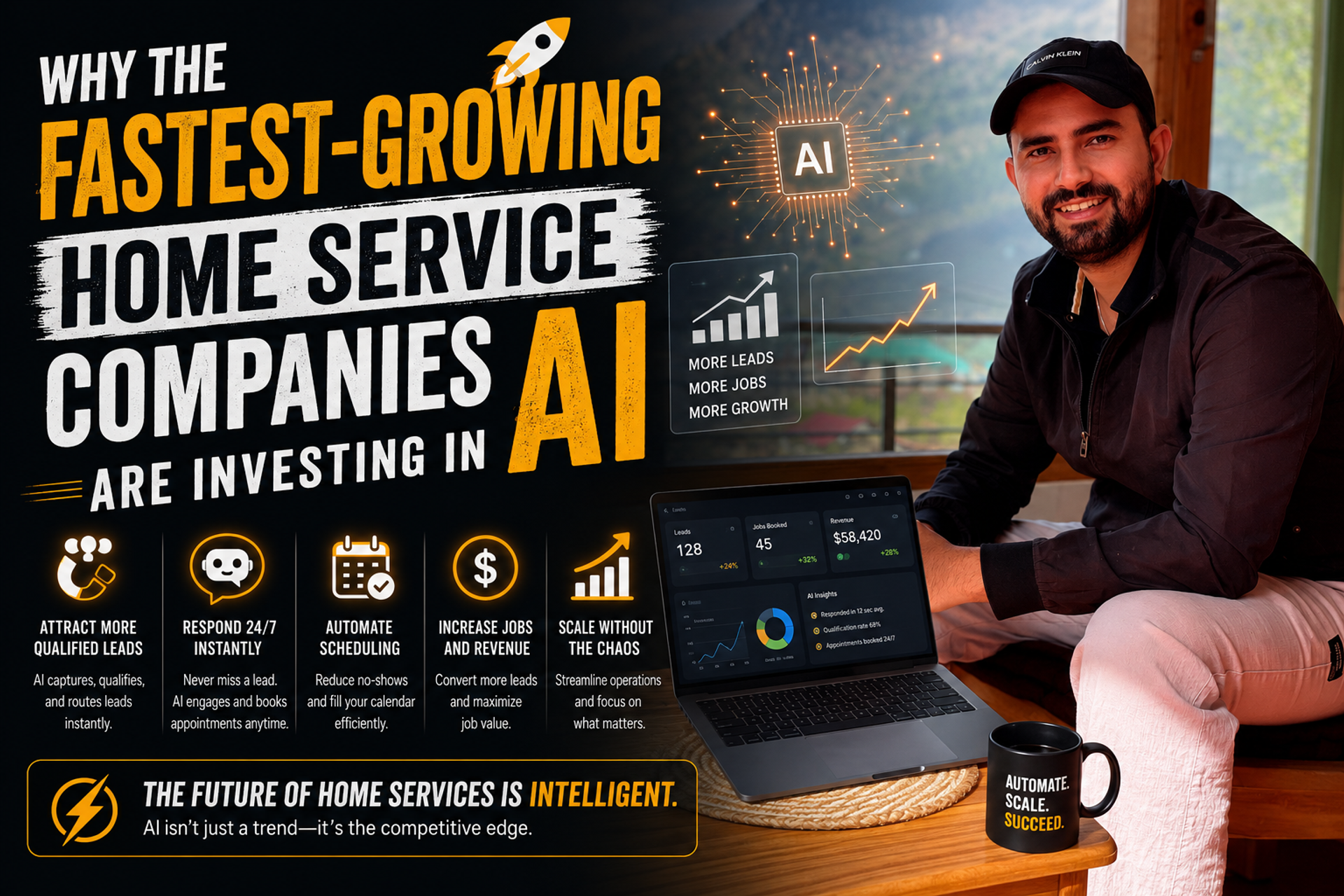
A few years ago, AI was a conversation happening in tech boardrooms and research labs. Today it is happening on the exhibition floor at InstallerSHOW.
At InstallerSHOW 2026, we noticed something that would have been unusual at the same event just two or three years earlier. Business owners from HVAC companies, plumbing contractors, electrical businesses, and solar installers were asking about AI. Not cautiously, and not theoretically. They were asking which tools were worth using, how quickly they could be set up, and what kind of return other businesses were seeing from them.
The shift in the conversation was striking. AI had moved from something these business owners had read about to something they were actively looking to implement. And the reason was straightforward: the businesses around them that had already started using it were visibly pulling ahead.
More booked jobs from the same volume of leads. Faster response times without hiring more office staff. Customer communication that was consistent and professional regardless of how busy the team was. The results were tangible enough that businesses still on the fence were feeling the pressure to act.
This article explains what is driving that shift, which specific AI tools are delivering the most impact in the home services sector, and what the businesses investing in AI right now are gaining over those that are waiting.
Table of Contents
Common Business Bottlenecks
AI Use Cases for Home Service Businesses
- AI Chatbots
- AI Voice Agents
- Lead Qualification
- Automated Outreach
Real Business Benefits
- More Booked Jobs
- Faster Response Times
- Better Customer Experience
Conclusion
Frequently Asked Questions
Common Business Bottlenecks
Before exploring what AI can do, it is worth being specific about the problems it is solving. Because the appeal of AI in home services is not about technology for its own sake. It is about fixing the operational bottlenecks that are costing businesses money every single day.
Lead Management
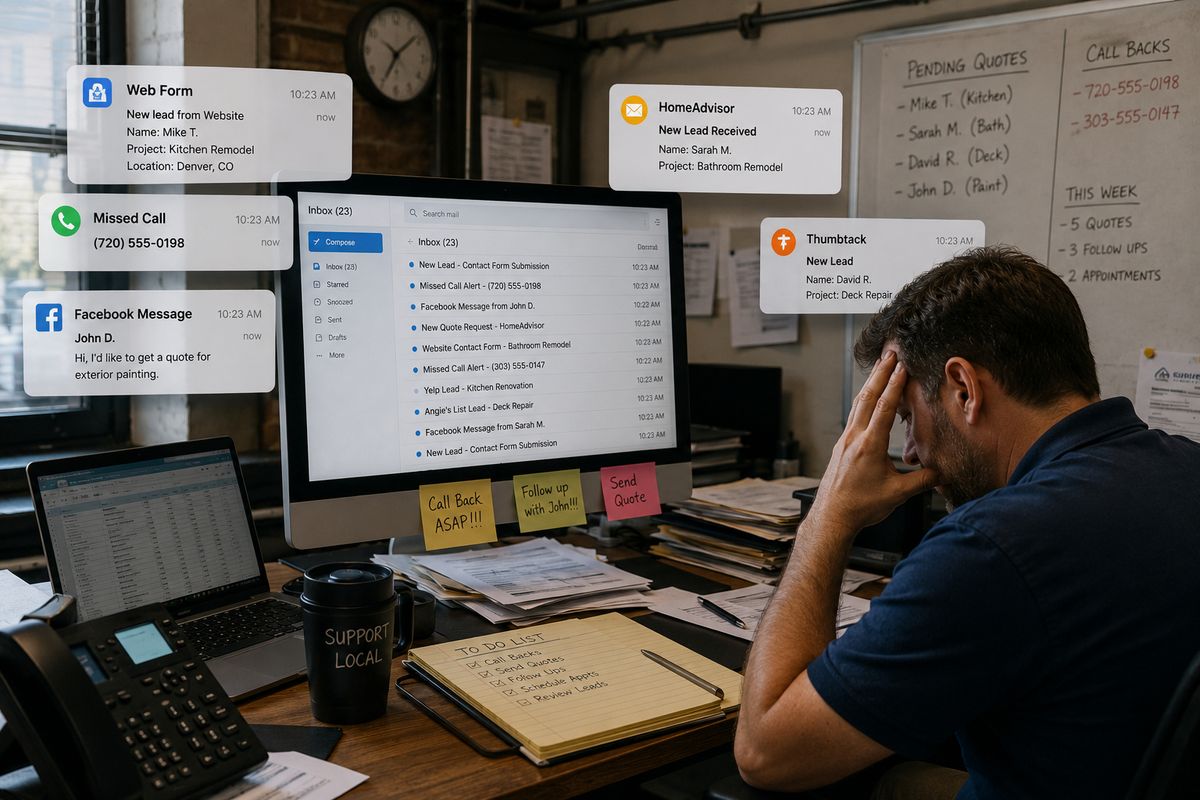
The majority of home service businesses have a lead management problem that they have normalised to the point of no longer questioning it. Leads come in through multiple channels simultaneously: website forms, phone calls, social media messages, referrals, and comparison sites. Each one requires a timely response, accurate recording, and consistent follow-up. Without a system managing all of that automatically, something always falls through the cracks.
The result is a conversion rate that is lower than it should be, and a marketing spend that is generating less return than the business is paying for. Most owners know this is happening. The challenge is that fixing it manually would require hiring more office staff, and the economics of doing so rarely make sense at the volume of leads a typical home service business receives.
Scheduling
Scheduling is one of the most time-consuming administrative tasks in any home service business. Matching engineer availability to customer requirements, managing travel time between jobs, handling rescheduling requests, and communicating booking details to both the team and the customer, all of this adds up to a significant daily overhead for the office team.
When scheduling is managed manually, it is also prone to error. Double bookings happen. Travel time is underestimated. Engineers arrive without full information about the job. Customers are not notified of delays. Each of these small failures creates friction that damages the customer experience and puts pressure on the team.
Customer Communication
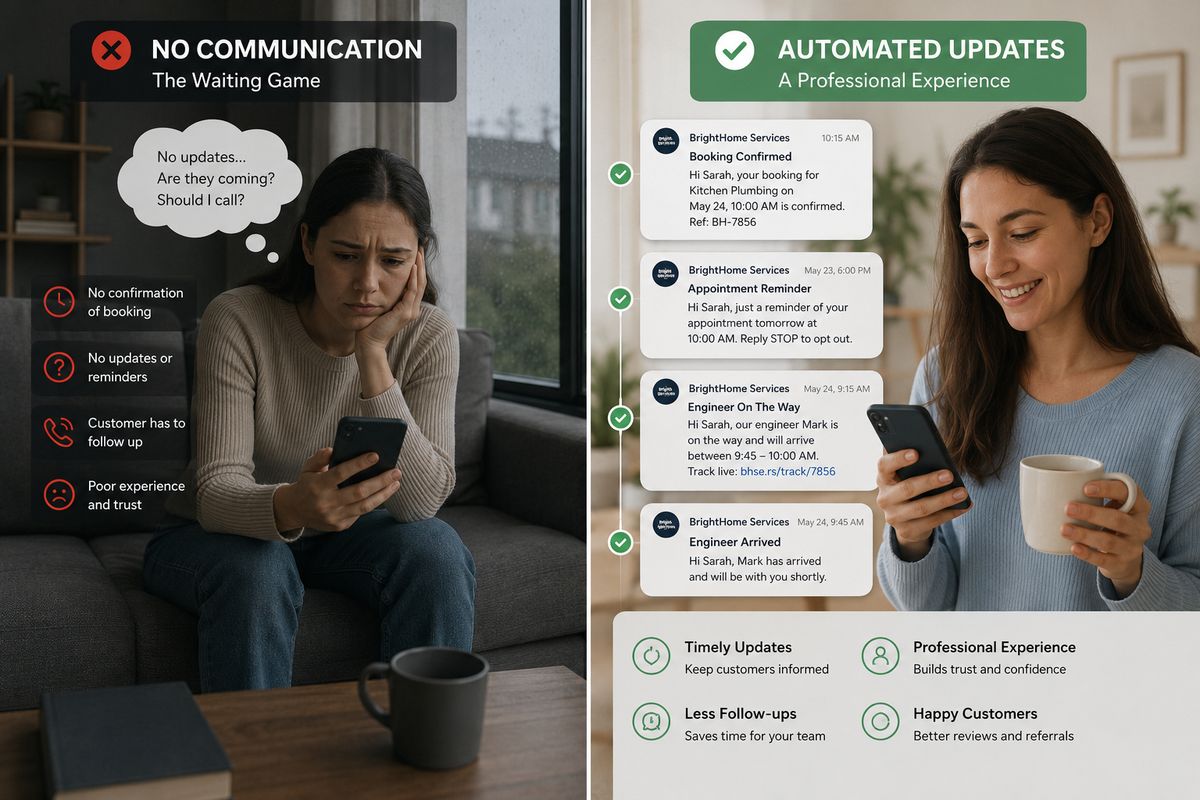
Consistent, professional customer communication is one of the clearest markers of a well-run home service business, and one of the hardest things to maintain manually as the business grows.
Confirmation messages, appointment reminders, engineer arrival notifications, post-job follow-ups, review requests, and seasonal service reminders all need to go out at the right time to the right person with the right information. When this is handled manually, it depends entirely on whoever is in the office having the time and the memory to make it happen. Inevitably, it does not happen consistently.
The businesses that get this right create a customer experience that feels professional, attentive, and organised at every stage of the interaction. The ones that do not leave customers feeling uncertain about what is happening, which damages trust and reduces the likelihood of repeat bookings and referrals.
Sales Follow-Up
Sales follow-up is the activity that home service businesses most consistently fail to do well, and the one with the most direct impact on revenue.
When a quote goes out, the likelihood of it converting into a booked job decreases with every day that passes without follow-up. Most businesses know this. Most businesses also have days where the volume of live jobs, incoming calls, and operational demands makes it impossible for anyone to sit down and work through a list of outstanding quotes. The follow-up gets pushed back. Then pushed back again. Then the quote is three weeks old and the customer has moved on.
Multiply that across a year, and the revenue lost to inadequate quote follow-up alone is substantial for most home service businesses.
AI Use Cases for Home Service Businesses
The reason AI is generating such strong results in home services is that it addresses each of the bottlenecks above directly, without requiring the business to hire more staff, change how the team operates day to day, or invest in complex infrastructure.
AI Chatbots
An AI chatbot deployed on a home service company website handles the first stage of customer interaction automatically, at any time of day or night.
When a homeowner visits the website and has a question, the chatbot responds immediately. It can answer questions about services, provide indicative pricing for common jobs, collect the information needed to qualify the lead, and route the customer to the next step, whether that is booking an appointment, receiving a callback, or being connected to the team during office hours.
For businesses losing leads because enquiries arrive outside of working hours and nobody is available to respond, an AI chatbot is one of the highest-impact changes available. A customer searching for an emergency plumber at 9pm does not want to leave a voicemail. A chatbot that engages them immediately, collects their details, and confirms that the business will be in touch keeps that lead in play rather than sending them to a competitor.
The quality of AI chatbot technology has improved dramatically over the past two years. Modern systems handle natural, conversational exchanges rather than rigid scripted menus, which means customers get a genuinely helpful experience rather than a frustrating one.
AI Voice Agents
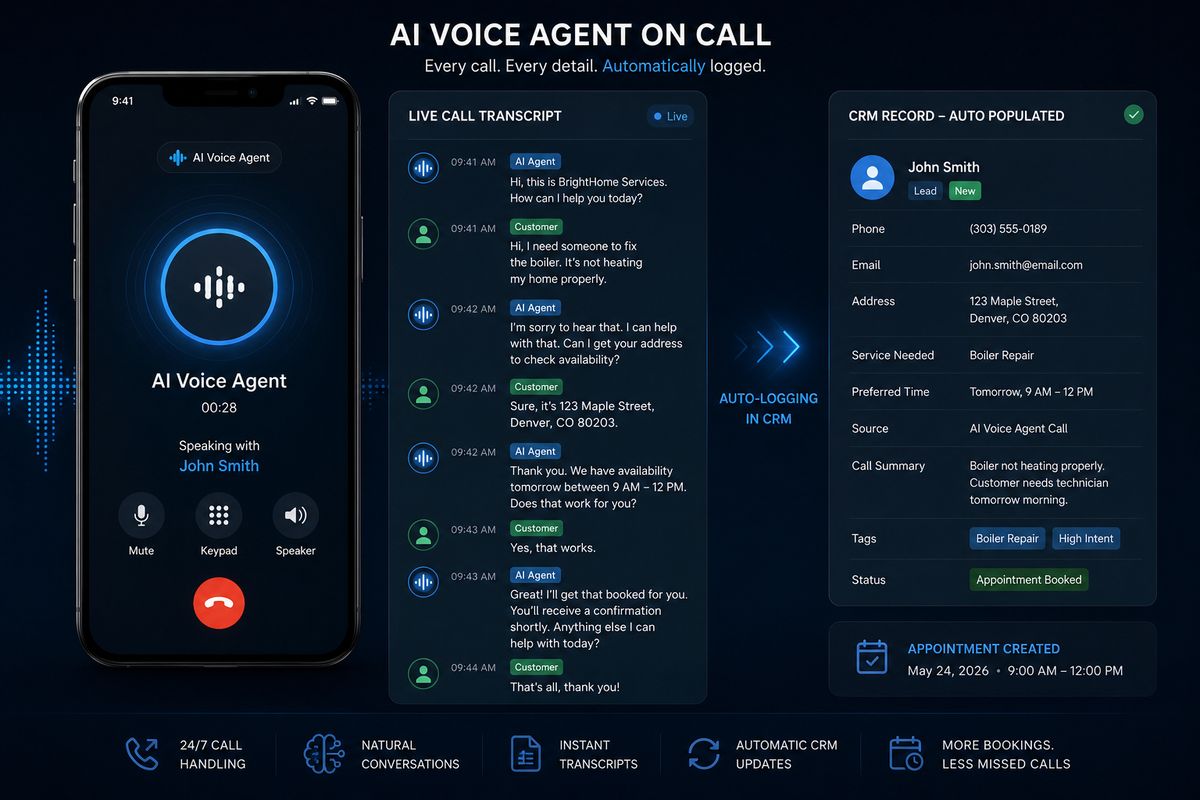
AI voice agents take the capability of chatbots and apply it to inbound and outbound phone calls, which remain the primary contact channel for a large proportion of home service customers.
An AI voice agent can answer inbound calls, handle routine enquiries, collect lead information, and book appointments without any human involvement. For businesses where calls are going unanswered during busy periods or outside of office hours, this means every call gets a response. No more missed opportunities because the phone rang when everyone was on a job.
On the outbound side, AI voice agents can make calls to new leads within minutes of an enquiry being received, significantly improving the speed of initial contact. They can also work through lists of dormant contacts for reactivation campaigns, handling the volume of outreach that would be impossible for a human team to manage manually.
It is worth being clear about what AI voice agents are and are not. They are not indistinguishable from a human, and the best implementations are transparent about what they are. But they are highly effective at handling structured conversations efficiently, and customers are increasingly comfortable with them for routine interactions.
Read More: How to Automate Follow-Ups for Renovation Leads (SMS, Email & AI Calls)
Lead Qualification
Not every lead that comes into a home service business is equally likely to convert, and spending equal time on every enquiry regardless of quality is an inefficient use of the team's attention.
AI lead qualification tools assess incoming leads based on a set of defined criteria: the type of service requested, the location, the urgency, the information provided, and the engagement behaviour of the contact. High-quality leads are prioritised and passed to the team immediately. Lower-quality or incomplete leads are routed into automated nurture sequences that continue working on them without requiring manual effort.
The result is a sales team that spends more of its time on the leads most likely to convert, and an automated system handling the ones that need more nurturing before they are ready. Conversion rates improve because attention is concentrated where it matters most, and fewer opportunities are lost because the system continues working on every lead regardless of its initial quality.
Automated Outreach
Automated outreach combines the channels available: SMS, email, and voice, into coordinated sequences that reach leads and customers at the right time with the right message, without anyone on the team managing the process manually.
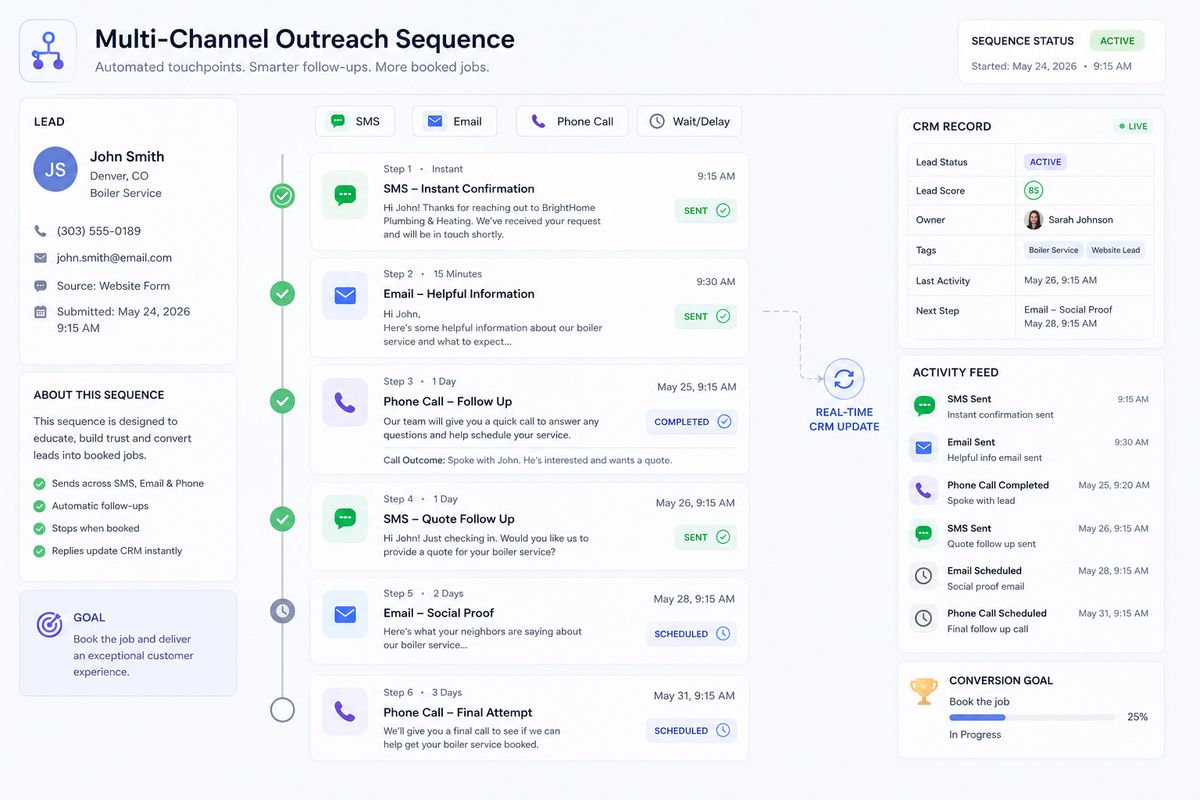
For new leads, an automated outreach sequence might begin with an SMS within 30 seconds of an enquiry, followed by an email with more detail, followed by an AI voice call if the first two messages go unanswered. Each step is logged automatically in the CRM, and the sequence pauses the moment the contact responds.
For existing customers, automated outreach handles the full lifecycle of communication. Annual service reminders go out at the right time. Seasonal campaigns reach customers before the heating season begins. Referral requests go out after a completed job. Lapsed customers receive reactivation messages at defined intervals. All of this happens on a schedule, consistently, without anyone needing to manage it day to day.
To Know More: 9 Best AI Tools for Home Renovation Contractors in 2026
Real Business Benefits
The case for AI in home services is ultimately made not by the technology itself but by the results it produces. Here is what businesses implementing these tools are consistently reporting.
More Booked Jobs
The most direct and measurable benefit of AI automation in home services is an increase in booked jobs from the same volume of leads. When every enquiry receives an immediate response, every quote receives structured follow-up, and every dormant contact is reached through a reactivation campaign, the conversion rate from lead to booked job improves significantly.
Businesses that have moved from manual follow-up processes to automated sequences typically report conversion rate improvements of between 20 and 40 percent in the first six months. That improvement does not come from generating more leads. It comes from converting more of the leads that were already there.
For a business generating 100 enquiries a month with an average job value of £600, a 30 percent improvement in conversion rate is worth an additional £18,000 in monthly revenue from the same marketing spend. The financial case is straightforward.
Faster Response Times
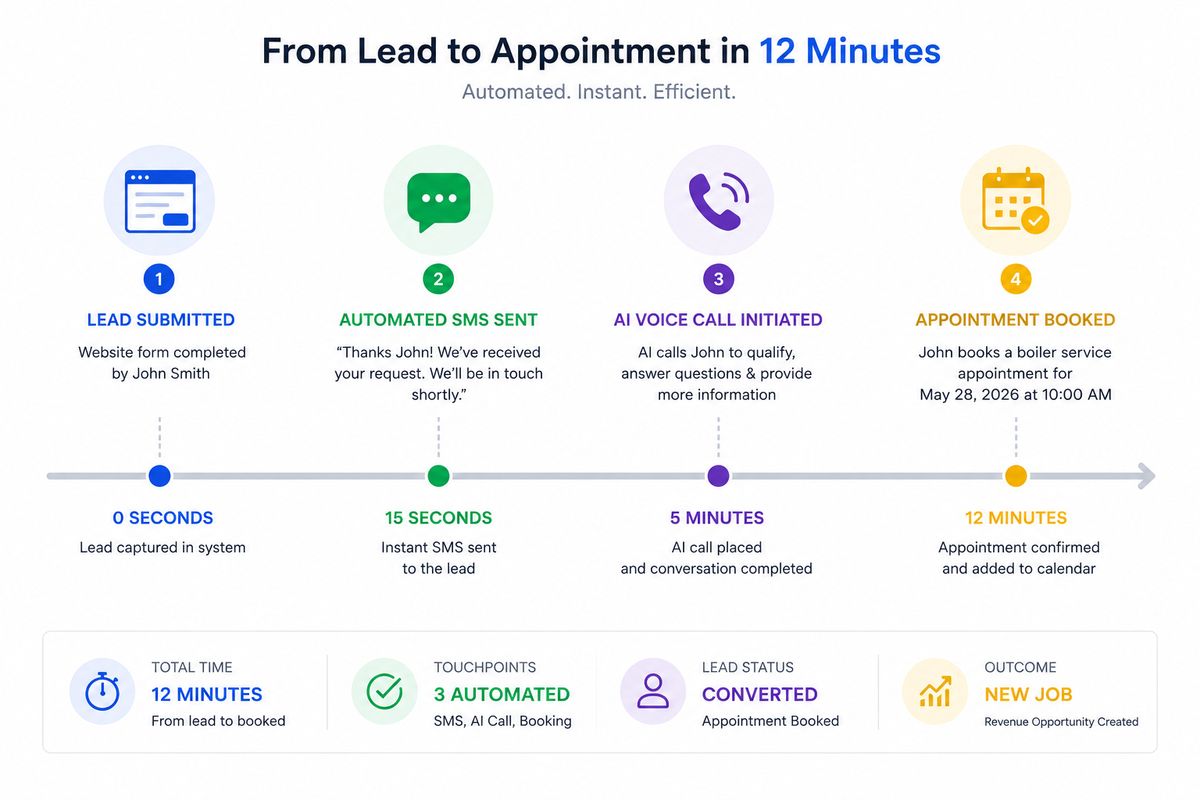
Speed of response is one of the single most important factors in home service lead conversion, and it is the area where AI delivers the most immediate and dramatic improvement.
Manual response processes, however well-intentioned, cannot reliably deliver sub-five-minute response times across every enquiry, at every time of day. AI can. An automated system that sends an SMS within seconds of a web form submission, initiates a voice call within minutes, and sends a detailed email within the hour operates at a speed that a human team simply cannot match consistently.
The competitive impact of this is significant. In a market where multiple businesses are receiving the same enquiry simultaneously, the first to respond establishes an immediate advantage. Businesses with automated response systems are consistently that business.
Better Customer Experience
Beyond the direct commercial benefits, AI automation materially improves the experience customers have with a home service business from the first point of contact through to job completion and beyond.
Customers receive immediate acknowledgement of their enquiry. They receive confirmation of their appointment. They receive a reminder the day before. They receive a notification when the engineer is on the way. They receive a follow-up message after the job is complete. They receive a review request at the right moment. Every one of these touchpoints happens automatically and consistently, creating the impression of a business that is highly professional and genuinely attentive.
In a sector where customer experience is often an afterthought — where the quality of the work is prioritised over the quality of the surrounding communication — this level of consistency is a genuine differentiator. It drives higher review scores, more repeat bookings, and stronger referral rates, all of which compound over time into a more resilient and profitable business.
Conclusion
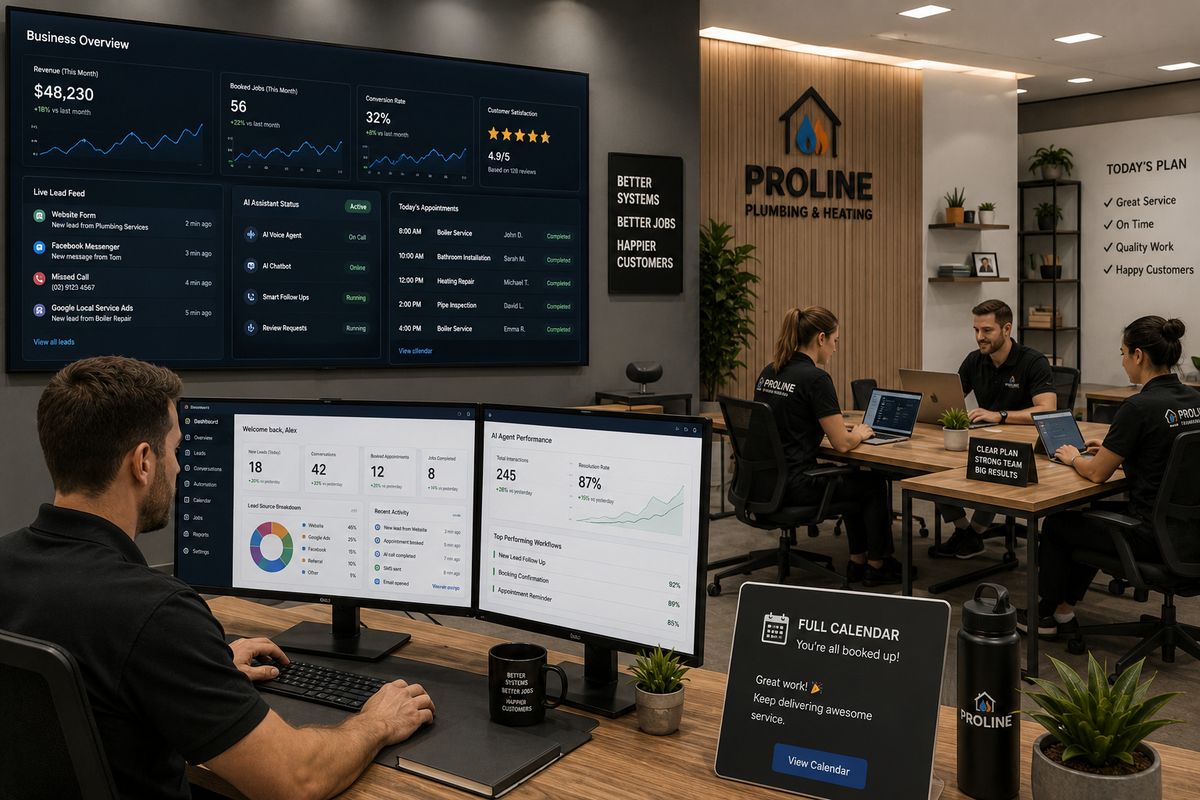
The home services industry is at an inflection point. The businesses investing in AI right now are not doing so because they are technology enthusiasts. They are doing so because the results are real, the tools are accessible, and the competitive pressure to act is building.
Lead management, scheduling, customer communication, and sales follow-up are the four areas where the gap between manual and automated processes is most visible, and most costly. AI tools built for each of these areas are already being used by home service businesses across HVAC, plumbing, electrical, and renewables to convert more leads, respond faster, and create customer experiences that drive repeat business and referrals.
The businesses that move first on this will build an advantage that compounds over time. Faster response means more conversions, which means more revenue, which means more capacity to invest in the systems that maintain the advantage. The ones that wait will find themselves competing against businesses that are structurally more efficient, operationally more consistent, and fundamentally better positioned to win the same leads.
The conversation at InstallerSHOW 2026 was about whether businesses should be investing in AI. The conversation at InstallerSHOW 2027 will be about how far behind the ones that did not invest have fallen. The window for a head start is now, and it will not stay open indefinitely.
Frequently Asked Questions
Is AI genuinely relevant for small home service businesses, or is it only for large companies?
AI tools built for home services are designed to be accessible and cost-effective for businesses of all sizes. In fact, smaller businesses often see the most dramatic impact, because every lead that would otherwise have been missed represents a significant share of their monthly revenue. The tools do not require large teams or technical expertise to operate.
How quickly can AI automation be set up for a home service business?
Most AI automation systems for home services can be operational within one to two weeks. The setup process involves connecting the tools to existing channels, configuring the follow-up sequences, and integrating with the business CRM. Businesses working with a specialist implementation partner can typically be up and running faster.
Will customers respond negatively to automated messages?
When automated messages are well-written, relevant, and timely, the vast majority of customers respond positively. Most people appreciate receiving an immediate response to an enquiry or a reminder about an upcoming appointment. The key is ensuring the communication feels helpful and professional rather than generic or intrusive, which is a function of how the sequences are set up rather than the automation itself.
What is the return on investment from AI automation for home service businesses?
The return varies depending on the business, the volume of leads, and the baseline conversion rate, but the principle is consistent. Businesses that improve their lead response speed and follow-up consistency typically see conversion rate improvements of 20 to 40 percent in the first six months. Combined with the revenue generated from lead reactivation campaigns, the return on investment from AI automation is typically achieved within the first two to three months of implementation.
How does FatCamel AI help home service businesses implement AI?
FatCamel AI designs and implements AI automation systems specifically for HVAC, plumbing, electrical, and home service businesses. This covers AI chatbots, voice agents, automated lead follow-up, sales sequences, CRM integration, and lead reactivation campaigns. The goal is to get the right systems running quickly and effectively, so the business starts seeing results without a long and complicated setup process.