
Somewhere in your CRM right now, there is a homeowner who enquired about a full kitchen renovation eight months ago. There is a property owner who asked about a whole-house remodel last spring and never heard back after the first call. There is someone who got an estimate for a thirty-thousand-dollar bathroom and basement project and went quiet.
These are not dead leads. These are high-ticket renovation projects sitting untouched in your pipeline because the follow-up has stopped.
Renovation projects are not impulse purchases. They are major financial decisions that often take months to move from initial interest to a signed contract. A lead that goes quiet for ninety days has not necessarily said no. They might be waiting on financing, comparing contractors, dealing with a life event, or simply not ready yet. But if no one follows up during that window, the project goes to whichever contractor happens to still be in their inbox when they are ready to move.
This guide breaks down exactly how to build an automated follow-up system using SMS, email, and AI voice calls that brings old renovation leads back to life and converts the high-ticket projects that manual follow-up was always going to miss.
Table of Contents
Why Old Renovation Leads Are Your Highest-ROI Opportunity
The Three-Channel Follow-Up System: SMS, Email, and AI Calls
Building the Automated SMS Follow-Up Sequence
Email Follow-Up: The Backbone for High-Ticket Decisions
AI Voice Calls: Reaching the Leads That Never Reply
The Full Reactivation Flow, Start to Finish
How FatCamel AI Runs the Complete Follow-Up System
FAQ
References
Why Old Renovation Leads Are Your Highest-ROI Opportunity
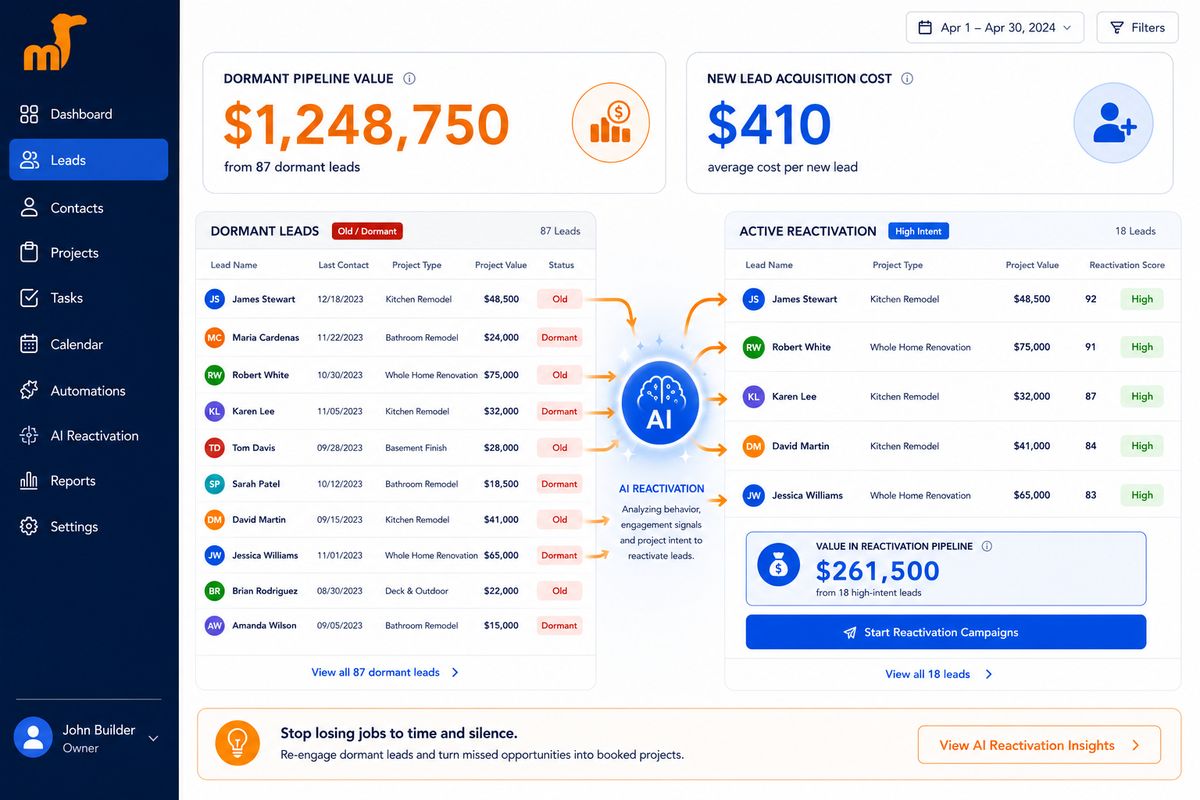
Every renovation business has a graveyard of old leads sitting in its CRM. People who requested a quote, had a conversation, maybe even got an estimate, and then disappeared. Most contractors look at this list and assume those people are gone. They are not.
Here is what actually happened to most of those leads. They were not ready at the time. Maybe they were getting other quotes, and the timeline stretched. Maybe a family situation came up, and the project got delayed. Maybe they were waiting to sell a property or secure financing before committing to a thirty or fifty-thousand-dollar renovation.
The project did not disappear. It just moved further down their list of priorities. And eventually, it moves back up. The question is whether your business is still there when it does.
Old leads are the highest-ROI opportunity in a renovation business for one simple reason: the acquisition cost has already been paid. You already spent the marketing dollars to generate that lead. You may have already done a site visit or sent an estimate. All of that investment is sitting dormant. Reactivating even a fraction of those leads generates revenue at a fraction of the cost of generating brand-new leads through advertising.
And because renovation projects are high-ticket, the math is dramatic. If your average renovation project is worth fifteen thousand dollars and you have two hundred old leads sitting dormant, reactivating just ten percent of them at a typical close rate represents a meaningful revenue injection that requires zero new ad spend.
The problem has never been that these leads are unreachable. The problem is that manually reaching out to 200 old leads across multiple channels, with the right timing and messaging, is not something any renovation business has the staff to do consistently. That is exactly the gap automation fills.
Read More: Why Fast Response Wins Painting Jobs (And How to Automate It in 2026)
The Three-Channel Follow-Up System: SMS, Email, and AI Calls
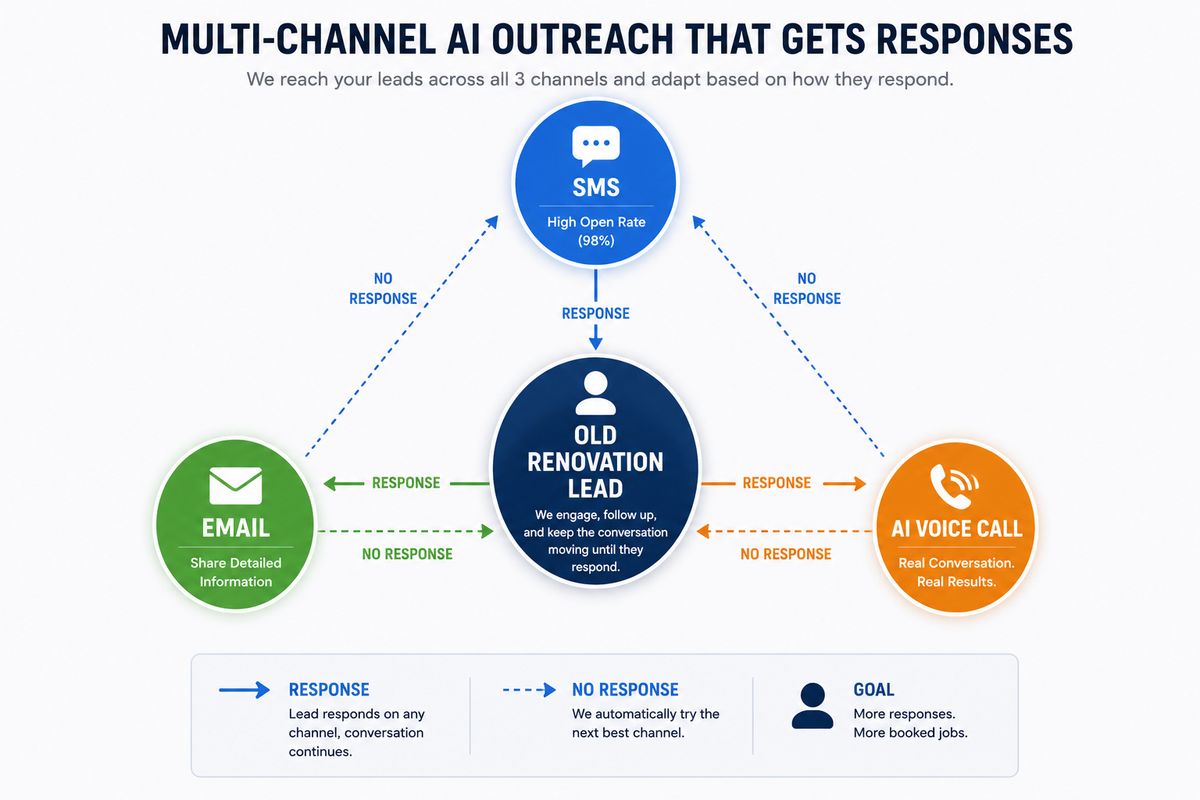
Reactivating old renovation leads is not about picking the single best communication channel. It is about using three channels together, each playing a different role, so that no matter how a prospect prefers to engage, the system reaches them.
SMS is fast, direct, and has extremely high open rates. For a renovation lead who has gone quiet, a text message is far less likely to be ignored than an email sitting in a crowded inbox. SMS works best for short, low-pressure check-ins that are easy to respond to with a quick reply.
Email gives you space. High-ticket renovation decisions involve detail: project scope, timelines, budget considerations, and material options. Email is where you can share a relevant case study, a useful planning resource, or a clear next step without it feeling like a text message demanding an immediate answer.
AI voice calls solve the problem that neither SMS nor email can. Some leads simply do not respond to text or email, no matter how well-timed or well-written. A phone call, especially one that arrives at the right moment with the right context, can re-engage a prospect who has mentally filed your business under "dealt with" without ever making a final decision.
The reason this three-channel system works for high-ticket renovation leads specifically is that big decisions involve multiple touchpoints across multiple contexts. The homeowner who ignores an email on their work computer might reply to a text on their phone that evening. The prospect who never replies to either might pick up a phone call because it feels more personal and immediate.
Used together as a coordinated sequence rather than three disconnected efforts, these channels reach significantly more of your dormant pipeline than any single channel could on its own.
Building the Automated SMS Follow-Up Sequence
SMS is the fastest way to re-open a conversation with an old renovation lead, and it works because it feels personal and immediate in a way that email often does not.
The key to SMS reactivation is keeping it short, low-pressure, and easy to respond to. A renovation lead who has not heard from you in months does not want a sales pitch. They want a friendly nudge that makes it easy to pick the conversation back up if the timing is right, and easy to ignore without guilt if it is not.
Initial reactivation text: A short message that references the original inquiry without being pushy. Something like a check-in asking if the project they enquired about is still something they're planning, with an easy way to reply if so.
Follow-up text, five to seven days later, if no response: A slightly different angle. Perhaps referencing a relevant detail, like material availability or seasonal timing for the type of project they were considering, framed as useful information rather than a sales push.
Final SMS touchpoint: A brief message that lets them know you are happy to pick things back up whenever the timing works for them, with no further texts planned unless they respond. This respects their inbox while leaving the door open.
If a lead responds positively at any point, the automated sequence stops immediately, and the conversation is handed to a real person on your sales team with the full context of the original inquiry and everything since. If the lead does not respond to the SMS sequence, they move into the email sequence next.
The SMS sequence is deliberately brief. Its job is not to close the deal. Its job is to get a reply, a thumbs up, a "yes, still interested," anything that re-opens the line of communication. Everything after that happens in a real conversation or through the next channel in the sequence.
Read More: How to Reactivate Dead Painting Leads Using AI Automation in 2026 (Full System Breakdown)
Email Follow-Up: The Backbone for High-Ticket Decisions
Where SMS gets attention, email does the work of moving a high-ticket renovation decision forward. For projects in the fifteen to fifty thousand dollar range and above, prospects want more than a text exchange before they re-engage seriously. Email gives the reactivation sequence room to provide real value.
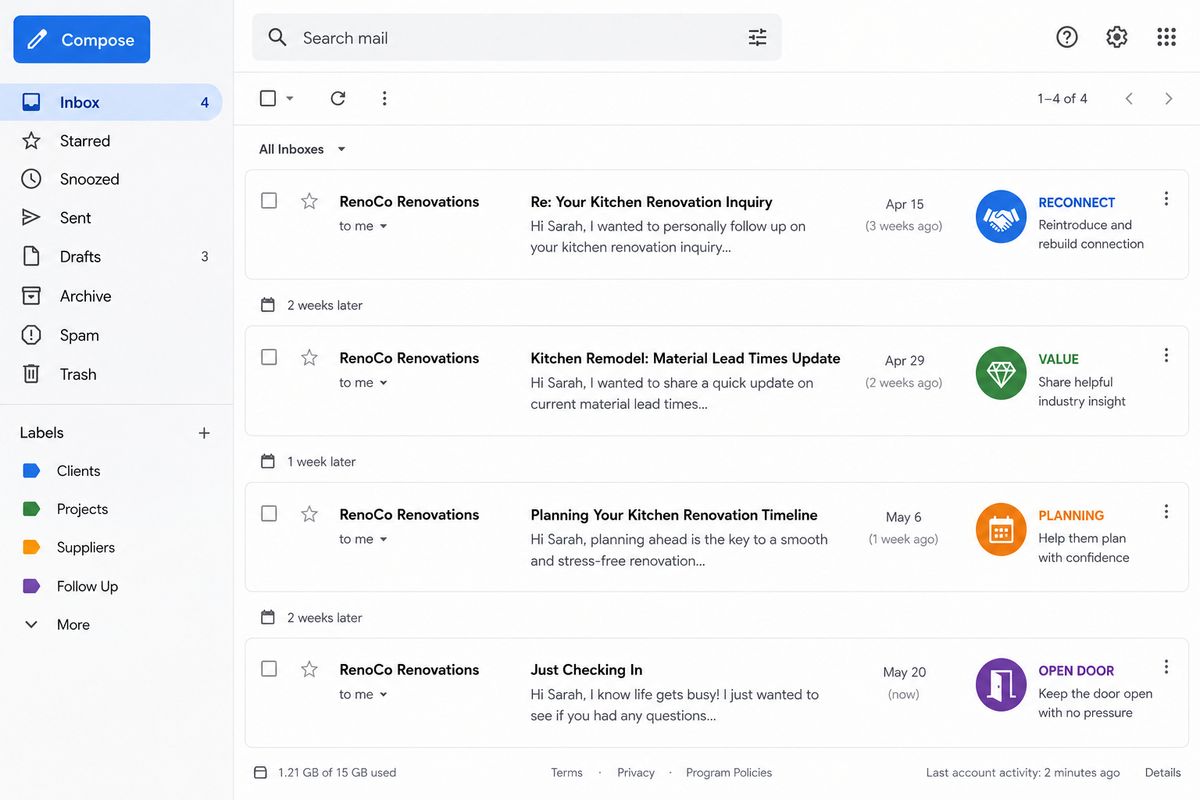
Email 1: The reintroduction. This email references the original project inquiry specifically, not generically. It acknowledges that circumstances change and projects get delayed, and offers a simple way to pick things back up: an updated conversation about their project, with no pressure or assumption that anything has been decided.
Email 2: The value email. Sent if there is no response to the first. This email shares something genuinely useful related to their specific project type. For a kitchen renovation lead, that might be insight into current material lead times or design trends affecting project timelines. For a whole-home remodel lead, it might be a brief case study of a similar project completed recently, with real numbers and a timeline.
Email 3: The planning-focused email. Sent if there is still no response. This email shifts the framing toward planning rather than selling. It might address how renovation timelines work backward from a target completion date, helping the prospect think practically about when they would need to start the process to hit a goal, such as completing a renovation before a specific season or event.
Email 4: The light final touch. A short, warm message that lets the prospect know you are available whenever they are ready, with an open invitation rather than a hard close. This email often performs surprisingly well because it removes all pressure at exactly the point where some prospects feel most comfortable re-engaging.
Throughout this sequence, every email is personalized using the actual project details from the original inquiry. The project type, the approximate scope, and any notes from the original conversation. A generic email blast to "all old leads" produces a fraction of the response rate of an email that clearly remembers the specific project the prospect asked about months ago.
Read More: How Painting Businesses Can Grow Faster Using AI in 2026 Without Changing Their CRM
AI Voice Calls: Reaching the Leads That Never Reply
Some of the highest-value renovation leads in your dormant pipeline will never respond to a text or an email, not because they are not interested, but because replying to messages requires effort that competes with everything else in their life. A phone call changes the dynamic entirely.
The challenge has always been that manually calling every old lead is enormously time-consuming, and the success rate of cold callbacks from a busy salesperson working through a long list is low. AI voice calling changes the economics of this completely.
Here is how AI voice calls fit into the reactivation sequence. After a lead has gone through the SMS and email sequences without responding, they are flagged for an AI voice call. The call is not cold. The AI agent has full context: the original project type, the approximate timeline they mentioned, any details from previous conversations, and the fact that they enquired some months ago.
The AI agent opens the call by referencing that context directly. It is calling because the prospect previously enquired about a specific renovation project, and the business wanted to check in on whether that project was still something they were considering. This framing matters enormously. It is not a sales call from a stranger. It is a follow-up on something the prospect themselves initiated months earlier.
If the prospect responds positively, the AI agent can answer basic questions, confirm the project is still relevant, and book a callback or consultation directly on the sales team's calendar in real time. If the prospect is not interested, the AI agent notes the outcome, and the lead is tagged accordingly so future reactivation attempts are calibrated appropriately. If there is no answer, the AI agent can leave a brief, professional voicemail referencing the original inquiry.
For high-ticket renovation projects specifically, a single AI voice call reactivating a thirty-thousand-dollar kitchen and living space remodel that had gone completely cold can produce a return that covers months of the entire automation system's cost on its own. This is the channel that recovers the leads that SMS and email genuinely cannot reach.
Read More: How to Add AI to Your Painting CRM Without Replacing It in 2026
The Full Reactivation Flow, Start to Finish
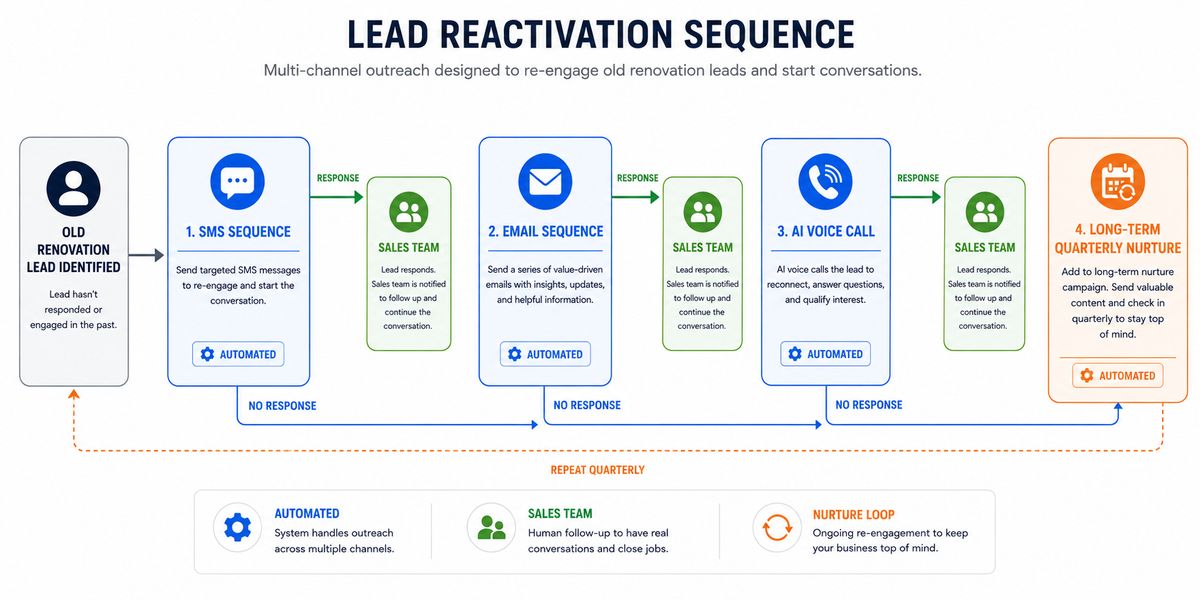
Putting the three channels together, here is what the complete automated follow-up sequence looks like for an old renovation lead.
The sequence begins with leads identified from the CRM based on how long they have been inactive and what stage they reached, whether that was an initial inquiry, a completed consultation, or a sent estimate that was never accepted.
SMS goes out first because it is the fastest way to get a response and the least intrusive way to reopen contact. If the prospect responds, the sequence stops, and a human takes over immediately with full context.
If there is no SMS response after the full SMS sequence, the lead moves into the email sequence. Email provides the depth and value that high-ticket renovation decisions require, spread across several touchpoints over two to three weeks.
If there is still no response after the email sequence, the lead moves to an AI voice call. This is the highest-effort, highest-context touchpoint, reserved for leads that have not engaged through faster channels but represent meaningful project value.
If the AI voice call does not connect or does not result in re-engagement, the lead is not discarded. It is tagged and moved into a long-term quarterly nurture cycle, where it will receive occasional value-based touchpoints indefinitely. Many renovation projects that seemed permanently dormant come back to life six or twelve months later when circumstances change, and the business that is still occasionally present in that prospect's world is the one that gets the call.
At every stage, any positive response from the prospect, whether a text reply, an email response, or a call answer, immediately routes the lead to a real person on your sales team with the complete history attached. The automation's job is to get the conversation reopened. From there, your team closes the deal the way they always have.
How FatCamel AI Runs the Complete Follow-Up System
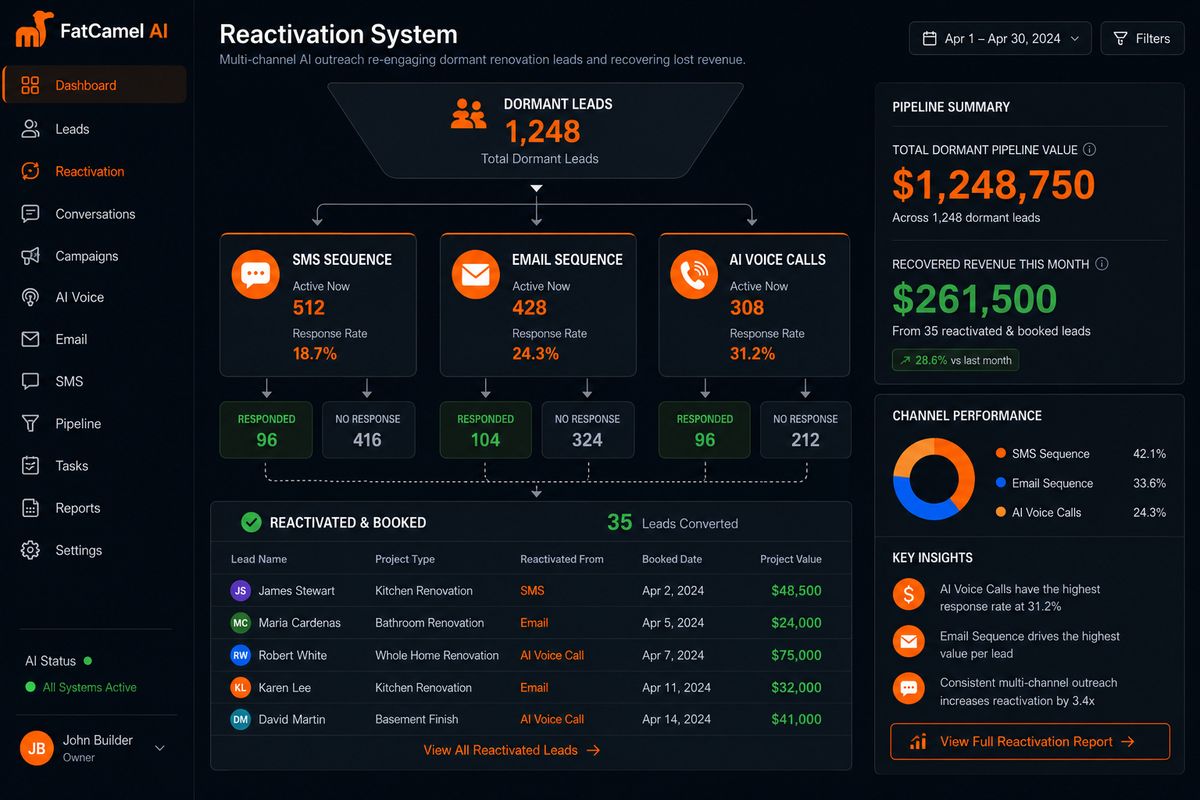
Building and managing a three-channel reactivation system manually, segmenting old leads, writing personalized message sequences for each project type, coordinating timing across SMS, email, and voice calls, and routing responses to the right team member, is not realistic without the right system running it.
FatCamel AI is built to run this entire reactivation system for renovation businesses automatically. The CRM is scanned continuously to identify dormant leads based on the inactivity period and project stage. Each lead is segmented by project type and approximate value, so the messaging in every channel references the specific project they originally enquired about rather than a generic template.
The SMS sequence runs automatically with personalized, project-specific messages. The email sequence follows for non-responders, with each email referencing the original inquiry details and providing value relevant to that project type. AI voice calls are triggered for leads that complete both sequences without responding, with the AI agent fully briefed on the project history before the call connects.
Every response, across every channel, is logged back to the CRM in real time and routed to the appropriate team member with full context. Leads that do not respond at all are automatically moved into a long-term nurture cycle, so the opportunity is never permanently lost.
The result is a renovation business where the dormant value sitting in the CRM, often representing hundreds of thousands of dollars in past project inquiries, is systematically and consistently worked, without anyone on the team spending hours manually texting, emailing, and calling through old lead lists.
👉 Get a Free AI Revenue Audit for Your Renovation Business at https://www.fatcamel.ai/contact
FAQ
1. How do you automate follow-up for old renovation leads?
Automating follow-up for old renovation leads involves building a sequenced system across SMS, email, and AI voice calls that re-engages dormant prospects based on their original project inquiry. The system segments leads by project type and inactivity period, sends personalized messages referencing the specific project they enquired about, and escalates to AI voice calls for leads that do not respond to text or email. Any positive response routes immediately to a human team member.
2. Is SMS automation effective for construction and renovation leads?
Yes. SMS has significantly higher open and response rates than email, making it an effective first touchpoint for reactivating dormant renovation leads. Short, low-pressure SMS messages that reference the original project inquiry are far more likely to get a reply than a cold email, especially for leads who have gone quiet for several months.
3. What is an AI follow-up system, and how does it work for renovation businesses?
An AI follow-up system is an automated sequence that uses AI to personalize and manage outreach across multiple channels based on each lead's history and project details. For renovation businesses, this means the system identifies dormant leads, segments them by project type, and runs SMS, email, and AI voice call sequences automatically, each referencing the specific renovation project the lead originally enquired about, without any manual effort from the sales team.
4. Why are old renovation leads worth pursuing instead of focusing only on new leads?
Old renovation leads represent acquisition costs that have already been spent. The marketing dollars, the initial conversation, and in many cases, a completed estimate have already happened. Reactivating even a small percentage of dormant leads, especially for high-ticket renovation projects worth fifteen thousand dollars or more, produces revenue at a fraction of the cost of generating equivalent value through new advertising.
5. How do AI voice calls work for following up with unresponsive leads?
AI voice calls are used as the final step in a reactivation sequence for leads that did not respond to SMS or email. The AI agent is briefed with the lead's original project details and opens the call by referencing that the prospect previously enquired about a specific renovation project. If the prospect is interested, the AI can book a callback or consultation directly. If there is no answer, a professional voicemail referencing the original inquiry is left.
6. How long should a renovation lead reactivation sequence run before giving up?
The active sequence across SMS, email, and AI voice calls typically runs over three to four weeks. Leads that do not respond within that window are not discarded but moved into a long-term quarterly nurture cycle, where they continue receiving occasional value-based touchpoints indefinitely. Many renovation projects that seemed permanently dormant convert six to twelve months later when the prospect's circumstances change.
7. What happens when a dormant lead responds to a reactivation message?
The moment a dormant lead responds positively through any channel, whether a text reply, an email response, or answering an AI voice call, the automated sequence stops immediately, and the lead is routed to a human team member with the complete history of the original inquiry and everything sent during the reactivation sequence. The team member picks up the conversation with full context rather than starting from scratch.
References
https://www.artisan.co/blog/automated-lead-follow-up-system
https://homelead.in/automate-follow-ups-in-real-estate/
https://homelead.in/automate-follow-ups-in-real-estate/
https://www.builderleadconverter.com/automated-follow-up/
https://www.gushwork.ai/blog/lead-generation-for-home-services