
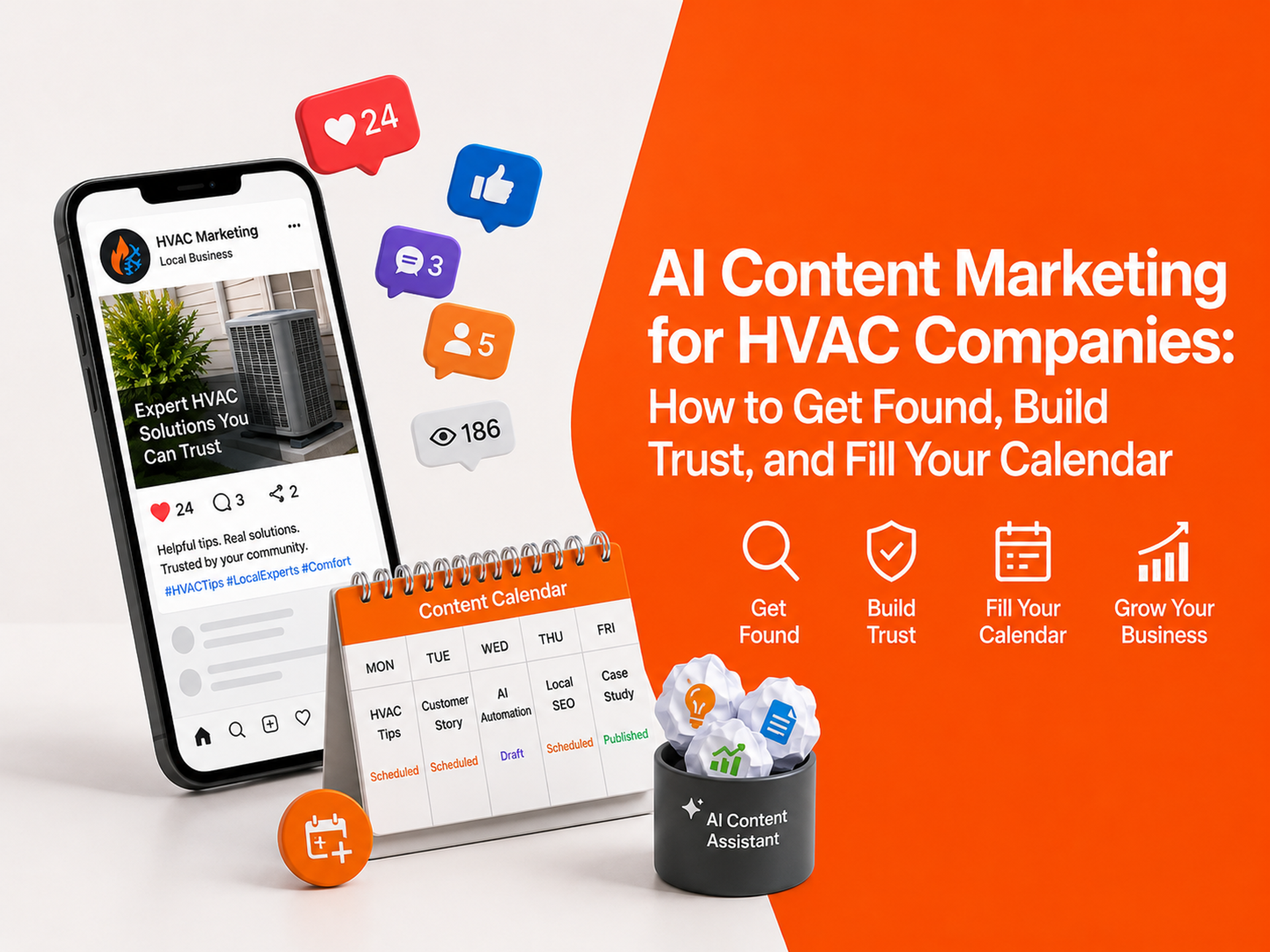
Here's what content marketing actually looks like for most HVAC businesses. The owner knows they should be blogging. They write one post about AC maintenance in May, another about furnace tips in November, and then nothing for seven months because the team is busy with actual jobs. The website sits there. Google doesn't notice. Homeowners don't find them.
The HVAC businesses ranking on page one for local searches aren't necessarily doing anything more creative. They're just doing it more often. A blog that publishes two useful posts per month, consistently, for twelve months has 24 indexed pages telling Google what the business does and who it serves. The business that published twice and stopped has two. That's the gap and AI closes it.
Table of Contents
Why Content Marketing Works Differently for HVAC Than Other Industries
What AI Content Marketing Actually Covers for HVAC Companies
The Content Types That Drive HVAC Leads and Rankings
How to Build a 12-Month HVAC Content Calendar Using AI
AI Blog Writing for HVAC: What Works and What Doesn't
Email Content Automation for HVAC Businesses
Social Content for HVAC: Using AI to Stay Consistent
How AI Connects Content to Lead Capture
How FatCamel AI's ContentFlow Handles HVAC Content Marketing
FAQ
References
Why Content Marketing Works Differently for HVAC Than Other Industries
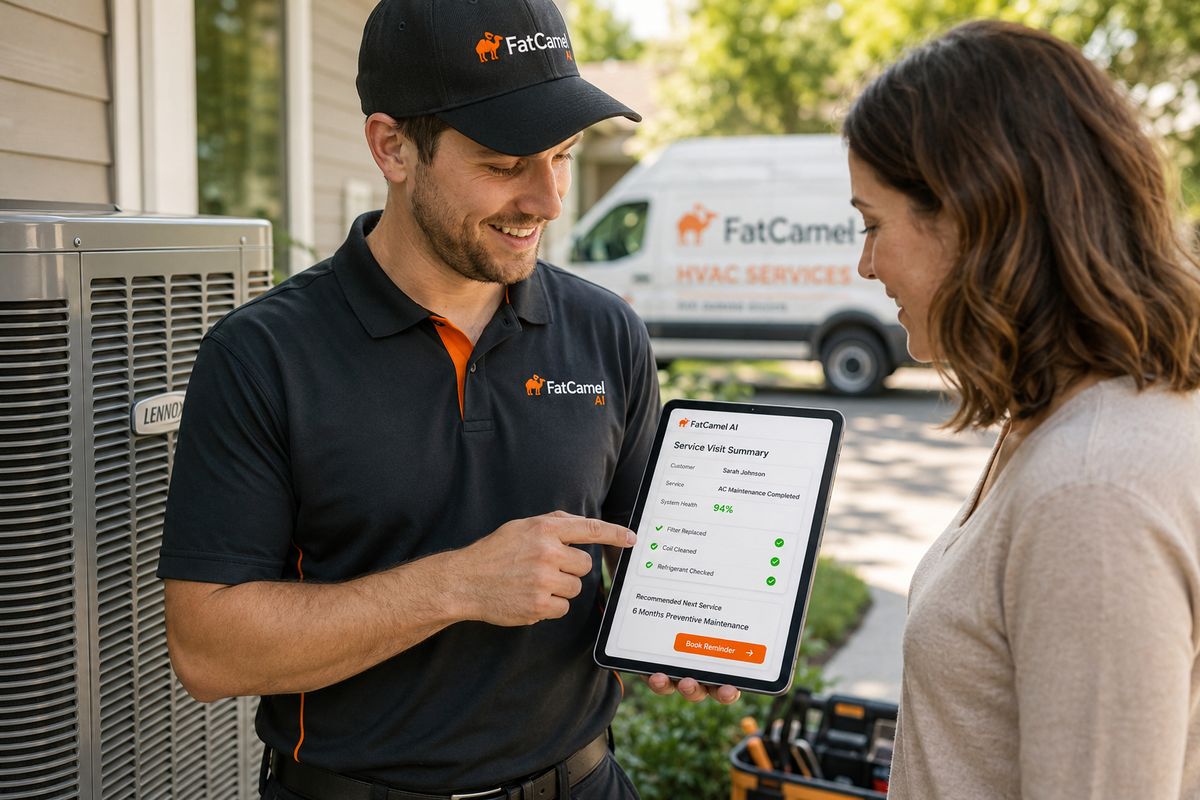
HVAC is a high-trust service purchase. A homeowner letting an HVAC technician into their home is making a decision about whether they trust that company and most of that trust gets built before the first phone call, not during it. Content is how that trust gets built at scale.
A homeowner whose furnace stopped working at midnight doesn't start by calling contractors. They start by Googling "why is my furnace not turning on." The HVAC company that wrote a clear, honest answer to that question months ago is the one that shows up. If the answer is actually useful, the homeowner finishes reading it and calls the number on the page. That's a content-to-lead conversion and it cost nothing in ad spend.
This is what separates content marketing from paid advertising for HVAC. A Google ad stops producing leads the moment you stop paying for it. A blog post that answers a question homeowners actually search for keeps producing organic traffic indefinitely. According to HubSpot research, businesses that blog consistently generate 55% more website visitors than businesses that don't. For HVAC companies in competitive local markets, that compounding effect is significant.
The challenge has always been consistency. Writing useful HVAC content requires time, HVAC knowledge, and marketing discipline three things that don't naturally coexist in a business where the owner is managing crews, handling customer calls, and fixing equipment all day. AI doesn't replace the HVAC knowledge. But it handles the writing, the formatting, the SEO structure, and the distribution turning one idea from the owner into a finished, published piece without consuming hours of their time.
What AI Content Marketing Actually Covers for HVAC Companies
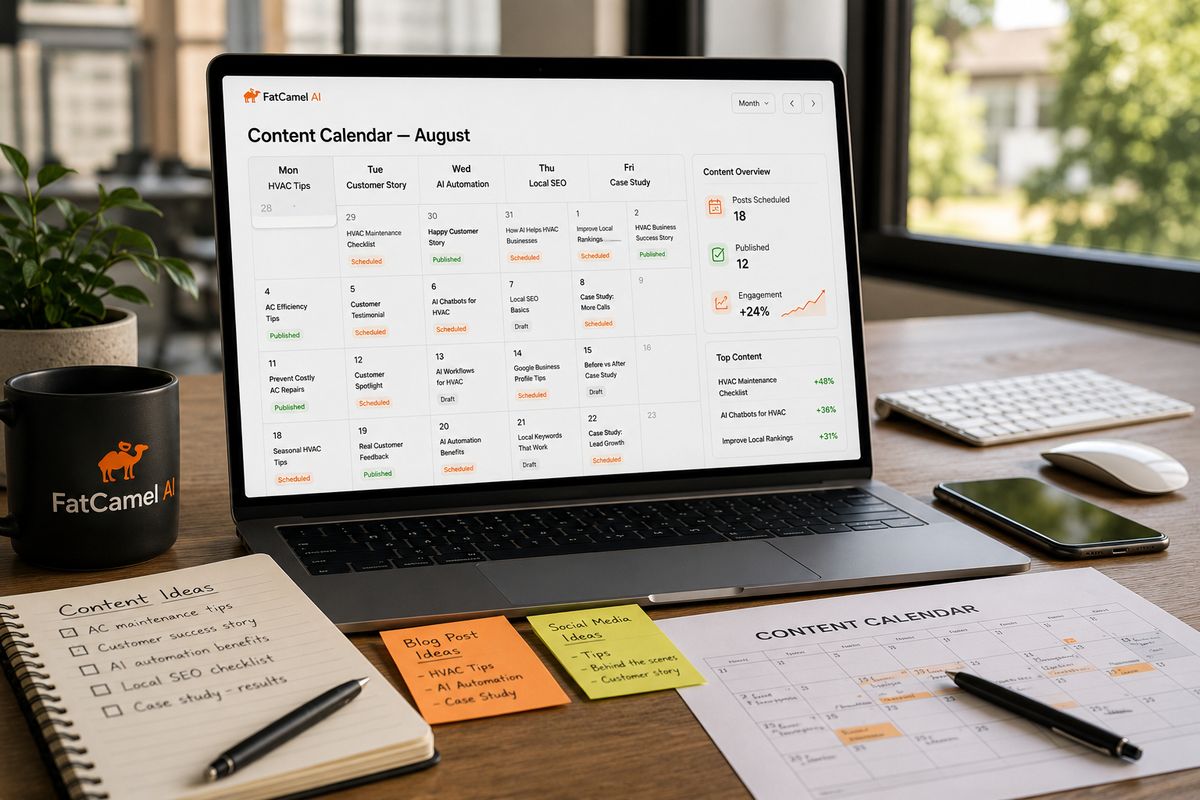
AI content marketing for HVAC isn't just about writing blog posts. It covers every touchpoint where content influences whether a homeowner or facility manager finds, trusts, and contacts an HVAC business.
Blog content the posts that answer homeowner questions, target local keywords, and build the topical authority that improves Google rankings over time. These are the highest-value content assets for long-term organic traffic, and the ones where AI assistance makes the biggest difference in production consistency.
Email campaigns seasonal promotions, maintenance reminders, estimate follow-ups, and re-engagement campaigns sent to past customers and existing leads. These drive repeat bookings and referrals from the customer base already built, which is the highest-ROI marketing activity most HVAC businesses underinvest in.
Social content the regular posts on Facebook, Instagram, and Nextdoor that keep the business visible between active jobs, build trust with local homeowners who aren't ready to call yet, and generate the social proof that influences decisions when they are.
Google Business Profile posts the weekly updates that signal to Google that the business is active, which directly influences local pack rankings. Most HVAC businesses set up their profile and never update it again. AI can produce and schedule these posts automatically.
Service page content the copy on individual service pages that tells Google what the business does and convinces visitors to call. AI can produce initial drafts and keep these pages refreshed as services and pricing evolve.
Together, these content types form a complete content marketing system. Each one serves a different stage of the customer journey blog posts bring people in, social content keeps them warm, email campaigns convert them, and service pages close them.
Read More: Why Social Media Doesn't Work for HVAC Companies (And What Does)
The Content Types That Drive HVAC Leads and Rankings
Not all content is equal for HVAC companies. Some types consistently produce traffic and leads. Others produce impressions with no commercial outcome. Knowing the difference saves significant time and money.
Educational how-to content is the highest-performing content type for HVAC organic search. Homeowners search for answers to specific problems "why is my AC making a loud noise," "what does an HVAC tune-up include," "how often should I replace my air filter," "signs my furnace needs replacing." These are questions with clear intent, reasonable search volume, and very little competition from the big HVAC software companies and trade magazines that dominate broader keywords. An HVAC business that answers fifteen of these questions well has fifteen indexed pages attracting homeowners who are actively experiencing HVAC issues which is exactly the audience that books appointments.
Seasonal urgency content drives short-term bookings. A blog post titled "Pre-Summer AC Tune-Up Checklist: Book Before the Wait Times Hit" published in March converts readers into bookings during the period when the content is most relevant. This type of content has a shorter traffic window than evergreen how-to content, but it drives more immediate action.
Local content improves geographic rankings. A post about "how extreme summer heat affects HVAC systems in [city]" or "the most common HVAC problems during [city] winters" tells Google that the business is specifically relevant to that local area, not just HVAC in general. Combined with properly structured service area pages, this local content layer is what separates businesses ranking in multiple service area cities from those ranking only around their primary location.
Comparison and decision-support content captures homeowners at the decision stage. "Repair vs. replace: how to decide when your HVAC system fails," "heat pump vs. gas furnace in [region's climate]," "what to look for when hiring an HVAC contractor" this type of content attracts homeowners who are already committed to taking action and trying to make the right choice. The company whose content helped them make that decision has already established trust before the first call.
How to Build a 12-Month HVAC Content Calendar Using AI
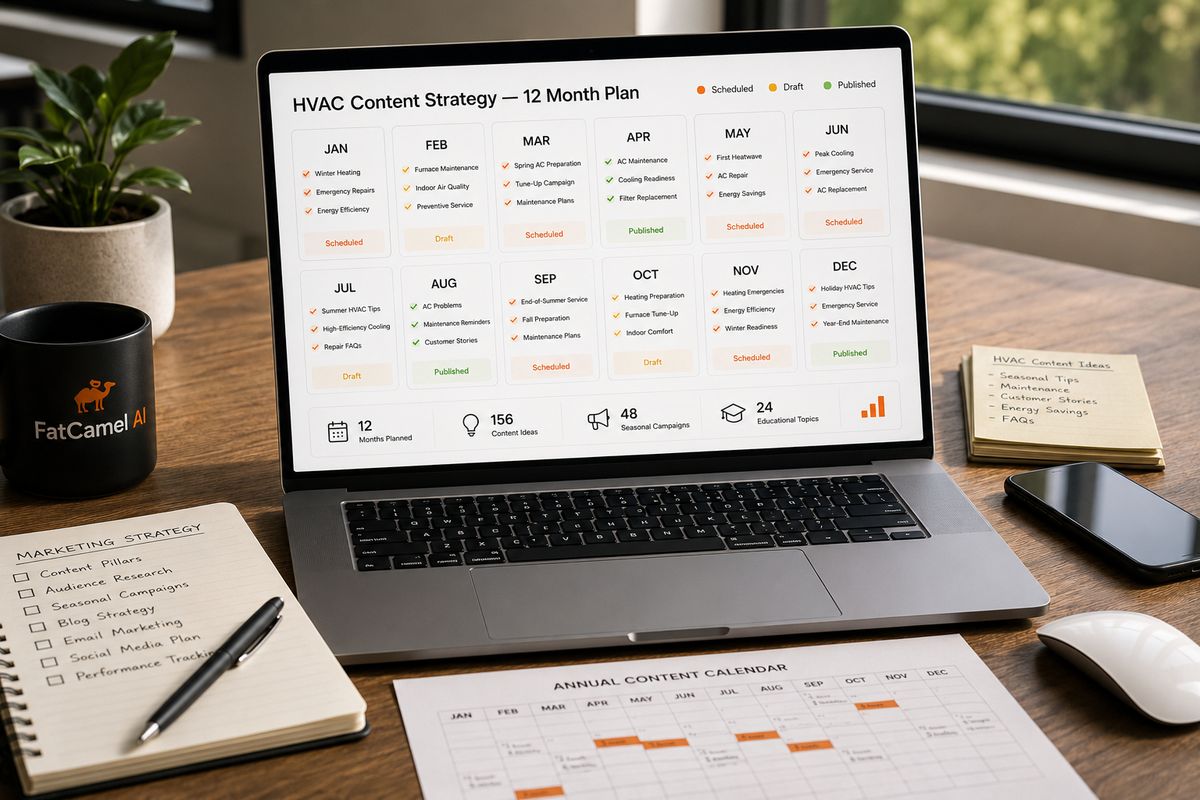
A 12-month content calendar for an HVAC business maps content topics to the seasonal demand cycles that drive HVAC buying behavior. AI assists in building this calendar by identifying the specific questions homeowners search during each season, matching them to the business's service offerings, and organizing them into a publication schedule the business can actually maintain.
January through March is pre-spring preparation content. Topics like "how to prepare your AC for summer," "what HVAC maintenance should you do before the heat arrives," and "how to improve your home's energy efficiency before summer" perform well as homeowners start thinking ahead. This content should be published and indexed before the search volume peaks in April and May.
April through June is peak booking season content. Emergency repair guides, "what to do when your AC stops working," and "how to get an emergency HVAC appointment fast" all capture high-intent searchers during the period when search volume is highest. This is also when seasonal promotion content drives immediate bookings.
July through September is maintenance and system evaluation content. "Is it time to replace my AC?" "How do I know if my HVAC system is efficient?" and "why is my energy bill so high this summer?" attract homeowners who are experiencing problems and starting to think about longer-term solutions like system replacement.
October through December is heating system content. Furnace preparation guides, heating efficiency tips, and "what to do if your heat stops working in winter" all perform during this period. Pre-winter content published in September and October is indexed and ranking by the time the heating season begins.
AI tools can generate topic lists, draft outlines, produce first drafts, and suggest internal linking opportunities for each piece in this calendar compressing what would be 20 to 30 hours of manual content work per month into a fraction of that.
Read More: How to Increase HVAC Lead Conversion Rate (From First Call to Booked Job)
AI Blog Writing for HVAC: What Works and What Doesn't
AI blog writing is not a replacement for HVAC expertise. The most common mistake HVAC businesses make when using AI for content is treating it as a content generation machine prompting it to write a blog post and publishing whatever comes out. The result is generic, factually thin content that reads like every other HVAC blog and provides no real value to the homeowner reading it.
What works is using AI as a drafting and structuring tool while the business owner or a technically knowledgeable team member provides the substance. The owner describes a problem they see commonly in the field "we get a lot of calls about AC systems short-cycling in the summer" and gives AI the context to structure that knowledge into a well-organized, search-optimized post. The HVAC knowledge comes from the person who actually works in the industry. The writing, formatting, and SEO structure comes from the AI.
This approach produces content that is genuinely more useful than competitor content because it contains real, specific knowledge rather than generic information that any business with internet access could produce. Google's helpful content guidelines increasingly reward exactly this kind of expertise-backed content over AI-generated filler.
The editing step matters. Every AI-drafted piece should be reviewed by someone who can verify the technical accuracy, add specific local details (contractor regulations, climate considerations, local equipment preferences), and ensure the business's voice comes through rather than sounding like it was written by a machine. This review takes significantly less time than writing from scratch which is where the productivity gain actually lives.
Email Content Automation for HVAC Businesses
Email is consistently one of the highest-ROI marketing channels for HVAC businesses because it reaches people who have already expressed interest past customers, existing leads, maintenance agreement holders without requiring any ad spend to reach them.
The challenge is the same as with blog content: most HVAC businesses intend to do email marketing consistently and don't. They send a promotion before summer, maybe one before winter, and then nothing for eight months. The subscribers who don't hear from them don't think about the business when a problem comes up. They search Google and call whoever ranks first.
AI content automation runs the email calendar in the background. Seasonal campaigns go out on schedule the spring AC preparation email in March, the pre-winter furnace check reminder in October. Post-job satisfaction emails fire within 24 hours of every completed job. Dormant customer re-engagement campaigns go to contacts who haven't had service in 12 or more months. Estimate follow-up sequences send at day three, day seven, and day fourteen after every quote.
Each of these emails is personalized using data from the CRM the customer's name, the specific equipment on file, the last job completed, the quote amount. A maintenance reminder that says "Hi James, it's been about 14 months since we serviced your Carrier system at 847 Oak Street" performs dramatically better than a generic "time for your annual tune-up" blast, because it proves the business actually knows who James is and what he had serviced. AI makes that personalization happen at scale across hundreds of contacts simultaneously.
Read More: AI Automation for HVAC Companies: Benefits, Process, Pricing & ROI
Social Content for HVAC: Using AI to Stay Consistent
Social media works for HVAC when it's consistent and specific. It doesn't work when it's sporadic and generic. The businesses that generate real leads from social are posting two or three times per week, showing real jobs and real technicians, and making it easy for homeowners to take the next step.
AI helps HVAC businesses stay consistent by handling the drafting and scheduling work. A technician takes a photo of a clean install or a before/after of a system replacement. The owner provides a sentence of context. AI drafts the caption, suggests relevant hashtags, and prepares the post for scheduling. The editing step adds local details, the owner's voice, and anything AI got wrong. The whole process takes a few minutes rather than the 30 to 45 minutes it would take to write a thoughtful post from scratch.
The content that actually drives HVAC leads from social is proof content real jobs, real technicians, real outcomes. "We replaced a 22-year-old Trane unit in Fort Worth today the homeowner's energy bill should drop significantly this summer" tells a story that a stock photo of a thermostat simply doesn't. Homeowners respond to evidence that the business is real, competent, and local.
Google Business Profile posts are a form of social content that directly influences local rankings and get overlooked by most HVAC businesses. A post promoting a seasonal offer, highlighting a completed job, or sharing a relevant homeowner tip signals to Google that the business is active. AI can draft and schedule these posts on a weekly cadence without the business owner having to think about it.
How AI Connects Content to Lead Capture
Content marketing generates visitors. But visitors only become revenue if there's a system in place to capture them the moment they're ready to act.
This is the gap most HVAC content strategies ignore. The blog post brings a homeowner to the website. They read the content, trust the business, and click "contact us." Then they call at 8 PM, because they were reading after dinner and get voicemail. The trust built by three months of content marketing evaporates in the moment the lead has nowhere to go.
FatCamel AI's RealtorVoiceAI closes this gap by answering every call that content generates, at any hour. A homeowner who lands on the blog at 9 PM and calls the number on the page gets a real conversation, not a voicemail. The content brought them to the door. The AI voice agent opens it.
The same logic applies to web form submissions. A homeowner who fills out a "request a quote" form at midnight after reading an article should receive an automated response within 60 seconds that acknowledges their inquiry and offers a direct booking link. Without that response, the content did its job and the lead system failed to capture the opportunity it created.
Content marketing and lead capture automation are two halves of the same system. Content brings qualified homeowners to the business. Lead capture automation converts them before they have time to move on. Running one without the other leaves most of the value of both on the table.
How FatCamel AI's ContentFlow Handles HVAC Content Marketing
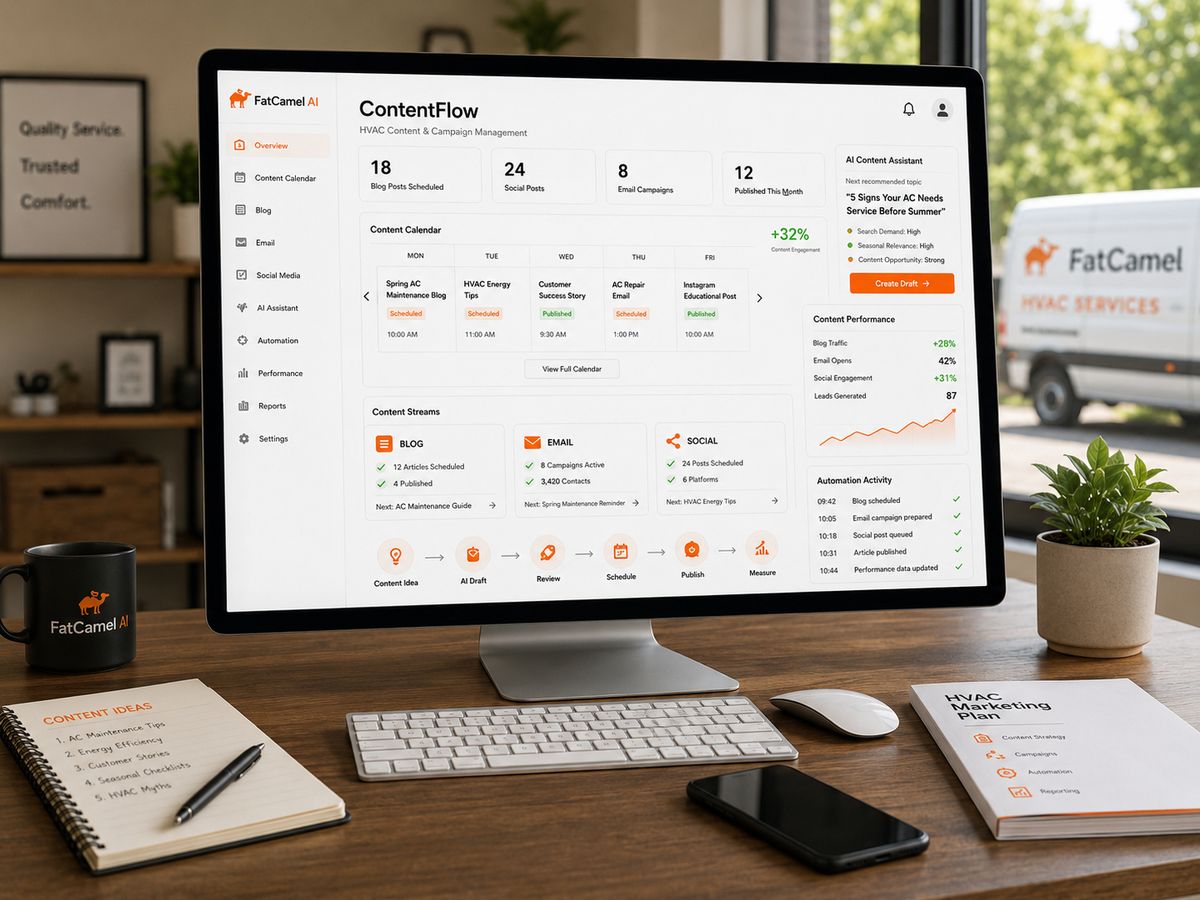
FatCamel AI's ContentFlow is built to run the complete HVAC content marketing operation blog production, email campaigns, social content, and Google Business Profile posts as a connected system that feeds into the lead capture and follow-up stack rather than operating as a standalone content tool.
The blog production component handles topic research, draft generation, SEO structuring, and publication scheduling based on the business's services and service area. Content is planned around the seasonal demand cycles that drive HVAC buying behavior, so the right topics reach homeowners at the right moments pre-summer AC content in March, heating preparation content in September rather than being published randomly.
The email automation layer runs seasonal campaigns, post-job follow-ups, estimate sequences, and dormant customer re-engagement campaigns automatically, drawing customer details from the CRM to personalize each message. The social content component drafts and schedules posts based on job activity and seasonal topics, maintaining the consistent presence that builds local brand recognition without requiring daily manual input.
And because ContentFlow connects to the broader FatCamel automation stack, every content-driven lead whether it's a call from a blog post, a form submission from a social media link, or a homeowner who clicked through from an email enters the same pipeline managed by RealtorVoiceAI and the Lead Activation Engine. Content generates the leads. The automation stack captures and converts them.
For HVAC businesses that have the right services and the right reputation but aren't getting found by homeowners who would happily hire them, this is the missing piece a content marketing operation that runs consistently in the background, building the organic visibility and trust that fills the booking calendar without requiring a dedicated marketing team to manage it.
👉 Get a Free AI Revenue Audit for Your HVAC Business at https://www.fatcamel.ai/contact
FAQ
1. What is AI content marketing for HVAC companies?
AI content marketing for HVAC companies means using AI tools to plan, produce, and distribute the blog posts, email campaigns, social content, and Google Business Profile updates that bring homeowners to the website and build the trust that converts them into calls. AI handles the writing, formatting, and scheduling work the production bottleneck that prevents most HVAC businesses from publishing content consistently. The HVAC knowledge and the editing still come from the business. AI is the drafting and distribution engine that makes consistency possible without a full marketing team.
2. What kind of content actually drives HVAC leads?
The content types that consistently drive HVAC leads are educational how-to posts answering specific homeowner questions, seasonal urgency content timed to peak demand periods, local content that builds geographic relevance in the service area, and decision-support content that helps homeowners choose between options. Generic tips and stock-photo social posts don't drive leads because they don't prove anything about the business and don't rank for the specific questions homeowners search.
3. How often should HVAC companies publish blog content?
Two posts per month is the minimum that produces measurable results for most HVAC companies enough to build topical authority over time without overwhelming a small team's capacity to maintain quality. Businesses publishing four or more posts per month see faster results, particularly in competitive local markets. The consistency matters more than the frequency. Two posts per month every month for a year outperforms ten posts in January and nothing for the rest of the year.
4. Can AI write HVAC blog posts without technical input from the owner?
AI can produce structurally sound, SEO-optimized drafts for common HVAC topics, but the best-performing content includes real, specific knowledge from someone with field experience. Generic AI-generated content ranks below content that clearly comes from a business that actually does the work. The effective approach is using AI to draft and structure while the owner or a technically knowledgeable team member provides specific details, local context, and factual verification before publication.
5. How does content marketing connect to actual bookings for HVAC companies?
Content marketing drives organic website traffic from homeowners searching for HVAC-related information. That traffic converts to bookings when the website has clear calls to action, a phone number that's answered immediately, and a web form that triggers an instant automated response. Without the lead capture layer an AI voice agent answering calls and an automated response to form submissions the content generates traffic but not bookings. Content marketing and lead capture automation work together.
6. What's the ROI on AI content marketing for HVAC businesses?
The ROI on content marketing is longer-term than paid advertising but compounds over time. A blog post published today continues driving organic traffic for years. HubSpot research shows businesses that blog consistently generate 55% more website visitors than those that don't. For an HVAC business in a competitive local market, ranking on page one for ten relevant local keywords can produce 30 to 50 additional inbound leads per month at zero ongoing cost per lead once the content is published and indexed.
7. How does FatCamel AI's ContentFlow handle HVAC content marketing?
FatCamel AI's ContentFlow runs blog production, email campaigns, social content, and Google Business Profile posts as a connected system timed around HVAC seasonal demand cycles. Blog topics are planned around homeowner search behavior in the service area. Email campaigns run automatically based on CRM triggers. Social content drafts and schedules around job activity and seasonal topics. And every content-driven lead enters the same pipeline managed by RealtorVoiceAI and the Lead Activation Engine so the content generates leads and the automation stack captures and converts them.
References
https://www.bbehmermedia.com/blog/ai-marketing-and-social-media-for-hvac-businesses
https://www.gushwork.ai/blog/content-marketing-services-hvac-manufacturers
https://www.webfx.com/blog/home-services/hvac-ai/
https://www.leadhub.net/industries/air-conditioning/how-ai-is-shaping-hvac-marketing-strategies/
https://digitalhvacmarketing.com/5-steps-to-implement-ai-in-hvac-businesses-and-get-more-leads/
https://www.simprogroup.com/blog/ai-hvac
https://www.hubspot.com/marketing-statistics
https://www.brightlocal.com/research/local-consumer-review-survey/
https://www.fatcamel.ai/services/crm-automation