
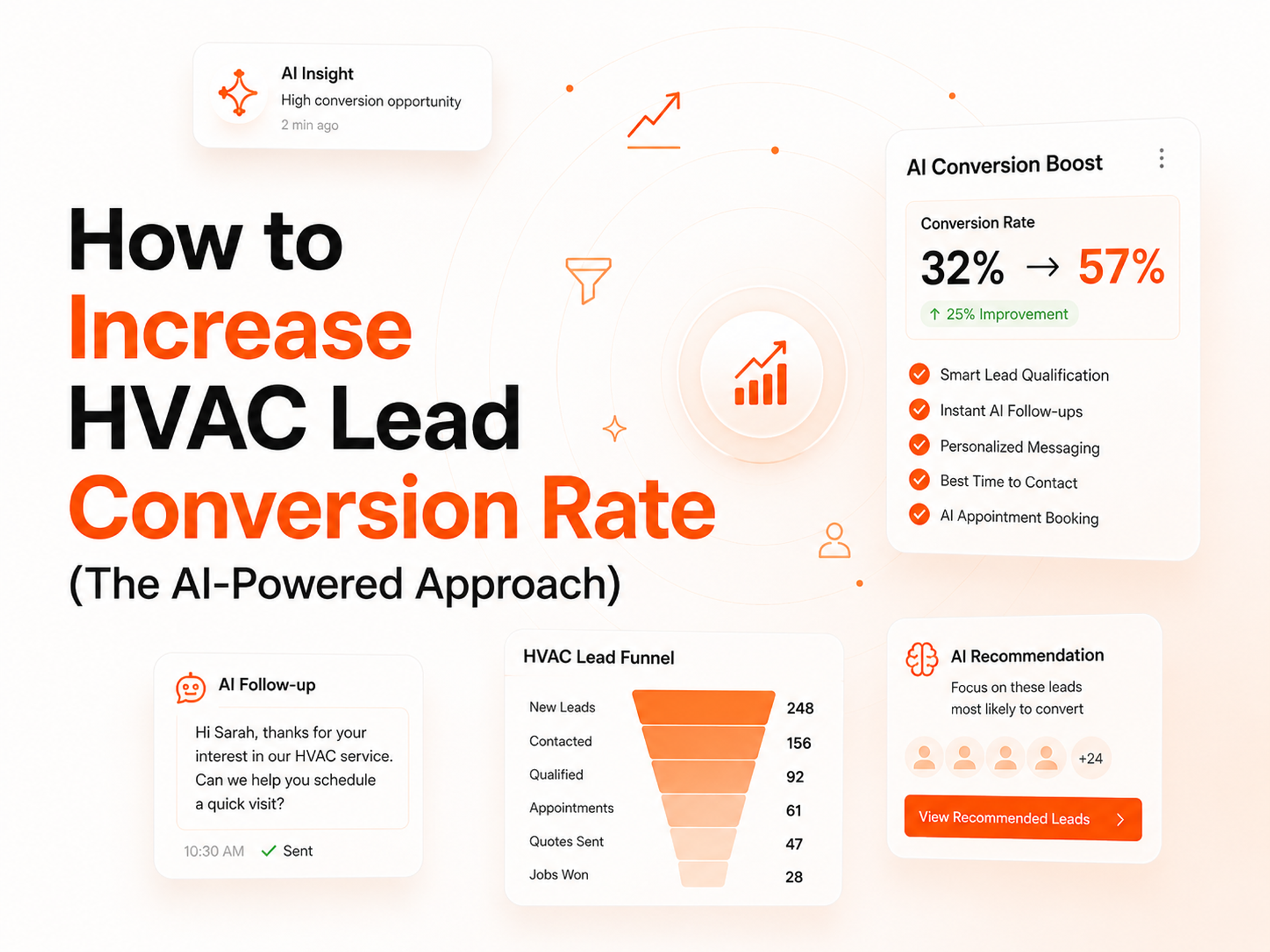
Most HVAC owners trying to grow their business instinctively reach for more marketing. More Google ads. Better targeting. Higher budget. And sometimes that's the right move. But there's a version of this problem that more leads can't fix and it's the one most HVAC businesses are actually dealing with.
If your conversion rate is low, every additional lead you generate converts at that same low rate. Doubling your ad spend without fixing conversion doesn't double your revenue. It usually doesn't move it much at all. The leads go into the same pipeline, hit the same friction points, and drop out at the same stages. The spend doubles. The output doesn't.
This guide covers where HVAC leads actually drop out, what the data says about each friction point, and how AI fixes the ones that cost the most revenue.
Table of Contents
What's Actually Causing Low HVAC Conversion Rates
The Conversion Rate Math Most HVAC Owners Get Wrong
Fix 1: Response Speed The Highest-Leverage Change You Can Make
Fix 2: Lead Qualification Stop Wasting Time on the Wrong Leads
Fix 3: The Consultation and Site Visit
Fix 4: Estimate Follow-Up Where the Most Revenue Is Lost
Fix 5: Multi-Touch Follow-Up Sequences
Fix 6: Past Customer Re-Engagement
How to Track Your HVAC Conversion Rate Properly
How FatCamel AI Improves HVAC Conversion at Every Stage
FAQ
References
What's Actually Causing Low HVAC Conversion Rates
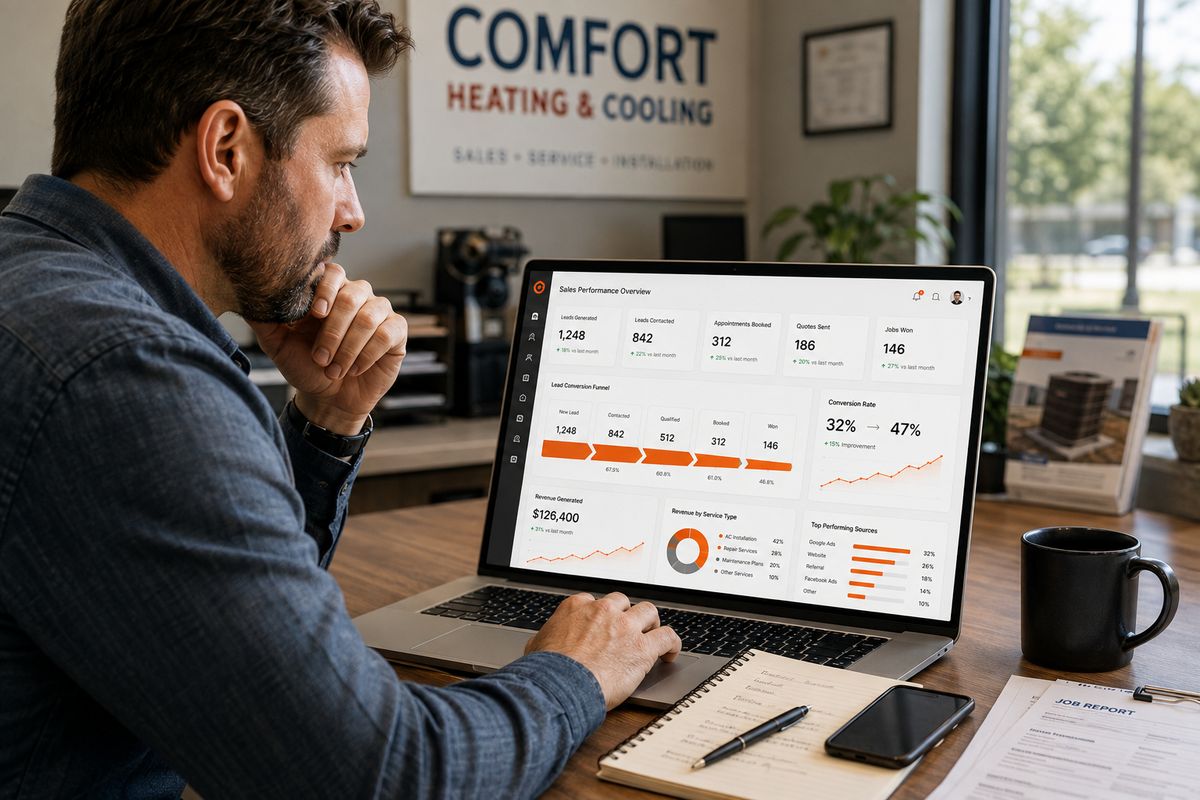
Most HVAC businesses diagnose a low conversion rate as a lead quality problem. The leads from Google ads aren't serious. The website visitors aren't the right audience. The solution they reach for is better targeting, more budget, a different agency.
But the data tells a different story. The average HVAC website conversion rate sits between 2 and 5 percent, according to Valve+Meter's research into HVAC marketing performance. Onepath's analysis of HVAC conversion data found that top-performing contractors those consistently closing 30 percent or more of their inbound leads share three operational characteristics that have nothing to do with their marketing budget or ad targeting.
They respond within five minutes. They follow up at least five times. And they have a structured process for chasing estimates after they go out.
That's it. Those three things separate a 5 percent conversion rate from a 35 percent one. Not better ads. Not a fancier website. Not a lower price.
The reason most HVAC businesses don't do these three things consistently isn't lack of knowledge it's operational capacity. Responding within five minutes to a lead that comes in at 7pm when the owner is finishing a job is structurally impossible without automation. Following up five times on every lead when the dispatcher is managing active jobs during peak season is equally impossible manually. And estimate follow-up requires someone to remember to do it for every quote sent, every time which doesn't happen.
These aren't discipline problems. They're systems problems. And systems problems have systems solutions.
The Conversion Rate Math Most HVAC Owners Get Wrong
Before getting into the fixes, it's worth understanding exactly what's at stake financially.
An HVAC company generating 60 leads per month at a 15 percent close rate is booking 9 jobs. At 650 dollars average job value, that's 5,850 dollars in monthly revenue from those leads. The same 60 leads at a 35 percent close rate which is achievable with the right systems is 21 booked jobs and 13,650 dollars. The difference is 7,800 dollars per month, or 93,600 dollars per year, from the exact same marketing spend and the exact same lead volume.
The business doesn't need more leads. It needs to convert more of the ones it already has.
This matters even more when you factor in that the cost per lead in HVAC is real. Google Local Services Ads typically run 50 to 150 dollars per lead. Non-branded paid search averages closer to 200 dollars per lead in competitive markets. Every lead that doesn't convert is a marketing cost that produced zero revenue. Improving conversion rate doesn't just add revenue it makes every existing marketing investment more efficient.
Fix 1: Response Speed The Highest-Leverage Change You Can Make
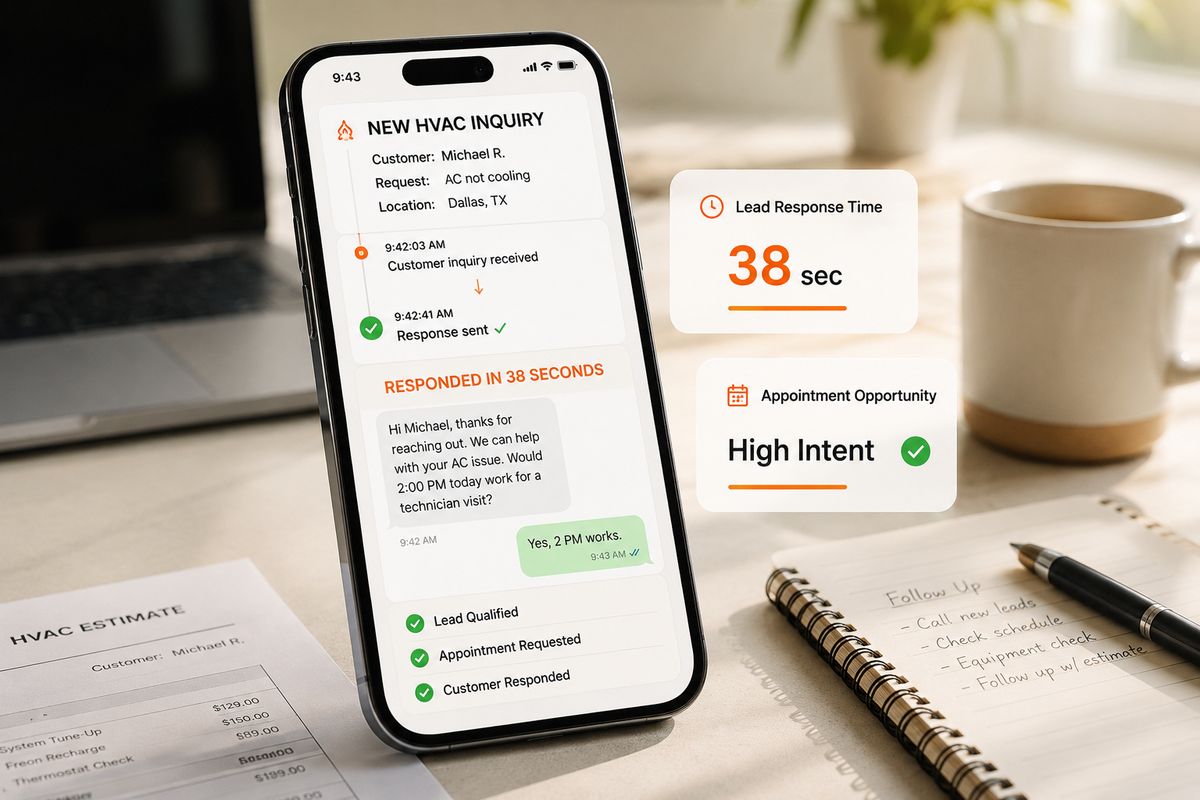
Research from MIT and InsideSales.com across more than 15,000 leads found that responding within five minutes of an inquiry produces a contact rate 100 times higher than responding after 30 minutes. One hundred times. That's not a marginal improvement it's a different category of outcome entirely.
In HVAC, where homeowners call three or four companies simultaneously when their system fails, the first company to respond gets the conversation before the others have even seen the notification. In most cases, whoever the homeowner speaks to first is the one they book with assuming the conversation goes reasonably well.
The industry benchmark for HVAC response time is not impressive. Only 11 percent of contractors respond to a new lead within an hour, per SearchLight's 2026 data. That means 89 percent are leaving the fastest-moving leads the ones most likely to convert to their competitors simply by being slower.
FatCamel AI's RealtorVoiceAI answers every inbound call immediately, day or night, and responds to web form submissions within 60 seconds through automated SMS and email. Every lead gets a professional, personalized response before the owner has even seen it in their notifications. The conversion impact of this single change is typically the largest of any improvement an HVAC business can make.
Read More: Why Most HVAC CRMs Fail (And How Our CRM Automation Solves It)
Fix 2: Lead Qualification Stop Wasting Time on the Wrong Leads
Not all HVAC leads convert at the same rate, and not all of them deserve the same amount of dispatcher time. A homeowner whose system failed in a heat wave with three young kids at home is at a fundamentally different point in their decision process than someone casually asking about a tune-up they've been meaning to book for six months.
AI-powered lead qualification gathers the relevant information urgency, system type, property type, job scope through the initial interaction and routes accordingly. High-urgency leads get immediate human attention and expedited scheduling. Routine maintenance inquiries go through an automated booking flow. Commercial inquiries enter the commercial sales process.
The conversion impact is twofold. Urgent leads get the fast response they need to convert, rather than sitting in the same queue as low-priority inquiries. And the team's limited time gets focused on the leads most likely to convert at high value, rather than being spread equally across every inquiry regardless of quality or urgency.
Fix 3: The Consultation and Site Visit
The consultation is where trust is built or lost. Everything before it is about getting the homeowner to the table everything after it depends on how well the table conversation went.
The most common conversion problem at the consultation stage isn't price. It's that the homeowner doesn't feel confident enough in the contractor to pull the trigger. They liked the technician, the price was reasonable, but something felt uncertain maybe the technician seemed rushed, maybe the explanation of what needed to be done wasn't clear enough, maybe the quote arrived with no context for what it included.
The fix here is operational: technicians showing up with complete job context from the CRM, including the homeowner's call notes, any prior service history at the address, and the likely scope of the job based on the initial qualification. A technician who says "I see from your call that you mentioned the system's been struggling since last summer that helps me know where to look first" builds more trust in the first 60 seconds than any sales training could.
Automated CRM logging from every intake call means this context is always available before the technician arrives on site.
Read More: 15 HVAC Tasks You Can Automate Using AI (And What Each One Is Worth)
Fix 4: Estimate Follow-Up Where the Most Revenue Is Lost
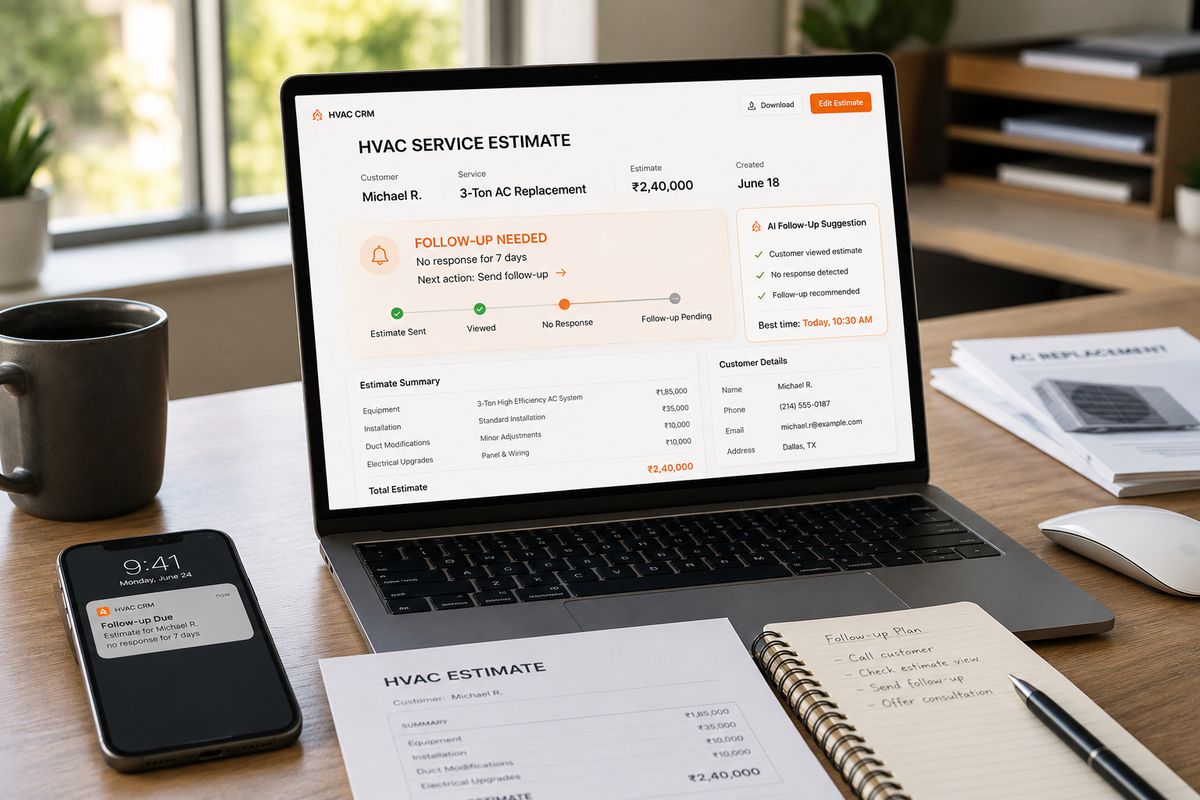
This is where the majority of recoverable HVAC conversion revenue sits. An estimate goes out. The homeowner says they'll think about it. The team follows up once, maybe twice. No response. The lead gets marked as cold.
Meanwhile, the homeowner is comparing three quotes, waiting for their spouse to look it over, or simply managing a busy week. None of that means they're not interested. It means they need more time and more contact than two phone calls provide.
Less than 40 percent of HVAC businesses have any systematic process for following up after an estimate is sent, per industry data. Of those that do follow up, most stop after one or two attempts. The research-backed threshold for buying decisions in service industries is five to eight contacts. The gap between two and eight is where the estimate revenue goes.
A structured estimate follow-up sequence starts the moment an estimate is sent. Day three: a message asking if there are questions about the scope or pricing. Day seven: context about what's included and why the approach reflects quality work. Day fourteen: a soft, low-pressure message that makes re-engagement easy. Day twenty-one: a final light close.
HVAC businesses running structured estimate follow-up consistently see acceptance rates improve by 15 to 25 percentage points. On a system replacement quote worth 10,000 dollars, a 20-point improvement is 2,000 dollars in additional revenue from a single quote from a sequence that runs automatically once it's configured.
Fix 5: Multi-Touch Follow-Up Sequences
For leads that don't convert on the first interaction and most don't the conversion rate is determined entirely by how many follow-up attempts the business makes and how well those attempts are personalized to the specific lead.
Generic follow-up produces low conversion rates. A message that says "Just checking in still interested in HVAC service?" gets ignored. A message that says "Hi Marcus, following up on the Carrier 3-ton quote for 847 Riverside just wanted to make sure you had everything you needed to make a decision" gets responses.
The personalization comes from the CRM data already in the system the caller's name, the specific system they asked about, the service address, the quote details. AI-powered follow-up sequences use this data to personalize every message automatically, making each touchpoint feel like a real person remembered the conversation rather than a system sending a scheduled blast.
Multi-touch sequences should run across both SMS and email in a coordinated schedule. SMS for short, low-pressure check-ins where a quick reply is the goal. Email for value-adding messages where there's context to share. Five to eight touchpoints over 14 to 21 days, stopping automatically the moment the lead responds or books.
Read More: AI Automation for HVAC Companies: Benefits, Process, Pricing & ROI
Fix 6: Past Customer Re-Engagement
The easiest conversion in HVAC is a past customer who already trusts the business. They've had a good experience. They know the technicians. Their equipment is another year older. The probability of converting an outreach to a past customer into a service booking is significantly higher than converting a cold lead yet most HVAC businesses have no systematic process for staying in contact with past customers between service visits.
A simple automated re-engagement sequence a post-job satisfaction message within 24 hours, a seasonal maintenance reminder tied to the equipment on file, an annual equipment check-in referencing the last service date keeps the business visible between visits and drives repeat bookings that would otherwise go to a competitor who happened to be visible at the right moment.
FatCamel AI's Lead Activation Engine handles all of these re-engagement sequences automatically, triggered by CRM data rather than anyone's memory.
How to Track Your HVAC Conversion Rate Properly
Conversion rate is one number, but it's produced by several smaller conversion rates multiplied together. Understanding which stage is leaking the most leads is the difference between targeted improvement and guesswork.
The stages that matter for HVAC:
Lead to first contact: what percentage of leads receive a response within five minutes? This is often the biggest leak and the one with the most immediate fix available.
First contact to consultation booked: what percentage of leads that receive a response go on to book a consultation or site visit? A low rate here usually indicates the initial response isn't compelling enough or isn't fast enough.
Consultation to estimate sent: what percentage of site visits result in an estimate being sent? A low rate here indicates an issue with the consultation itself.
Estimate to accepted: what percentage of sent estimates convert to accepted jobs? This is typically the highest-leverage improvement point because the acquisition cost has already been fully invested.
Past customer to repeat booking: what percentage of past customers book again within 18 months? A low rate here indicates insufficient re-engagement activity.
Tracking these five rates separately reveals where the system is actually leaking, so improvement effort goes to the highest-value fix rather than being spread thin across the whole pipeline.
Read More: Why HVAC Companies Lose Leads After Hours (And How to Fix It With an AI Answering Service)
How FatCamel AI Improves HVAC Conversion at Every Stage
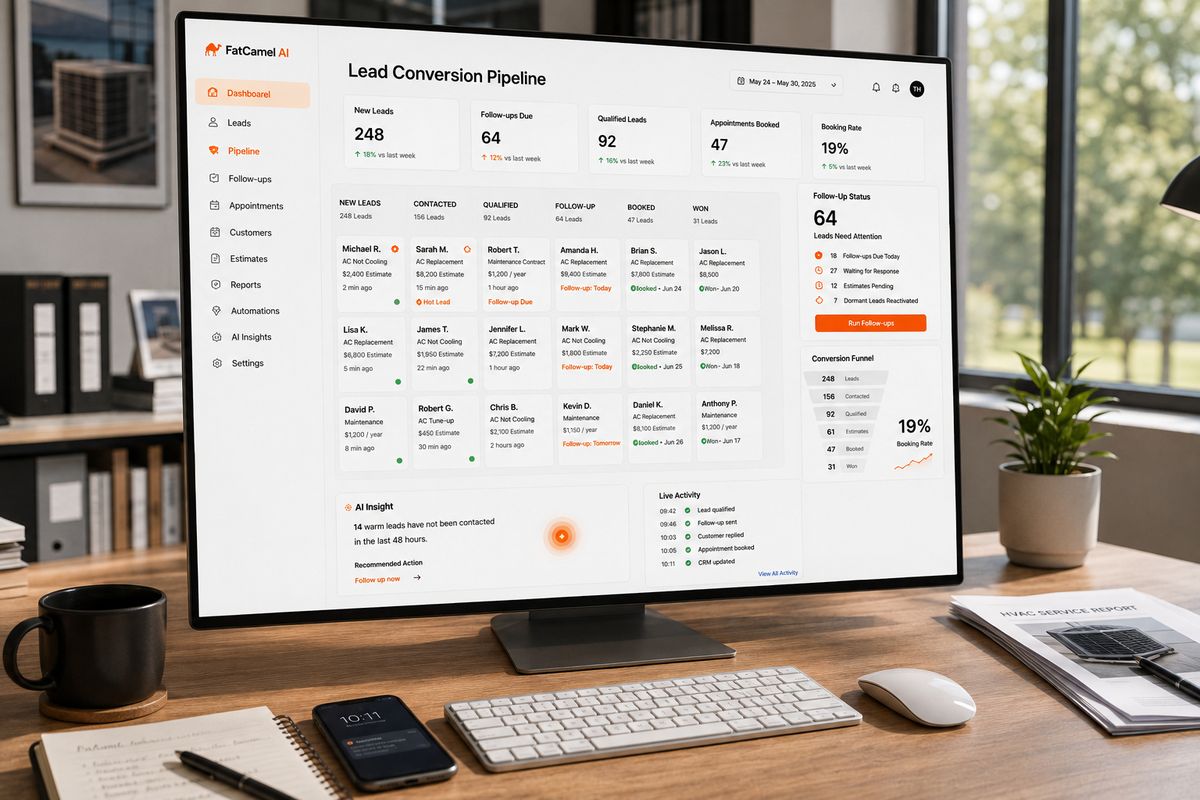
Every conversion fix described in this guide addresses a specific point in the pipeline where leads are currently leaking. FatCamel AI's automation stack is built to close each of those leaks for HVAC contractors, working on top of the existing CRM rather than replacing it.
RealtorVoiceAI closes the response speed gap answering every call within one ring and responding to every web form within 60 seconds, at any hour, without requiring anyone on the team to be available. The lead qualification built into the voice interaction routes high-value leads appropriately and creates the CRM context that allows technicians to arrive at site visits prepared.
The Lead Activation Engine runs the multi-touch follow-up sequences, estimate follow-up automation, and past customer re-engagement that turn a 15 percent conversion rate into a 35 percent one. Every sequence is configured around the specific services the business offers and the specific decision timeline HVAC clients in that market follow not a generic template.
CRM Automation ensures the pipeline tracking data is always accurate, which means conversion rates by stage are always visible and the next improvement opportunity is always identifiable.
The result is an HVAC business whose conversion rate reflects what the lead volume actually deserves not what a manual follow-up process can sustain during peak season.
👉 Get a Free AI Revenue Audit for Your HVAC Business at https://www.fatcamel.ai/contact
FAQ
What is a good conversion rate for an HVAC business?
The HVAC industry average sits between 2 and 5 percent for website visitors converting to leads, and 15 to 25 percent for leads converting to booked jobs with manual follow-up processes. HVAC businesses running structured AI-powered follow-up, instant lead response, and systematic estimate follow-up commonly see lead-to-job conversion rates of 30 to 45 percent. The gap between average and top-performing is almost entirely explained by response speed and follow-up consistency rather than advertising quality or pricing.
Why is my HVAC conversion rate low despite getting leads?
Low HVAC conversion rates despite reasonable lead volume almost always indicate one of three problems: slow response time allowing competitors to make first contact, insufficient follow-up (most businesses stop at one or two attempts when five to eight are needed), or absent estimate follow-up allowing quotes to go cold without being chased. All three are systems problems rather than lead quality problems, and all three are fixable without changing the marketing.
How much does response speed actually affect HVAC conversion rates?
MIT and InsideSales.com research across 15,000+ leads found that responding within five minutes produces a contact rate 100 times higher than responding after 30 minutes. In HVAC specifically, where homeowners contact multiple companies simultaneously during an emergency, being first to respond often means being the only company the homeowner actually speaks to before making a booking decision.
How many follow-up attempts should an HVAC business make before giving up?
Research across service industries consistently shows buyers need five to eight contacts before making a purchase decision. Most HVAC businesses make one to three follow-up attempts. The gap between those numbers is where the majority of recoverable conversion revenue sits. An automated follow-up sequence should run five to six touchpoints across SMS and email over 14 to 21 days before moving a non-responsive lead to a long-term nurture track.
What is a good HVAC estimate acceptance rate?
Industry data suggests that HVAC businesses without structured estimate follow-up see acceptance rates of 20 to 35 percent. Businesses running systematic estimate follow-up a structured sequence starting three days after the estimate is sent and running for three weeks consistently see acceptance rates of 40 to 55 percent. The improvement is almost entirely driven by the follow-up rather than by changes to the estimate itself.
How do I track my HVAC conversion rate by pipeline stage?
Effective HVAC conversion tracking breaks the pipeline into five stages: lead to first contact, first contact to consultation booked, consultation to estimate sent, estimate to accepted, and past customer to repeat booking. Tracking the conversion rate at each stage separately reveals which stage is leaking the most leads, allowing improvement effort to be directed at the highest-value fix rather than spread across the whole pipeline. AI-powered CRM automation keeps these stage conversion rates current without manual report building.
How does FatCamel AI improve HVAC lead conversion rates?
FatCamel AI closes the three highest-impact conversion gaps for HVAC businesses. RealtorVoiceAI closes the response speed gap by answering every lead within 60 seconds at any hour. The Lead Activation Engine runs multi-touch follow-up sequences, estimate follow-up automation, and past customer re-engagement automatically based on CRM pipeline data. CRM Automation keeps pipeline stage conversion rates visible continuously so the next improvement opportunity is always identifiable. Together these components typically move HVAC conversion rates from the 15 to 20 percent range to 30 to 40 percent or above.
References
https://valveandmeter.com/blog/marketing/hvac-conversion-rate-optimization/
https://onepath.ai/blog/hvac-conversion-rates-ultimate-guide
https://www.simprogroup.com/blog/how-to-get-more-hvac-sales
https://www.avoca.ai/blog/generate-more-hvac-leads-strategies-tips
https://www.artifactaisolutions.com/blog/hvac-revenue-lost-from-missed-calls
https://www.callrail.com/blog/missed-calls-stats
https://simpletexting.com/blog/sms-marketing-statistics/
https://www.servicetitan.com/blog/hvac-ai
https://www.fatcamel.ai/services/crm-automation
https://www.fatcamel.ai/