
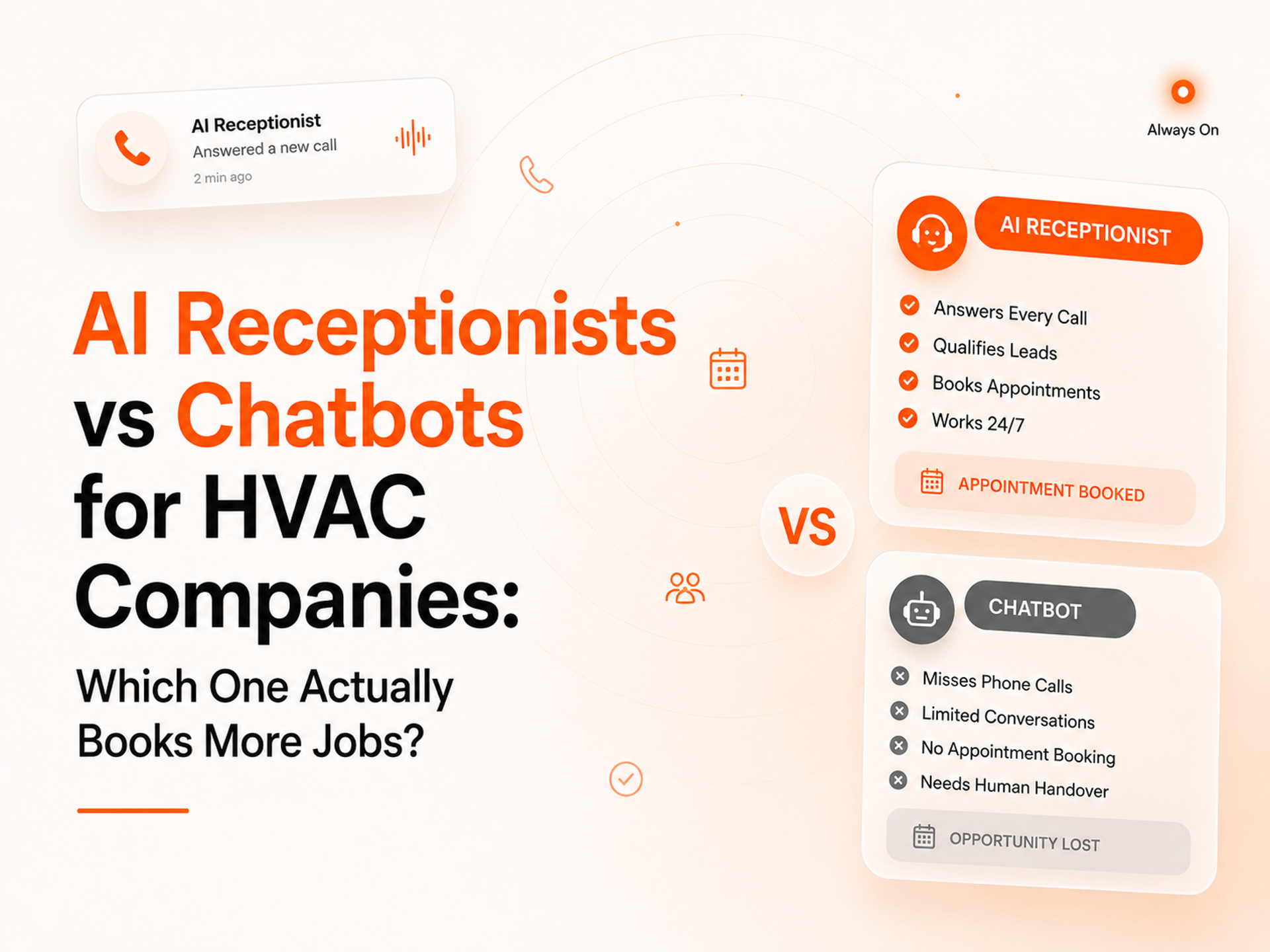
Here's a question most HVAC owners get wrong: when someone says "AI for your phones," do they mean a receptionist or a chatbot? Because those are two completely different tools, and picking the wrong one means spending 200 to 400 dollars a month solving a problem you don't actually have.
The short version: HVAC leads come in by phone. Emergencies especially. Nobody whose AC died at 9 PM in July is typing questions into a website chat widget they're calling down a list until someone picks up. That makes the AI receptionist the right first call for most HVAC businesses. But there's more to it than that, and this guide covers all of it.
Table of Contents
What an AI Receptionist Does for an HVAC Business
What an AI Chatbot Does for an HVAC Business
The Real Difference: Phone vs Web
When the AI Receptionist Is the Clear Winner
When a Chatbot Actually Adds Value
Pricing: What HVAC Companies Actually Pay in 2026
When to Run Both
How to Decide What Your Business Needs First
How FatCamel AI's RealtorVoiceAI Works for HVAC
FAQ
References
What an AI Receptionist Does for an HVAC Business
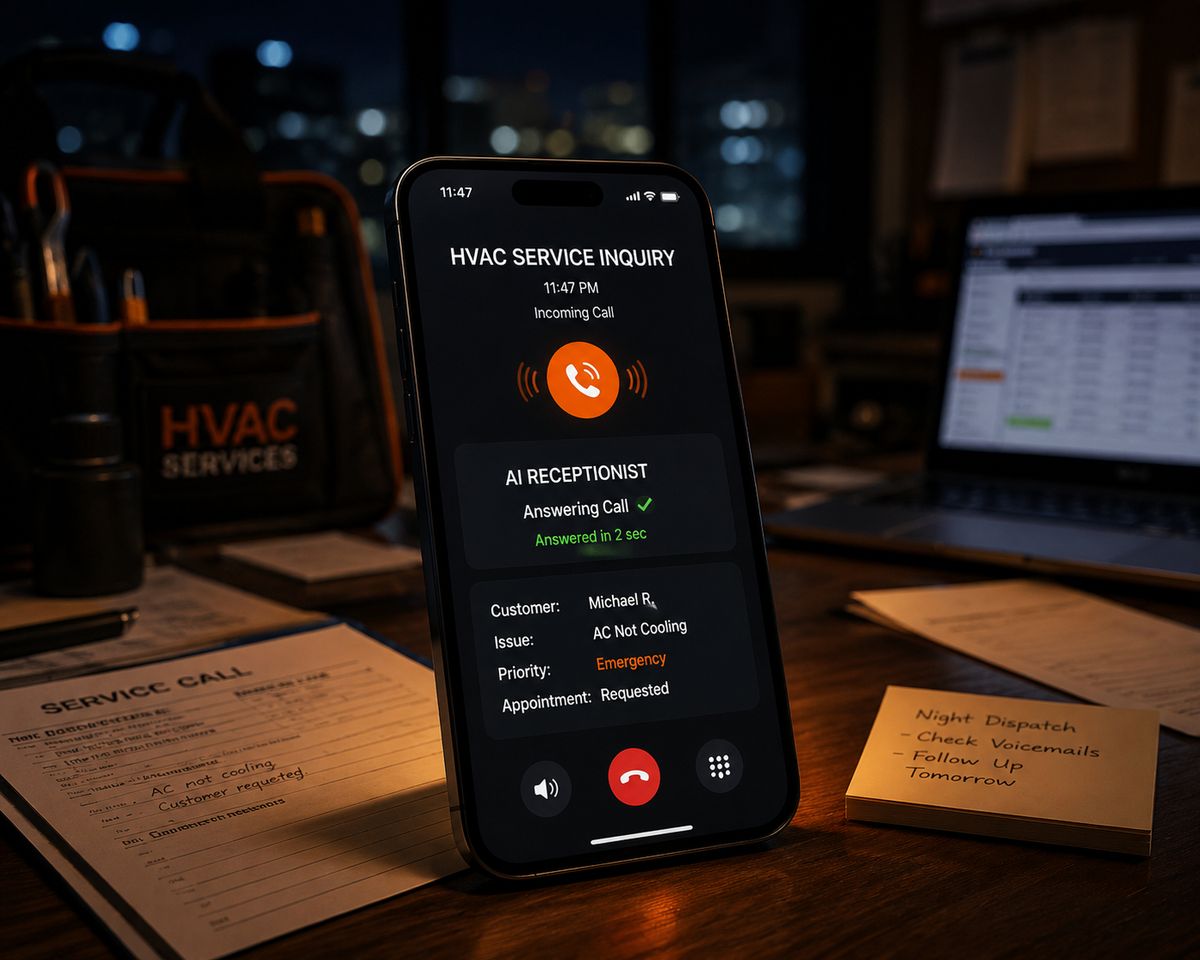
An AI receptionist answers your phone calls. That's the core of it. When a homeowner dials your HVAC number at 2 PM on Tuesday or 11 PM Saturday the AI picks up, introduces itself as your company, asks about the issue, collects the details, and either books the job directly or sends an emergency alert to whoever's on call.
For HVAC, this covers the exact moment that matters most. The homeowner whose system just failed isn't browsing your website. They're calling down a list of contractors and booking with whoever answers. An AI receptionist makes sure that's always you, regardless of the hour.
Where it works well: after-hours calls that currently go to voicemail, overflow when the dispatcher's already on another line, emergency triage to separate a gas smell from a warm room, routine maintenance bookings, and immediate text-back to callers who hung up before the AI connected.
Where it struggles: complex technical conversations where the homeowner needs real troubleshooting guidance, upset customers who specifically want to talk to an owner, and high-stakes commercial pitches where the relationship itself is the close.
What an AI Chatbot Does for an HVAC Business
An AI chatbot handles typed conversations on your website, in Facebook Messenger, or via SMS. It answers questions, qualifies leads with structured prompts, and moves interested visitors toward a booking link or a human. It doesn't touch the phone.
For HVAC, the chatbot's value is real but narrower. A homeowner researching HVAC services at midnight who wants to know your service area or what a tune-up costs gets an instant answer without anyone on your team being awake. A paid search landing page with a chatbot filters visitors before they hit your calendar, so your dispatcher handles fewer dead-end calls.
Where it works well: FAQ questions (service area, pricing ranges, what a tune-up includes), qualifying web traffic from Google Ads, and text-based support for markets with bilingual customers who prefer typing.
Where it completely misses: urgent calls. Nobody with no heat in January is opening a chat widget. Voice is where HVAC emergencies live, and a chatbot is invisible to them.
The Real Difference: Phone vs Web
This is the whole comparison right here.
HVAC leads are phone-first. Per Invoca research, 27% of all home service calls go unanswered. Between 35 and 45% of HVAC inbound calls arrive outside business hours. Emergency situations failed systems, gas smells, water leaking from units always come in by phone. The homeowner is stressed, the problem is urgent, and they're calling until someone answers.
Web leads exist for HVAC contact forms, chatbot enquiries, and paid search landing pages all produce text-based interactions. But these tend to come from homeowners who are researching rather than responding to an immediate problem. They're valuable, but they're a smaller share of total inbound volume and they're lower urgency.
AI receptionist captures the phone volume. Chatbot captures the web volume. Since phone volume is larger and higher-urgency for most HVAC businesses, the receptionist almost always comes first.
Read More: Build an HVAC Lead Generation System That Works 24/7
When the AI Receptionist Is the Clear Winner
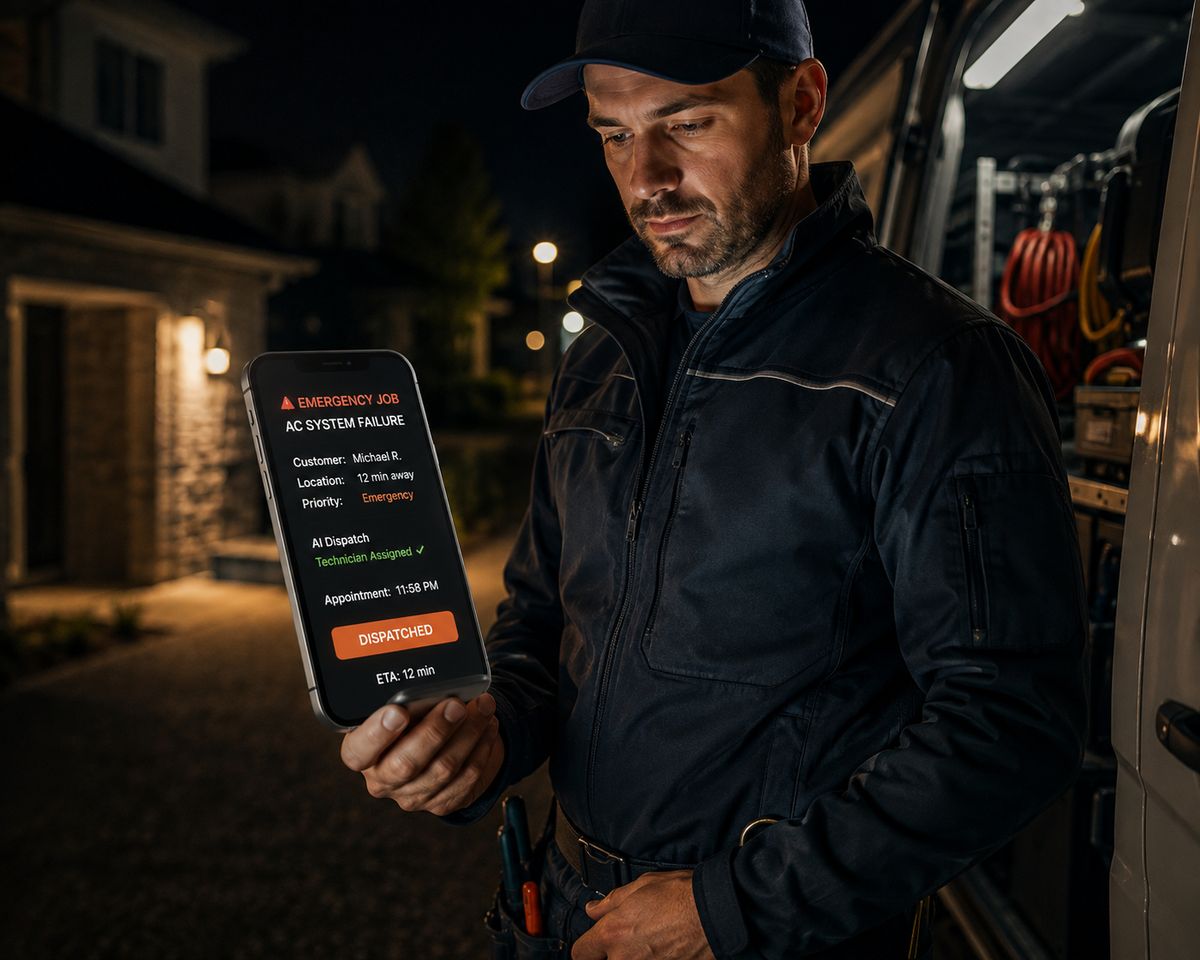
Four situations where the AI receptionist is the obvious first investment.
You're spending on Google Ads and missing after-hours calls. If you're paying 80 to 200 dollars per lead to get the phone ringing and then sending 27% of those calls to voicemail, the math is brutal. At 150 dollars per lead and a 45% close rate, each missed call wastes roughly 333 dollars in ad spend. An AI receptionist at 200 to 400 dollars per month that captures those calls pays for itself with two or three recovered jobs.
You're a small team where the owner is often in the field. When the dispatcher is also sometimes the estimator or the technician, calls get missed during active jobs. An AI receptionist handles those gaps without adding headcount.
Your market has significant after-hours HVAC demand. Phoenix, Dallas, Atlanta, Minneapolis extreme heat or cold generates emergency HVAC calls at all hours. That overnight call volume is revenue going somewhere. An AI receptionist makes sure it goes to you.
You want technicians to arrive prepared. An AI receptionist that collects system type, symptoms, equipment age, and service address means every tech arrives knowing what they're walking into fewer callbacks, better first impressions.
When a Chatbot Actually Adds Value
A chatbot isn't the right first move for most HVAC businesses. But it's genuinely useful in specific situations.
You run paid traffic to a website. If Google Ads or Facebook sends volume to a landing page, a chatbot qualifies visitors before they hit your calendar. The ready-to-book ones move forward. The price shoppers get their questions answered without consuming dispatcher time.
You get consistent after-hours web form submissions. Some HVAC markets particularly commercial-focused ones generate form traffic from facility managers doing research after hours. A chatbot that acknowledges and qualifies those submissions bridges the gap until morning.
You serve a bilingual market. For HVAC businesses in markets with large Spanish-speaking populations, a bilingual chatbot on the website gives those customers a comfortable way to get answers in their preferred language before calling.
Read More: Recover Cold HVAC Leads Using AI (And Turn Dead Contacts Into Booked Jobs)
Pricing: What HVAC Companies Actually Pay in 2026
Ignore the "starts at" numbers. Here's what actually happens.
AI receptionist: Subscription tools for home service businesses run 59 to 150 dollars per month at lower call volumes, scaling to 300 to 500 dollars for busy HVAC operations taking 200 to 400 calls monthly. Custom-built AI voice agents configured specifically for HVAC — with HVAC-specific call flows, emergency triage, and direct integration with ServiceTitan, Jobber, or Housecall Pro typically cost 3,000 to 8,000 dollars to build, with 200 to 500 dollars monthly after that. The custom build outperforms the subscription tool because it's built around real HVAC scenarios, not a generic service business template.
AI chatbot: Hosted platforms start with free tiers and run 99 to 300 dollars per month for HVAC-level usage. Per-resolution pricing models about 0.99 dollars per resolved conversation add up quickly at high volume.
The ROI comparison matters more than the cost comparison. An AI receptionist at 300 dollars per month capturing three extra after-hours jobs per week at 650 dollars average value produces over 7,800 dollars in monthly revenue recovery. That's the math that determines whether this is worth it, not the subscription price alone.
When to Run Both
Running an AI receptionist and a chatbot together makes sense once you have meaningful volume coming through both channels.
The receptionist covers every phone call after-hours, overflow, emergency, routine. The chatbot covers every web interaction forms, FAQs, paid traffic qualification. Together they close every gap. No lead goes unanswered through any channel at any hour.
For HVAC businesses spending on both paid search and local SEO, this combination fully protects the marketing investment. Google Ads generate calls the receptionist answers them. SEO generates web form submissions the chatbot responds immediately. Neither channel produces leads that sit waiting until business hours.
How to Decide What Your Business Needs First
Five questions. Answer these before spending on either tool.
Where do most of your leads come in? Pull two weeks of CRM data. If 70% or more are phone calls, start with the receptionist. If you're seeing significant web form volume, add the chatbot.
What's your missed-call rate? Check your VoIP log. If you're missing more than 20 calls per month most HVAC businesses are missing significantly more the receptionist pays for itself immediately.
Do you take emergency calls? If yes, voice first, always. Emergencies come in by phone.
What's your average job value? Emergency HVAC calls at 600 to 1,500 dollars make the receptionist ROI fast and clear. Routine maintenance at 150 to 250 dollars makes the chatbot's qualification value proportionally more relevant.
Are you running paid search? If you're spending on Google Ads or LSAs, every missed call is doubly expensive. The receptionist is non-negotiable.
Read More: Why Most HVAC CRMs Fail (And How Our CRM Automation Solves It)
How FatCamel AI's RealtorVoiceAI Works for HVAC
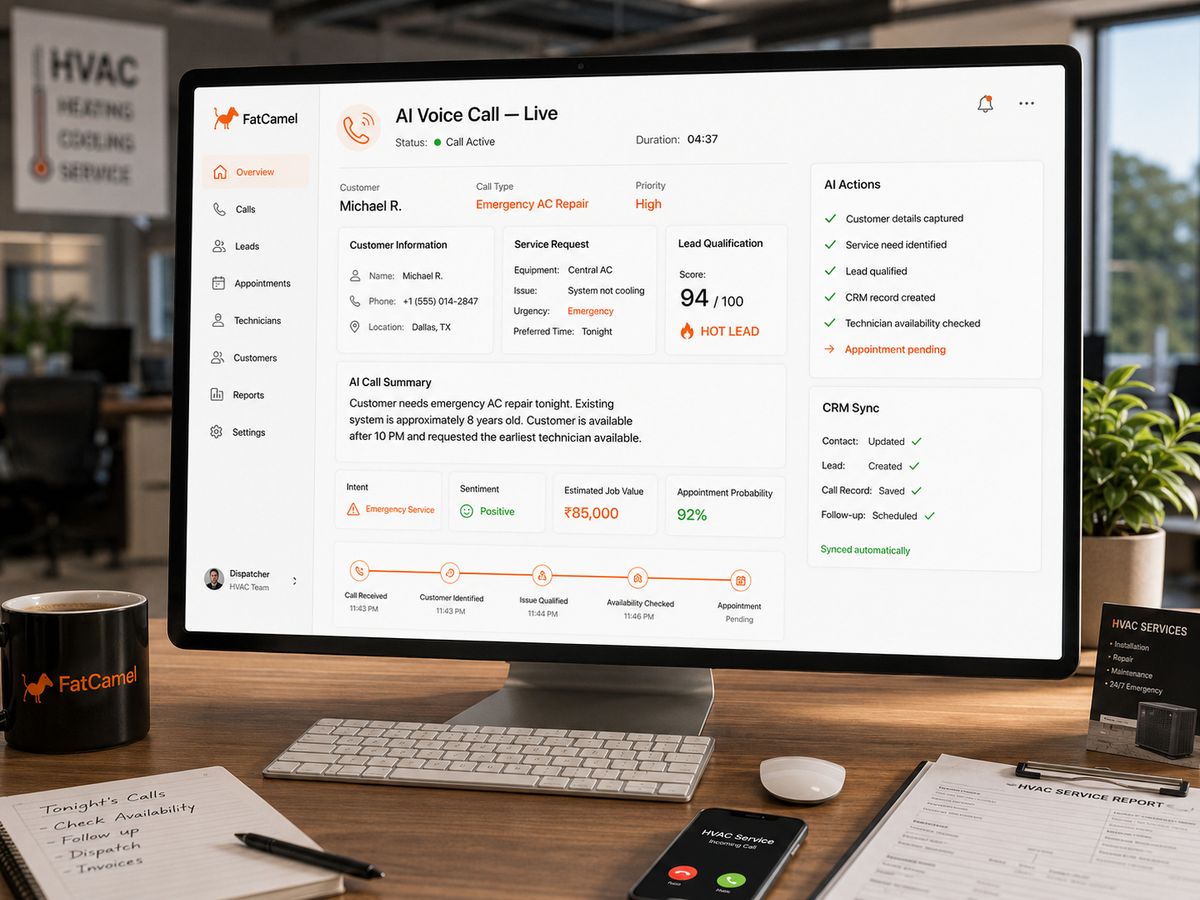
FatCamel AI's RealtorVoiceAI isn't a generic answering service applied to HVAC. It's configured around the actual call types HVAC businesses receive and that distinction changes what it can do.
Emergency recognition is built into the call flow. Gas smell, no heat, burning smell, water leaking from the unit these trigger a different response than a tune-up inquiry. The on-call technician gets an SMS immediately. The caller gets a clear confirmation that help is coming. The system captures the address, the symptoms, and the situation details before the call ends.
Standard bookings work just as cleanly. Routine maintenance, seasonal tune-ups, system replacement consultations the AI collects the relevant details, checks available slots, books directly into the scheduling system, and sends a confirmation SMS to the customer before the conversation ends.
Every call is logged to the CRM automatically caller name, address, issue description, urgency level, outcome. The dispatching team arrives in the morning with a complete organized overnight summary, not a voicemail box to sort through.
And because FatCamel AI's system connects the voice layer to the full automation stack, calls that don't immediately convert the caller who asked questions but didn't book automatically enter the follow-up and reactivation workflows. The lead doesn't disappear just because the first call didn't close it.
For businesses that want both voice and web coverage, FatCamel AI's chatbot component handles the website and social channels through the same connected system one CRM, one pipeline, both channels covered.
👉 Get a Free AI Revenue Audit for Your HVAC Business at https://www.fatcamel.ai/contact
FAQ
1. What's the main difference between an AI receptionist and an AI chatbot for HVAC?
An AI receptionist answers phone calls using voice AI it speaks with callers, qualifies their situation, and books appointments in real time. An AI chatbot handles typed conversations on websites or messaging apps. For HVAC, the difference matters because most leads come in by phone, particularly urgent ones. Nobody calls a chat widget when their heat stops working in January.
2. Does an HVAC company need an AI receptionist or chatbot first?
The receptionist almost always comes first for HVAC. Between 35 and 45% of HVAC calls arrive after hours, and 27% of home service calls go unanswered. At 600 to 1,500 dollars per emergency job, recovering even a few of those calls per week pays for the tool immediately. A chatbot adds value for businesses with significant web traffic, but it doesn't fix the phone gap.
3. Can an AI receptionist handle HVAC emergency calls?
Yes and emergency handling needs to be configured correctly for HVAC. A properly set up system recognizes emergency language gas smell, no heat in extreme cold, burning smell, water from the unit and responds differently than it would to a routine maintenance inquiry. The on-call technician gets an SMS immediately. The caller gets confirmation that help is coming.
4. How much does an AI receptionist cost for an HVAC business?
Subscription tools for home service businesses run 59 to 400 dollars per month depending on call volume. Custom-built solutions configured for HVAC specifically with emergency triage, HVAC call flows, and direct CRM integration typically cost 3,000 to 8,000 dollars to build with 200 to 500 dollars monthly after that. Most businesses recover that cost within the first month through captured after-hours calls.
5. When does running both an AI receptionist and chatbot make sense?
When you have meaningful volume through both channels. The receptionist covers every phone call. The chatbot covers every web interaction. Together they ensure no lead goes unanswered through any source at any hour which fully protects marketing investment driving traffic from both paid and organic sources.
6. Will an AI receptionist sound robotic to HVAC customers?
Modern voice AI sounds significantly more natural than older phone systems. The experience varies by how well the call flow is configured for HVAC specifically a generic template sounds different from a system built around real HVAC scenarios. Practical measures like booking conversion rates suggest most callers engage comfortably enough to complete the process, which is what actually matters.
7. How does FatCamel AI's RealtorVoiceAI differ from generic AI answering services?
It's built for HVAC contractors specifically, not applied from a generic template. The call flows cover real HVAC scenarios emergency triage, routine booking, commercial routing. It integrates with ServiceTitan, Jobber, and Housecall Pro directly. And it connects to the full FatCamel automation stack, so calls that don't immediately convert enter follow-up workflows automatically rather than disappearing.
References
https://www.southarcdigital.com/journal/ai-receptionist-vs-ai-chatbot-local-service-business
https://ainora.lt/blog/chatbot-vs-ai-voice-receptionist-differences
https://www.invoca.com/blog/inbound-call-statistics
https://skillmammoth.com/blog/ai-for-hvac
https://hyperleap.ai/hvac-agents
https://www.callrail.com/blog/missed-calls-stats
https://www.artifactaisolutions.com/blog/hvac-revenue-lost-from-missed-calls
https://www.fatcamel.ai/services/voice-assistant
https://www.fatcamel.ai/ser