
Quick Answer: Most HVAC CRMs fail not because the software is bad, but because CRM software alone is passive it stores data but doesn't act on it. It doesn't answer calls when nobody's available, trigger follow-up sequences, chase estimates, or reach out to dormant contacts. The fix isn't a new CRM. It's adding an AI automation layer on top of the one you already have one that turns a passive database into a system that actively captures leads, follows up automatically, and retains customers without manual input from your team.
There's a pattern that shows up in HVAC businesses of every size. The CRM was supposed to fix the lead management problem. It got set up, the team was trained, data got entered. And for a few months, things felt more organized. Then busy season hit. Data entry fell behind. Follow-up sequences that someone was supposed to manage manually stopped happening. Leads piled up in a status that nobody updated. The CRM became a contact database expensive, partially used, and not solving the problem it was bought to solve.
This isn't a software quality problem. It's a fundamental mismatch between what CRM software is built to do and what an HVAC business actually needs. This guide explains that mismatch in detail, covers the six most common HVAC CRM failure points, and shows exactly how CRM automation fixes each one without replacing the platform you already use.
Table of Contents
What a CRM Is Actually Built For (And What It Isn't)
The Six Reasons HVAC CRMs Fail in Practice
Failure 1: It Doesn't Capture After-Hours Leads
Failure 2: It Doesn't Follow Up Automatically
Failure 3: It Doesn't Chase Estimates
Failure 4: The Data Is Always Out of Date
Failure 5: Dormant Contacts Just Sit There
Failure 6: No Visibility Into Where Leads Are Actually Going
How CRM Automation Fixes Every One of These
How FatCamel AI's CRM Automation Works for HVAC Businesses
FAQ
References
What a CRM Is Actually Built For (And What It Isn't)
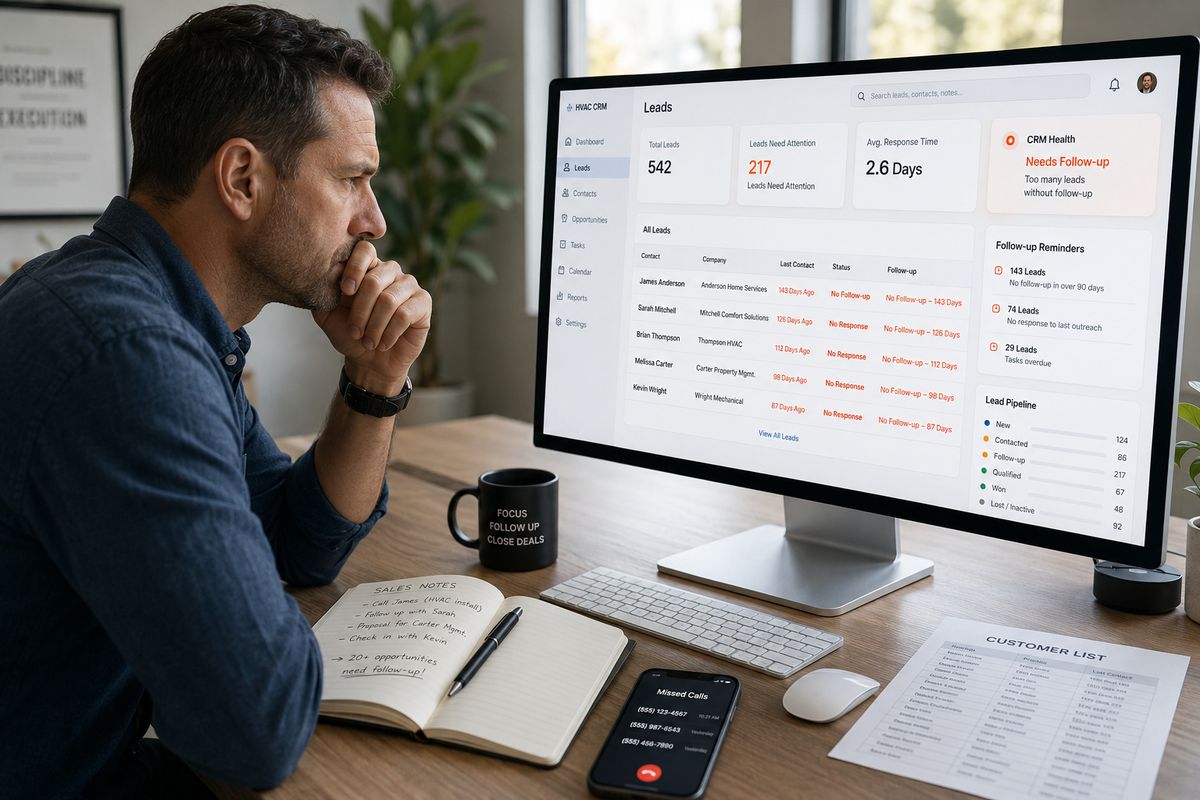
CRM software is built to store and organize customer data. That's it. At its core, a CRM is a structured database customer contact information, job history, equipment records, communication logs, pipeline stages. When someone updates it, the information is there. When nobody updates it, the information isn't.
That's the design. CRMs are reactive systems. They record what humans put into them. They surface what humans ask them to show. They don't do anything on their own.
Most HVAC businesses don't have a CRM problem. They have an expectation gap they bought a CRM expecting it to fix their lead management and customer retention issues, and it didn't, because those problems require action, not just storage. The leads that came in after hours and never got logged didn't get logged because the CRM didn't answer the phone. The follow-up that never happened didn't happen because the CRM doesn't send messages. The estimate that went cold went cold because the CRM doesn't chase it.
The average HVAC company loses somewhere between 20 and 30% of repeat business it could otherwise keep, largely because there's no automated follow-up after the first job, per HVAC CRM research published by ZenTrades. That's not a CRM data quality problem. That's an action problem and adding a better CRM doesn't solve it.
Read More:15 HVAC Tasks You Can Automate Using AI (And What Each One Is Worth)
The Six Reasons HVAC CRMs Fail in Practice
The failure modes are consistent across businesses that use different platforms, have different team sizes, and serve different markets. The CRM itself rarely matters. What matters is what the CRM can and can't do on its own.
Failure 1: It Doesn't Capture After-Hours Leads
Between 35 and 45% of HVAC inbound calls arrive outside standard business hours. Most CRMs have no mechanism for capturing those calls they can only log what a human enters. When a homeowner calls at 9 PM because their system failed and gets voicemail, that lead doesn't get into the CRM. It doesn't show up in any pipeline report. It doesn't trigger any follow-up. It simply disappears.
Per CallRail data, 85% of callers who reach voicemail don't call that business back. Which means the CRM isn't just missing a record it's missing the revenue that contact would have generated, the lifetime customer value, and the referrals that customer would have sent. All invisible. All untracked.
This isn't fixable with a better CRM. It's fixable with a system that answers the call, captures the information, and creates the CRM record automatically before any human is involved.
Failure 2: It Doesn't Follow Up Automatically
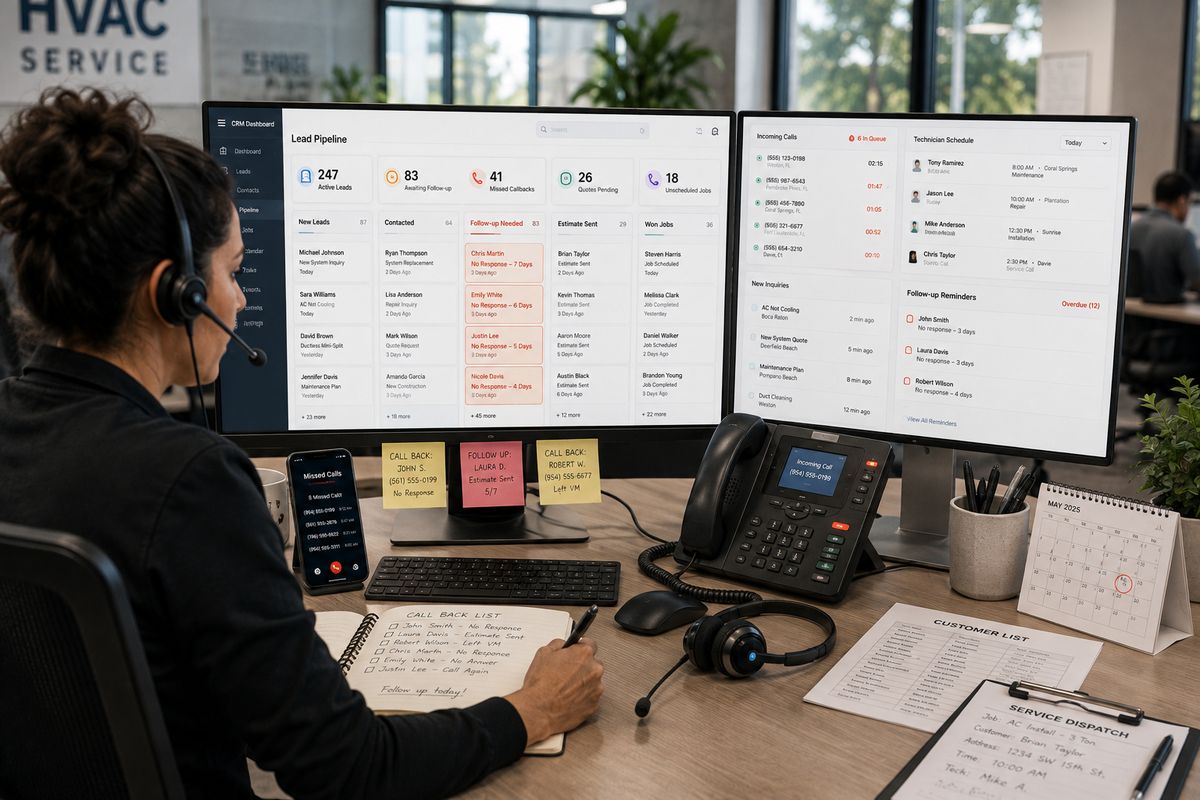
Most HVAC CRMs have a follow-up task feature. Someone can set a reminder to call a lead in three days. The problem is that setting reminders and completing them at scale requires consistent human discipline that breaks down exactly when it's needed most during peak season, when call volume is high, jobs are running back to back, and the last thing anyone is thinking about is a lead who said "maybe" two weeks ago.
Industry research is consistent on this: most buyers need five to eight touchpoints before making a decision. Most HVAC businesses deliver one or two. The gap between those numbers is where the majority of follow-up revenue disappears not to competitors who are better at the work, but to competitors who simply stayed in contact longer.
A CRM task reminder doesn't close this gap. It shifts the responsibility to the dispatcher and hopes the timing works. An automated follow-up sequence closes it because it runs on a fixed schedule regardless of what the team is doing, stops automatically when the lead responds, and doesn't require anyone to remember to initiate it.
Failure 3: It Doesn't Chase Estimates
This is the most expensive CRM failure point in most HVAC businesses. An estimate goes out. It represents the maximum investment the business has made in that lead the site visit, the technician's time, the detailed scope and pricing work. And then it sits in the CRM with a "sent" status while nobody follows up on it.
Less than 40% of HVAC businesses have any systematic process for following up after an estimate goes out, per industry data. The team sends the estimate, waits for the customer to decide, and moves on to active jobs. The customer, meanwhile, is comparing three quotes, discussing it with their partner, and waiting to see which contractor cares enough to check in.
The contractor who calls on day three to ask if they have any questions wins a disproportionate share of those estimates not because their price is lower, but because they demonstrated they actually want the work. HVAC businesses running structured estimate follow-up consistently see acceptance rates improve by 15 to 25 percentage points. On a system replacement quote worth 10,000 dollars, that's significant revenue from a sequence that costs nothing to run once it's automated.
Failure 4: The Data Is Always Out of Date
Every HVAC CRM suffers from this. Calls come in. Jobs get completed. Customers reschedule. Estimates get accepted or declined. And all of this needs to get logged into the CRM manually by someone who is simultaneously managing a dispatch board, answering incoming calls, and coordinating with technicians in the field.
Manual data entry is always the last priority. Which means the CRM is always a day or two behind reality. And when the CRM is inaccurate, every decision made from it dispatch planning, follow-up sequencing, pipeline reporting, management reporting is based on outdated information.
This creates a compounding problem. The CRM gets used less because people don't trust it. It gets updated less because it's being used less. The data gets worse. Eventually it becomes a contact database that nobody relies on for operational decisions which is exactly what it was before the CRM was implemented.
Read More: AI Voice Agent for HVAC Companies: Features, Pricing & Benefits
Failure 5: Dormant Contacts Just Sit There
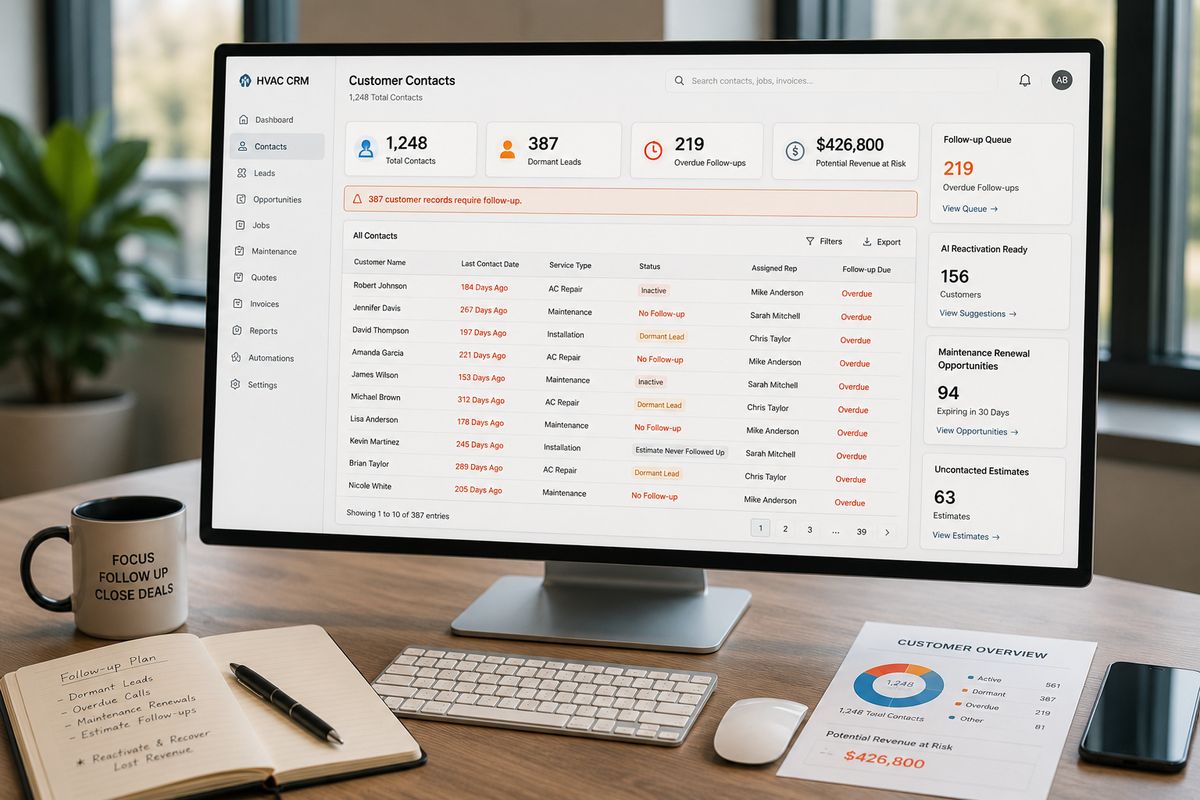
Every HVAC CRM with any real history is full of dormant contacts. Past customers who haven't had service in 18 months. Leads who enquired, got a quote, and went quiet. Maintenance agreement holders whose agreements lapsed without renewal. All of this represents acquisition cost that's already been paid the marketing spend, the initial call, sometimes a site visit.
Most CRMs surface this data in a report that someone has to remember to run, review, and act on. Which is a manual process that rarely happens consistently. So the dormant contacts just sit there, not generating revenue, not being re-engaged, slowly drifting further from the business.
A competing HVAC company with an AI reactivation layer running on the same data would systematically reach back out to every dormant contact on a scheduled cadence, with personalized messages referencing the original service history. Converting 10% of a CRM with 200 dormant contacts at an average quote value of 2,500 dollars is 25,000 dollars in recovered revenue from a list that was previously invisible.
Failure 6: No Visibility Into Where Leads Are Actually Going
Most HVAC CRMs produce reports on revenue and completed jobs. What they don't produce clearly is visibility into where leads are dropping out of the pipeline which stage loses the most contacts, which source produces the highest-quality leads, which follow-up sequences are converting and which aren't.
Without that visibility, improvement is guesswork. A business might invest more in Google ads when the actual problem is that 60% of leads go cold after one follow-up attempt. Or they might hire another dispatcher when the real bottleneck is that after-hours calls never enter the pipeline at all. The data to diagnose these problems is in the CRM. But extracting it, connecting the dots, and acting on what it shows requires more than a standard CRM report.
Read More: How to Add AI to Your HVAC CRM Without Replacing It
How CRM Automation Fixes Every One of These
The fix for all six failure points is the same: an AI automation layer that connects to the existing CRM and adds the autonomous action capability the core platform doesn't provide.
For after-hours lead capture: An AI voice agent answers every inbound call immediately, qualifies the situation, and creates the CRM record automatically before any human is involved. Every after-hours lead enters the pipeline. None go untracked.
For follow-up sequences: Automated multi-touch sequences trigger the moment a lead enters a specific pipeline stage, run across SMS and email on a fixed schedule, and stop automatically when the lead responds or books. No human has to initiate or manage them.
For estimate chasing: Estimate follow-up sequences start the moment an estimate status is updated to "sent" in the CRM. Day three, day seven, day fourteen each message different, each one adding value, each one running without dispatcher involvement.
For data accuracy: Every call outcome, every message sent, every job status change gets logged back to the CRM automatically, in real time, without manual entry. The CRM reflects what's actually happening at all times.
For dormant contacts: An AI reactivation system identifies contacts crossing inactivity thresholds and initiates personalized outreach referencing the original service history. Revenue gets recovered from contacts that were previously sitting idle.
For pipeline visibility: Automated reporting surfaces conversion rates by stage, by source, and by service type continuously without anyone building a manual report.
How FatCamel AI's CRM Automation Works for HVAC Businesses
FatCamel AI's CRM Automation service is built specifically to fix these six failure points for HVAC contractors not by replacing the CRM they're already using, but by connecting an AI automation layer on top of it.
The implementation starts with a review of the current CRM setup and the specific failure points costing the business the most revenue. Most HVAC businesses start with after-hours call capture and follow-up automation, because those two produce the fastest measurable returns. From there, estimate follow-up, dormant lead reactivation, and customer communication workflows get layered in.
Every component connects to the existing field service platform ServiceTitan, Jobber, Housecall Pro, FieldEdge through standard API integrations. The team keeps using the CRM exactly as they always have. The automation layer runs in the background. The difference is that CRM records are always current, every lead gets followed up, every estimate gets chased, every dormant contact gets a systematic reactivation attempt, and the pipeline data is always accurate enough to make real decisions from.
FatCamel AI's RealtorVoiceAI closes the after-hours capture gap answering every call, qualifying the situation, and creating the CRM record before the team arrives in the morning. The Lead Activation Engine runs follow-up sequences, estimate chasers, and dormant reactivation automatically based on CRM pipeline data. And the reporting layer surfaces the conversion data needed to identify where the next improvement opportunity is.
The result is an HVAC CRM that actually does what most owners thought they were buying when they implemented one in the first place a system that actively works leads, retains customers, and captures revenue without depending on manual input from a team that's always busy doing everything else.
👉 Get a Free AI Revenue Audit for Your HVAC Business at https://www.fatcamel.ai/contact
FAQ
1. Why do most HVAC CRMs fail to deliver results?
Most HVAC CRMs fail because they're passive systems they store data when humans put it in, but they don't act autonomously. They don't answer after-hours calls, trigger follow-up sequences, chase estimates, or reactivate dormant contacts. The expectation that a CRM alone will fix lead management and customer retention issues is a fundamental mismatch with what CRM software is actually built to do. The fix is adding an AI automation layer that provides the action capability the CRM doesn't have.
2. What's the most expensive HVAC CRM failure point?
Estimate follow-up is consistently the most expensive failure point. An estimate represents the maximum investment the business has made in a lead site visit, technician time, detailed scope and pricing work. Yet less than 40% of HVAC businesses have any systematic follow-up process after the estimate goes out. HVAC businesses running structured estimate follow-up see acceptance rates improve by 15 to 25 percentage points. On a 10,000 dollar system replacement quote, that improvement represents significant individual deal recovery.
3. Do I need to replace my HVAC CRM to fix these problems?
No. Every failure point described in this guide is fixable by adding an AI automation layer on top of the existing CRM rather than replacing it. ServiceTitan, Jobber, Housecall Pro, and FieldEdge all support API integrations that allow AI tools to read from and write to existing records in real time. The CRM stays. The team keeps using it the same way. The AI layer adds the autonomous action capability the core platform doesn't provide.
4. How does AI fix the after-hours lead capture problem in HVAC CRMs?
An AI voice agent answers every inbound call immediately at any hour, for any call volume qualifies the situation through a natural conversation, and creates or updates the CRM record automatically before any human is involved. Every after-hours lead enters the pipeline with full context captured. None go untracked because nobody was available to answer the phone.
5. What is dormant lead reactivation and why does it matter for HVAC CRMs?
Dormant lead reactivation identifies CRM contacts that have been inactive beyond a defined threshold typically 90 days or more and initiates personalized outreach referencing their original service history. For HVAC businesses, this means reaching back out to past customers, lapsed maintenance agreement holders, and leads who went quiet after receiving a quote. The acquisition cost for these contacts is already paid. Converting 10% of a CRM with 200 dormant contacts at a 2,500 dollar average quote value represents 25,000 dollars in recovered revenue.
6. How does CRM automation improve data accuracy in HVAC businesses?
CRM automation logs every call outcome, every message sent, and every job status change back to the CRM in real time, automatically, without requiring any team member to manually enter the data. The CRM reflects what's actually happening at all times rather than depending on someone remembering to update it after a busy day. When the CRM is accurate, every downstream process dispatching, follow-up sequencing, pipeline reporting runs on correct information.
7. How does FatCamel AI's CRM Automation work for HVAC businesses?
FatCamel AI's CRM Automation connects to the existing HVAC CRM through API integrations and adds the autonomous action layer the core platform doesn't provide. RealtorVoiceAI closes the after-hours call capture gap. The Lead Activation Engine runs follow-up sequences, estimate chasers, and dormant reactivation based on live CRM pipeline data. Real-time logging keeps the CRM current without manual entry. And pipeline reporting surfaces conversion data continuously without manual report building. Every component works with the existing system rather than replacing it.
References
https://zentrades.pro/zenhvac/blog/hvac-crm-software-a-practical-guide-for-hvac-businesses-in-2026
https://www.bdrco.com/blog/hvac-crm-software/
https://uibakery.io/blog/best-hvac-crm-software
https://www.southarcdigital.com/journal/best-crm-for-hvac-contractors-in-2026-an-honest-comparison
https://myquoteiq.com/ai-powered-crm-for-hvac-companies/
https://www.callrail.com/blog/missed-calls-stats
https://www.servicetitan.com/blog/hvac-crm-software-app
https://www.simprogroup.com/resources/ebooks/trades-outlook-report-2025
https://www.fatcamel.ai/services/crm-automation
https://www.fatcamel.ai/