
Most HVAC marketing advice focuses on one thing: how to get more people to find you. More ads. Better SEO. Post on social media. That's only half the problem.
The harder half and the one most guides completely skip is what happens after someone finds you. They call. They fill out a form. They send a message. And then what? For a lot of HVAC businesses, the answer is a voicemail, a next-day callback, one follow-up attempt, and silence. The lead found you. The process lost them.
This guide covers both sides the strategies that bring leads in, and the process changes that actually convert them into booked jobs.
Table of Contents
The Two Sides of HVAC Marketing
Getting Found: Strategies That Drive Inbound Leads
Google Local Services Ads
Pay-Per-Click Search Advertising
Local SEO and Google Business Profile
Reviews: The Channel Most HVAC Businesses Underuse
Content Marketing and Blogging
Email and Seasonal Campaigns
Social Media for HVAC
Referrals and Trade Partnerships
Converting Leads: The Part Most HVAC Marketing Guides Ignore
How AI Automation Fills the Gap
How FatCamel AI Connects Marketing to Revenue
FAQ
References
The Two Sides of HVAC Marketing
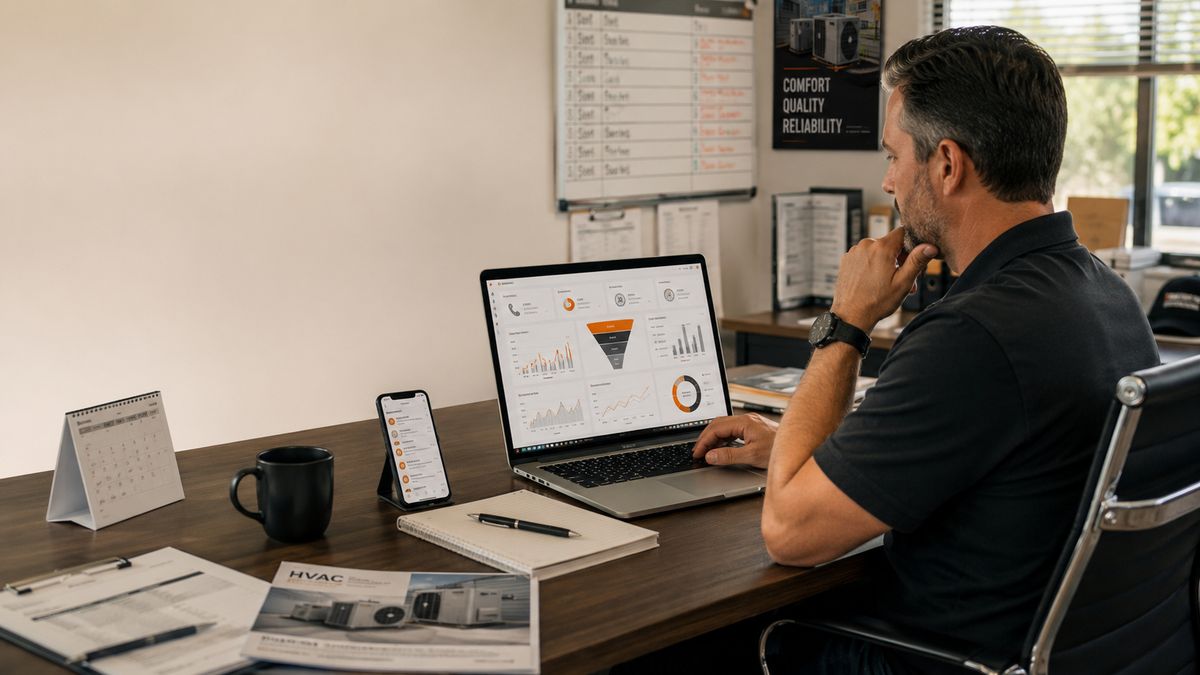
Here's a number worth sitting with. An HVAC business generating 50 leads per month at a 25% conversion rate books 12 or 13 jobs. The exact same business same marketing spend, same lead volume at a 45% conversion rate books 22 or 23 jobs. That's almost double the revenue without spending another dollar on advertising.
The difference between those two outcomes isn't more leads. It's a better process for converting the leads already coming in.
Most HVAC marketing conversations focus entirely on lead generation. That's where the money gets spent and where the metrics are most visible. But the revenue gap in most HVAC businesses isn't in awareness or traffic it's in what happens between first contact and booked job. The strategies below cover both.
Getting Found: Strategies That Drive Inbound Leads
Google Local Services Ads
LSAs sit at the very top of Google search results above traditional ads and above organic results for searches like "AC repair near me" or "emergency HVAC service." They run on a pay-per-lead model, so the business pays only when a homeowner actually contacts them through the listing.
For HVAC businesses, they're worth prioritizing for a few reasons. They show the Google Guaranteed badge, which builds immediate trust with homeowners comparing contractors. They display star ratings and review counts directly in the listing. And they target people who are actively searching for a specific service right now not browsing, not researching, actively looking to hire someone.
One thing most LSA guides don't mention: Google's ranking algorithm for LSAs accounts for response speed. Businesses that answer calls quickly rank higher than those with slow response patterns. This is one of the less obvious reasons why automated call answering directly influences paid ad performance not just conversion rate, but ad visibility itself.
Pay-Per-Click Search Advertising
PPC on Google lets HVAC businesses appear for high-intent keywords "furnace repair Dallas," "emergency HVAC service," "AC installation near me" searched by homeowners dealing with a problem right now. Unlike LSAs, PPC gives more control over messaging, targeting, and where the traffic goes after the click.
The most common mistake with HVAC PPC is sending traffic to the homepage. A homeowner who searched "furnace repair in Austin" and lands on a generic "we do HVAC" homepage is already half-lost. A landing page that specifically addresses furnace repair in Austin, includes a phone number that actually gets answered, and makes the next step obvious converts at a meaningfully higher rate.
Track cost per booked call, not cost per click. Clicks don't pay for technicians. Jobs do.
Local SEO and Google Business Profile
Paid advertising stops generating leads the moment the budget stops. Local SEO keeps working long after the initial investment.
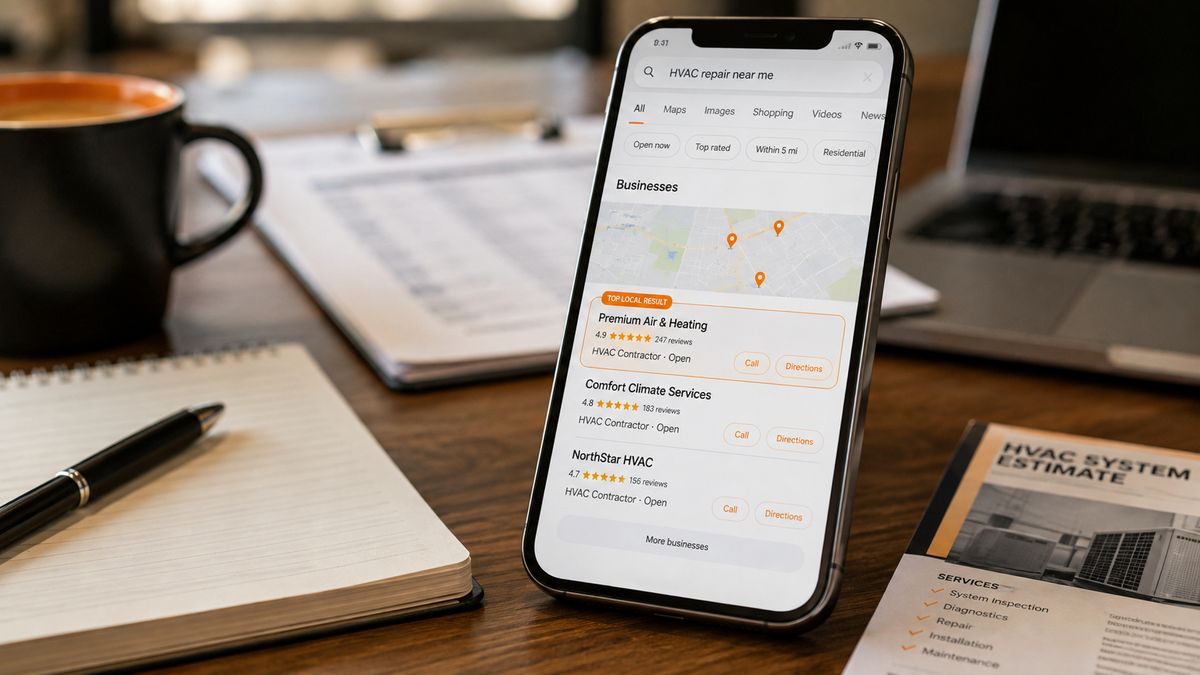
The Google Maps local pack those three listings with the map that appear above organic results captures the majority of clicks for local HVAC searches. Getting into those three spots requires a fully optimized Google Business Profile, consistent NAP information across directories, and a steady flow of recent reviews. That's essentially it. The businesses in the top three aren't doing anything exotic. They've maintained those three things more consistently than their competitors.
The Business Profile is where most HVAC businesses leave the most local SEO value on the table. Setting it up once and never updating it produces declining results over time. Regular posts, new job photos, responses to every review, and accurate service information all signal to Google that the business is active. The profiles Google rewards are the ones that look like someone is running the business not the ones that were set up two years ago and haven't changed since.
Service area pages extend local rankings to every city the business actually serves, not just the one where the office is located. A company serving eight cities with only one location page is invisible in organic search for seven of those cities.
Reviews: The Channel Most HVAC Businesses Underuse
BrightLocal research consistently shows that the vast majority of homeowners read reviews before contacting a local service business. Google's local ranking algorithm treats review recency and volume as ranking factors. A business with 200 reviews where several arrived last week ranks above one with 180 reviews where the most recent came in four months ago.
The businesses with the strongest review profiles don't have better customers. They have a better system. A review request goes to every customer within 24 hours of every completed job automatically, without anyone on the team manually sending it. That consistency compounds over time into a review profile that looks meaningfully more credible than competitors who ask occasionally.
Content Marketing and Blogging
Content marketing drives HVAC leads by capturing organic traffic from homeowners researching problems before they're ready to call anyone. The homeowner whose AC stopped working at 8 PM starts by Googling "why is my AC not turning on" before they search for HVAC companies. The business whose blog appears at that moment has established some level of trust before the first contact happens.
The content that works for HVAC isn't general seasonal tips. It's specific answers to specific questions: "repair vs replace furnace," "why is my HVAC short-cycling," "what does an AC tune-up actually include," "signs I need a new heat pump." These questions have real search volume and far less competition than broader HVAC industry terms dominated by software companies and trade magazines.
Consistency matters more than quality per post. Two solid posts per month published for 12 months produces 24 indexed pages attracting organic traffic. Two posts published and then nothing produces almost nothing from organic search.
Email and Seasonal Campaigns
Email has the highest ROI of any marketing channel for HVAC businesses with an established customer base because it reaches people who already know the business without requiring any ad spend
Seasonal campaigns timed to HVAC demand cycles fill calendars before peak periods rather than competing for bookings during them. A spring AC tune-up campaign in March, when homeowners are starting to think about summer but haven't experienced a problem yet, generates bookings with less urgency and more scheduling flexibility than emergency calls in July. The businesses that stay consistently busy through peak season are usually the ones whose email campaigns ran in the weeks before it started.
The campaigns that convert best aren't generic blasts. They reference the specific customer's equipment history and last service date. That personalization requires accurate CRM data and automation that can do it at scale not manually.
Social Media for HVAC
Social media works for HVAC when it builds trust rather than chasing engagement metrics. The content that drives real enquiries isn't seasonal tips and stock photos of thermostats. It's proof content actual job photos, before-and-after system replacements, technician introductions, short clips of what an installation process looks like. This content answers the question homeowners are actually asking before they call: can I trust these people in my home?
Facebook has the largest homeowner-age audience and the strongest local targeting options for HVAC service areas. Instagram supports visual proof content that builds credibility over time. Nextdoor reaches hyper-local audiences and generates referral-quality leads from neighborhood conversations the kind where someone asks "does anyone know a good HVAC company" and a business with a local presence gets recommended.
The part social media guides consistently miss: social creates the moment of interest, but the response system captures it or loses it. An HVAC business whose Facebook posts generate calls that go to voicemail after hours hasn't solved a marketing problem it's created a conversion problem.
Referrals and Trade Partnerships
Word of mouth is the highest-trust lead source in residential HVAC and the one most businesses do the least to systematize. Happy customers refer neighbors and family members. The businesses that generate referrals consistently aren't just doing better work they're asking more consistently, at the right moment (right after a completed job), with a simple and clear process for following through.
Partnerships with adjacent professionals create reliable referral streams without ongoing marketing spend. Real estate agents need HVAC inspections and repairs during home sales. Property managers need reliable contractors for multiple units. Plumbers and electricians encounter HVAC problems while on other jobs. Three or four active trade partnerships often produce more consistent lead flow than most paid advertising campaigns and they cost nothing beyond the relationship itself.
Read More: Build an HVAC Lead Generation System That Works 24/7
Converting Leads: The Part Most HVAC Marketing Guides Ignore
Every strategy above generates leads. None of them produce revenue without a conversion process that actually works.
The conversion gap the space between a lead making contact and a job getting booked is where most HVAC marketing investment quietly disappears. An after-hours call that goes to voicemail. An estimate that was sent and never followed up on. A past customer who hasn't heard from the business in 14 months and calls a competitor when the next problem comes up.
These aren't marketing failures. They're process failures. And unlike ad targeting or keyword selection, they're entirely fixable without additional marketing spend.
Improving response speed specifically, getting to every lead within minutes rather than hours is the single highest-leverage conversion improvement available to most HVAC businesses. The research is consistent: the odds of reaching a lead drop sharply with every minute that passes after initial contact. For HVAC specifically, where homeowners often call multiple companies simultaneously, being first isn't just an advantage it's frequently the entire decision.
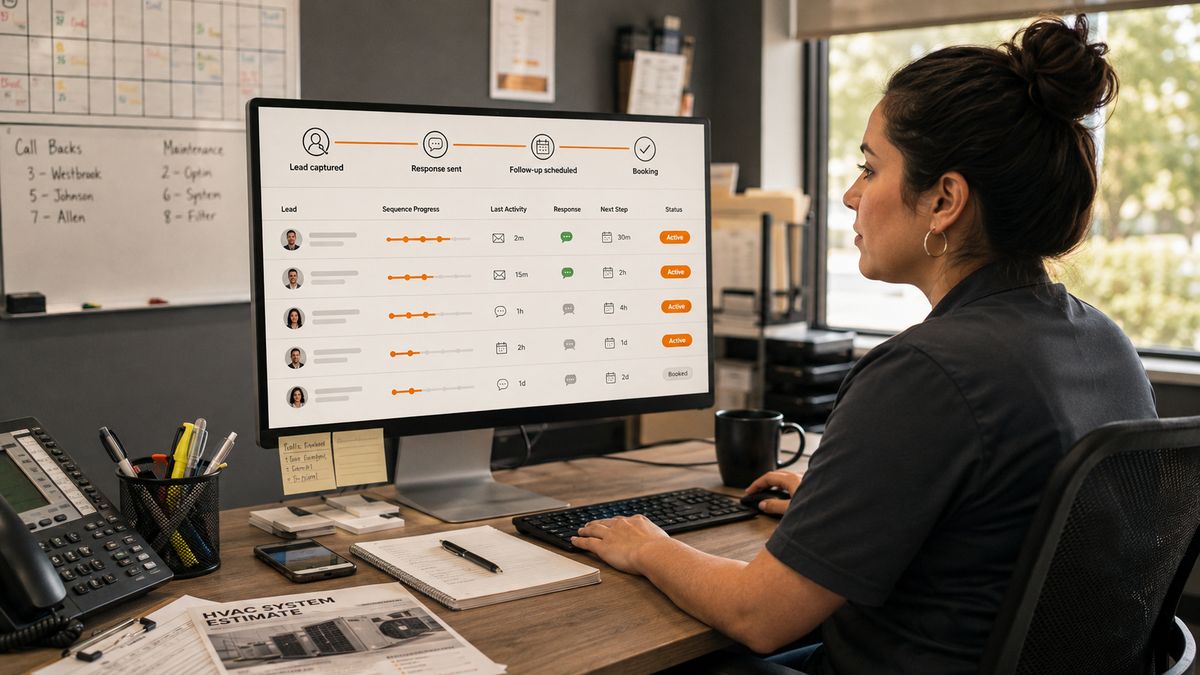
Estimate follow-up is the next highest-impact gap. Less than 40% of HVAC businesses have any systematic process after an estimate goes out. The estimate gets sent, the team moves on to active jobs, and the lead either books or disappears without anyone knowing which happened or why. A structured follow-up sequence day three, day seven, day fourteen keeps the conversation moving without requiring anyone to manually track each outstanding quote.
How AI Automation Fills the Gap
AI automation handles the specific process points where HVAC businesses consistently lose marketing-generated leads.
An AI voice agent answers every inbound call immediately at 11 PM on Saturday the same as 10 AM on Tuesday. The homeowner whose system failed after the office closed reaches a real conversation rather than voicemail. The lead that would have gone to whoever answered first stays with the business that built a system to always answer first.
Automated follow-up sequences run the multi-touch follow-up process across every lead simultaneously, on a fixed schedule, whether the team is managing a heat wave or a slow week. Estimate follow-up triggers automatically when an estimate is sent. Review requests fire within 24 hours of every job completion. Past customer reactivation campaigns reach dormant contacts with personalized messages referencing their original service history without anyone on the team pulling a report and sending messages manually
Run the numbers: 50 leads a month, converting at 45% instead of 25%, means 10 extra booked jobs. At a $6,500 average ticket, that’s $65,000 in additional monthly revenue from the same marketing spend. The marketing wasn’t the problem. The conversion process was.
How FatCamel AI Connects Marketing to Revenue
Most HVAC marketing tools address one part of this either the lead generation side or the conversion side. FatCamel AI connects both.
RealtorVoiceAI answers every inbound call generated by any marketing channel LSAs, PPC, organic search, social media immediately, at any hour, qualifying the situation and booking directly into the scheduling system. The Lead Activation Engine runs follow-up sequences, estimate chasers, and dormant customer reactivation automatically based on live CRM data. ContentFlow handles the content production layer blog posts, email campaigns, and social content timed to HVAC seasonal demand cycles. Review generation automation fires after every completed job, building the review volume that improves local search rankings and makes every other marketing channel more effective.
The result is a connected system where marketing brings leads in and automation converts them before they cool off. Not because everything went perfectly, but because the process doesn't depend on everything going perfectly.
👉 Get a Free AI Revenue Audit for Your HVAC Business at https://www.fatcamel.ai/contact
FAQ
1. What's the most effective HVAC marketing strategy for generating leads?
It depends on where the business is starting from. For businesses with no local SEO presence, optimizing the Google Business Profile and building review volume produces the fastest measurable results. For businesses already generating leads but converting poorly, improving response speed and adding automated follow-up produces more revenue from the same marketing spend without any additional advertising cost. Google Local Services Ads tend to deliver the highest-intent paid leads. Content marketing and local SEO deliver the most cost-effective long-term lead generation.
2. How important are online reviews for HVAC lead generation?
Very. BrightLocal research shows the vast majority of homeowners read reviews before contacting a local service business. Reviews influence both Google local search rankings and the conversion rate from those rankings a business with more recent reviews gets more clicks and more calls from the same position in local search results. The businesses with strong review profiles don't have better customers. They ask consistently, after every job, rather than occasionally.
3. Should HVAC businesses invest in Google Ads or local SEO?
Both serve different purposes. Google Ads and LSAs capture immediate demand from homeowners actively searching right now they produce leads quickly but stop when the budget stops. Local SEO and Google Business Profile optimization build organic visibility that generates leads without ongoing ad spend. Most established HVAC businesses benefit from running both while investing in the conversion process that makes both channels produce revenue rather than just traffic.
4. Why do HVAC businesses lose leads even after spending on marketing?
Usually because of slow response and inconsistent follow-up. When a homeowner contacts an HVAC business after hours and gets voicemail, a significant portion will contact another contractor rather than wait. When an estimate goes out and isn't systematically followed up on, many of those quotes are lost to competitors who stayed in contact longer. Marketing generates the lead. Response speed and follow-up consistency determine how many of those leads become booked jobs.
5. How does FatCamel AI help HVAC businesses generate and convert more leads?
FatCamel AI addresses both sides. ContentFlow handles content production, email campaigns, and social content that build organic visibility over time. RealtorVoiceAI answers every inbound call immediately at any hour, converting marketing-generated leads before they contact a competitor. The Lead Activation Engine runs follow-up sequences, estimate chasers, and dormant customer reactivation automatically. Review generation fires after every completed job, building the review volume that improves search rankings and makes every marketing channel more effective.
References
https://www.simprogroup.com/blog/hvac-marketing-strategies
https://www.callrail.com/blog/hvac-marketing
https://www.brightlocal.com/research/local-consumer-review-survey/
https://payaca.com/us/blog/hvac-lead-generation
https://webmarkhq.com/15-powerful-strategies-for-hvac-leads-generation/
https://www.fieldinsight.com/blog/top-10-hvac-marketing-ideas-that-work-for-field-services/