
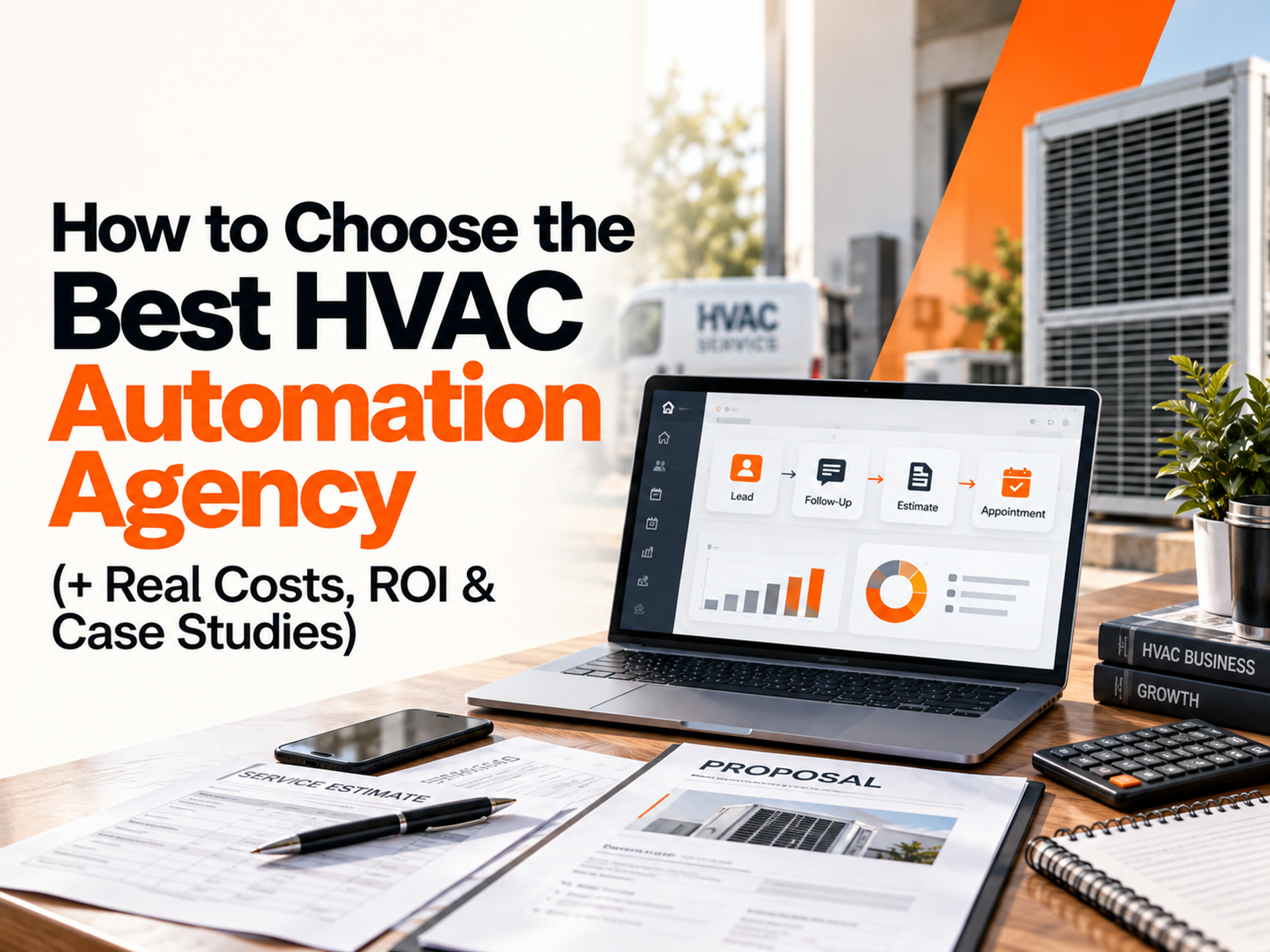
The right HVAC automation agency starts with your business problem, not its product. A legitimate agency should understand your current operation call volume, CRM, estimate pipeline, and team structure before recommending anything. They should build around the tools you already use where practical and measure results against baselines established before implementation.
If the first conversation focuses mainly on software rather than understanding your operations, ask for a proper discovery or audit before making a decision.
Searching for an HVAC automation agency in 2026 returns pages of marketing agencies, software vendors, and generic "digital transformation" consultants. The HVAC contractor who needs their after-hours calls answered, their estimates followed up, and their dormant CRM contacts re-engaged isn't necessarily looking for a marketing retainer. They're looking for someone who understands how their operation works and can build systems around it.
This guide covers how to tell the difference, what the engagement should look like, what it can cost, and how to evaluate realistic ROI from an HVAC automation project.
Table of Contents
- What an HVAC Automation Agency Actually Does
- The Difference Between a Marketing Agency and an Automation Agency
- What to Look for Before Hiring
- The Right Engagement Process
- Real Costs in 2026
- ROI: What a Real HVAC Automation Project Returns
- Case Study: $100K+ Recovered From a Dormant CRM
- Red Flags to Watch For
- How FatCamel AI Works With HVAC Contractors
- FAQ
What an HVAC Automation Agency Actually Does
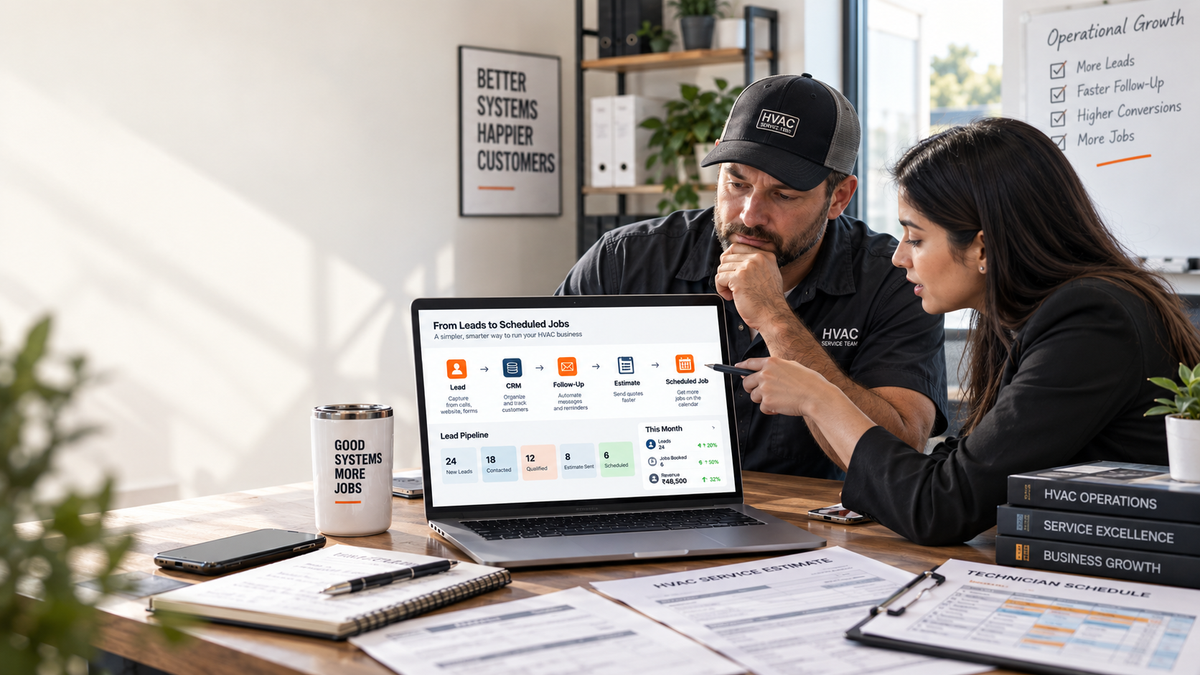
An HVAC automation agency builds and manages the systems that handle the repetitive, time-sensitive parts of running an HVAC business automatically not the work that requires a skilled technician, but the tasks that happen before and after the job.
That includes: answering after-hours calls and booking appointments without a dispatcher involved, running multi-touch follow-up sequences on leads that don't convert immediately, chasing estimates that go out and go quiet, logging CRM data in real time without manual entry, re-engaging past customers who haven't had service in over a year, and generating reviews after every completed job.
None of these tasks require a human to initiate them every time. They require a system. An automation agency builds that system, configures it around how the HVAC business actually operates, integrates it with the tools already in use, and measures whether it's producing the expected return.
The Difference Between a Marketing Agency and an Automation Agency
This distinction matters because contractors looking for "HVAC automation" may end up talking to marketing agencies.
A marketing agency manages advertising Google Ads, local SEO, social media, and content to generate more leads at the top of the funnel. They measure impressions, clicks, and lead volume.
An automation agency works with the leads that are already arriving making sure they get answered quickly, followed up consistently, and moved through the appropriate workflow. They can measure close rates, revenue recovered, response times, and time saved.
Both can be useful. They address different problems. A contractor spending $3,000 per month on Google Ads and converting 20% of those leads has a different problem from one converting 40% from the same spend. One may need to examine lead generation, while the other may benefit from examining conversion and follow-up.
For HVAC businesses losing opportunities through after-hours missed calls or inconsistent follow-up, automation may be an area worth evaluating alongside marketing.
Read More: How HVAC Businesses Can Grow Faster Using AI (Without Changing Their CRM)
What to Look for Before Hiring

The difference between a legitimate HVAC automation agency and a product vendor calling themselves a consultant often shows up in how the first conversation goes.
They audit before they recommend. A serious automation agency shouldn't recommend a specific tool or workflow until they understand your current operation call volume, CRM platform, estimate pipeline, team structure, and where revenue may be leaking. A useful audit should give the business a clear view of its current workflows, gaps, and potential automation opportunities.
They integrate with what you have. The right agency should be able to build automation that connects to the field service platform already in use ServiceTitan, Jobber, Housecall Pro, FieldEdge rather than automatically requiring you to migrate to a new system. Replacing your CRM as a condition of engagement should have a clear, business-specific reason.
They provide documented results, not industry statistics. Ask for case studies from HVAC or home-service contractors with specific numbers response time improved from X to Y, leads reactivated, revenue recovered. Broad claims about "AI transforming the industry" don't tell you whether an agency has actually done the work.
They measure against baselines. A strong automation process establishes measurable benchmarks before implementation current call answer rate, current close rate, current estimate acceptance rate and tracks performance against those baselines after. Without pre-implementation baselines, it's difficult to determine whether the automation is working.
The Right Engagement Process
A properly structured HVAC automation engagement can run in four stages, regardless of which agency you use.
Stage 1 - Audit. The agency reviews your current operation: inbound call data, CRM pipeline, estimate volume and close rate, team structure, existing tools, and where the highest-cost manual gaps are. The output should be a prioritized list of automation opportunities with the potential business impact of each gap.
Stage 2 - Roadmap. The audit feeds into a sequenced implementation plan. The first automation should address the clearest operational or revenue gap. For some HVAC businesses, that may be after-hours call capture, but the right starting point depends on the existing workflow and call volume.
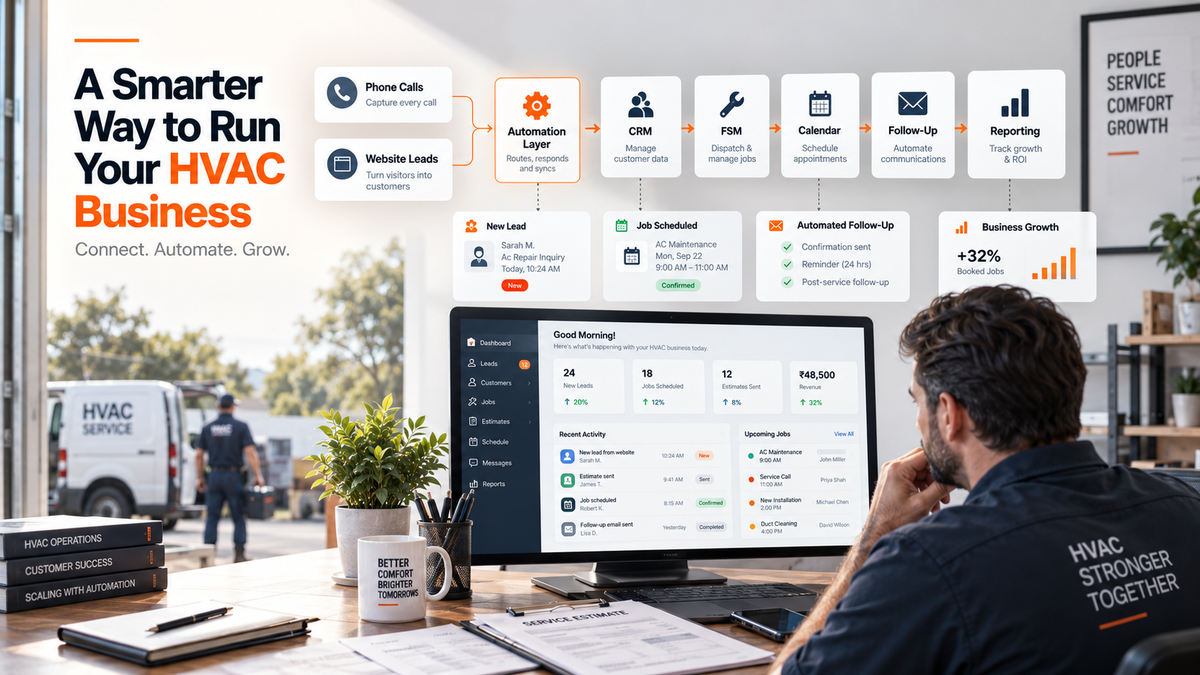
Stage 3 - Build and integrate. The automation is built using the right technology for the workflow n8n, Make, Zapier, custom API connections, or a combination and connected to the existing field service platform. The team continues using their current tools. The automation runs underneath.
Stage 4 - Measure and optimize. After deployment, the agency tracks performance against the pre-implementation baselines and makes configuration adjustments based on actual data. Performance should be reviewed after deployment so the workflow can be refined using actual business data.
Read More: Build an HVAC Lead Generation System That Works 24/7
Real Costs in 2026
HVAC automation agency costs vary significantly by scope. Here's what contractors should evaluate when comparing engagements.
Automation audit: Pricing varies by business complexity and scope. This may cover the workflow review, gap analysis, and implementation roadmap. Ask the agency what is included and whether the audit fee is separate from implementation.
Single workflow automation (e.g., after-hours call capture with CRM integration): The cost depends on the workflow, integrations, software requirements, and implementation complexity. Ask for a breakdown of the build, configuration, and ongoing operating costs.
Multi-phase automation stack (call capture, follow-up sequences, estimate chasing, CRM automation, review generation): Costs increase with the number of workflows, integrations, data volume, and ongoing support required.
Ongoing retainer (optimization, new workflow development, performance monitoring): This may be appropriate for businesses that want continuous improvement rather than a one-time build.
The right question when evaluating cost isn't simply "is this expensive?" It's "what does the potential business impact look like?" An agency should be able to explain how the proposed automation connects to a measurable business problem before you commit.
ROI: What a Real HVAC Automation Project Returns
The ROI from HVAC automation can come from several areas, including missed-call recovery, improved follow-up, and dormant lead reactivation.
After-hours call recovery
Take your estimated weekly after-hours call volume and multiply it by the percentage of calls that may be lost after reaching voicemail, using a relevant benchmark where appropriate. Multiply that by your average emergency job value and then by 52 for an annual estimate.
That provides an estimate of the annual job value potentially affected by missed calls.
Worked example: If an HVAC business receives 8 after-hours calls per week and uses an illustrative 85% voicemail-abandonment assumption, that represents approximately 6.8 potentially missed opportunities. At an illustrative average job value of $700, that equals about $4,760 in potential job value per week, or approximately $247,000 annually.
This is an illustrative calculation, not a projection of actual revenue loss. Actual results depend on call intent, booking rates, service availability, average job value, and other factors.
Estimate conversion improvement
For an illustrative calculation, model a 15-point improvement in acceptance rate from structured follow-up. Multiply the additional accepted estimates by the average estimate value.
Worked example: 25 estimates per month × 15% improvement = 3.75 additional accepted estimates × $3,200 average value = $12,000 additional monthly revenue. Annual: $144,000.
Actual improvement will vary by business, follow-up process, customer mix, and implementation quality.
Dormant lead reactivation
Take your CRM's dormant contact count. Apply an assumed reactivation rate for personalized outreach and an assumed close rate on reactivated leads. Multiply by average quote value.
Worked example: 200 dormant contacts × 10% × 50% = 10 converted jobs × $2,500 average = $25,000 from one campaign.
These are estimates actual results depend on call volume, close rates, database quality, offer, outreach, and configuration quality. But they provide a framework for evaluating whether an automation project could make financial sense.
Case Study: Re-Engaging Dormant CRM Leads
CertaPro Painters of North Raleigh, an established home-service contractor, had an existing CRM database of previous leads contacts that had inquired, entered the pipeline, and gone quiet.
FatCamel built an automated lead-reactivation system designed to identify dormant contacts and run personalized outreach based on their previous interactions. The automation handled the repetitive reactivation process, allowing the sales team to focus on prospects who showed renewed interest.
The example demonstrates how businesses can revisit opportunities already present in their CRM instead of relying only on generating new leads.
"Working with FatCamel AI has had a significant impact on our business. They've automated processes we never thought could be automated, helped us reconnect with past customers and lost opportunities, and even built us an AI Chief of Staff that gives me a real-time view of what's happening across the company."
— Kirt Storch, Owner, CertaPro Painters of North Raleigh
This is a home-service case study rather than an HVAC-specific result. The same type of CRM reactivation workflow can be evaluated by HVAC contractors with established databases, but actual results will depend on the quality of the database, outreach, offer, and conversion process.
Red Flags to Watch For
First conversation is about the product, not your operations. A strong automation agency should lead with questions about your business and workflow before recommending a solution.
No audit before recommendations. If an agency recommends specific tools or workflows before understanding your current call volume, CRM, and pipeline, the proposed solution may not address your specific problem.
Vague ROI claims. "AI will transform your business" is not an ROI calculation. A specific calculation based on your call volume, close rate, and average job value is easier to evaluate.
They require CRM migration as a condition. An automation agency should be able to explain why a platform change is necessary if one is being proposed. The answer should be specific to your situation.
No measurement framework. If there's no plan for establishing baselines before implementation and tracking performance after, it becomes difficult to measure the impact of the automation.
To Know More: HVAC Marketing Automation Services: The Complete Guide to Predictable Leads and Booked Jobs
How FatCamel AI Works With HVAC Contractors
FatCamel AI is an automation agency based in Raleigh, NC, with profiles on platforms including Clutch and GoodFirms. Its model is consulting-led, beginning with an Audit & Strategy process before build work begins.
The audit reviews the existing CRM and software stack, maps current lead flow and manual processes, identifies workflow gaps, and produces a prioritized roadmap.
HVAC contractors can evaluate areas such as after-hours lead capture, follow-up automation, CRM integration, and customer retention workflows based on their specific operational gaps.
FatCamel builds using n8n, Make, Zapier, custom APIs, and AI agents depending on what the workflow requires. The technology serves the business need rather than being the product itself. They can build around platforms such as Jobber, ServiceTitan, Housecall Pro, and FieldEdge rather than automatically replacing them.
After deployment, FatCamel stays involved through monitoring, configuration improvements, and further workflow development as the business evaluates additional opportunities. The engagement model is designed as an ongoing partnership rather than simply a one-time project handoff.
👉 Book a Free Consultation with FatCamel AI
FAQ
1. What does an HVAC automation agency actually do?
An HVAC automation agency builds systems that handle repetitive, time-sensitive parts of the business automatically answering after-hours calls, following up on leads, chasing estimates, logging CRM data, reactivating dormant contacts, and generating reviews. They can integrate these systems with the tools already in use and measure performance against baselines established before implementation.
2. How is an HVAC automation agency different from a marketing agency?
A marketing agency generates leads through advertising, SEO, and content. An automation agency focuses on improving how the business handles and follows up with the leads already arriving. Both can be useful for different business problems.
3. How much does hiring an HVAC automation agency cost?
Costs vary based on scope, integrations, software requirements, data volume, and ongoing support. Single-workflow projects may require very different resources from multi-workflow automation systems. Ask for a clear breakdown of implementation, software, and ongoing operating costs and compare those costs with the expected business impact.
4. How do I know if an HVAC automation agency is legitimate?
Look for three things: they audit before recommending, they provide documented results from real clients with specific numbers, and they measure performance against baselines established before implementation. A good discovery process should focus on your business operations before recommending specific technology.
5. Can an automation agency work with my existing HVAC software?
In many cases, yes. ServiceTitan, Jobber, Housecall Pro, and FieldEdge can support integrations or API connections that allow external automation tools to connect with business workflows. The exact capabilities depend on the platform, account configuration, and workflow.
6. What ROI should I expect from HVAC automation?
ROI varies by scope and business situation. The calculations are most useful when based on your actual call volume, close rate, average job value, estimate volume, and dormant CRM contacts. A legitimate agency should work through these calculations with you before making specific ROI expectations.
7. How does FatCamel AI approach HVAC automation?
FatCamel starts by reviewing the CRM, software stack, lead flow, and manual processes before recommending automation. The process produces a prioritized implementation roadmap. FatCamel builds using n8n, Make, Zapier, custom APIs, and AI systems around the platforms already in use. After deployment, they stay involved through ongoing optimization.
References
https://www.webfx.com/blog/home-services/how-to-choose-hvac-marketing-agency/
https://stakdsystems.com/blog/how-to-choose-ai-agency
https://azariangrowthagency.com/choosing-hvac-marketing-agency/
https://www.callrail.com/blog/missed-calls-stats
https://onepath.ai/blog/hvac-conversion-rates-ultimate-guide
https://cleverlabs.ai/case-studies
https://www.issmechanical.com/hvac-automation-roi/
https://clutch.co/profile/fatcamel-ai
https://www.fatcamel.ai/services/business-automation