
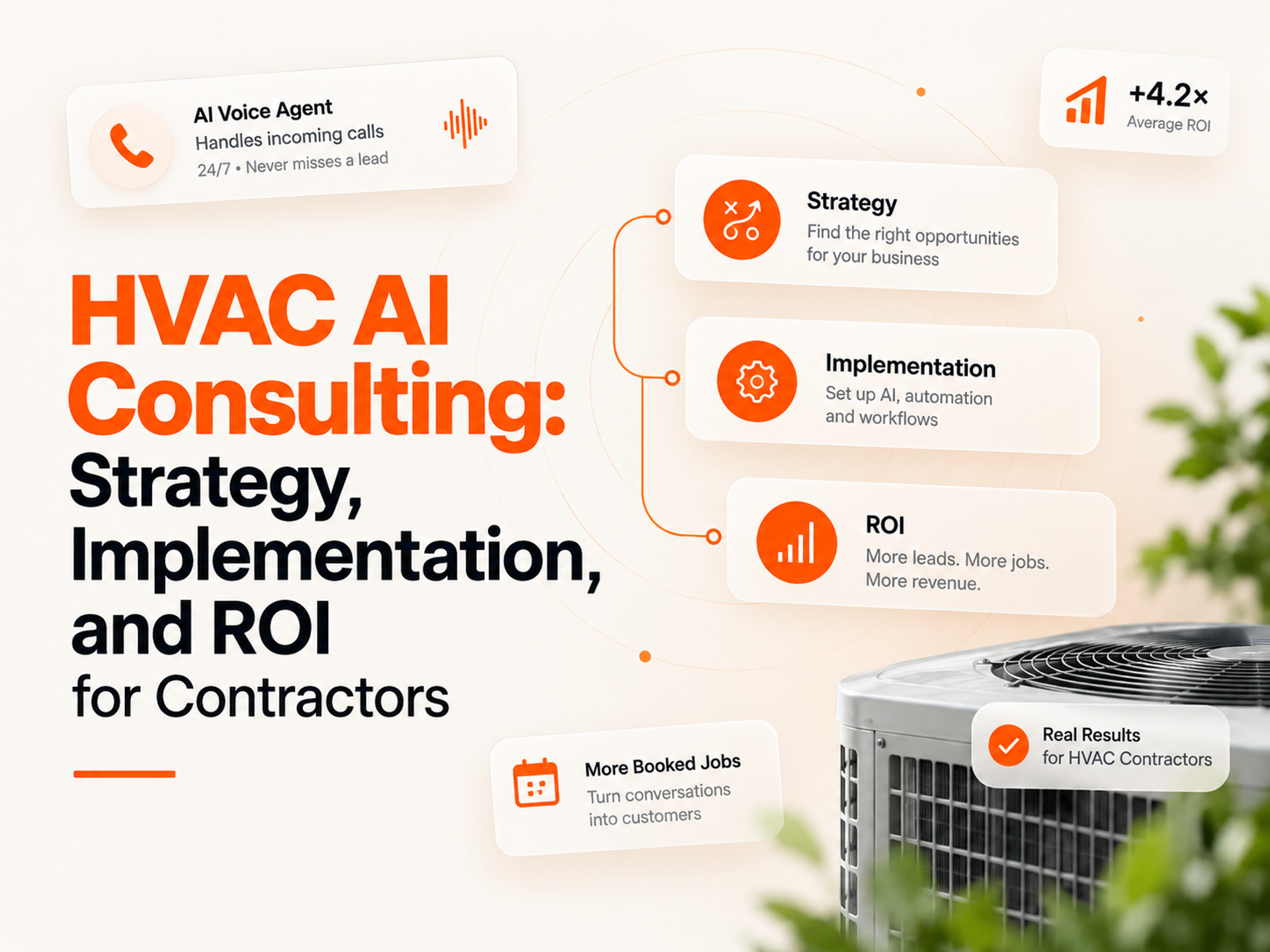
Quick Answer: HVAC AI consulting is the process of assessing an HVAC business’s current operation, identifying the workflow gaps where automation could create the most value, building a prioritized AI roadmap, and managing implementation against clear baselines. It starts with an audit not a product pitch and usually focuses first on missed calls, estimate follow-up, CRM accuracy, dispatch visibility, and customer reactivation.
Table of Contents
What HVAC AI Consulting Actually Is
The Five Stages of an HVAC AI Consulting Engagement
How to Calculate ROI Before Committing
Questions to Ask an HVAC AI Consultant
Common AI Adoption Mistakes
How FatCamel AI Approaches HVAC Consulting
FAQ
What HVAC AI Consulting Actually Is
Most HVAC owners researching AI find the same thing: too many tools, too many vendors, and very little guidance on where to begin. A voice agent may sound useful. So might automated follow-up, predictive maintenance, or AI-assisted dispatch. But a tool is not a strategy.
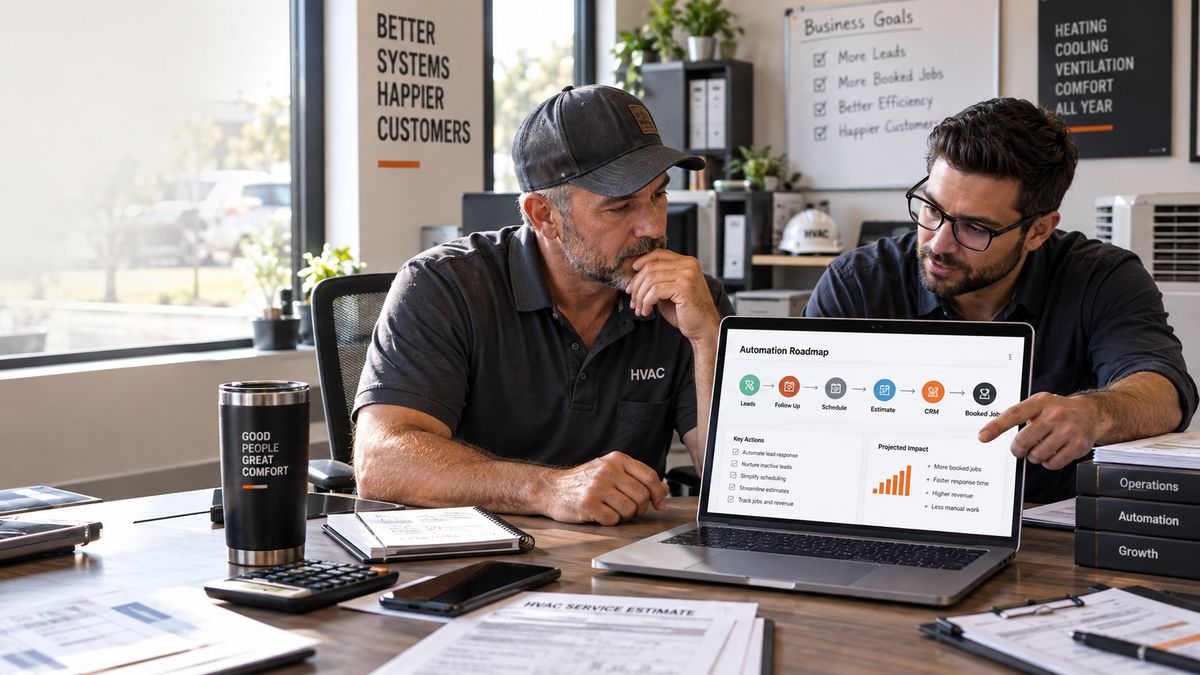
HVAC AI consulting is the work that comes before and around the software purchase. It looks at how calls arrive, how leads enter the CRM, how estimates are sent, how jobs are scheduled, and where information gets lost between the office and the field. From there, the consultant recommends what to automate, in what order, and how to measure the result.
That distinction matters. A generic template may not understand emergency triage, maintenance bookings, commercial inquiries, billing questions, or an upset customer who needs a person. A properly configured system can route those situations differently and hand them to the right team member.
The practical rule is straightforward: the business problem comes first; the tool comes second.
The Five Stages of an HVAC AI Consulting Engagement
Stage 1: The automation audit

A useful engagement begins with an automation audit. The goal is to identify where manual process gaps are costing time, capacity, or revenue.
The audit may review after-hours call volume, unanswered calls, lead response time, estimate acceptance, aging opportunities, technician utilization, dispatch corrections, customer retention, review requests, and maintenance reminders. It should also document the current CRM, field-service platform, phone system, scheduling process, and reporting tools.
The output is a baseline. For example, an owner might learn how many calls are reaching voicemail, how many estimates have no follow-up, or how much office time is spent re-entering information. Without that baseline, it is difficult to prove whether an automation is helping.
Stage 2: The prioritized AI roadmap
The roadmap should sequence projects by expected value, complexity, readiness, and risk. In many service businesses, missed-call capture and estimate follow-up deserve attention before content or review automation because they are closer to existing revenue.
A practical sequence might look like this:
Phase one: after-hours call capture and instant lead response.
Phase two: estimate follow-up and appointment reminders.
Phase three: CRM synchronization and real-time data logging.
Phase four: dormant customer and lead reactivation.
Phase five: review generation, content workflows, and commercial outreach.
This is not a fixed formula. A commercial contractor with strong inbound demand may prioritize service reporting or maintenance renewals instead. The point is to create a written plan with expected costs, owners, timelines, dependencies, and success metrics not a list of fashionable AI features.
Read More: Best HVAC Marketing Strategies to Generate More Leads (That Actually Work in 2026)
Stage 3: Tool selection and vendor evaluation
Once the roadmap is clear, tools can be evaluated against the actual operation. Does the system connect to the field-service platform already in use? Can it write useful information back to the CRM? Does it support permissions, escalation, reporting, and human overrides?
ServiceTitan, Jobber, Housecall Pro, and FieldEdge have different workflows and integration capabilities. A consultant should explain exactly how data will move between systems rather than promising that everything will “integrate.”
The right choice may be a subscription tool, a custom workflow, or a combination of both. A good consultant also discusses limitations. AI can handle routine booking and qualification well, but complex technical troubleshooting, sensitive complaints, and unusual commercial requests need an escalation path.
Stage 4: Implementation and configuration
Implementation is where strategy becomes operational. For HVAC businesses, configuration may include call-flow logic, qualifying questions, emergency protocols, follow-up timing, CRM triggers, and routing rules for residential, commercial, maintenance, and installation leads.
The wording matters too. A heat-pump installation estimate should not receive the same message as a no-cool service call. The system should use the service details available to it, stop follow-up after a customer books, and notify a human when the conversation falls outside its boundaries.
The best implementation works with the systems and habits the company can realistically maintain. Replacing every platform at once often creates more disruption than value.
Stage 5: Measurement and optimization
Go-live is not the finish line. During the first 90 days, review performance and adjust the configuration. Useful measures include answer rate, booked-job rate, response time, estimate acceptance, follow-up completion, data accuracy, manual entry time, reactivation response, callbacks, and revenue per lead.
Review the numbers monthly and compare them with the pre-implementation baseline. If a sequence is being ignored, change the timing or message. If calls are being routed incorrectly, refine the qualification questions. If the team is overriding the automation, find out why.
AI systems usually improve through this feedback cycle. A consultant should be able to explain who reviews the metrics, how often adjustments occur, and what happens when results fall short.
Read More: Why Social Media Doesn't Work for HVAC Companies (And What Does)
How to Calculate ROI Before Committing
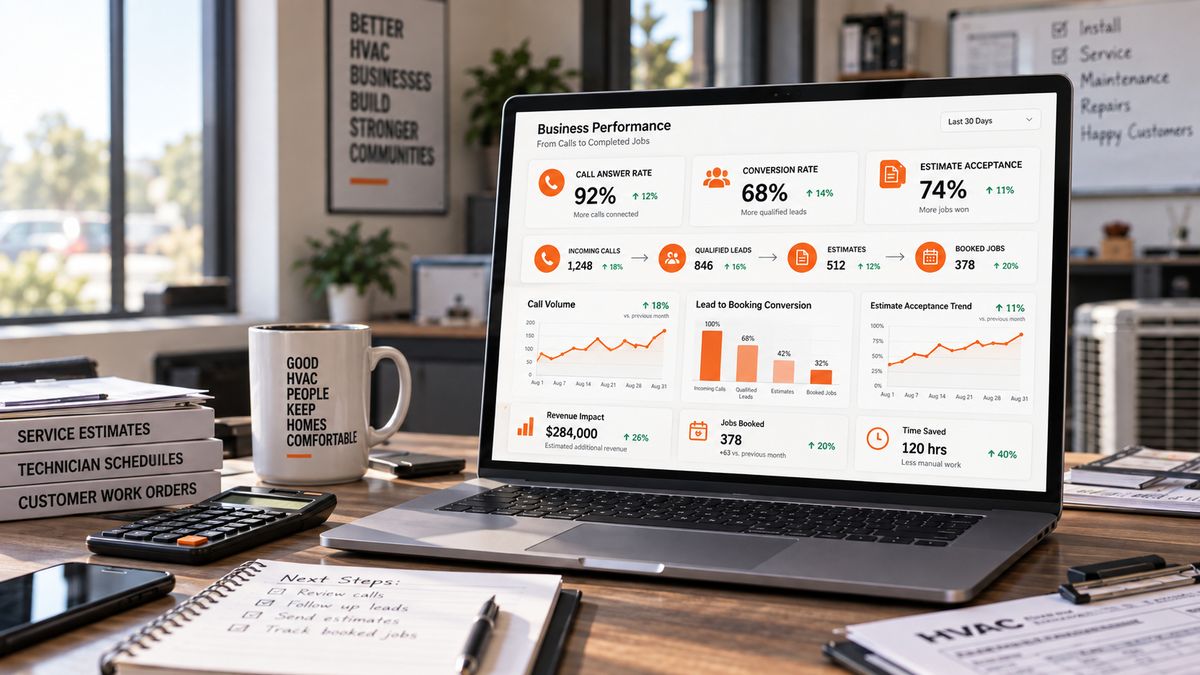
ROI should be estimated before purchasing a system, using the company’s own numbers. A simple model is:
Expected annual value = volume × conversion improvement × average job value.
For missed calls, use actual after-hours call logs, the percentage that become appointments, the average completed-job value, and the portion the new response system is expected to capture. For estimates, use the number sent each month, the current acceptance rate, a conservative improvement assumption, and the average estimate value. For reactivation, use the size and quality of the dormant database, expected response, close rate, and average job value.
These are planning estimates, not guarantees. Keep the assumptions visible and separate revenue recovery from cost savings. The business should also include implementation fees, subscriptions, integration work, training, and ongoing optimization in the calculation.
Questions to Ask Before Hiring an HVAC AI Consultant
Ask how the consultant audits your specific operation before recommending a tool. Ask which field-service platforms the implementation supports and how the connection works. Ask for documented HVAC results, not broad AI statistics. Ask what happens if performance is below target after 30, 60, or 90 days. Finally, ask who owns configuration, training, reporting, and ongoing improvements.
Specificity is the signal. A consultant who can describe the call flows, data fields, handoffs, and success metrics for your team is doing more than presenting a product brochure.
Read More: 15 HVAC Tasks You Can Automate Using AI (And What Each One Is Worth)
Common AI Adoption Mistakes
The most common mistake is buying software before building a strategy. The second is starting with a low-priority automation while a larger revenue leak remains unaddressed. The third is setting up the system and never reviewing it.
Other problems include failing to establish a baseline, ignoring data cleanup, expecting AI to handle every customer situation, and asking technicians or dispatchers to change their process without training. Automation should remove friction, not simply move the work somewhere less visible.
How FatCamel AI Approaches HVAC AI Consulting
FatCamel AI starts with the operation rather than a generic package. The process can review call volume, after-hours coverage, CRM and field-service workflows, estimate follow-up, team structure, and the points where leads or customer information are being lost.
From that assessment, FatCamel can build a phased roadmap around the highest-value opportunities. Depending on the business, that may include voice assistance for inbound calls, lead and estimate follow-up, CRM automation, customer reactivation, review workflows, or content support. The specific order should follow the company’s data, capacity, and revenue gaps.
The goal is not to add AI for its own sake. It is to make one part of the operation more reliable, measure the effect, and then connect the next workflow when the foundation is ready.
Contact FatCamel AI to discuss an automation assessment and practical AI roadmap for your HVAC business.
FAQ
1. What is HVAC AI consulting?
HVAC AI consulting helps contractors assess operational gaps, prioritize automation, choose suitable tools, manage implementation, and measure results against a baseline.
2. How is consulting different from buying an AI tool?
Buying a tool gives you software. Consulting determines whether that tool fits your workflow, how it should be configured, what it should connect to, and how success will be measured.
3. What should an HVAC contractor automate first?
Start with a workflow that has visible volume and a measurable cost. For many contractors, that is missed-call response, estimate follow-up, or CRM data synchronization.
4. Does AI require replacing an existing field-service platform?
Not necessarily. Many projects can connect to existing systems. The consultant should explain what can remain in place and what data needs to move.
5. Will AI replace HVAC staff?
The strongest use cases reduce repetitive coordination and data entry while leaving judgment, safety, pricing, customer relationships, and complex field decisions with people.
References
https://www.simprogroup.com/blog/ai-hvac
https://www.callrail.com/blog/missed-calls-stats
https://www.artifactaisolutions.com/blog/hvac-revenue-lost-from-missed-calls
https://stratefix.com/solutions/ai-automation-consulting-and-implementation/
https://www.servicetitan.com/blog/hvac-ai
https://www.simprogroup.com/resources/ebooks/trades-outlook-report-2025
https://onepath.ai/blog/hvac-conversion-rates-ultimate-guide
https://www.fatcamel.ai/services/crm-automation