
Quick Answer: HVAC dispatch and scheduling automation uses AI to assign the right technician to the right job based on skills, location, and availability automatically, in real time. The biggest gains come from eliminating the manual dispatch bottleneck: missed emergency calls, double-booked technicians, and wasted drive time between jobs. HVAC companies using AI-assisted dispatch consistently complete more jobs per technician per day without adding headcount.
Every HVAC dispatcher knows the moment a busy day turns into a disaster. Two emergency calls come in at once. One technician is thirty minutes from a job they're not certified for. Another is parked two blocks from a call nobody assigned them. And somewhere in the CRM there's a scheduled maintenance visit that nobody remembered to confirm, so the customer isn't home when the tech arrives.
This isn't bad management. It's what happens when a manually-operated dispatch system hits the limits of what any human can juggle simultaneously. Dispatch and scheduling automation doesn't replace the dispatcher it removes the parts of the job that a computer handles better than a person, so the dispatcher can focus on the parts that actually require human judgment.
Table of Contents
Why HVAC Dispatch Breaks Down Under Pressure
The Real Cost of Inefficient Scheduling
What HVAC Dispatch Automation Actually Does
The 7 Dispatch and Scheduling Tasks AI Handles Better Than Manual
How AI Scheduling Integrates With Existing HVAC Systems
What HVAC Businesses See After Implementing Dispatch Automation
How FatCamel AI Automates HVAC Scheduling and Dispatch
FAQ
References
Why HVAC Dispatch Breaks Down Under Pressure
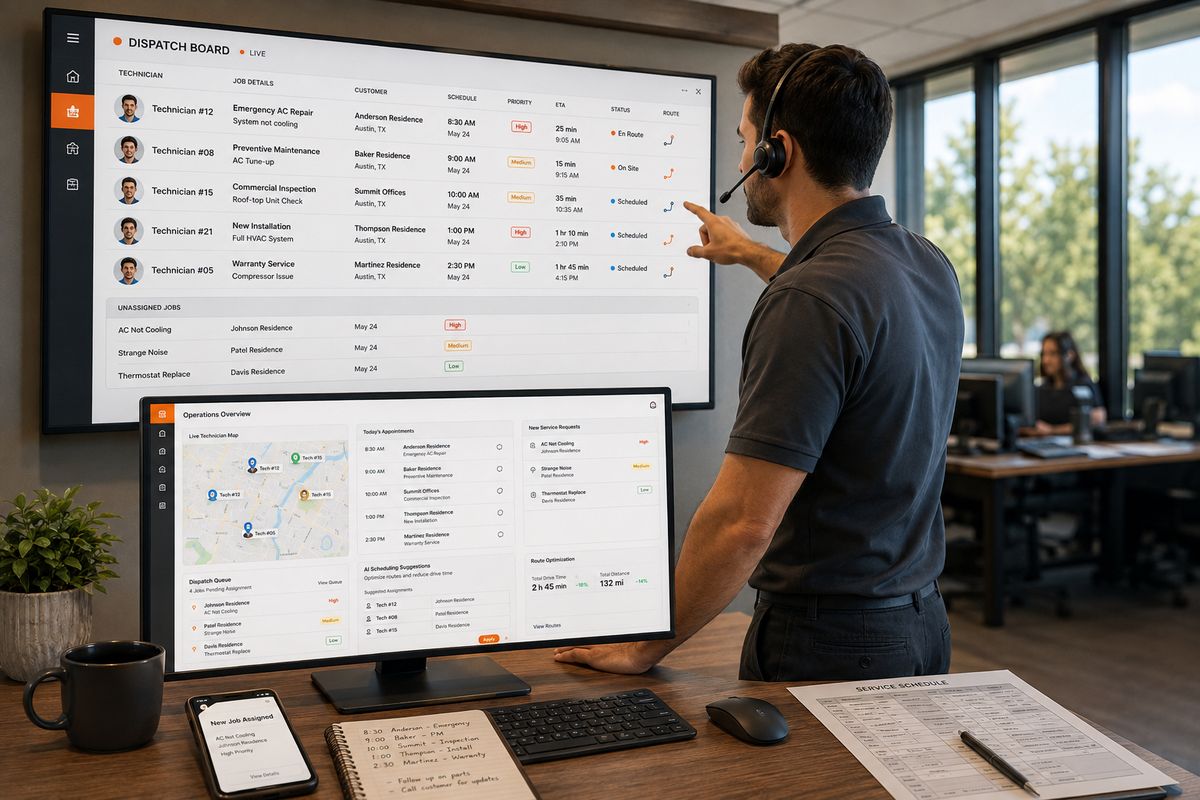
Manual dispatch works reasonably well when call volume is predictable and the team is small. At five technicians handling fifteen jobs a day, a good dispatcher can hold most of the relevant information in their head who's certified for what, who's closest to which area, which jobs have parts waiting at the shop.
But HVAC businesses don't operate in predictable conditions. A summer heat wave can triple inbound call volume in 48 hours. A winter cold snap sends the same surge in a different direction. And during those surges the exact moments when dispatch efficiency matters most the manual system is already operating at its limit. Every new call adds pressure to a dispatcher who's already managing ten simultaneous conversations, and mistakes start happening. The wrong technician gets sent to a refrigerant leak they're not certified to handle. Two techs end up at the same address. A high-priority emergency sits in the queue for forty minutes because nobody noticed it.
Service Titan data shows that scheduling errors and suboptimal routing account for a meaningful share of wasted technician time in HVAC businesses of all sizes. The problem scales with the business the more technicians you have, the more variables the dispatcher has to track simultaneously, and the more opportunities there are for things to go wrong.
The fix isn't a better dispatcher. It's a system that handles the complexity automatically so the dispatcher can focus on the edge cases that actually require judgment.
Read More: 15 HVAC Tasks You Can Automate Using AI (And What Each One Is Worth)
The Real Cost of Inefficient Scheduling
Before building the case for automation, it's worth putting a number on what inefficient dispatch actually costs.
Technician windshield time time spent driving between jobs rather than working on them is the most direct cost. A study of field service businesses found that technicians in urban markets average between 25 and 35% of their workday in transit. In a team of eight technicians at 75 dollars per billable hour, reducing transit time by even 20% recovers 1.5 hours of billable capacity per technician per day. Across eight technicians over 250 working days, that's 2,250 additional billable hours annually at 75 dollars each, that's 168,750 dollars in recovered capacity from routing improvements alone.
Scheduling errors carry their own costs. A technician dispatched to a job they can't complete wrong certification, missing parts, wrong equipment type means a second truck roll to the same address. Field service industry benchmarks put the average cost of a callback at 200 to 400 dollars when technician time, fuel, and customer satisfaction impact are factored in. For an HVAC business running 30 jobs per day with a 15% callback rate, that's four to five callbacks daily 800 to 2,000 dollars in daily avoidable cost.
And then there's the revenue impact of emergency calls that get delayed because the dispatch system couldn't identify and prioritize them quickly enough. A homeowner with no AC in August who waits four hours while a technician handles a routine tune-up nearby is a customer who calls a competitor next time. The immediate revenue loss from the delayed job is one thing. The lost lifetime customer value is another.
What HVAC Dispatch Automation Actually Does
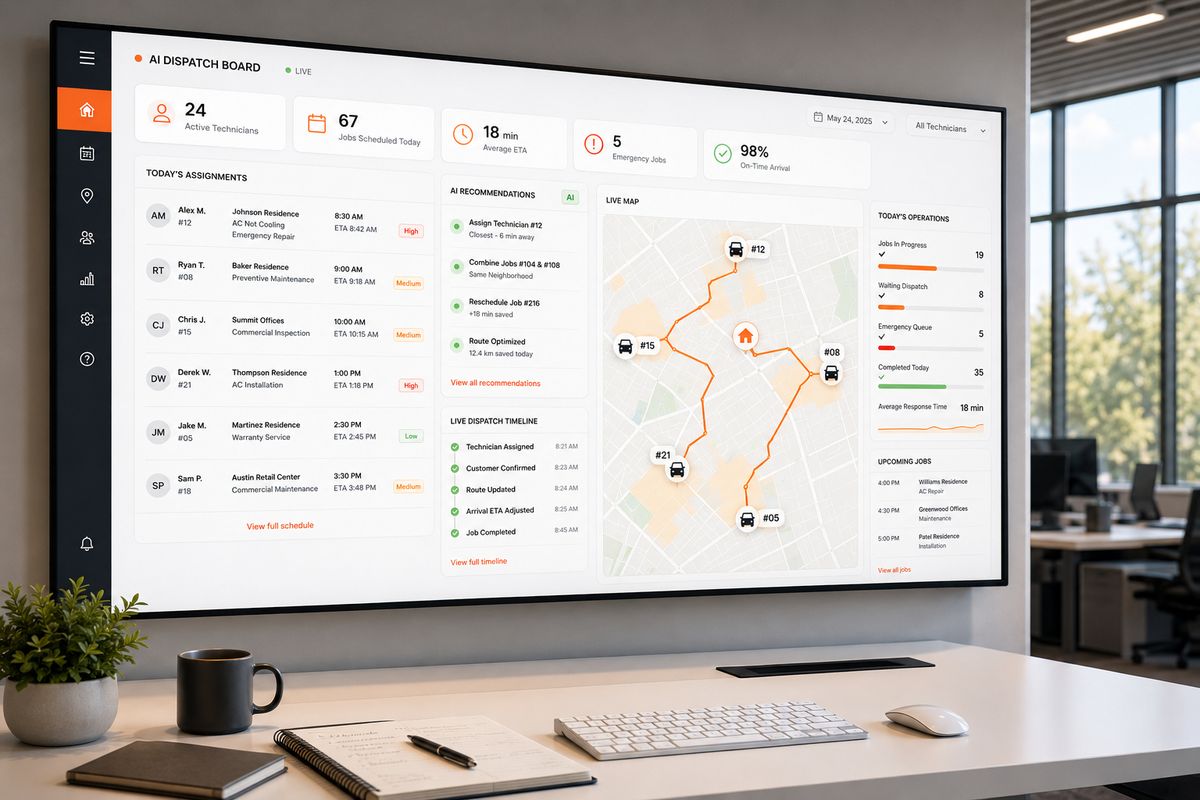
AI dispatch automation doesn't take the dispatcher out of the loop. It gives them better information, faster so the decisions they make are based on the full picture rather than whatever they can hold in their head at that moment.
Here's what the system handles automatically. When a new job comes in whether it's an inbound call captured by the AI voice agent, a web form submission, or a scheduled maintenance visit the automation pulls together everything relevant: the job type and required certifications, the service address and geographic proximity to available technicians, each technician's current status and workload, the parts and equipment the job will require, and any customer history tied to the address.
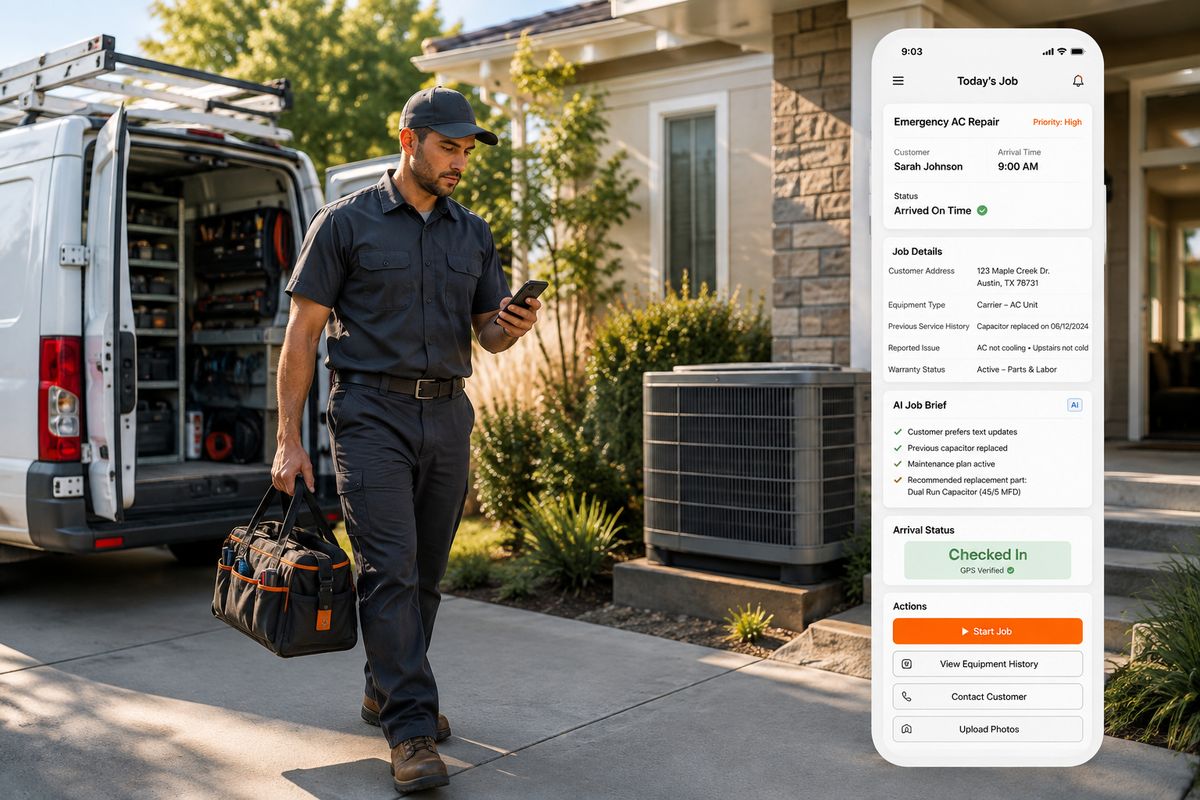
From that data, the system surfaces the optimal assignment not just which technician is closest, but which technician is closest, available, certified for the job, and carrying the right parts. The dispatcher reviews the recommendation and confirms or overrides it. The technician gets the job details on their mobile app immediately. The customer gets an automated confirmation with the technician's estimated arrival time.
When something changes a job runs long, a technician calls in sick, an emergency comes in that needs to bump existing jobs the automation reoptimizes the remaining schedule and surfaces updated recommendations. The dispatcher doesn't have to manually reconstruct the entire day. The system does it, and they approve the result.
The 7 Dispatch and Scheduling Tasks AI Handles Better Than Manual
1. Technician-job matching. Manual dispatch relies on the dispatcher knowing each technician's certifications, current parts inventory, and skill level from memory. AI dispatch reads this data from the CRM in real time and filters the available technician pool to only those who can actually complete the job before surfacing a recommendation. No more sending an EPA 608-uncertified tech to a refrigerant recovery call.
2. Real-time route optimization. Static routing assigning jobs in the order they were received without accounting for geography adds significant unnecessary drive time to every day. AI route optimization sequences the day's jobs to minimize total drive time across all technicians simultaneously, accounting for real-time traffic conditions and estimated job duration. The difference between a static route and an optimized one is typically 15 to 25% less drive time per technician per day.
3. Emergency prioritization. When an emergency call comes in a gas smell, a complete system failure in extreme weather, a commercial facility with no heat it needs to jump the queue automatically and trigger an immediate response. Manual dispatch depends on the dispatcher recognizing the urgency and manually restructuring the schedule. AI dispatch flags emergency keywords and severity indicators automatically, inserts the job at the appropriate priority level, and recalculates the affected technicians' schedules in real time.
4. Workload balancing. Uneven workload distribution is one of the most common causes of technician burnout in HVAC businesses. Some technicians consistently get more jobs than others because they're faster, because they're more responsive to the dispatcher, or simply because they're the name that comes to mind first. AI dispatch distributes work based on capacity and certification rather than habit, producing more even workloads and better technician retention.
5. Maintenance appointment scheduling. Maintenance agreements produce recurring revenue but only if the appointments actually get scheduled and confirmed. AI scheduling handles the outbound appointment-setting for maintenance visits automatically, sends confirmation messages to customers before the appointment, and triggers rescheduling sequences when customers don't confirm. No appointment falls through because someone forgot to follow up.
6. After-hours job capture and morning queue building. Emergency calls that come in overnight captured by the AI voice agent need to be incorporated into the next morning's dispatch schedule before the team arrives. AI scheduling handles this automatically, adding overnight bookings to the queue, pre-assigning based on available technician profiles, and presenting the dispatcher with a populated schedule rather than an empty board to fill from scratch.
7. Customer communication triggers. Every scheduling event confirmation, technician en route, job complete, reschedule needed should trigger an automated customer notification. Manual dispatch means someone has to remember to send each one. Automated dispatch sends every notification automatically, at the right moment, without any dispatcher involvement.
Read More: Build an HVAC Lead Generation System That Works 24/7
How AI Scheduling Integrates With Existing HVAC Systems
One of the most common concerns about dispatch automation is compatibility. Most HVAC businesses are running ServiceTitan, Jobber, Housecall Pro, or FieldEdge and the prospect of replacing any of those with a new system is enough to stop the conversation.
The good news is that effective dispatch automation doesn't require replacing the field service platform. It connects to it. ServiceTitan, Jobber, and Housecall Pro all expose APIs that allow external automation tools to read from and write to scheduling data in real time. The dispatch board in the existing platform stays as the primary interface. The AI optimization layer runs on top of it pulling the data it needs to make recommendations and pushing confirmed assignments back into the platform automatically.
The technician experience doesn't change either. They still get job assignments through whatever mobile app they're already using. The difference is that those assignments are better matched to their skills and location, more evenly distributed across the team, and accompanied by more complete customer and job information than a manually-assigned job typically includes.
Implementation for a single AI scheduling integration typically takes one to two weeks the time needed to connect to the existing platform, configure the job-type and certification matching logic, and test the routing optimization against real job data. The team continues dispatching normally throughout. There's no cutover day where the old system stops and the new one starts.
What HVAC Businesses See After Implementing Dispatch Automation
The outcomes from dispatch automation appear across several parts of the business simultaneously.
Jobs completed per technician per day typically increases by 10 to 20% within the first 30 days, driven by reduced windshield time and elimination of the wrong-technician dispatching that requires callbacks. For a team completing 30 jobs per day at 650 dollars average value, a 15% improvement in daily throughput is an additional 4 to 5 jobs roughly 2,900 to 3,250 dollars in daily revenue from the same team size.
First-time fix rate improves because technicians arrive with the right information, the right parts, and the right certifications matched to the job. ServiceTitan benchmark data shows first-time fix rates averaging around 75% for HVAC businesses without intelligent dispatch, compared to 85 to 90% for businesses running AI-assisted job matching. Every point of improvement in first-time fix rate eliminates a callback and its associated cost.
Customer satisfaction scores improve as a direct result of accurate arrival windows, proactive communication, and technicians who arrive prepared. HVAC businesses report fewer negative reviews related to scheduling and dispatch after implementing automation specifically, fewer complaints about late arrivals, uncertified technicians, and jobs that required multiple visits to complete.
Dispatcher stress and turnover decreases. This is one of the less-discussed benefits but shows up consistently in post-implementation feedback. When the dispatcher isn't manually tracking seventeen simultaneous variables under peak-season pressure, they make fewer mistakes and burn out more slowly. For a role that requires significant institutional knowledge and is difficult to replace, lower turnover is a meaningful operational benefit.
Read More: How to Add AI to Your HVAC CRM Without Replacing It
How FatCamel AI Automates HVAC Scheduling and Dispatch
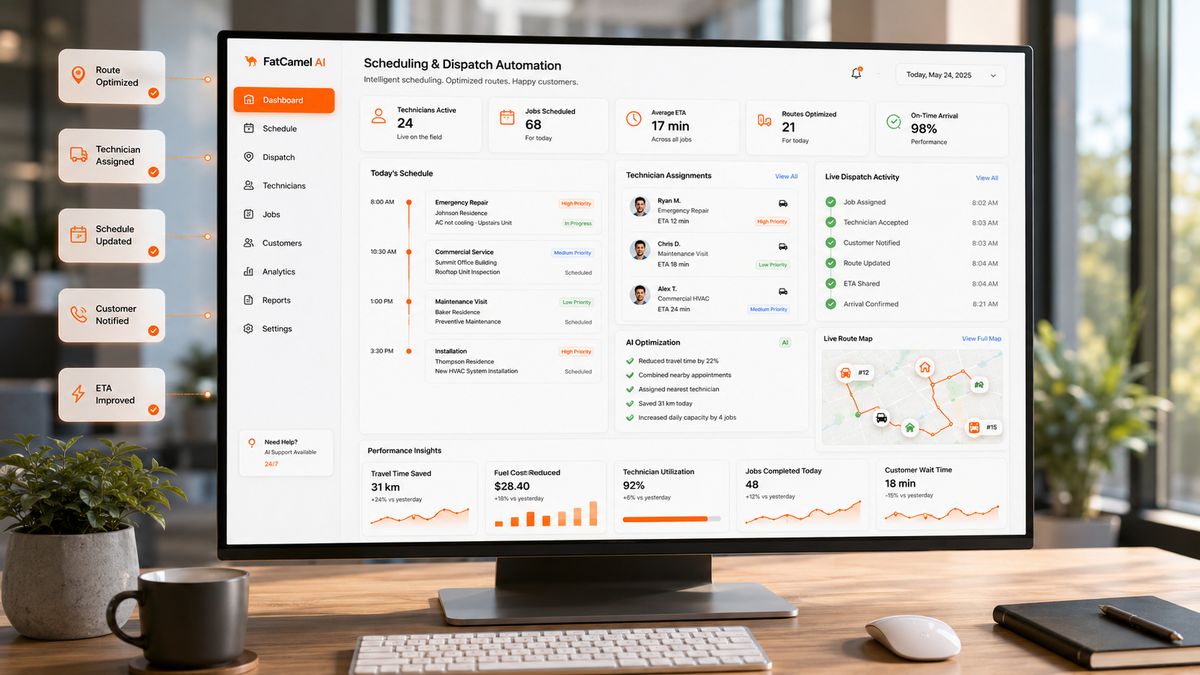
Dispatch automation doesn't work in isolation. The full benefit comes when scheduling connects to the rest of the operational pipeline the after-hours call that gets captured by RealtorVoiceAI at 10 PM needs to flow directly into the morning dispatch queue without anyone manually transferring the booking. The estimate that converts in the Lead Activation Engine needs to trigger a job record that dispatching can act on. The post-job follow-up that goes out through the CRM automation needs to know the job actually closed before it sends.
FatCamel AI's scheduling and workflow automation connects every step of this pipeline for HVAC contractors. Calls captured after hours by RealtorVoiceAI flow automatically into the dispatch queue. Jobs completed in the field trigger post-job communication and review requests through the customer communication layer. CRM Automation keeps every record current without manual entry. And the dispatch optimization layer surfaces technician-job recommendations based on live data from the existing field service platform.
The team doesn't switch to a new system. They use what they already have. The automation layer runs underneath, handling the complexity that slows down a manual process job matching, route sequencing, priority adjustment, customer notifications and surfacing the results in the existing platform the dispatcher is already working from.
For HVAC businesses that are growing into the complexity where manual dispatch is starting to create daily problems, this is the answer. Not a new platform to learn. A smarter layer on top of the one you already use.
👉 Get a Free AI Revenue Audit for Your HVAC Business at https://www.fatcamel.ai/contact
FAQ
1. What is HVAC dispatch automation?
HVAC dispatch automation uses AI to match incoming jobs to the right technician based on skills, location, availability, and parts inventory automatically, in real time. It surfaces recommended assignments to the dispatcher rather than requiring them to manually track all variables simultaneously. The dispatcher reviews and confirms, the technician gets job details on their mobile app, and the customer receives an automated confirmation. The process is faster, more accurate, and less dependent on any single person's memory and availability.
2. How much time does dispatch automation save an HVAC business?
The primary time savings come from two sources: reduced technician drive time through route optimization, and elimination of the manual work order sorting and assignment process. HVAC businesses report 15 to 25% reductions in technician drive time after implementing route optimization, and dispatchers report spending 30 to 50% less time on manual assignment tasks. For a dispatcher managing a team of ten technicians, that's roughly two to three hours per day recovered for higher-value work.
3. Does dispatch automation work with ServiceTitan, Jobber, and Housecall Pro?
Yes. ServiceTitan, Jobber, Housecall Pro, and FieldEdge all expose API integrations that allow dispatch automation tools to read scheduling data and write confirmed assignments back to the platform in real time. The existing dispatch board stays as the primary interface. The AI optimization layer runs on top of it, surfacing better recommendations than a manual process would produce, without requiring the team to learn a new system.
4. What's the difference between dispatch software and dispatch automation?
Dispatch software provides the interface for managing technician schedules a drag-and-drop board, technician profiles, job tracking. Dispatch automation adds an AI layer that actively analyzes available data and surfaces optimized recommendations rather than requiring the dispatcher to construct every assignment from scratch. Software is the tool. Automation is the intelligence that makes the tool work better than a manual process.
5. How does AI handle emergency calls in HVAC dispatching?
AI dispatch systems recognize emergency indicators specific language in the job description, severity flags set during call qualification, or customer-reported symptoms that indicate urgency and automatically prioritize those jobs in the queue. When an emergency job enters the system, the automation recalculates the affected technicians' schedules, identifies the best available match, and surfaces an updated dispatch recommendation without requiring the dispatcher to manually restructure the entire day.
6. What does HVAC dispatch automation cost, and what's the ROI?
Dispatch automation tools for HVAC businesses range from 200 to 600 dollars per month for subscription-based scheduling optimization platforms, to 5,000 to 15,000 dollars for custom implementations that integrate directly with existing field service management platforms. The ROI calculation typically starts with windshield time reduction recovering one hour of billable technician capacity per day across a team of eight technicians at 75 dollars per hour is over 150,000 dollars in annual recovered revenue. Most businesses see positive ROI within the first 60 to 90 days.
7. How does FatCamel AI connect dispatch automation to the rest of the HVAC business?
FatCamel AI connects dispatch automation to the complete HVAC operational pipeline after-hours calls captured by RealtorVoiceAI flow automatically into the morning dispatch queue, lead conversions from the Lead Activation Engine trigger job records that dispatching can act on, and CRM Automation keeps every record current without manual entry. The result is a connected system where every stage of the customer journey from the first call through job completion and follow-up runs without manual handoffs between disconnected tools.
References
https://buildops.com/resources/hvac-scheduling-and-dispatching
https://www.servicetitan.com/blog/hvac-dispatching-tips
https://getfieldy.com/blogs/hvac-scheduling-and-dispatching
https://swivl.tech/blog/hvac-scheduling-guide
https://www.simprogroup.com/blog/ai-hvac
https://locus.sh/blogs/best-hvac-software/
https://www.servicetitan.com/blog/hvac-ai