

Why Fast Response Wins Renovation Projects (And How to Automate It)
When a homeowner decides to renovate their kitchen, they rarely contact just one contractor. They fill out a form on your website, then do the same on two or three competitor websites within the same fifteen minutes. From that moment, a quiet race begins. The contractor who responds first does not just get the early advantage. In a meaningful number of cases, they get the entire job before any of the other contractors even pick up the phone.
This is not a theory. It is one of the most consistent findings in sales research across industries, and it applies especially strongly to renovation projects, where the decision involves trust, comfort, and a sense of who is going to be reliable to work with. The first contractor to respond sets the tone. Everyone after that is compared against them.
Most renovation businesses know that speed matters. What they underestimate is how much it matters, and how impossible it is to win that race consistently with a manual process. The owner is on a job site. The office manager is on the phone with a supplier. The lead comes in at 6:45 pm on a Friday and sits in an inbox until Monday morning.
This guide breaks down why fast response is the single highest-leverage factor in winning renovation projects, and exactly how to build a system using instant qualification, automatic CRM entry, and AI voice follow-up that responds to every lead in seconds, every time, regardless of what your team is doing.
Table of Contents
The Five-Minute Window That Decides Most Renovation Jobs
Why Manual Response Cannot Win the Speed Race
The Three-Part Fast Response System
Instant Qualification: Sorting Leads the Moment They Arrive
Auto CRM Entry: No Lead Ever Sits in an Inbox Again
AI Voice Follow-Up: Speed That Feels Personal
What a Fast Response System Looks Like in Practice
How FatCamel AI Builds Speed Into Your Pipeline
FAQ
References
The Five-Minute Window That Decides Most Renovation Jobs
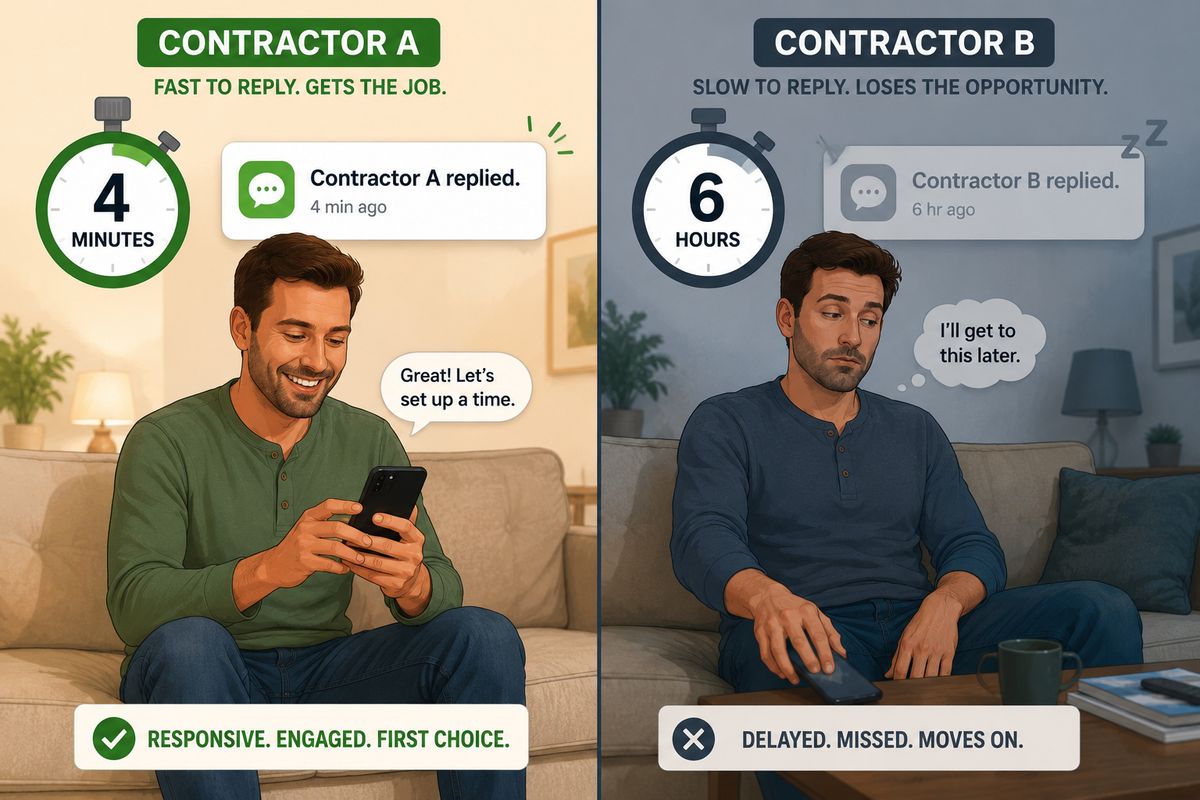
There is a well-documented pattern in lead conversion research across service industries: the odds of converting a lead into a real conversation drop sharply with every minute that passes after the initial inquiry. Within the first five minutes, the odds of a meaningful conversation happening are dramatically higher than they are even one hour later. After thirty minutes, the odds have fallen substantially. After a few hours, the lead has often moved on entirely.
For renovation projects specifically, this window matters even more than it does for smaller transactions. A renovation is a significant financial and emotional decision. Homeowners often submit several inquiries in a short burst of motivation, then get pulled back into their day. The contractor who calls back while that motivation is still fresh gets a homeowner who is engaged, available, and ready to talk. The contractor who calls back the next day gets someone who has moved on mentally, even if they still technically respond.
There is also a psychological effect that compounds the speed advantage. When a contractor responds within minutes, it signals something about how the business operates. It suggests organization, responsiveness, and a team that takes the client's project seriously. When a response takes a day or more, it suggests the opposite, regardless of how good the actual work turns out to be. The first impression is set before any conversation about the project itself has even started.
This means that for renovation businesses, response speed is not just a tiebreaker between similar contractors. It is often the primary factor that determines which contractors even get a real conversation, before quality, price, or portfolio are ever discussed.
Read More: How to Build a Commercial Lead Generation System for Your Painting Business
Why Manual Response Cannot Win the Speed Race
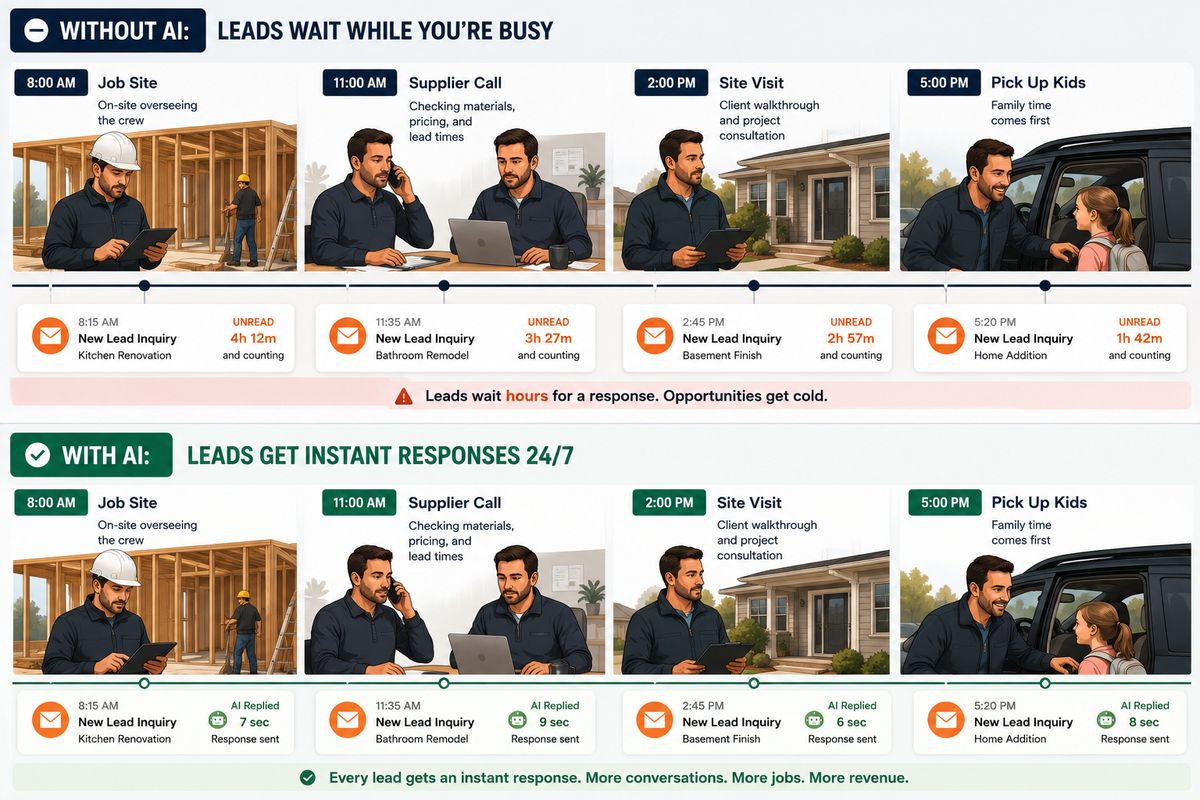
Renovation business owners are not slow to respond because they do not care. They are slow because the structure of their day makes a fast response physically impossible most of the time.
Consider a typical day. The owner is on a job site supervising a crew, often in an environment where phones are in pockets and checking messages means stopping work. The office manager, if there is one, is juggling supplier calls, scheduling, and existing client questions. Leads come in through multiple channels: a website form, a Facebook ad, a phone call that goes to voicemail, and a referral text from a past client. Each of these lands in a different place, and someone has to notice it before anything can happen.
Even with the best intentions, this structure means leads sit. A form submission at 10 am might not be seen until lunch. A call that goes to voicemail at 2 pm might not get a callback until the end of the day, after the crew has wrapped up. A weekend inquiry almost certainly waits until Monday.
None of this is a failure of effort. It is a structural mismatch. The renovation business operates on the rhythm of physical work: jobs, sites, materials, schedules. The lead response race operates on the rhythm of digital attention: minutes, not hours. Trying to win a minutes-based race with an hours-based operating rhythm is not something that more effort fixes. It requires a different mechanism entirely.
That mechanism is automation. Not because automation is more capable than a person at having a conversation, but because automation does not have a job site, a supplier call, or a weekend. It is available in the first sixty seconds after every single inquiry, every time, without exception.
Read More: Why Fast Response Wins Painting Jobs (And How to Automate It in 2026)
The Three-Part Fast Response System
Winning the speed race for renovation leads is not about one tool or one trick. It requires three components working together, each addressing a different part of what happens in the critical first minutes after a lead comes in.
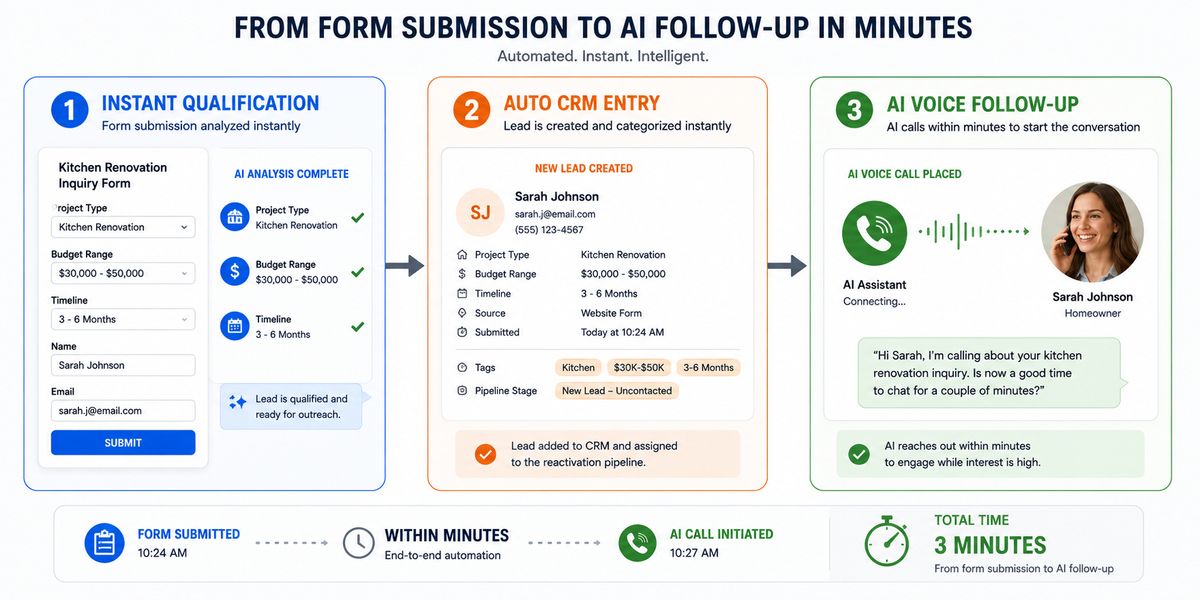
Instant qualification happens the moment the lead arrives. Before any human is involved, the system gathers the information needed to understand what this lead is, what they are interested in, and how urgent or valuable the opportunity might be.
Auto CRM entry happens simultaneously. The lead, along with everything learned through qualification, is recorded in the CRM instantly, with the right tags, the right pipeline stage, and the right routing, so nothing depends on someone manually transferring information from one place to another.
AI voice follow-up happens within moments of the lead being qualified and logged. Rather than waiting for a human to find time to call, an AI voice agent reaches out immediately, has a real conversation, answers initial questions, and either books a consultation directly or gathers enough information to hand a warm, qualified conversation to your sales team.
Together, these three components compress what used to take hours or days into a process that completes within minutes of the original inquiry, without requiring anyone on your team to drop what they are doing.
Instant Qualification: Sorting Leads the Moment They Arrive
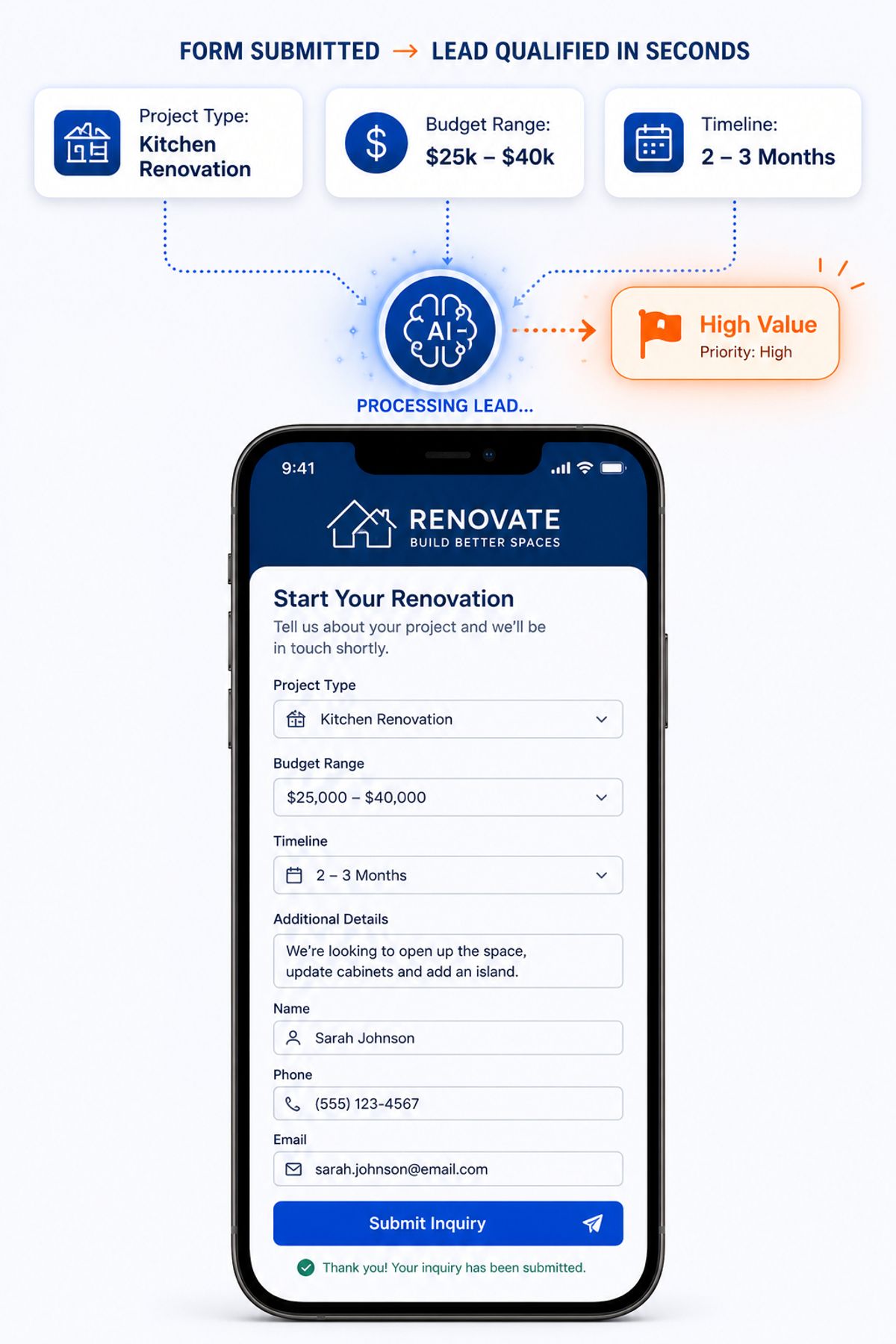
Not every lead that comes in is the same, and treating them all identically wastes the speed advantage you are trying to build. A homeowner asking about a full kitchen and addition renovation with a defined budget and a desire to start in two months is a fundamentally different opportunity than someone filling out a form just to get a rough idea of cost with no real timeline.
Instant qualification means that the moment a lead comes in, before any human sees it, the system gathers and organizes the information needed to understand what kind of opportunity this is.
This can happen in a few ways, depending on the source of the lead. For website form submissions, the form itself can be structured to capture project type, approximate scope, budget range, and desired timeline as part of the submission. For leads that come in with less information, such as a phone call that goes to voicemail or a simple contact form, an automated follow-up message can ask one or two quick questions to fill in the gaps before the next step happens.
The goal of instant qualification is not to filter people out. It is to make sure that by the time a human or an AI voice agent engages with the lead, there is already context. The conversation does not start from zero. It starts from "I see you are interested in a bathroom renovation with a target budget around this range and a timeline of a few months," which immediately signals to the prospect that their inquiry was taken seriously and understood.
For renovation businesses fielding leads across multiple project types and price points, instant qualification also enables something else that matters enormously for speed: prioritization. A lead indicating a large-scope, high-budget project with a near-term timeline can be flagged for immediate human attention in addition to the automated response, ensuring your highest-value opportunities get a layer of personal attention on top of the automated speed.
Read More: Why Your Painting Business Is Losing Jobs - And How AI Fixes the Lead Leakage Problem
Auto CRM Entry: No Lead Ever Sits in an Inbox Again
One of the quiet failure points in renovation lead management is the gap between when a lead arrives and when it actually becomes visible and actionable inside the business's systems. A form submission generates an email notification. That email sits in an inbox. Someone has to see it, open it, and manually enter the details into the CRM before any follow-up process can begin.
Every step in that chain is a place where a lead can sit unnoticed, sometimes for hours, sometimes until the next business day.
Auto CRM entry removes this gap entirely. The moment a lead comes in, from any source, a record is created in the CRM automatically. Not as a raw notification that someone needs to process, but as a fully formed lead record, complete with the contact information, the project details gathered through instant qualification, the source the lead came from, and the appropriate pipeline stage already assigned.
This matters for speed in a way that is easy to underestimate. The entire fast-response system, the AI voice follow-up, the routing to the right team member, the prioritization based on project value, all of it depends on the lead existing in a structured, accessible form the moment it arrives. If the lead is sitting as an unread email, none of the downstream automation can act on it.
Auto CRM entry also solves a second problem that compounds over time: data quality. When leads are manually entered, details get missed, fields get left blank, and inconsistent formatting makes the data difficult to use for reporting or follow-up later. When the entry happens automatically and consistently, every lead record has the same structure, the same level of detail, and the same reliability, which makes every automation built on top of that data work better.
For renovation businesses managing leads from a website, multiple ad platforms, phone calls, and referrals simultaneously, auto CRM entry is what turns five separate, inconsistent intake processes into one unified, instant, structured pipeline.
AI Voice Follow-Up: Speed That Feels Personal
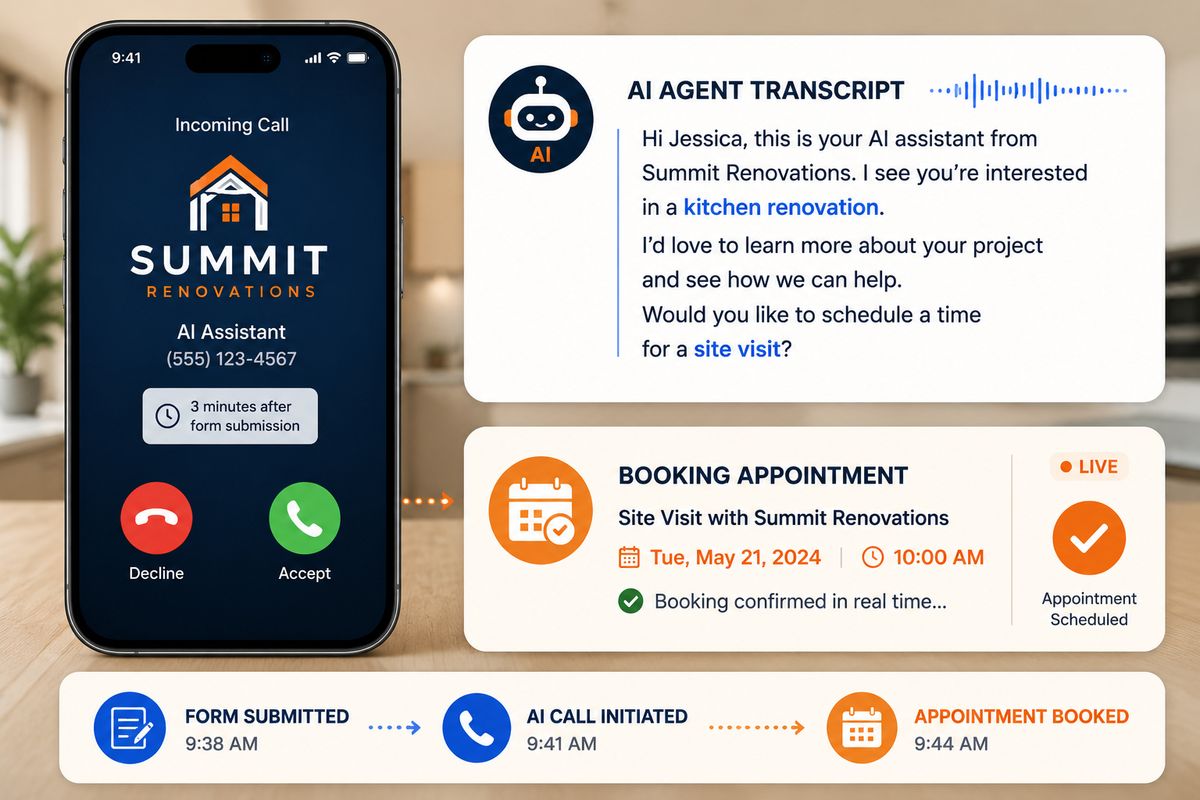
Text and email follow-up can be instant, but for many renovation leads, particularly higher-value projects, a phone conversation moves things forward in a way that written messages cannot. The challenge has always been that having a real person available to call every lead within minutes, at any hour, is simply not staffable for most renovation businesses.
AI voice follow-up solves this by making a phone conversation part of the instant response itself.
Within moments of a lead being qualified and entered into the CRM, an AI voice agent calls the number provided. The agent already has the context gathered during qualification: the project type, the approximate scope, and anything else captured from the original inquiry. The call opens by referencing that context directly, confirming the homeowner's interest in their specific project rather than launching into a generic script.
From there, the AI agent can do several things depending on how the conversation goes. It can answer common initial questions about how the process works, what to expect from a consultation, and general timelines. It can gather any additional details that help the sales team prepare for a deeper conversation. And critically, it can offer to book a consultation or site visit directly on the calendar, in real time, while the homeowner is still on the call and still in the mindset that prompted them to reach out in the first place.
If the homeowner does not answer, the AI agent can leave a warm, specific voicemail referencing their inquiry, followed by a text message with the same context and an easy way to respond or book directly. This means that even when the call does not connect, the prospect receives a fast, personalized touchpoint that feels like a real business responded to them quickly, not a generic automated blast.
The combination of speed and personalization is what makes AI voice follow-up so effective for renovation leads specifically. A call that arrives within minutes, references the exact project the homeowner just enquired about, and offers to book the next step immediately creates an experience that most homeowners have never had with a contractor before. It sets your business apart before any comparison of price or portfolio has even begun.
What a Fast Response System Looks Like in Practice
To understand how these three components come together, it helps to walk through what actually happens from the moment a lead arrives.
A homeowner is browsing renovation contractors on a Tuesday evening after putting the kids to bed. They fill out a contact form on your website, providing their name, phone number, a brief description of wanting to renovate their kitchen, and a rough budget range they selected from a dropdown.
The moment they hit submit, the system creates a lead record in the CRM automatically. The project type, budget range, and contact details are all captured in structured fields. The lead is tagged based on the budget range as a higher-value opportunity.
Within roughly a minute, an AI voice agent calls the number provided. The homeowner, slightly surprised at how quickly someone called, answers. The agent introduces itself, references their interest in a kitchen renovation in the budget range they indicated, and asks a couple of light questions about their timeline and what is motivating the project, perhaps a desire to update before hosting a holiday gathering.
Based on the homeowner's responses, the AI agent offers to schedule a consultation with the design team, suggesting a couple of available times in the coming days. The homeowner picks a time. The appointment is booked directly into the calendar and confirmed via text message immediately after the call, along with a summary of what to expect.
The entire process, from form submission to a booked consultation, took under five minutes, and it happened at 9:15 pm on a Tuesday when no one on the renovation team was available or working.
The next morning, the sales team opens the CRM and sees a fully qualified, scheduled consultation for a kitchen renovation, complete with the homeowner's stated motivations and timeline, ready to walk into a meeting with full context. No lead sat in an inbox. No callback was missed. No competitor had a six-hour head start.
This is the practical difference between a renovation business that wins the speed race consistently and one that wins it occasionally, when the timing happens to align with someone being available.
How FatCamel AI Builds Speed Into Your Pipeline
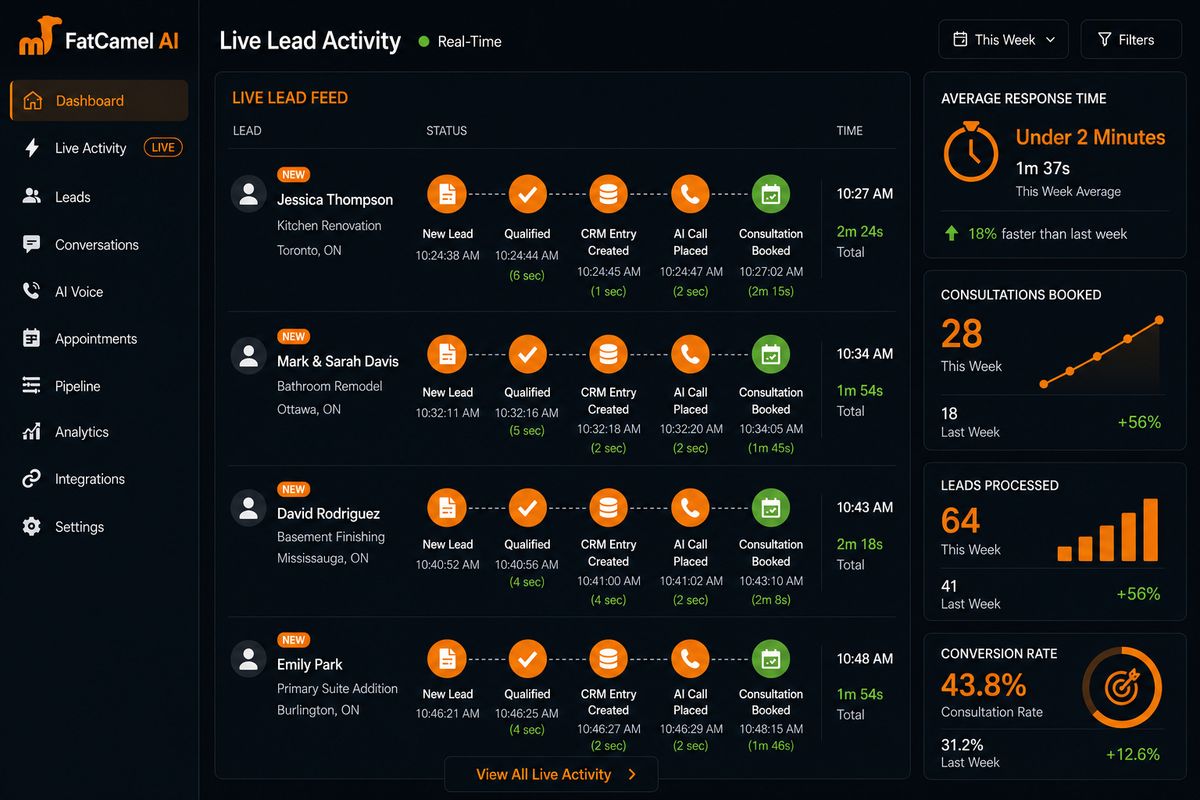
FatCamel AI is built to deliver exactly this kind of fast response system for renovation businesses, combining instant qualification, automatic CRM entry, and AI voice follow-up into a single connected workflow that runs continuously, regardless of what time a lead comes in or what your team is doing at that moment.
The moment a lead arrives from any source, whether a website form, a paid ad, a phone call, or a referral, FatCamel AI captures the available information and, where needed, gathers additional qualifying details through a quick automated exchange. This happens before the lead is even visible to your team, ensuring every lead arrives in your pipeline already understood.
That qualified information is written into your CRM instantly, as a structured, complete record with the appropriate pipeline stage and priority tagging already applied. There is no gap between a lead arriving and it being fully represented in your system, and no manual data entry step that could introduce delay or error.
From there, FatCamel AI's voice agent reaches out to the prospect within minutes, referencing the specific details of their inquiry, answering initial questions, and offering to book a consultation directly on your team's calendar in real time. If the call does not connect, a personalized voicemail and follow-up text go out automatically, maintaining the same speed and personalization even when the phone is not answered.
Every outcome, whether a booked consultation, a request for more information, or no response at all, is logged back to the CRM automatically, and any lead that needs human attention is flagged with full context so your sales team can step in seamlessly.
The result is a renovation business that responds to every single lead within minutes, every day of the week, at any hour, without requiring anyone on your team to be available at that moment. For a business category where the first responder so often wins the project, this is not a marginal improvement. It is the difference between competing for projects and consistently winning the right to compete for them in the first place.
👉 Get a Free AI Revenue Audit for Your Renovation Business at https://www.fatcamel.ai/contact
FAQ
1. Why does response speed matter so much for winning renovation projects?
Homeowners considering a renovation typically contact multiple contractors within a short window of time. The contractor who responds first sets the standard that every other response is compared against, and research consistently shows that the odds of a meaningful conversation drop sharply with every minute that passes after the initial inquiry. For renovation projects, where trust and reliability are major factors in the decision, being first to respond often determines which contractors even get a real conversation.
2. What is instant lead qualification, and why does it matter?
Instant lead qualification means gathering key information about a lead, such as project type, budget range, and timeline, the moment they make contact, before any human is involved. This allows the system to understand and prioritize the opportunity immediately, and ensures that any follow-up, whether automated or human, starts with context rather than from zero.
3. How does auto CRM entry improve lead response time?
Auto CRM entry removes the manual step where someone has to see a lead notification, open it, and enter the details into the CRM before any follow-up can happen. By creating a fully structured lead record automatically the moment a lead arrives, every downstream automation, including AI voice follow-up and team routing, can act on the lead immediately rather than waiting for someone to process it manually.
4. How does AI voice follow-up work for renovation leads?
AI voice follow-up means an AI agent calls a new lead within minutes of their inquiry, using the context gathered during qualification to have a relevant conversation rather than a generic one. The agent can answer initial questions, gather additional details, and book a consultation directly on the calendar in real time. If the call is not answered, a personalized voicemail and text message follow up immediately with the same context.
5. Can a small renovation business realistically respond to leads within minutes?
Yes, and this is exactly what makes lead response automation so valuable for smaller businesses. A small renovation business cannot realistically have a person available to respond within minutes to every lead at any hour. Automation makes this possible without adding staff, because the instant qualification, CRM entry, and AI voice follow-up run continuously regardless of what the team is doing or what time it is.
6. What happens if a lead does not answer the AI voice call?
If the AI voice call is not answered, the system leaves a personalized voicemail referencing the specific project the prospect enquired about, followed immediately by a text message with the same context and an easy way to respond or book a consultation directly. This ensures the prospect still receives a fast, relevant touchpoint even when the call itself does not connect.
7. How does a fast response system change the sales conversation for renovation businesses?
When a lead has already been qualified, logged, and engaged through an AI voice call that may have already booked a consultation, the sales team's first conversation starts from a position of context and momentum rather than a cold introduction. The prospect has already had a positive, fast experience with the business before any human conversation takes place, which shifts the tone of the entire sales process in the contractor's favor.
References
https://www.artisan.co/blog/automated-lead-follow-up-system
https://homelead.in/automate-follow-ups-in-real-estate/
https://homelead.in/automate-follow-ups-in-real-estate/
https://www.builderleadconverter.com/automated-follow-up/
https://www.gushwork.ai/blog/lead-generation-for-home-services