
Most renovation businesses measure success by lead volume. More website traffic, more ad spend, more inquiries coming in. But volume is only half the equation, and it is the half that gets all the attention while the more important number quietly goes unmanaged.
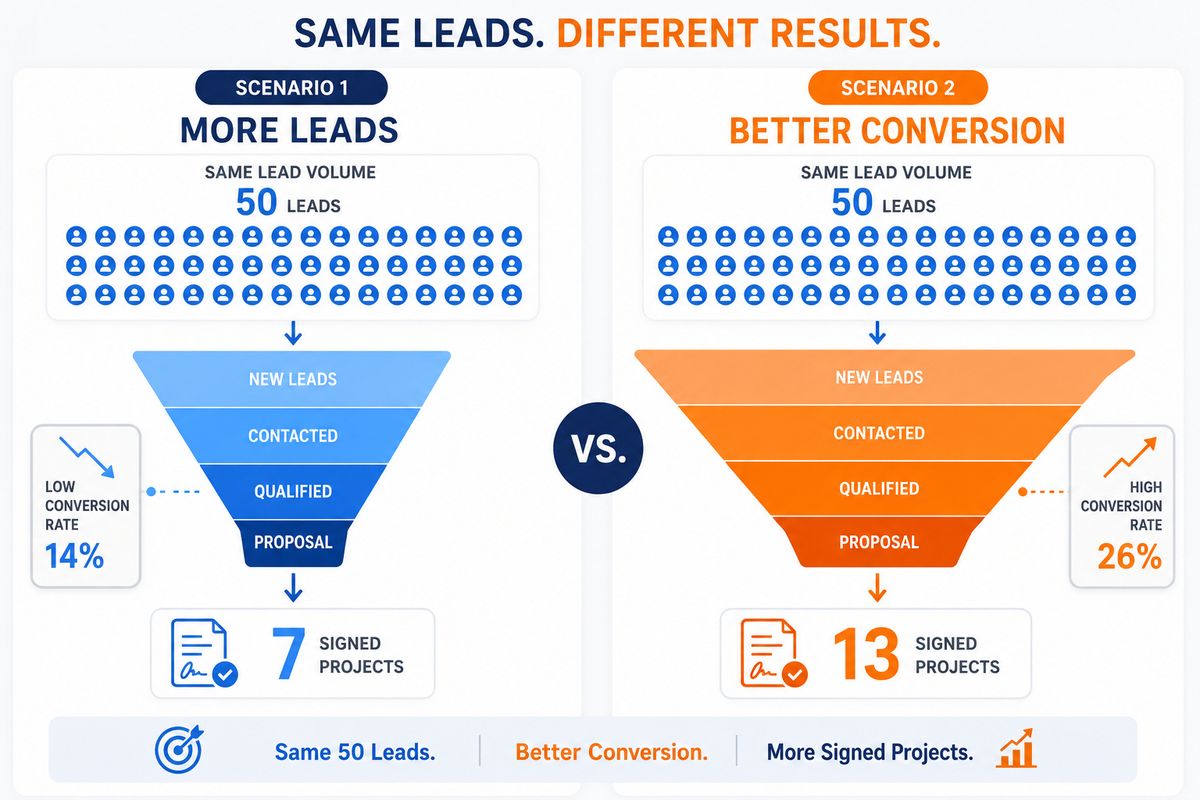
Conversion rate, the percentage of leads that actually turn into signed projects, is where the real money in a renovation business is made or lost. A business generating fifty leads a month at a fifteen percent conversion rate is closing roughly the same number of jobs as a business generating thirty leads a month at a twenty-five percent conversion rate. The second business is spending less on advertising, working fewer dead-end conversations, and running a fundamentally healthier operation.
Yet most renovation businesses spend the majority of their energy trying to generate more leads rather than converting more of the leads they already have. This is partly because lead generation is visible and measurable, while conversion improvement requires a closer look at the messy middle of the sales process, where speed, follow-up consistency, personalization, and timing all interact in ways that are hard to track manually.
This guide breaks down the specific, practical ways AI is helping renovation businesses increase their conversion rate, not by generating more leads, but by converting significantly more of the leads they are already paying for.
Table of Contents
Why Conversion Rate Matters More Than Lead Volume
The Conversion Rate Math Most Renovation Businesses Get Wrong
AI Strategy 1: Speed to First Contact
AI Strategy 2: Intelligent Lead Scoring and Prioritization
AI Strategy 3: Personalized, Multi-Touch Follow-Up
AI Strategy 4: Smarter Estimate Follow-Up
AI Strategy 5: Objection Handling at Scale
AI Strategy 6: Data-Driven Process Improvement
How FatCamel AI Increases Conversion Across the Full Pipeline
FAQ
References
Why Conversion Rate Matters More Than Lead Volume
Every renovation business owner has felt the frustration of a slow month and responded the same way: spend more on ads, push harder for referrals, chase more leads. It is the instinctive response, and it is usually the wrong first move.
The reason is simple math that gets overlooked in the daily pressure of running a business. If your conversion rate is low, every additional lead you generate is also converting at that same low rate. Doubling your ad spend without fixing conversion does not double your revenue. It often barely moves it, while significantly increasing your costs and the strain on your team trying to follow up with twice as many people using the same broken process.
Improving conversion rate, on the other hand, has a compounding effect on every lead you already have and every lead you generate going forward. A renovation business that improves its conversion rate from fifteen percent to twenty-five percent does not need to spend a single additional dollar on advertising to see a meaningful revenue increase. The same leads, the same ad spend, and significantly more signed projects.
This is why the most sophisticated renovation businesses in 2026 are treating conversion rate as their primary growth lever, not an afterthought to be addressed once lead volume is solved. Lead generation gets you in front of opportunities. Conversion is what turns those opportunities into actual revenue, and it is almost always the area with the most room for improvement.
Read More: Why Fast Response Wins Renovation Projects (And How to Automate It)
The Conversion Rate Math Most Renovation Businesses Get Wrong
To understand where AI creates the most leverage, it helps to break the renovation sales process into its individual conversion stages, because most businesses think about conversion as a single number when it is actually the product of several smaller conversion rates multiplied together.
A typical renovation sales process moves through stages like this: lead inquiry to consultation booked, consultation booked to consultation completed, consultation completed to estimate sent, estimate sent to estimate accepted, estimate accepted to contract signed. Each of these stages has its own conversion rate, and the overall conversion rate from initial lead to signed project is the product of all of them together.
This matters because a small improvement at any single stage compounds across the whole pipeline. If a renovation business improves its inquiry-to-consultation rate from forty percent to sixty percent, and improves its estimate-to-acceptance rate from thirty percent to forty-five percent, the combined effect on overall conversion is far larger than either improvement looks on its own.
Most renovation businesses focus their improvement efforts on the stages that feel most controllable, usually the in-person consultation and the estimate presentation itself, because that is where the human sales skill is most visible. But the data consistently shows that the biggest leakage, and therefore the biggest opportunity, happens in the stages that are entirely dependent on follow-up: getting a lead to book a consultation in the first place, and getting a sent estimate to actually convert into a signed contract.
These are exactly the stages where AI has the most leverage, because they depend on speed, consistency, and persistence rather than in-person sales skill, and those are the qualities that automation handles better than any human team can sustain manually.
AI Strategy 1: Speed to First Contact
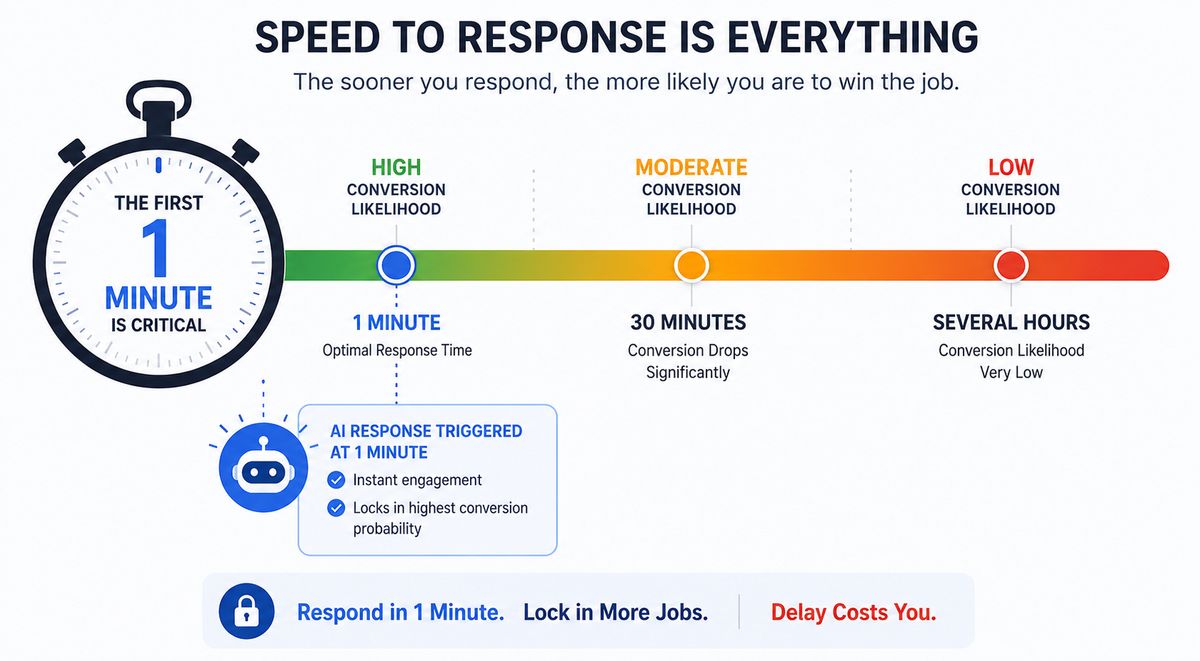
The single highest-leverage conversion improvement available to most renovation businesses is reducing the time between a lead's initial inquiry and the first meaningful contact from the business.
Research across service industries consistently shows that the odds of converting a lead into a real conversation fall sharply with every minute that passes after their initial inquiry. For renovation projects specifically, where homeowners often submit inquiries to multiple contractors within the same short window, the business that responds first frequently wins the engagement before any comparison of price or quality has even started.
AI changes this by making instant response structurally possible rather than dependent on a team member happening to be available. The moment a lead arrives, regardless of the source or the time of day, an automated response goes out immediately, followed by an AI voice call within minutes that engages the prospect in a real conversation and works toward booking a consultation directly.
The conversion impact of this single change is often the largest of any improvement a renovation business can make, because it does not depend on improving anything about the sales conversation itself. It simply ensures that more of the leads who were genuinely interested actually get engaged before they move on to a competitor.
Read More: Why Most Contractor CRMs Fail And How AI Fixes It
AI Strategy 2: Intelligent Lead Scoring and Prioritization
Not every lead deserves the same amount of attention, and treating every inquiry identically wastes the limited time your sales team has on conversations that were never likely to convert, while underserving the high-value opportunities that deserve immediate personal attention.
AI-powered lead scoring solves this by analyzing the details of each incoming lead, project type, budget range, timeline, property type, and even behavioral signals like how quickly someone responds to follow-up messages, to assign a priority score automatically. High-value, high-intent leads are flagged for immediate attention from your most experienced salesperson. Lower-priority leads continue through the automated nurture sequence without consuming the same level of resource.
This matters for conversion rate because sales capacity is finite. A renovation business with one or two estimators cannot give every lead the same depth of personal attention without sacrificing quality somewhere. Intelligent prioritization ensures that the leads most likely to convert into your highest-value projects get the attention that actually moves the needle, while the system handles everything else competently in the background.
Over time, AI lead scoring also improves itself. As the system observes which lead characteristics actually correlate with conversion in your specific business, the scoring model becomes more accurate, helping your team focus their energy with increasing precision rather than relying on gut feeling about which leads seem promising.
AI Strategy 3: Personalized, Multi-Touch Follow-Up
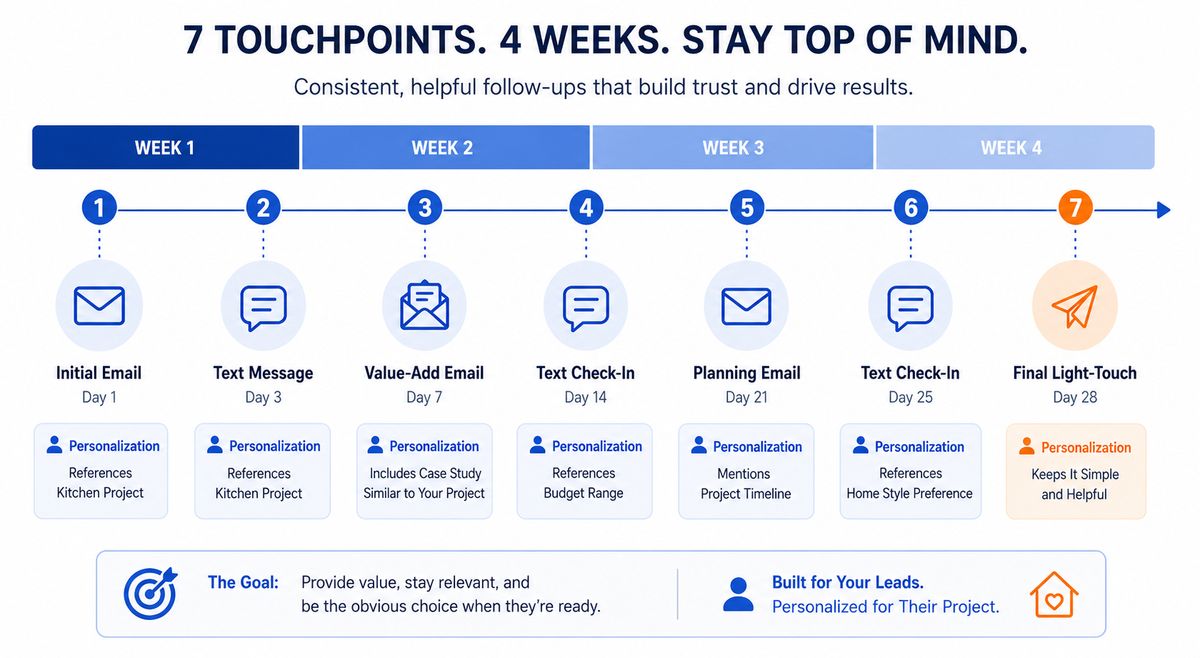
One of the most consistent findings in sales research is that most buyers, particularly for high-consideration purchases like renovation projects, need multiple touchpoints before making a decision, and most businesses give up on follow-up long before that threshold is reached.
AI-powered follow-up solves this by running a structured, multi-touch sequence automatically for every lead, regardless of how busy your team is. Rather than one or two follow-up attempts before a salesperson moves on to the next opportunity, leads receive a coordinated sequence across email and SMS over several weeks, each message different from the last, adding value or addressing a likely concern rather than simply repeating the same ask.
Personalization is what makes this effective rather than annoying. Generic follow-up messages sent to every lead identically produce low response rates and can actively damage how a prospect perceives the business. AI-powered follow-up uses the specific details captured about each lead, their project type, their stated timeline, and their budget range, to tailor every message so it feels relevant rather than templated.
The conversion impact here is significant because it specifically targets the leads who are genuinely interested but were not ready to commit during the first conversation. These leads represent some of the most recoverable lost revenue in a typical renovation pipeline, and a structured, personalized follow-up sequence converts a meaningful percentage of them without requiring any additional sales effort.
Read More: Why Most Contractor CRMs Fail And How AI Fixes It
AI Strategy 4: Smarter Estimate Follow-Up
The point where renovation businesses lose the most already-invested revenue is after the estimate has been sent. The site visit happened. The proposal was built. The investment of time is already made. And then the follow-up stops, often because the salesperson assumes the client will reach out when ready, or simply moves on to the next active opportunity.
AI-powered estimate follow-up addresses this directly by running a structured sequence the moment an estimate is sent, without requiring anyone to remember to follow up manually. A check-in a few days after the estimate goes out, asking if there are any questions. A value-add message about a week later, perhaps addressing a common concern about timeline or material costs. A final, low-pressure message a couple of weeks after that, keeping the door open without applying obvious pressure.
What makes this strategy particularly powerful for conversion rate is that the follow-up is working with leads who have already demonstrated serious intent. They requested a site visit, sat through a consultation, and received a detailed proposal. These are not cold leads. They are warm, qualified prospects who, in many cases, simply needed one more nudge or one more piece of information before signing.
Renovation businesses that implement structured, automated estimate follow-up consistently see a measurable lift in their estimate-to-signed-contract conversion rate, often recovering deals that would otherwise have been silently lost to a competitor who happened to follow up more persistently.
AI Strategy 5: Objection Handling at Scale
Every renovation salesperson has heard the same handful of objections repeatedly. The price feels high. The timeline does not fit. They want to get one more quote first. They need to discuss it with a partner. Experienced salespeople develop intuitive responses to these objections over time, but that expertise is locked inside their heads and only available during a live conversation they happen to be part of.
AI changes this by encoding effective responses to common objections directly into the automated follow-up sequences, so every lead benefits from thoughtful objection handling, not just the ones who happen to get your most experienced team member on the phone.
When a lead indicates hesitation around price, the follow-up sequence can include a message that reframes the investment in terms of long-term value, financing options, or a relevant case study showing the return a similar renovation delivered for a past client. When the timeline is the concern, a message addressing how the project schedule actually works, and what flexibility exists, can directly address the hesitation. When a prospect mentions they are still comparing quotes, a message highlighting the specific differentiators of your business, without disparaging competitors, can tip the decision in your favor.
This does not replace skilled human conversation, particularly for complex, high-value projects where nuance matters. But it ensures that the objections holding back lower-touch leads, the ones who never get a deep, personal conversation simply due to sales capacity constraints, are still being addressed thoughtfully rather than left completely unanswered.
Read More: How to Reactivate Dead Painting Leads Using AI Automation in 2026 (Full System Breakdown)
AI Strategy 6: Data-Driven Process Improvement
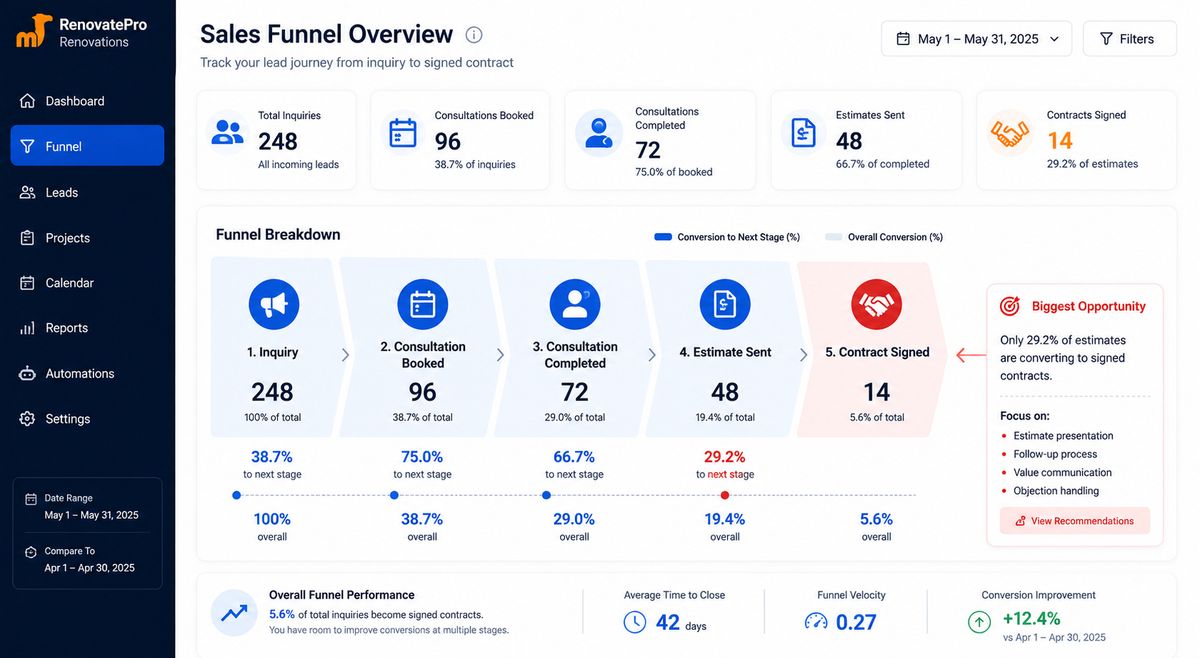
Perhaps the most underappreciated AI conversion strategy is the simplest in concept: knowing exactly where your pipeline is losing leads, with enough specificity to actually fix the problem.
Most renovation businesses have a rough sense of their overall close rate but very little visibility into the conversion rate at each stage of their sales process. Without that visibility, improvement efforts are essentially guesswork. A business might invest heavily in sales training when the real problem is response speed, or invest in better lead quality when the real problem is a complete absence of estimated follow-up.
AI-powered CRM systems track every stage transition automatically, providing a clear, stage-by-stage conversion breakdown. Inquiry to consultation. Consultation to estimate. Estimate to signed contract. With this data, a renovation business can identify precisely where the biggest leakage is happening and direct improvement efforts at the highest-impact area rather than spreading attention thin across the entire process.
This data also reveals patterns that would be invisible without systematic tracking. Perhaps leads from a particular source convert at a noticeably higher rate, suggesting where to focus the advertising budget. Perhaps a specific project type has a much lower estimate acceptance rate, suggesting a pricing or positioning issue worth addressing directly. These insights turn conversion improvement from a vague aspiration into a specific, measurable, ongoing process.
How FatCamel AI Increases Conversion Across the Full Pipeline
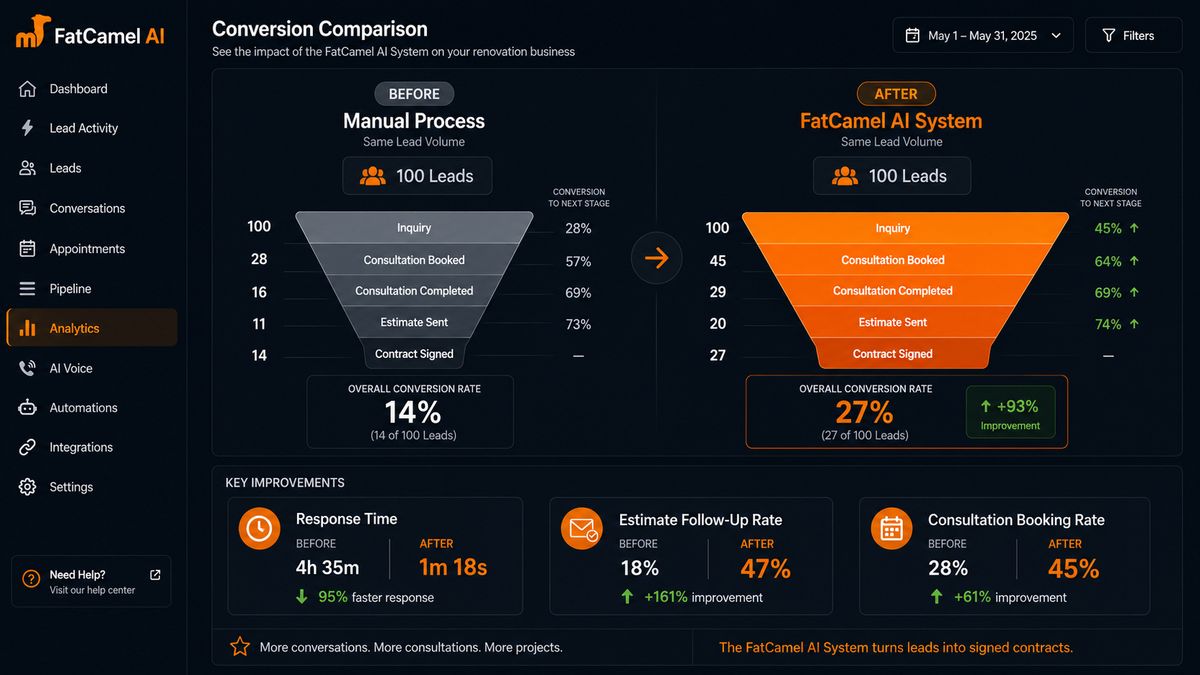
Each of the strategies described in this guide produces a meaningful conversion improvement on its own. Combined into a single connected system, the impact compounds significantly, because speed, scoring, follow-up, and data all reinforce each other rather than operating in isolation.
FatCamel AI is built to deliver every one of these conversion strategies as a unified system for renovation businesses. The moment a lead arrives, an instant response goes out, and an AI voice call engages the prospect within minutes, maximizing the conversion advantage that comes from speed alone. Every lead is automatically scored and prioritized based on project details and behavioral signals, ensuring your sales team's attention goes where it matters most.
Every lead, regardless of priority level, receives a personalized, multi-touch follow-up sequence that adapts based on the project type and any signals of hesitation, addressing common objections automatically rather than leaving lower-touch leads completely unaddressed. Estimates that are sent trigger an automated follow-up sequence immediately, recovering deals that would otherwise be silently lost to inconsistent manual follow-up.
Throughout the entire pipeline, every stage transition is tracked automatically, giving you a clear, stage-by-stage view of exactly where leads are converting and where they are not, so improvement efforts can be directed with precision rather than guesswork.
The result is a renovation business that converts a significantly higher percentage of the leads it already has, without spending an additional dollar on advertising, and with a sales team that spends its time on the conversations that matter most rather than chasing every lead manually through a process that was always going to lose people along the way.
👉 Get a Free AI Revenue Audit for Your Renovation Business at https://www.fatcamel.ai/contact
FAQ
1. What is a good conversion rate for renovation leads?
Conversion rates vary significantly by lead source, project type, and average project value, but most renovation businesses operating with manual follow-up processes see overall lead-to-signed-contract conversion rates in the range of ten to twenty percent. Businesses running structured AI-powered follow-up, scoring, and estimate sequences commonly see this rise into the twenty-five to thirty-five percent range, sometimes higher for businesses with strong reputations and referral-based leads.
2. How does AI improve sales conversion for construction and renovation businesses?
AI improves conversion by addressing the specific points in the sales process where manual effort consistently falls short: response speed, follow-up consistency, lead prioritization, estimate follow-up, and objection handling at scale. Rather than replacing the sales skill involved in consultations and proposals, AI ensures that every lead receives a fast, consistent, and well-timed experience leading up to and following those human conversations.
3. What is the biggest factor in improving contractor conversion rates?
Speed to first contact is consistently the single highest-leverage factor in improving conversion rates for contractors and renovation businesses. Responding to a lead within minutes rather than hours dramatically increases the likelihood of a real conversation happening before the prospect moves on to a competitor. Beyond speed, consistent multi-touch follow-up and structured estimate follow-up are the next highest-impact areas.
4. Can AI sales automation replace the need for a skilled sales team?
No. AI sales automation handles the structural, repetitive aspects of the sales process, fast response, consistent follow-up, lead prioritization, and basic objection handling, which are difficult for a human team to sustain manually at volume. The skilled, nuanced parts of selling a renovation project, building trust during a consultation, presenting a proposal, and addressing complex client-specific concerns still require a capable human salesperson. AI ensures more leads reach that human conversation in a warmer, better-prepared state.
5. How does lead scoring work for renovation businesses?
Lead scoring uses details about each incoming lead, such as project type, budget range, timeline, and property type, along with behavioral signals like response speed to follow-up messages, to assign a priority score automatically. Higher-scoring leads are flagged for immediate attention from the sales team, while lower-scoring leads continue through automated follow-up. Over time, the scoring model improves as it learns which characteristics actually correlate with conversion in that specific business.
6. Why does estimate follow-up have such a big impact on conversion rate?
Estimate follow-up has an outsized impact because the leads at this stage have already demonstrated serious intent. They have requested a site visit, completed a consultation, and received a detailed proposal. These are warm, qualified prospects, not cold leads. When follow-up stops after the estimate is sent, businesses lose deals that were genuinely winnable simply due to a lack of persistence, which is exactly the gap automated follow-up sequences close.
7. How quickly can a renovation business expect to see conversion rate improvements after implementing AI?
Most renovation businesses see measurable improvements in response time and engagement rate within the first two weeks of implementing AI-powered speed and follow-up systems. Improvements in overall conversion rate, from inquiry through to signed contract, typically become clear within the first sixty to ninety days, as the full pipeline of automated touchpoints has time to work through a complete sales cycle.
References
https://landingi.com/blog/conversion-rate-optimization-with-ai/
https://www.leadinfo.com/en/blog/how-to-accelerate-and-improve-your-lead-generation-with-ai/
https://www.orbitmedia.com/blog/ai-conversion-optimization-lead-generation/
https://leadgulls.com/academic-articles/ai-lead-generation-contractor-marketing-funnels-2026
https://www.silvertouchinc.com/blog/ai-chatbots-lead-generation-conversion-rates/