
At InstallerSHOW 2026, we spoke with an HVAC business owner who has since stayed with us. His company was spending close to £8,000 a month on Google Ads and local SEO. The leads were coming in. The phone was ringing. The enquiry forms were being submitted. By every measure, the marketing was working.
But when we asked how many of those leads were actually converting into booked jobs, the answer was uncomfortable. Somewhere around 25 percent, he thought. Maybe less. He was not entirely sure because not all of them were being properly tracked.
Three-quarters of the leads his business was paying to generate were disappearing somewhere between the initial enquiry and the first conversation. And the painful part was that he already knew this was happening. He just had not found a way to stop it.
That conversation was not an outlier. We heard versions of it dozens of times across InstallerSHOW 2026. Businesses of every size, across every sector of the home services industry, were losing leads they had already paid for, not because of poor workmanship or bad reviews, but simply because of what happened after the lead arrived.
Table of Contents
Why Businesses Lose Leads
The Financial Impact
What Happens After 5 Minutes
Lead Reactivation Opportunities
How AI Can Help
- SMS Automation
- Email Automation
- Call Automation
- Follow-Up Systems
Conclusion
Frequently Asked Questions
Why Businesses Lose Leads
The instinct is to assume that when a lead does not convert, something went wrong with the pitch, the price, or the product. In reality, for a significant proportion of home service businesses, leads are being lost before a single conversation even takes place.
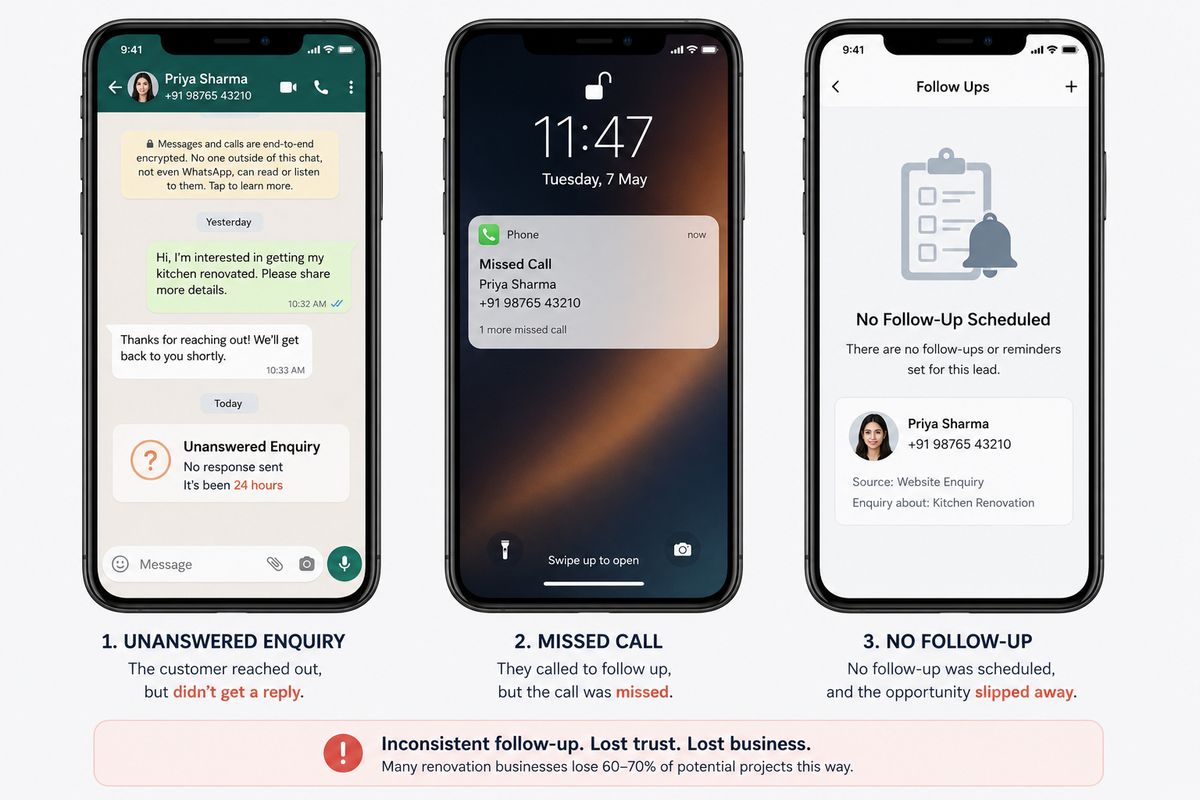
The mechanics are straightforward. A homeowner searches for a boiler repair or a solar installation quote. They submit a form or click a call button. They are busy, in the middle of something, and they send out two or three enquiries to different companies at the same time. Then they carry on with their day.
The home service business receives that enquiry at a point when the office manager is handling three other things simultaneously, an engineer just called to report a problem on a job, and there are four messages in the queue ahead of it. The enquiry sits. An hour passes. Then two. Then the end of the day arrives.
The follow-up call happens the next morning. By that point, one of the competitors has already spoken to the customer, quoted the job, and booked it in. The lead is gone. The marketing budget that generated it is gone with it. And nobody in the business is entirely sure why conversion rates are lower than they should be, because from the team's perspective, they did follow up. Just not fast enough.
The second way businesses lose leads is through inconsistency. Follow-up depends entirely on who is available and how busy they are on any given day. There is no system. No process guarantees every lead gets the same treatment regardless of when it arrives or what else is happening in the business. Some leads get called back within the hour. Others wait until someone finds time. And some simply get forgotten.
The third way is through a lack of persistence. Industry data consistently shows that most sales require multiple touchpoints before a customer makes a decision. Yet the majority of home service businesses make one or two follow-up attempts and then move on. The lead that did not convert on the first call might have converted on the third. Nobody will ever know, because the third call never happened.
Read More: What We Learned From Talking to Home Service Businesses at InstallerSHOW 2026
The Financial Impact
Understanding that leads are being lost is one thing. Understanding what that actually costs is another, and the numbers tend to focus attention quickly.
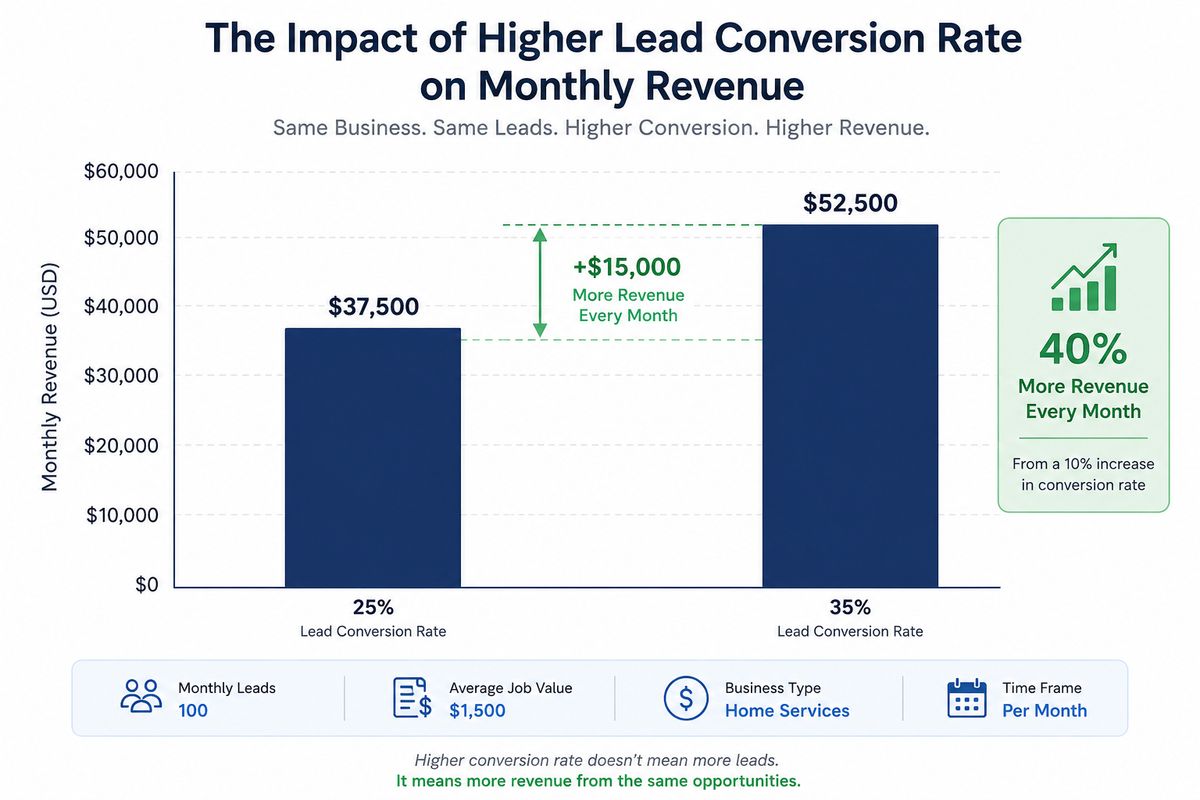
Take a home service business spending £5,000 a month on paid advertising. At a typical cost per lead for the home services sector, that might generate somewhere between 80 and 150 inbound enquiries depending on the service, the area, and the platform.
If the business is converting 25 percent of those leads into booked jobs, it is generating 20 to 37 jobs per month from that spend. The cost per acquired customer sits at roughly £135 to £250.
Now apply a modest improvement in follow-up speed and consistency. Studies across the home services sector suggest that businesses responding within five minutes convert leads at a rate three to five times higher than those responding after an hour. If the same business improved its conversion rate from 25 percent to 35 percent through faster, more consistent follow-up alone, it would generate an additional 8 to 15 jobs every month from the same marketing spend.
At an average job value of £500, that is £4,000 to £7,500 in additional monthly revenue. From no increase in marketing budget. No new staff. No price changes.
Now add in the leads that are currently being abandoned entirely. The enquiries that get one follow-up attempt and are never contacted again. The quotes that go out and receive no reminder. The customers who booked once, were satisfied, but have not been contacted since. Each of these represents revenue the business has effectively written off without realising it.
The total financial cost of poor lead management in a growing home service business is rarely calculated, but when it is, the number is almost always significantly larger than expected.
What Happens After 5 Minutes
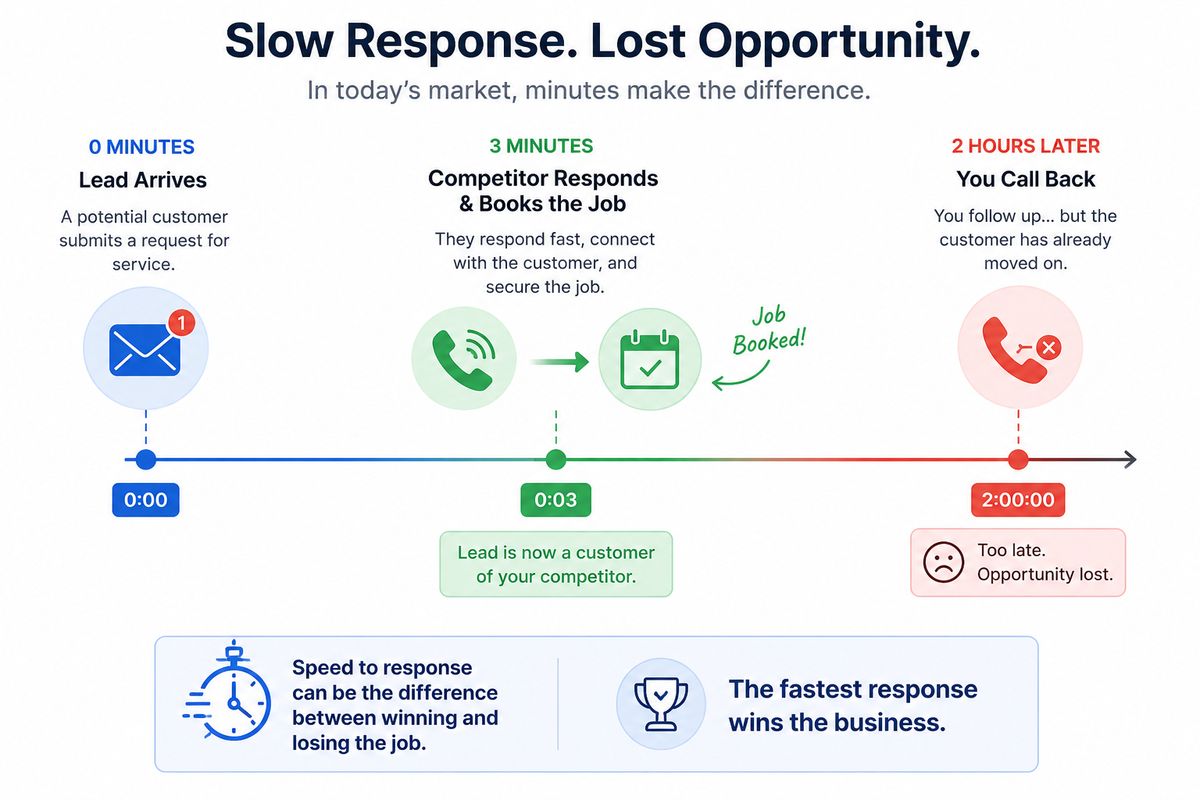
The five-minute window is not an arbitrary benchmark. It is consistently supported by research across sales and lead management, and it is particularly relevant in the home services sector where purchase decisions are often made quickly and emotionally.
When a homeowner submits an enquiry about a boiler that has stopped working, they are not browsing casually. They have a problem. They want it solved. They are motivated to make a decision as quickly as possible, which means they are also highly responsive in the minutes immediately after they make contact.
A study by the Harvard Business Review found that businesses responding to web leads within an hour were seven times more likely to have a meaningful conversation with a decision-maker than those waiting longer. Research specifically in the home services sector has found that response within five minutes can increase conversion rates by 300 to 400 percent compared to a response of 30 minutes or more.
What happens after five minutes? The customer's attention shifts. They move on to something else. If they submitted enquiries to multiple companies, the one that responded first is already in conversation with them. By the time the second or third business calls, the customer may already be committed, or at minimum, significantly less engaged.
After an hour, many leads have effectively gone cold. The moment of maximum motivation has passed. The customer has had time to reconsider, get distracted, or commit to a competitor. The follow-up call that happens three hours later is not following up on a warm lead. It is attempting to reopen a conversation that has already largely closed.
For home service businesses relying on manual follow-up processes, delivering a consistent sub-five-minute response is functionally impossible. There will always be moments when the office is busy, the team is out on jobs, or an enquiry arrives at 7 pm on a Thursday. The only way to guarantee fast response across every enquiry, at any time of day, is automation.
Read More: How to Automate Follow-Ups for Renovation Leads (SMS, Email & AI Calls)
Lead Reactivation Opportunities
Most conversations about lead generation focus on acquiring new leads. The conversation about reactivating old ones happens far less often, which is why it represents one of the largest untapped revenue opportunities in the home services industry.
Every home service business that has been operating for more than a year has a database of contacts that have gone quiet. Former customers who have not booked again. Prospects who requested a quote but never confirmed. Enquiries that came in during a busy period and slipped through without proper follow-up. People who said they would think about it and were never contacted again.
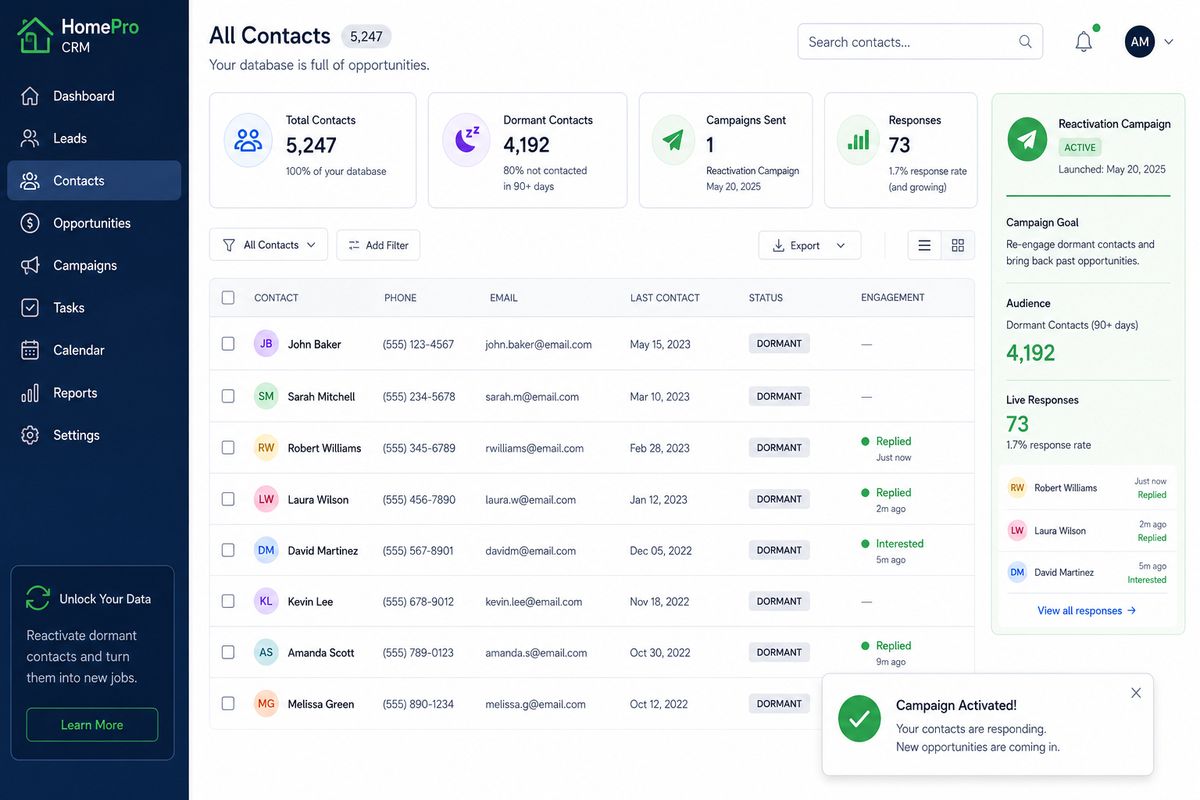
At InstallerSHOW 2026, we spoke with a business owner who had 12,000 contacts in his CRM. Less than five percent had been contacted in the last six months. The remaining 11,400 contacts were sitting completely untouched, representing marketing spend that had already been paid and customer relationships that had already been initiated, but were generating zero revenue.
The reason these contacts go uncontacted is simple: reaching out to them manually would take an enormous amount of time. Working through a list of thousands of people, crafting individual messages, tracking who has responded and who has not, and following up again on those who did not reply is simply not something a lean team can do while also running the day-to-day business.
But that reasoning changes entirely with automation. A well-structured lead reactivation campaign can reach thousands of dormant contacts simultaneously with personalised, relevant messages, track engagement, and pass warm responses directly to the sales team. The contacts who respond are already familiar with the business. They have already expressed interest at some point. The barrier to conversion is substantially lower than with a cold lead.
The economics are compelling. Reactivation campaigns consistently generate bookings at a fraction of the cost of new lead acquisition. For businesses sitting on large databases of inactive contacts, this represents a significant and largely overlooked revenue stream that can be activated relatively quickly.
How AI Can Help
Automation and AI tools are the practical solution to each of the problems described above. They do not require large teams, significant overhead, or complex technology infrastructure. Implemented correctly, they work in the background of an existing business, handling the time-sensitive and repetitive parts of lead management so the team can focus on delivering the actual service.
SMS Automation
SMS remains one of the highest-performing channels for lead follow-up in the home services sector. Open rates for SMS messages consistently sit above 90 percent, and response rates significantly outperform email in time-sensitive contexts.
An automated SMS system can send a personalised response to a new enquiry within seconds of it being received, at any time of day or night. It can follow up with a second message if the first goes unanswered. It can send appointment reminders, quote follow-ups, and reactivation messages to dormant contacts, all without anyone on the team manually composing or sending anything. For enquiries coming in outside of office hours, SMS automation ensures the customer hears from the business immediately rather than waiting until the next working day.
Read More: Best AI Tools for Painting Contractors in 2026
Email Automation
Email automation complements SMS by handling more detailed communication throughout the customer journey.
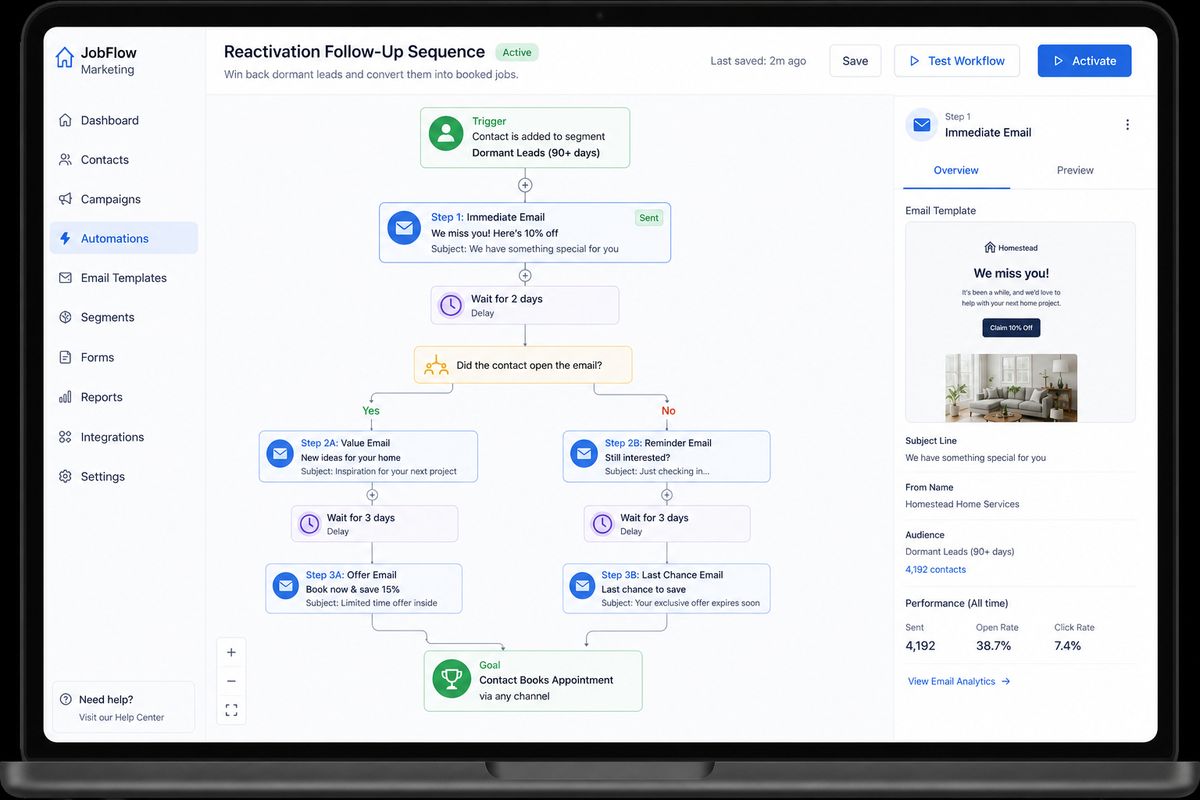
Where SMS excels at speed and immediacy, email is more effective for sending quote documents, booking confirmations, follow-up sequences that include supporting information, and longer-form reactivation campaigns. An automated email sequence triggered by a new enquiry can send an immediate acknowledgement, follow up 24 hours later if there has been no response, send a personalised reminder at 72 hours, and continue at scheduled intervals until the lead either converts or opts out.
For lead reactivation, email campaigns can reach large volumes of dormant contacts simultaneously with messages tailored to their history with the business. A contact who requested a solar quote 18 months ago might receive a message referencing the current government energy incentives. A former boiler customer approaching the three-year mark might receive a service reminder. These messages feel relevant and timely even though they are entirely automated.
Call Automation
Automated outbound calling is a less commonly discussed tool but one that is increasingly relevant for home service businesses managing high enquiry volumes.
Call automation systems can initiate outbound calls to new leads within minutes of an enquiry being received, connecting the customer directly to a sales team member or, where no team member is available, delivering a pre-recorded message that keeps the conversation alive until a live call can take place. For businesses managing large reactivation lists, automated calling can work through hundreds of contacts in a fraction of the time it would take a team member to dial manually, passing any engaged contacts directly to a live person.
Combined with SMS and email automation, call automation creates a multi-channel follow-up system that significantly increases the chances of reaching a lead before a competitor does.
Follow-Up Systems
Individual automation tools are effective in isolation, but their real power comes from being connected into a coherent follow-up system.
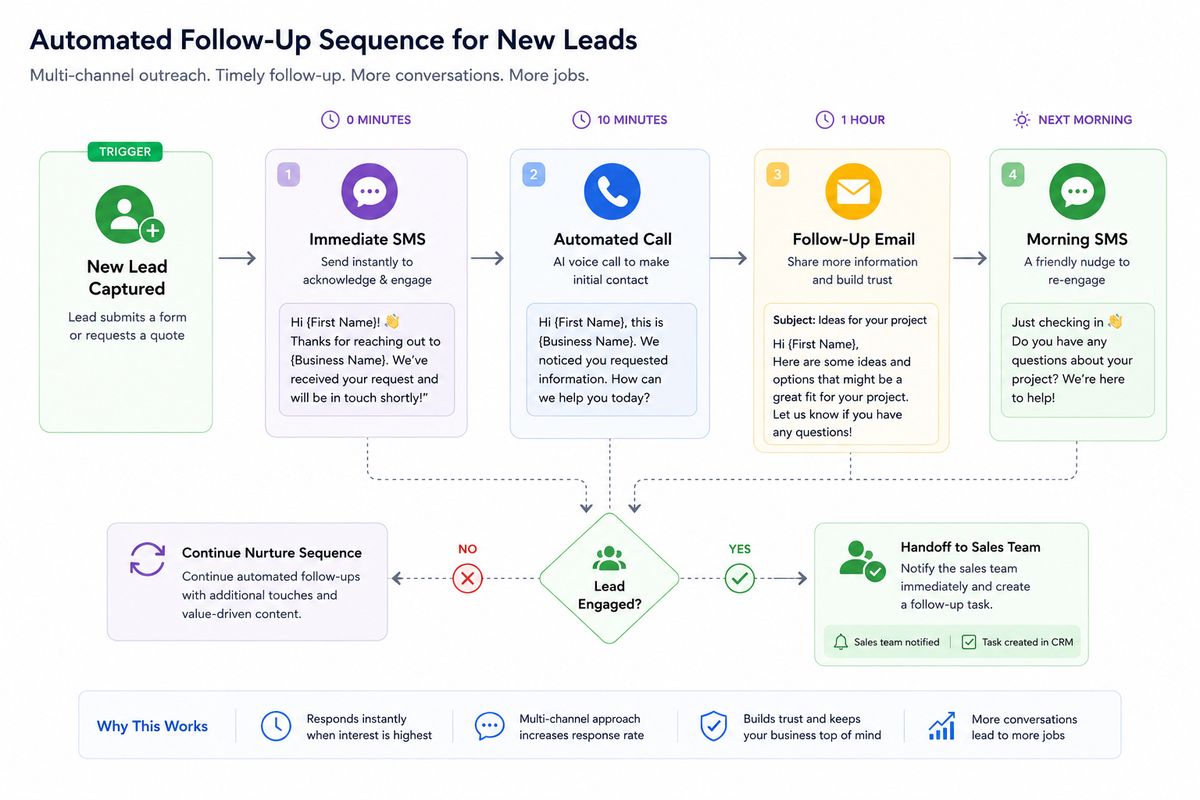
A properly structured follow-up system treats every lead as a sequence rather than a single event. A new enquiry triggers an immediate SMS. If unanswered, an automated call follows within ten minutes. An email goes out within the hour. A second SMS is sent the following morning. The lead's status is tracked automatically throughout, and the sales team is only brought in when the contact engages, at which point all of the relevant information has already been collected and organised.
This approach ensures that no lead falls through the cracks because of timing, workload, or human error. It also ensures that every lead receives the same standard of follow-up regardless of when the enquiry arrived or how busy the team is. The consistency that is impossible to achieve manually becomes the default.
Conclusion
The cost of missed leads in the home services industry is real, it is measurable, and for most businesses, it is significantly larger than it appears on the surface. Every lead that goes unanswered for more than five minutes is a lead at risk. Every quote that goes out without a follow-up reminder is an opportunity left to chance. Every dormant contact sitting untouched in a CRM is revenue that has already been paid for and not yet collected.
The businesses that understand this and act on it are not doing anything heroic. They are simply putting the right systems in place to capture what they are already generating. Faster response times. Consistent follow-up. Automated reactivation of old contacts. Multi-channel sequences that keep the business front of mind until the customer is ready to book.
These are not complex changes. They do not require large teams or significant investment. They require the right tools, set up correctly, running in the background of an existing operation. And the businesses that implement them consistently report meaningful improvements in conversion rates, customer retention, and revenue from their existing marketing spend.
The leads are there. The customers are ready. The only question is whether the systems are in place to meet them.
Frequently Asked Questions
What is a missed lead in the home service industry?
A missed lead is any inbound enquiry that fails to convert into a booked job due to slow response, inconsistent follow-up, or no follow-up at all. This includes web form submissions that go unanswered for hours, quotes that are sent but never followed up with a reminder, and old contacts in a CRM that have never been reactivated.
How much does a slow response time actually cost a business?
The financial impact depends on the volume of leads and average job value, but the principle is consistent. If a business converts 25 percent of its leads and could improve that to 35 percent through faster follow-up alone, the additional revenue from the same marketing spend can be substantial. For a business generating 100 leads a month with an average job value of £500, that improvement is worth an additional £5,000 in monthly revenue.
What is the ideal response time for a home service lead?
Research consistently points to five minutes or less as the window within which conversion rates are significantly higher. Beyond five minutes, the probability of reaching a motivated lead drops sharply. Beyond an hour, many leads have already committed to a competitor. The only reliable way to achieve consistent sub-five-minute response is through automation.
What is lead reactivation and how does it work?
Lead reactivation involves reaching out to contacts in your CRM who previously enquired, received a quote, or booked a service but have since gone quiet. Automated reactivation campaigns send personalised messages to these contacts at scale, track who engages, and pass warm responses to the sales team. Because these contacts already know the business, conversion rates are typically higher and costs lower than acquiring new leads.
Can automation replace the human element in home service sales?
No, and it is not designed to. Automation handles the time-sensitive, repetitive parts of the follow-up process: the immediate response, the reminders, the reactivation messages. Once a contact engages, the conversation is handed to a real person. The goal is to ensure the human conversation happens with more leads, more consistently, rather than replacing it.