
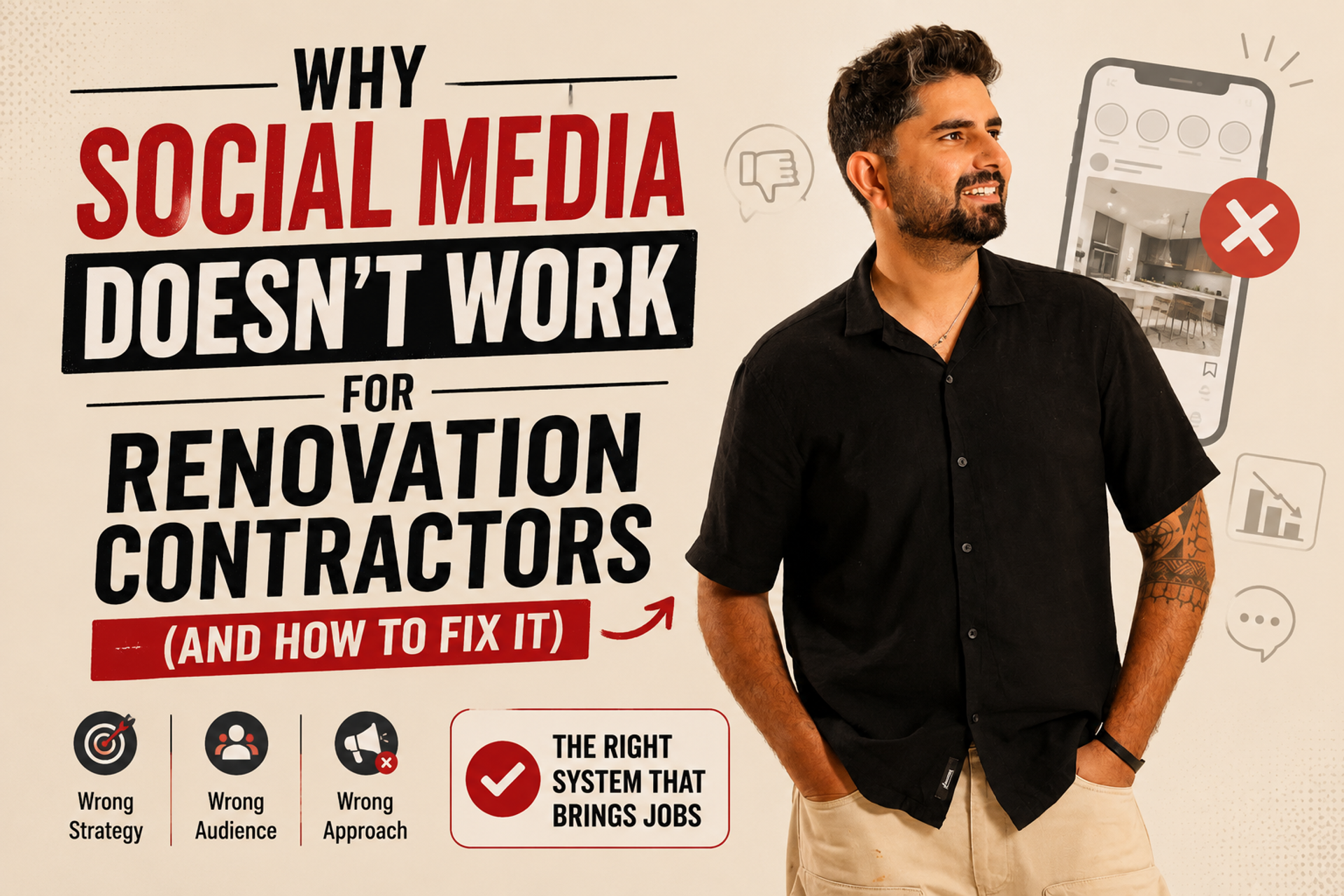
Most renovation contractors have tried social media. An Instagram account featuring before-and-after photos. A Facebook page with occasional project updates. Maybe a few reels that took an entire afternoon to film and edit and generated a handful of views from people who will never hire a renovation contractor.
The effort goes in consistently. The clients do not come back.
And the advice from every marketing platform and digital consultant is identical: post more, be more consistent, engage with your audience, use better hashtags, try video content. So renovation contractors keep posting, keep filming, and keep hoping that the next piece of content will finally generate the commercial jobs or high-value residential projects that justify all the effort.
It rarely does.
The problem is not that social media does not work. The problem is that the platforms most renovation contractors are spending their time on are built for the wrong audience, optimized for the wrong behavior, and measuring success in ways that have almost no relationship with how renovation contracts are actually won.
Understanding this mismatch is the first step. Knowing what to do instead is the second. And in 2026, the renovation contractors who make the shift to intent-based marketing and LinkedIn outreach early are building commercial pipelines that their competitors, still posting reels and waiting for engagement, will not be able to replicate quickly.
Table of Contents
Why Social Media Feels Like a Waste of Time for Renovation Contractors
The Platform Mismatch Problem
What Instagram and Facebook Actually Deliver for Contractors
The Problem With Vanity Metrics
What Intent-Based Marketing Means for Renovation Businesses
Why LinkedIn Is the Right Fix
Who Is Already on LinkedIn Waiting to Hire You
How to Build a LinkedIn Presence That Generates Renovation Contracts
How FatCamel AI Makes the Shift Scalable
FAQ
References
Why Social Media Feels Like a Waste of Time for Renovation Contractors
If you have spent a weekend creating content for Instagram and seen almost nothing come back from it, you are not alone, and you are not doing it wrong.
Renovation contractors across the industry report the same experience regardless of content quality, posting frequency, or budget spent on boosting posts. The metrics look active. Likes accumulate. Follower counts grow slowly. But the phone does not ring with commercial leads or high-ticket residential enquiries because of an Instagram post. The deals still come from referrals, from Google searches, from existing relationships. The social media effort runs in parallel with the business without connecting to it in any meaningful way.
The frustration typically leads to one of two conclusions. Either the content strategy needs to be better, and the business doubles down on more frequent posting, better photography, and more video. Or social media simply does not work for renovation contractors, and the effort should stop entirely.
Both conclusions miss the actual problem.
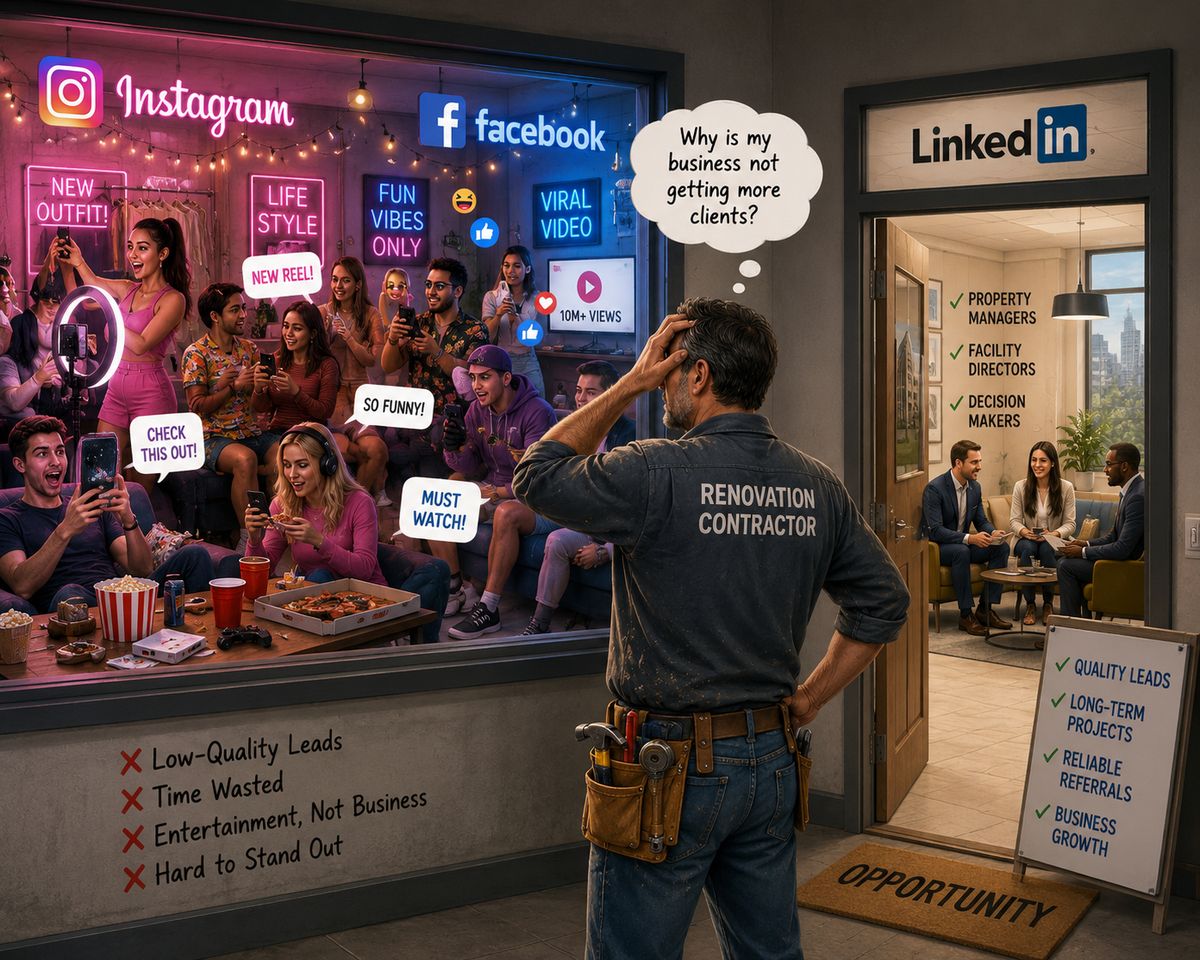
The actual problem is that the renovation contractor is showing up in the wrong room. Instagram and Facebook are full of people who are not renovation clients, and the few who are renovation clients encounter the content in a context where they are not thinking about renovation. They are browsing for entertainment, inspiration, and connection. A beautifully photographed kitchen renovation might get saved to a mood board. It will not produce a phone call.
The room where renovation clients are thinking professionally about their buildings, their budgets, and their vendors is a different room entirely. And most renovation contractors are not in it.
Read More: How to Automate Your Renovation Business (Step-by-Step System)
The Platform Mismatch Problem
Every social media platform is engineered around a specific user behavior and a specific audience mindset. Understanding this at a fundamental level is what reveals why most renovation contractors are wasting time on the wrong channels.
Instagram is engineered for visual discovery and entertainment consumption. Its algorithm rewards content that generates fast engagement: saves, shares, likes, and watch time on video. The audience using Instagram is primarily in a browsing and entertainment mindset. They are scrolling to be inspired, entertained, or distracted. Even when they encounter renovation content and find it genuinely appealing, they are rarely in the mindset to make a buying decision, and for commercial renovation clients specifically, they are rarely on the platform in a professional capacity at all.
Facebook has evolved primarily into a community and consumer connection platform. Its organic reach for business pages has declined dramatically over recent years. Without paid advertising, a renovation contractor's Facebook page reaches almost no one outside of people who already follow it. With paid advertising, it reaches a consumer audience that skews residential and discovery-based rather than commercial and intent-based.
TikTok can generate significant reach for entertaining content. Renovation contractors occasionally go viral on TikTok with satisfying transformation videos. That reach rarely translates to renovation enquiries because the audience engaging with viral renovation content is not in a buying mindset. They are watching for entertainment. Entertaining and purchasing are very different behaviors.
LinkedIn is different from all of these at a structural level. LinkedIn's users are on the platform in a professional mindset. They are thinking about their work, their businesses, their vendors, and their operational decisions. When a property manager opens LinkedIn during the working day, they are in the same mental mode as when they check their business email. They are thinking professionally. That professional mindset is what makes LinkedIn outreach and content work for renovation contractors in a way that Instagram and Facebook fundamentally cannot.
What Instagram and Facebook Actually Deliver for Contractors
This is not an argument to abandon Instagram and Facebook entirely. Both platforms have a legitimate role in a renovation contractor's marketing mix. The argument is for clarity about what that role actually is, so the business stops expecting outcomes the platforms were not designed to produce.
Instagram can build brand awareness among residential homeowners in a local area. It provides a portfolio showcase that supports the sales process when a residential prospect looks up the business after a referral. It can attract talented tradespeople looking for employers. It can generate occasional inbound enquiries from homeowners who happen to see the content at exactly the right moment of renovation planning.
What Instagram cannot reliably produce is commercial renovation contracts, facility management relationships, or high-value B2B leads from property managers and asset managers. The audience composition and browsing behavior of Instagram do not support that outcome regardless of how good the content is.
Facebook can produce residential homeowner leads through paid advertising targeted to local demographics. It can maintain community presence and support word of mouth in a local area. Business reviews on Facebook provide social proof that helps in the residential sales process.
What Facebook cannot produce is a systematic pipeline of commercial renovation opportunities from professional decision makers who hire based on vendor relationships and professional credibility rather than sponsored posts.
Knowing what each platform actually delivers allows the renovation contractor to use each one for its appropriate purpose, residential brand awareness and social proof, rather than expecting them to produce commercial pipeline activity they were never built to generate.
Read More: AI Systems to Get Repeat Renovation Jobs Automatically
The Problem With Vanity Metrics
One of the reasons the social media mismatch persists for so long in renovation businesses is that the metrics social platforms provide look like progress even when they are not.
Follower counts grow. Post reach increases when money is spent on boosting. Likes accumulate on before and after photos. Engagement rates provide a satisfying sense that the content is resonating with someone. All of these metrics feel meaningful because they are numbers that go up. But they are largely disconnected from the outcome that actually matters: renovation contracts won.
Vanity metrics are measurements that make the business feel like its marketing is working without demonstrating that it is producing revenue. A renovation contractor with ten thousand Instagram followers and a consistent posting schedule that generates no commercial enquiries has impressive vanity metrics and a social media strategy that is not working.
The shift to intent-based marketing requires measuring different things. How many qualified conversations were started this month. How many commercial decision-makers engaged with outreach. How many site visits or consultation calls were booked from outreach activity. How many proposals were generated from outreach-sourced contacts. These are the metrics that connect marketing activity to business outcomes.
When the measurement framework shifts from engagement metrics to pipeline metrics, the limitations of Instagram and Facebook become obvious almost immediately. And the value of a channel like LinkedIn, where every metric points toward professional relationship-building with actual buyers, becomes equally clear.
Read More: AI Voice Assistant for Painters: Automate Calls and Book More Estimates
What Intent-Based Marketing Means for Renovation Businesses
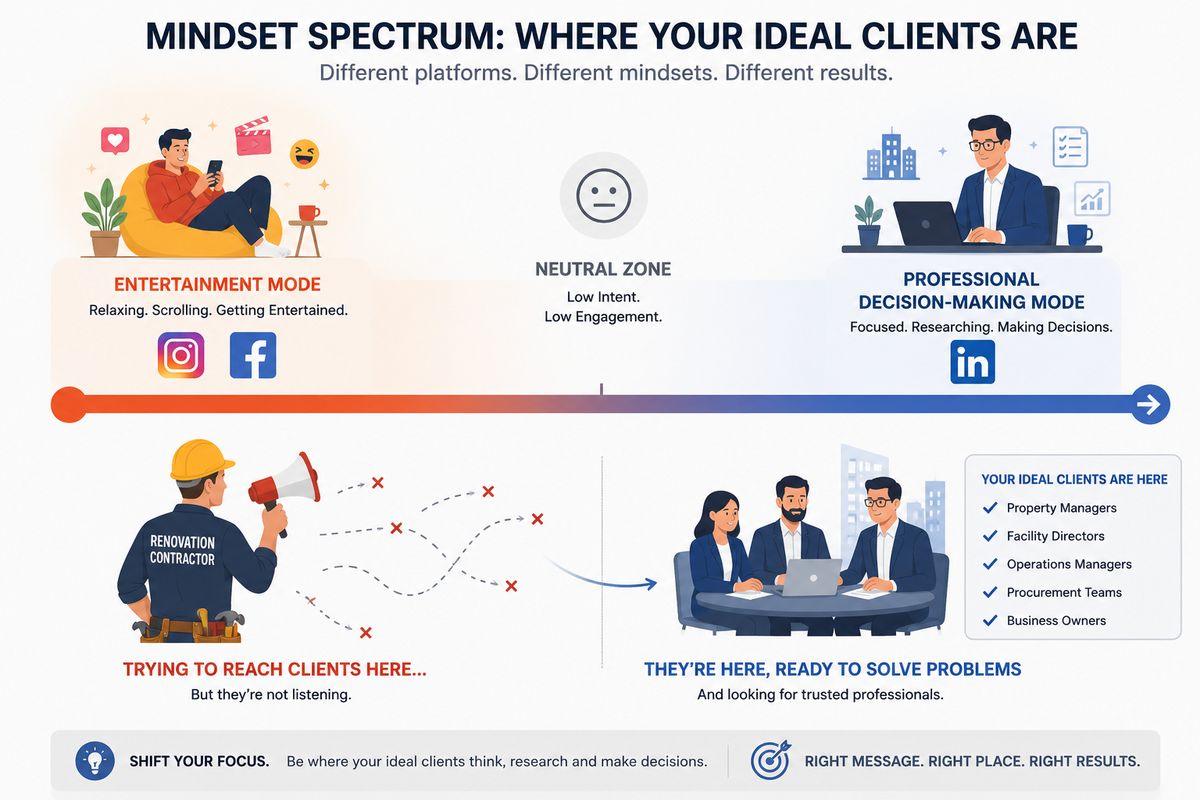
Intent-based marketing is an approach that reaches people who are already thinking about a decision rather than trying to interrupt people who are not. For renovation contractors, the distinction matters enormously because renovation decisions are high-consideration purchases that do not typically begin with a social media post.
Google Search is the most familiar form of intent-based marketing for renovation businesses. When someone searches for a bathroom renovation contractor in their city, they have explicit intent. They are actively looking for what the renovation contractor offers. The search ad or the SEO ranking that puts the business in front of that searcher is meeting a real, active need.
LinkedIn represents a more sophisticated form of intent-based marketing for renovation contractors targeting commercial clients. Commercial decision makers on LinkedIn are not explicitly searching for a renovation contractor at every moment, but they are consistently thinking about their properties, their vendor relationships, and their operational decisions in a professional context. The renovation contractor who shows up in that professional context, through relevant content and personalized outreach, is reaching people who are professionally receptive to the conversation even when they are not actively searching.
This is fundamentally different from reaching someone who is in entertainment mode on Instagram. Professional context creates professional receptivity. That is why a LinkedIn outreach message from a renovation contractor to a property manager generates a completely different response than the same contractor's Instagram post appearing in the property manager's feed during their evening scroll.
Intent-based marketing for renovation contractors means being present where clients are professionally receptive, not where they are passively entertained. LinkedIn is that place for commercial renovation clients.
Why LinkedIn Is the Right Fix
LinkedIn solves the platform mismatch problem for renovation contractors at a fundamental level, not by being a better version of Instagram, but by being a completely different type of channel that reaches a completely different audience in a completely different mindset.
The commercial renovation clients that most renovation contractors want to reach more of- property managers, facility directors, asset managers, commercial real estate developers, and hospitality operations directors- are professionally active on LinkedIn. This is where they post about their industry, share observations about their work, connect with vendors, and stay current with professional developments in property management and commercial real estate.
When a renovation contractor reaches one of these professionals on LinkedIn, the context of the interaction is professional. The property manager receiving a thoughtful connection request from a renovation contractor who has been engaging with their content is not being interrupted during entertainment time. They are being approached in their professional world by someone who appears to operate in a related professional space. The barrier to engagement is fundamentally lower.
LinkedIn also provides something no other social platform offers for commercial B2B outreach: searchable, filterable professional profiles that identify exactly who holds the decision-making role at specific types of organizations in specific locations. A renovation contractor can identify every property manager overseeing commercial real estate in their service area, every facility director at healthcare organizations in the region, every asset manager at commercial real estate firms in the city, and reach out to them directly through the platform.
This targeting precision, combined with the professional context and the relationship-building nature of the platform, makes LinkedIn a channel where consistent effort produces consistent commercial pipeline results, which is the outcome that Instagram effort almost never produces regardless of how long or how consistently it is applied.
Read More: How to Automate Your Painting Business (Step-by-Step System)
Who Is Already on LinkedIn Waiting to Hire You
The commercial renovation clients that most renovation contractors are trying to reach are already on LinkedIn in meaningful numbers. Here is who specifically is there and why they represent the right audience for a renovation contractor's outreach.
Property Managers overseeing commercial office buildings, retail properties, mixed-use developments, and residential apartment portfolios are among the most active professional groups on LinkedIn. They manage vendor relationships as a core part of their role and are continuously looking for reliable, professional contractors they can trust with the properties they manage.
Facility Directors at hospitals, schools, corporate campuses, and government facilities have renovation and capital improvement work as a regular budget line item. They are looking for contractors who understand operational constraints, can work in occupied environments, and bring the project management capability that complex facilities require.
Commercial Real Estate Asset Managers manage property portfolios where renovation and improvement work directly affects asset value, tenant retention, and investment returns. Renovation is not an occasional activity for them. It is a systematic part of how they manage and protect the value of the properties they oversee.
Hospitality and Retail Operations Directors at hotel chains, restaurant groups, and retail brands manage recurring renovation and refresh programs driven by brand standards and customer experience expectations. They work with renovation contractors repeatedly across multiple locations and represent long-term, high-value relationships rather than one-off projects.
Every one of these decision makers is reachable on LinkedIn right now. And because almost no renovation contractors are approaching them there with a consistent, professional, value-driven outreach strategy, the ones who start doing so immediately stand out in a channel where the competition is essentially absent.
How to Build a LinkedIn Presence That Generates Renovation Contracts
Making the shift from Instagram-focused social media to LinkedIn-focused professional outreach does not happen overnight, but it does not require months of preparation before results begin to appear. The key is building the right foundation and then running consistent activity rather than treating it as another content creation exercise.
Start with a professional profile that speaks to commercial clients. The LinkedIn profile is the first thing a property manager or facility director sees when they receive a connection request or encounter content. The profile headline, about section, and featured projects need to communicate clearly what the renovation company does for commercial clients, not just list services. A profile that reads as a professional operation experienced in commercial renovation work converts profile visitors into accepted connections at a significantly higher rate than a generic business profile.
Publish content that addresses the concerns of commercial decision makers. Two to three posts per week around topics that matter to property managers and facility directors: how to plan a renovation in an occupied commercial space, what drives renovation timelines in different facility types, how to evaluate contractor proposals for complex projects, before and after showcases from commercial renovation work with specific scope and outcome details. This content builds credibility and ensures that anyone who visits the profile after receiving a connection request or outreach message finds evidence of relevant expertise.
Engage daily with the content of target decision makers. Liking and commenting genuinely on posts from property managers, facility directors, and commercial real estate professionals in the target market builds name recognition before any direct outreach occurs. Decision makers who have seen the renovation contractor's name in their notifications multiple times before receiving a connection request are significantly more likely to accept than those receiving cold contact from an unknown account.
Run a structured outreach sequence to targeted profiles. After several days of engagement, personalized connection requests go out to the most relevant profiles in the target market. Once connections are accepted, a multi-stage message sequence builds the relationship over several weeks with value-first messages before any business ask is made.
How FatCamel AI Makes the Shift Scalable
The LinkedIn strategy above works. The challenge is that done manually, it requires several hours of daily effort that a renovation contractor managing active projects simply does not have. Identifying profiles, engaging with content, sending connection requests, managing message sequences, scheduling posts, tracking responses. Each element is manageable individually. Together, they constitute a near-full-time activity.
FatCamel AI makes the entire LinkedIn system scalable by automating every repetitive element of the strategy, leaving the renovation contractor to focus on the conversations that actually require human involvement.
Daily engagement with target decision-maker content runs automatically. The right profiles are identified and engaged with on a consistent schedule without anyone managing the activity manually. Targeted, personalized connection requests go out on a daily schedule to profiles matching the ideal commercial client criteria, with each request personalized from real profile data rather than using a generic template.
Once connections are accepted, FatCamel AI manages the full outreach sequence, personalizing each message based on the recipient's specific role, organization, and industry context, timing the sequence to build naturally toward a meeting conversation rather than pitching immediately.
LinkedIn content is planned and scheduled automatically around the renovation company's commercial expertise and project portfolio, keeping the profile active and credible without the renovation contractor needing to find time to write and publish posts between managing active jobs.
When a prospect responds with interest, a meeting booking link goes out, the appointment is confirmed, and the contact is logged in the CRM with full conversation history. The sales team receives a notification with complete context for the meeting.
The shift from Instagram to LinkedIn is not just a change of platform. It is a change of strategy, from broadcasting content to a passive audience in the hope that someone relevant sees it, to systematically building professional relationships with the exact people who award commercial renovation contracts. FatCamel AI makes that systematic approach sustainable without adding headcount or consuming the renovation contractor's already limited time.
👉 Get a Free AI Revenue Audit for Your Renovation Business at https://www.fatcamel.ai/contact
Frequently Asked Questions
1. Why does social media not work for renovation contractors?
Most renovation contractors use consumer social media platforms like Instagram and Facebook that are built for reaching people in entertainment and browsing mode. Commercial renovation clients, including property managers, facility directors, and asset managers, are not using these platforms in a professional decision-making context. The platform mismatch means that even high-quality content on Instagram rarely produces commercial renovation enquiries regardless of how consistently it is posted.
2. What is intent-based marketing for renovation contractors?
Intent-based marketing means reaching potential clients when they are in a professional, decision-making context rather than in entertainment mode. For renovation contractors targeting commercial clients, LinkedIn is the primary intent-based marketing channel because commercial decision-makers use it professionally, making them receptive to relevant outreach from renovation contractors in a way that an Instagram ad or Facebook post cannot replicate.
3. Is LinkedIn worth it for a renovation contractor?
Yes, particularly for renovation contractors targeting commercial clients. Property managers, facility directors, and commercial real estate professionals are professionally active on LinkedIn and are regularly connecting with and hiring vendors through their professional network. Because almost no renovation contractors have a serious LinkedIn presence, the channel is largely uncontested and rewards early movers significantly.
4. How is LinkedIn different from Instagram for a renovation contractor?
Instagram reaches people in entertainment mode who encounter renovation content passively during casual browsing. LinkedIn reaches professionals in a work mindset who are actively thinking about their properties, vendors, and operational decisions. The same renovation contractor content lands in a completely different psychological context on each platform, which is why LinkedIn outreach produces commercial conversations that Instagram content rarely does.
5. What should a renovation contractor post on LinkedIn?
The most effective LinkedIn content for renovation contractors includes commercial project showcases with specific scope and outcome details, educational posts about renovation planning in commercial or occupied spaces, case studies from relevant property types, and industry observations that demonstrate understanding of the commercial property world. This content builds credibility with exactly the audience the contractor wants to reach and improves the response rate of direct outreach.
6. How long does it take for LinkedIn outreach to generate renovation leads?
With a structured outreach system running consistently, most renovation contractors see initial connection acceptances and message responses within the first two weeks. Booked meetings typically begin coming in during weeks three to six as outreach sequences complete their course. The commercial pipeline impact compounds over time as the professional network grows and content builds ongoing authority with the target audience.
7. How does FatCamel AI help renovation contractors make the switch to LinkedIn?
FatCamel AI automates the complete LinkedIn outreach system for renovation contractors, including daily engagement with target decision-makers, personalized connection requests, multi-stage follow-up sequences, content scheduling, meeting booking, and CRM logging. This makes a consistent, professional LinkedIn presence sustainable for a renovation contractor who is already fully occupied managing active projects, without requiring additional staff or daily time investment from the business owner.
REFERENCES
- https://buildyourtrade.com/blog/construction-social-media-rely-alone
- https://gcsherpa.com/social-media-platforms-that-work-best-for-contractors-and-how-to-stop-wasting-time-on-the-wrong-ones/
- https://www.graphicmachine.com/blog/how-to-create-an-effective-social-media-strategy-for-construction-companies-in-7-steps
- https://www.gbim.com/blog/contractor-social-media-marketing-a-complete-guide/