
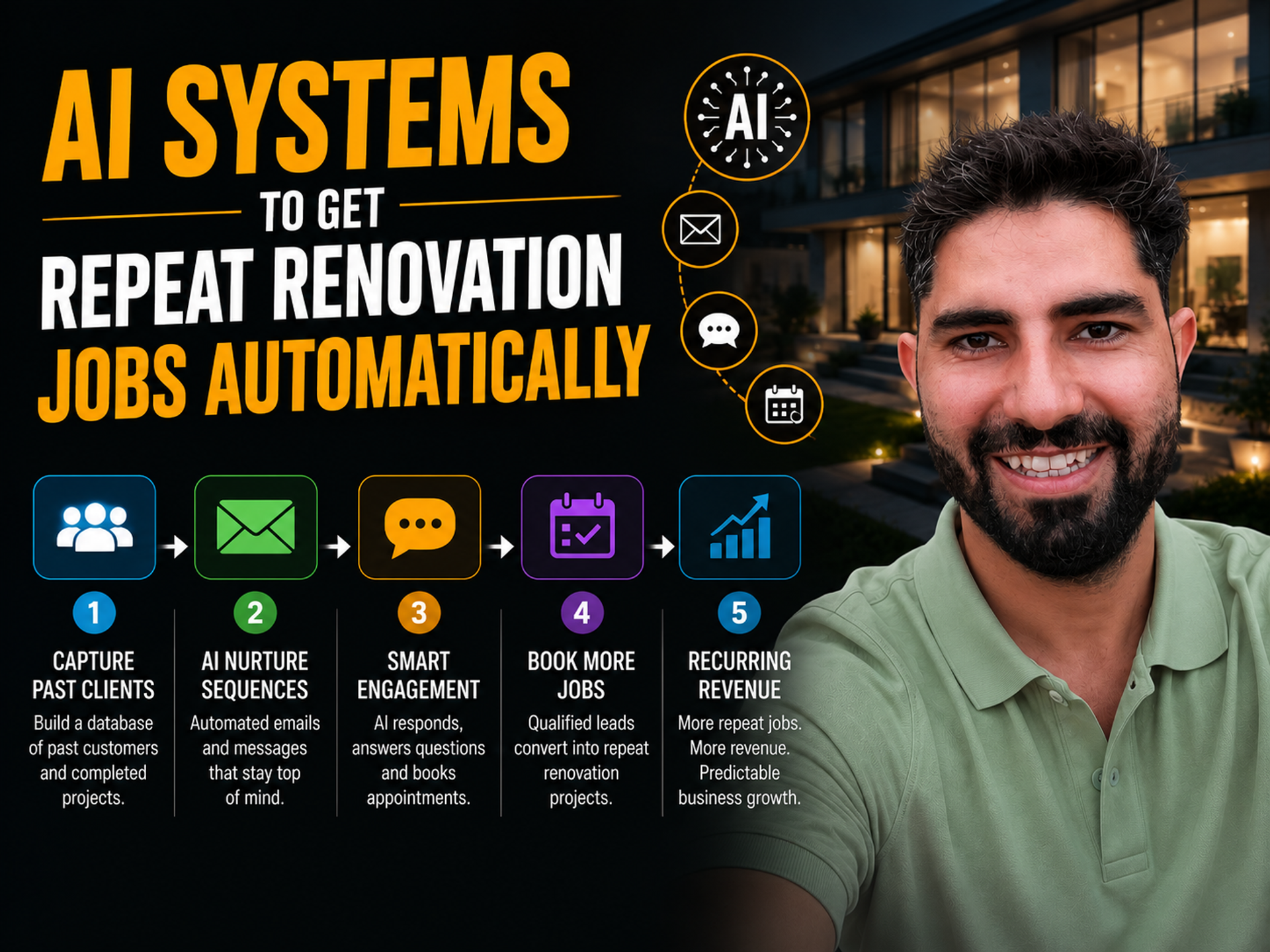
Every renovation job you complete is a future job waiting to happen. Kitchens age. Bathrooms date themselves. Commercial spaces need refreshing. The client who hired you two years ago will need a renovation contractor again, and the only question is whether they call you or someone else.
Most renovation businesses leave that question entirely to chance. They finish the job, move on to the next project, and hope the client remembers them when the time comes. No follow-up system. No reminder. No automated touchpoint keeping the relationship alive between jobs.
The renovation businesses that consistently win repeat work are not necessarily better at the job itself. They have a system. An automated follow-up and renovation reminder system that tracks every past client, understands when their next renovation is likely to be needed, and reaches out at exactly the right moment with the right message, without anyone on the team having to remember to do it.
This guide breaks down exactly how that system works, what it needs to include, and how AI makes it run on autopilot so your renovation business keeps generating repeat jobs in the background while your team focuses on active projects.
Table of Contents
Why Repeat Jobs Are the Most Profitable Jobs in a Renovation Business
The Renovation Cycle: Understanding When Clients Need You Again
The Problem With Manual Follow-Up for Repeat Business
How an Automated Renovation Reminder System Works
The Full Repeat Job Sequence: Step by Step
Segmenting Past Clients for Smarter Outreach
Multi-Channel Follow-Up: Reaching Clients Where They Are
How FatCamel AI Runs the Full Repeat Job System
FAQ
References
Why Repeat Jobs Are the Most Profitable Jobs in a Renovation Business
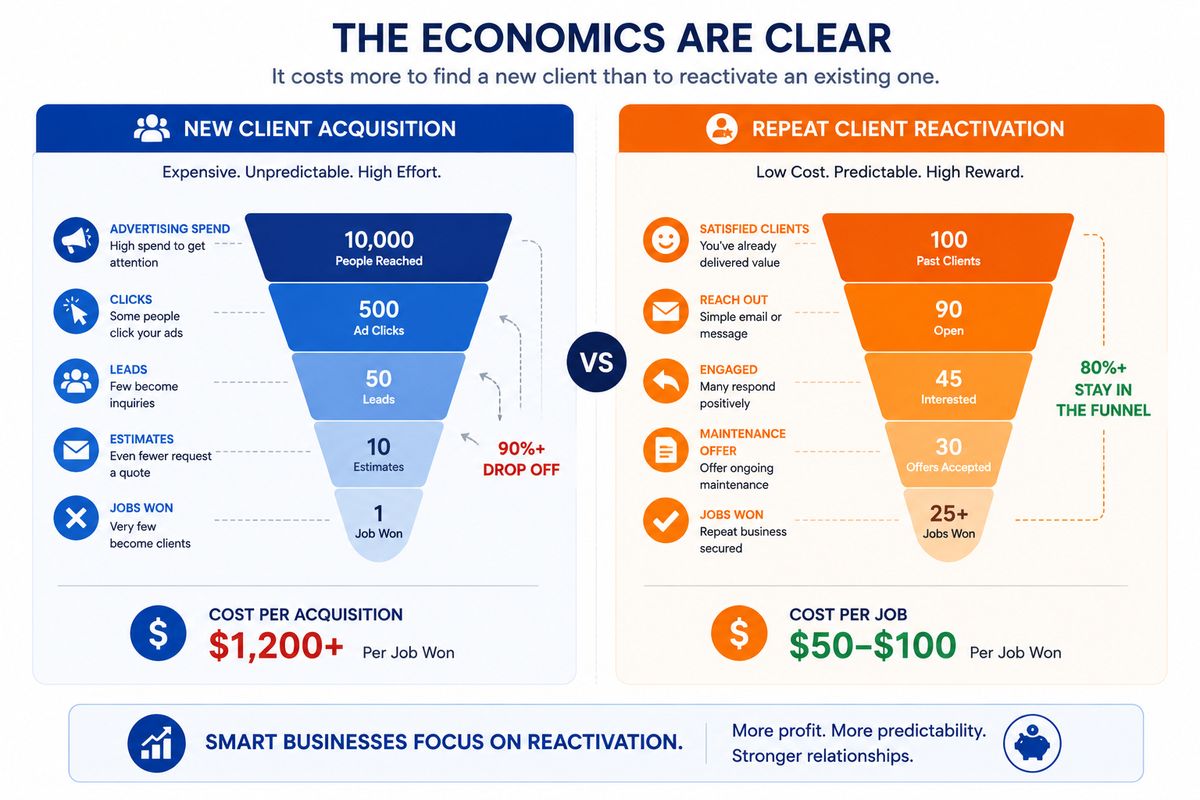
Winning a repeat job from a past client costs a fraction of what it costs to win a job from a new one. No ad spend. No competitive quoting process against contractors the client has never worked with. No trust to build from scratch. The client already knows the quality of your work, already trusts your team, and already has a positive experience with your business to draw on.
Repeat jobs are also faster to close. A past client does not need three competing quotes and two weeks to decide. They need a well-timed reminder that another renovation makes sense and a straightforward way to move forward. When your system provides both at the right moment, the conversion rate is dramatically higher than any cold outreach campaign.
The financial logic is equally compelling. A renovation business spending two thousand dollars a month on advertising to generate new leads while completely ignoring a database of two hundred satisfied past clients is spending money to acquire what it already owns. Those past clients are warm leads. The acquisition cost has already been paid. Reactivating them costs almost nothing compared to finding equivalent new business through advertising.
For commercial renovation clients, the repeat job opportunity is even more structured. Commercial properties operate on renovation and refresh cycles that are relatively predictable, driven by lease renewals, brand standards updates, and planned capital improvement schedules. A renovation company that understands these cycles and reaches out at the right point in them is not competing for the job the way a cold bidder would. They are the obvious first call.
Read More: How HVAC Businesses Can Grow Faster Using AI (Without Changing Their CRM)
The Renovation Cycle: Understanding When Clients Need You Again
A renovation reminder system works because renovation needs are not random. They follow predictable cycles driven by how long materials last, how design trends evolve, and how the way people use their spaces changes over time.
Understanding these cycles is what allows the system to reach clients at the right moment rather than at a random point in the year. A reminder that arrives when a client is just starting to notice that their kitchen feels dated lands entirely differently from one that arrives two years before the thought has even crossed their mind.
Different renovation types follow different cycles. Residential kitchens and bathrooms tend to go through major renovations every ten to fifteen years, with smaller refresh projects, new fixtures, updated finishes, and new surfaces happening every five to seven years. Living spaces, bedrooms, and common areas typically need refreshing every five to ten years depending on how heavily they are used and how quickly design preferences shift.
Commercial spaces follow shorter cycles driven by business needs. Retail environments that compete on customer experience typically refresh every three to five years to stay current with brand standards and customer expectations. Office spaces have been going through significant change as occupancy patterns shift, with fit-outs and reconfiguration projects becoming more frequent. Hospitality properties, hotels and restaurants, refresh common areas and rooms on rolling schedules that often operate on three- to seven-year cycles.
When the system logs each job with the completion date, the space type, and the materials or finishes used, it has everything it needs to calculate when that client is likely to be thinking about renovation again. That calculated date becomes the trigger for the automated reminder sequence, not an arbitrary calendar date someone picked, but a data-driven estimate of when the conversation is likely to land at exactly the right moment.
The Problem With Manual Follow-Up for Repeat Business
Every renovation business owner knows they should follow up with past clients. The intention is there. But between managing active projects, responding to new leads, handling supplier issues, and running the daily operation, following up with someone who hired you eighteen months ago never makes it to the top of the list.
The result is predictable. Past clients drift. The positive experience they had with the renovation fades in memory. When they eventually start thinking about their next project, the renovation company that did the last one is not the first thing that comes to mind, because there has been no contact to keep it there. They search Google. They ask friends for recommendations. They find someone new.
Manual follow-up has three structural problems that make it unreliable as a system for generating repeat business at any meaningful scale.
The first is memory dependency. If follow-up depends on someone remembering to do it, it will not happen consistently. People get busy, priorities shift, and past clients fall through the cracks not because anyone made a deliberate decision to ignore them, but because the operational demands of an active renovation business crowd out the administrative task of maintaining contact with people who are not currently a revenue source.
The second is the scaling problem. A renovation business with two hundred past clients cannot have a salesperson personally tracking the renovation cycle for every single one and reaching out at the optimal moment for each. The math simply does not work without automation.
The third is timing accuracy. Even when manual follow-up does happen, it is rarely timed to the moment a client is actually thinking about renovating. A call in the wrong month gets a polite "not right now." The same call six months later, when the client has just started to notice that their kitchen looks tired, gets a completely different response. Automation tied to renovation cycle data can approximate that right moment in a way that manual follow-up never reliably can.
How an Automated Renovation Reminder System Works
A renovation reminder system is built on a simple but powerful insight: renovation needs follow patterns that can be anticipated. By logging the right information at the end of every job, the system has everything it needs to calculate when each past client is likely to be ready for their next conversation.
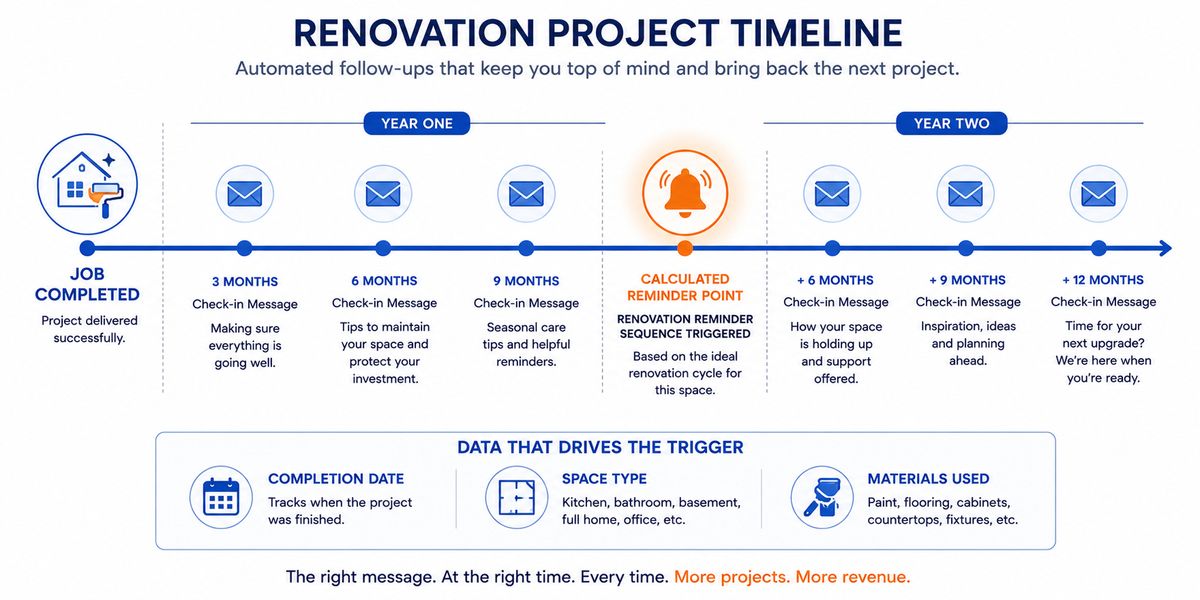
The data that drives the system is captured at job completion: the completion date, the space type, the scope of work done, the materials and finishes used, and any notes from the project that indicate the client's long-term plans for the property. The system uses this data to calculate a reminder date for each client based on the typical renovation cycle for that space type.
When the reminder date approaches, a multi-step outreach sequence begins automatically. The sequence is personalized to reference the original job, the specific space that was renovated, and the time that has passed since the project was completed. It does not feel like a generic marketing email. It feels like a contractor who remembered them and reached out because they genuinely know when the next conversation makes sense.
This is the fundamental difference between a renovation reminder system and generic email marketing. Generic email goes out on a fixed calendar because someone scheduled it. A renovation reminder goes out because the data says this specific client, for this specific property, at this specific point in time, is likely to be thinking about what comes next.
The system does not require the team to track anything manually. Once the job is logged with the right data at completion, everything that follows- the calculation, the reminder scheduling, the sequence triggering, and the follow-up management- runs automatically until the client either responds and re-engages, or the sequence completes, and the client moves into a lower-frequency long-term nurture track.
The Full Repeat Job Sequence: Step by Step
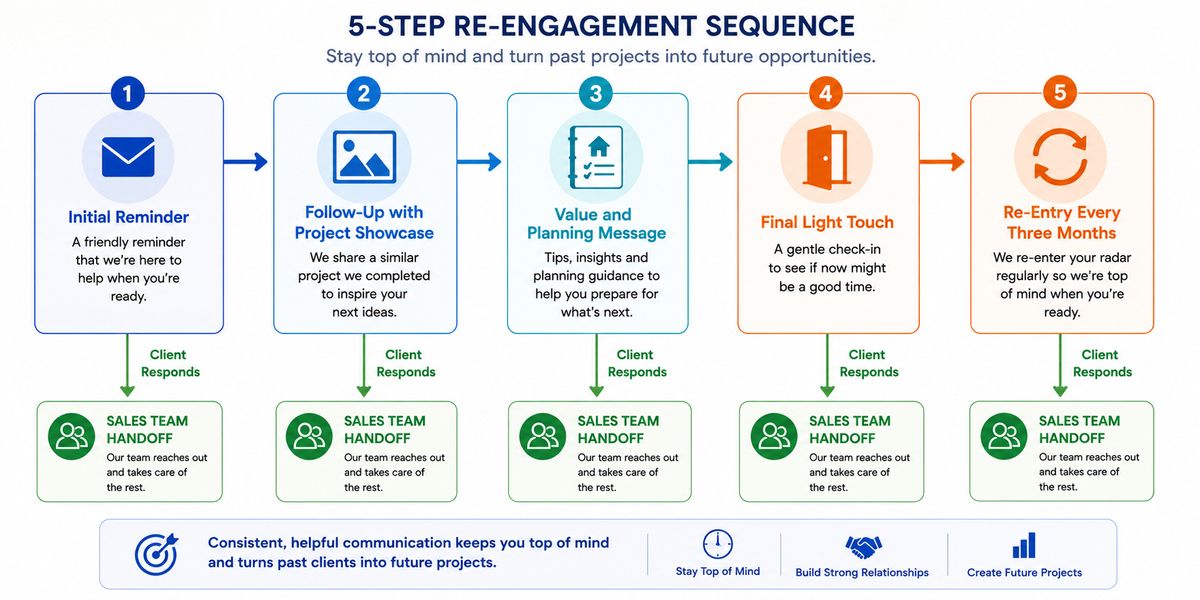
When the renovation reminder date arrives for a past client, a structured multi-step sequence runs automatically. Here is exactly how it works from the first message through to the sales team handoff.
Step 1: Initial renovation reminder
The first message goes out on the calculated reminder date. It is personalized with the client's name, the specific space that was renovated, and a reference to the time that has passed since the project was completed. The message acknowledges that renovation timelines vary and makes no assumption about what the client needs right now. It simply opens the door by noting that based on when their project was completed, it might be worth a quick conversation about what comes next for their property. A clear, low-effort call to action is included: reply to this message, click a link to book a conversation, or simply let us know if the timing is not right.
Step 2: Follow-up message, five to seven days later, if no response
The second message takes a slightly different angle. Rather than simply repeating the first message, it adds something useful: a brief observation about what tends to happen in the space type they renovated at this point in its lifecycle, or a relevant project showcase from a similar property that might spark ideas about their own next renovation. The goal is to be helpful rather than persistent, adding value with the follow-up rather than just chasing a response.
Step 3: Value message, approximately two weeks after the first
If there is still no response, a third message goes out that shifts the framing slightly toward planning rather than selling. It might share a brief guide about how to think through the scope of a renovation project, or a note about material availability and lead times that make planning worthwhile. This positions the renovation company as a resource rather than a vendor, which is a more comfortable dynamic for a client who is not yet ready to commit.
Step 4: Final light-touch message, approximately three weeks after the first
A short, warm final message that lets the client know this is the last outreach in this cycle. It keeps the door genuinely open: the company will be happy to reconnect whenever the timing is right, and they will check back in at the appropriate time. No guilt. No pressure. This message often performs surprisingly well because removing all pressure at the end of a sequence creates space for clients who were interested but hesitant to respond on their own terms.
Step 5: Re-entry for non-responders
Clients who complete the sequence without responding are not discarded. They are moved into a lower-frequency nurture track that sends a brief, relevant touchpoint every three to four months. Renovation timing is often determined by factors outside the client's control, such as a property sale, a life event, or a budget cycle. A sequence that ends and re-enters periodically catches clients when their circumstances change.
When a client responds at any point
The sequence stops immediately, and the sales team is notified with the client's full history, the original project details, and the conversation context. The team picks up from there with a warm handoff that starts from context rather than from zero.
Read More: Top Automation Opportunities for HVAC, Plumbing, and Home Service Businesses in 2026
Segmenting Past Clients for Smarter Outreach
Not every past client should receive the same reminder sequence. A commercial property manager overseeing a portfolio of office buildings has different needs, a different budget cycle, and a different decision-making process than a homeowner who had their kitchen renovated. Sending the same message to both produces worse results than tailoring the outreach to each segment.
The segmentation that produces the most meaningful improvement in repeat job conversion divides past clients into groups that reflect how they actually buy renovation services.
By property type and renovation scope: Residential clients who completed smaller, cosmetic renovations receive messaging focused on refresh and update ideas. Clients who completed major structural renovations receive messaging focused on complementary spaces and the natural next phase of their property improvement. Commercial clients receive messaging focused on their specific sector's renovation cycles and the operational considerations that drive their timeline.
By original project value: Higher-value past clients justify a more personalized outreach that involves a direct call from an account manager in addition to the automated sequence. Mid-range clients receive the full automated sequence. Smaller projects receive a lighter, more occasional touchpoint that prioritizes referral generation as much as repeat work.
By engagement history: Past clients who opened previous emails and clicked links but did not respond receive a sequence that shortens the gap between messages and goes more directly to the ask, since the engagement signals show they are interested but may need a clearer next step. Past clients who have shown no engagement with previous communications receive a sequence that prioritizes a different channel, text or phone, rather than continuing to send emails that are not being opened.
Segmentation does not make the system more complicated to operate. It makes it more effective by ensuring that the outreach each client receives matches how they are likely to buy, which is the difference between a repeat job system that generates consistent revenue and one that generates consistent activity without proportional results.
Multi-Channel Follow-Up: Reaching Clients Where They Are
Email is the backbone of the renovation reminder system, but relying on email alone leaves a meaningful portion of past clients unreached. Different clients engage through different channels, and a multi-channel approach ensures the system reaches people through the medium they are most likely to respond to.
Email provides the space to share project showcases, planning insights, and relevant value without the constraint of brevity. It is the right channel for the longer, more detailed messages in the sequence, and it works best for commercial clients who manage professional communications primarily through their inbox.
SMS works for shorter, higher-urgency touchpoints where getting a quick reply is the goal. For past residential clients who are less likely to read every email but will almost always see a text message, a brief SMS that references the original project and asks simply whether they have thought about their next renovation can generate responses that the same message in email format would not.
Direct mail for high-value clients: For past commercial clients above a certain contract value, a physical communication, a brief, professionally produced letter or a simple postcard with a relevant project image, adds a level of personal attention and stands out in a way that purely digital outreach cannot replicate. For clients who make significant renovation investment decisions, the small additional cost of a direct mail touchpoint can be well worth it.
The multi-channel system does not bombard past clients with the same message across every channel simultaneously. Each channel is used at a specific point in the sequence where its properties make it the most effective choice. Email leads with detail and depth. SMS follows up with directness. Direct mail reinforces the relationship for the highest-value accounts. Together, they reach significantly more of the past client base than any single channel could manage on its own.
Read More: Why Fast Response Wins Renovation Projects (And How to Automate It)
How FatCamel AI Runs the Full Repeat Job System
The repeat job automation system has multiple moving parts. Job data needs to be captured correctly at completion. Renovation cycles need to be calculated for each space type. Sequences need to trigger at the right time for each client. Segmentation needs to adjust the messaging based on client profile. Multi-channel coordination needs to send the right message through the right channel at the right point in the sequence. And the sales team handoff needs to happen seamlessly when a client responds.
Without the right system connecting all of these elements, the repeat job engine breaks down at the edges. Clients get missed. Sequences go out on the wrong schedule. The wrong message reaches the wrong segment. The sales team gets a notification without the context they need to pick up the conversation effectively.
FatCamel AI is built to run the complete repeat job automation system for renovation businesses, from job completion data capture through to sales team handoff, as one connected, continuously running workflow.
When a job is marked complete, FatCamel AI captures the space type, completion date, and project details automatically and calculates the renovation reminder date based on the renovation cycle data for that space type. No manual data entry. No spreadsheet to update. The reminder is scheduled automatically the moment the job closes.
When the reminder date arrives, FatCamel AI triggers the full follow-up sequence, selecting the appropriate version based on the client's segment, residential or commercial, project value tier, and engagement history. The right message goes to the right client through the right channel at the right time, every time, without anyone managing the schedule.
When a client responds, FatCamel AI stops the sequence immediately and notifies the sales team with the client's full history, the original project details, and the conversation context attached. The handoff is warm, immediate, and complete.
Non-responders move automatically into the periodic re-entry track. No manual list management. No tracking of who has been contacted when. The system knows where every past client is and what the appropriate next touchpoint should be.
A FatCamel AI dashboard shows the complete repeat job pipeline: how many past clients are in active reminder sequences, how many have responded, how many jobs have been booked from the system this month, and the total revenue generated from repeat work over time. You can see the value of your past client base in real numbers at any time without pulling data from multiple places.
FatCamel AI runs the repeat job system continuously in the background. Your team focuses on delivering active projects. The system makes sure the next round of projects is already being lined up from the clients who already know and trust your work.
👉 Get a Free AI Revenue Audit for Your Renovation Business at https://www.fatcamel.ai/contact
Frequently Asked Questions
1. What is repeat job automation for a renovation business?
Repeat job automation is a system that tracks past renovation clients and automatically sends follow-up messages when their property is likely ready for the next renovation phase. Based on the completion date, space type, and scope of the original project, the system calculates when to reach out and triggers a personalized multi-step sequence at that moment, without anyone on the team manually tracking or managing the outreach.
2. How does a renovation reminder system know when to reach out to past clients?
A renovation reminder system calculates reminder dates based on the renovation cycle for each space type combined with the job completion date. A kitchen completed three years ago might receive a reminder about refresh options. A commercial office fit-out completed five years ago might receive a reminder about reconfiguration or rebrand-driven renovation. The trigger is data-driven rather than calendar-based, making the timing significantly more relevant and effective.
3. How many follow-up messages should a renovation business send to past clients?
A structured reminder sequence typically runs four to five messages over three to four weeks. Each message is different, adding value or taking a slightly different angle rather than repeating the same ask. Clients who complete the sequence without responding move into a lower-frequency re-entry track that sends a brief touchpoint every three to four months, recognizing that renovation timing is often determined by factors outside the client's immediate control.
4. What is the best way to get repeat renovation jobs from past clients?
The most reliable way to get repeat renovation jobs is to reach out at the right moment with a personalized message that references the original project and speaks to what naturally comes next for that property. An automated renovation reminder system does this for every past client simultaneously, at the moment their renovation cycle suggests they are most likely to be receptive, without anyone on the team managing the outreach manually.
5. Can renovation reminder automation work for both residential and commercial clients?
Yes, but the messaging, timing, and channel mix differ significantly between segments. Residential clients respond to personal, warm communication focused on design refresh and home improvement planning. Commercial clients respond to professional, operationally focused messaging that addresses their business context and budget cycle. A well-configured system runs separate sequences for each segment, ensuring every past client receives outreach that matches how they actually make renovation decisions.
6. How does FatCamel AI manage the repeat job system for renovation businesses?
FatCamel AI automates the entire repeat job system from job completion data capture through to sales team handoff. It calculates renovation reminder dates automatically, triggers personalized sequences at the right time for each client segment, coordinates outreach across email and SMS, moves non-responders into re-entry tracks, and notifies the sales team immediately when a past client responds, with full context attached. The system runs continuously without requiring daily management.
7. How long does it take before a renovation reminder system starts generating repeat jobs?
The first reminder sequences go out as soon as the system is live and past client data is loaded with completion dates and space types. For clients who are already past their renovation reminder date, the sequence can begin immediately. For others, the reminders will trigger when their calculated date arrives. Most renovation businesses see initial responses and re-engaged conversations within the first few weeks, with a growing stream of repeat job bookings developing over the first two to three months of operation.
References
https://infinitysky.ai/blog/ai-automation-painting-contractors-home-renovation-2026
https://www.fatcamel.ai/blog/best-ai-tools-for-home-renovation-contractors
https://www.regal.ai/blog/ai-agent-use-cases-home-services
https://www.builderprime.com/blog/3-ways-to-use-ai-as-a-home-improvement-contractor
https://codiant.com/blog/ai-solutions-for-home-service-business/