

How to Build a Commercial Lead Generation System for Contractors
Most contractors do not have a lead generation system. They have a collection of habits. A Google ad running in the background, a hope that referrals keep coming in, an occasional post on social media when things get slow. It produces just enough work to stay busy, but never enough to grow with any predictability.
Commercial lead generation is different. Commercial clients, property managers, facility directors, developers, and asset managers do not discover contractors through ads or yard signs. They hire from their professional network. They work with vendors they have encountered over time in their professional world. And by the time a project budget is approved and they are ready to move, the shortlist of contractors they consider is usually already formed.
Getting onto that shortlist requires a system. Something that consistently builds your presence, regularly reaches the right decision-makers, and keeps your company visible to commercial clients over the weeks and months leading up to a contract opportunity. A one-time outreach push or an occasional social media post does not accomplish this. A repeatable, automated system does.
This guide breaks down exactly how to build that system from the ground up, what it needs to include, how each piece connects to the next, and how AI makes the whole thing sustainable for a contractor already fully occupied with active projects.
Table of Contents
Why Commercial Lead Generation Needs a System, Not a Tactic
Defining Your Ideal Commercial Client
LinkedIn: The Foundation of the Outreach System
Email Outreach: The Supporting Channel
Content That Makes the Outreach Work
The CRM Layer: Connecting Everything
Measuring the System
How FatCamel AI Builds and Runs the System
FAQ
References
Why Commercial Lead Generation Needs a System, Not a Tactic
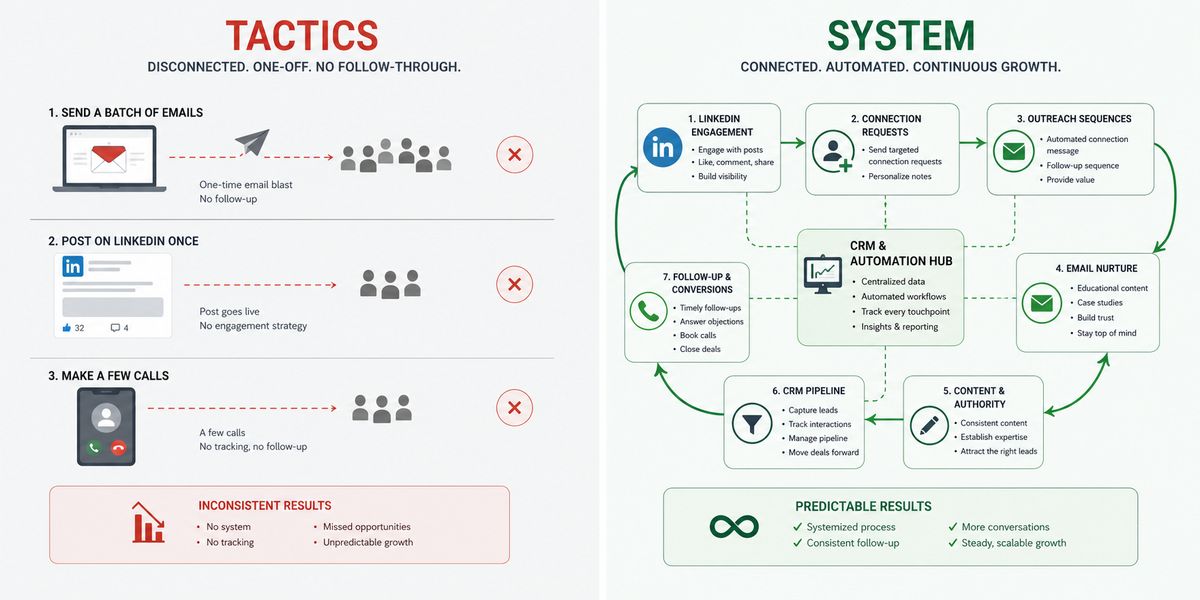
The most common mistake contractors make when trying to break into commercial work is treating lead generation as a series of disconnected tactics rather than an integrated system.
They spend a week on LinkedIn sending connection requests, get no immediate response, and conclude that LinkedIn does not work for contractors. They send a batch of cold emails to a list of property managers, hear nothing back, and decide email outreach is a waste of time. They publish a few posts on social media, get minimal engagement, and stop posting.
None of these tactics failed because they were wrong choices. They failed because they were executed once, without the consistency and structure that commercial lead generation requires. Commercial clients operate on long buying cycles. A property manager who receives a connection request today and is not ready to discuss a renovation for another six months cannot respond to an outreach effort that stopped after two weeks.
A system, by contrast, runs continuously. It builds presence over weeks and months. It reaches the same decision makers through multiple touchpoints across multiple channels. It stays in contact through content when direct outreach is not the right next step. And it does all of this without depending on the contractor's personal time and memory to sustain it, because it runs automatically in the background while the team is focused on active projects.
The difference between a tactic and a system is not the channel or the message. It is the continuity and the automation that make it possible to maintain that continuity without manual effort every day.
Read More: The Hidden Cost of Missed Leads in the Home Service Industry
Defining Your Ideal Commercial Client
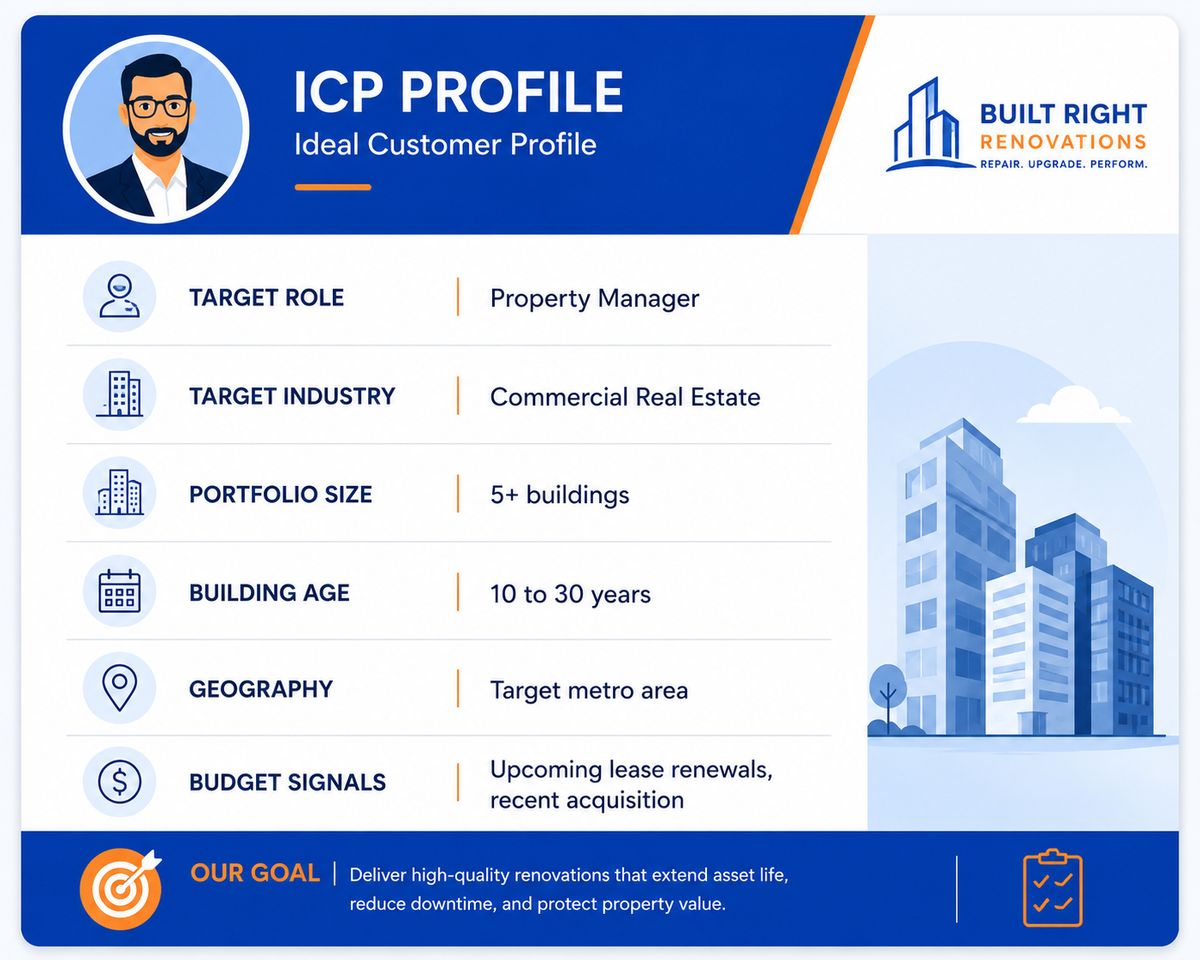
A lead generation system is only as effective as the targeting that drives it. Before any outreach begins, a contractor needs a precise definition of who the ideal commercial client is, specific enough to drive real targeting decisions rather than general enough to mean almost nothing.
Vague targeting produces vague results. "Commercial property owners" is not a useful ICP. "Property managers overseeing office building portfolios of five or more buildings in the greater metropolitan area, with buildings between ten and thirty years old that are likely entering renovation cycles" is the kind of definition that actually drives a targeted system.
The components of a useful ideal client profile for a commercial contractor include job title and seniority level, the types of properties or facilities they are responsible for, the industry they operate in, the geographic area your company can realistically serve, and the company size or portfolio scale that suggests a budget worth pursuing.
For most renovation and construction contractors, the primary targets fall across a consistent set of verticals: commercial real estate property management, facility management at healthcare organizations, corporate campus operations at large employers, hospitality property management, retail chain facility operations, and educational or government facility management.
Each vertical has different priorities and different language. A facility director at a hospital talks about minimizing disruption to clinical operations. An asset manager at a real estate investment firm talks about capital improvement returns and tenant retention. A retail operations director talks about brand standards and multi-site consistency. The outreach system needs to speak the language of each target clearly, which is only possible when the targeting is precise enough to know which language that is.
Read More: How Renovation Companies Can Get More Commercial Clients Using AI
LinkedIn: The Foundation of the Outreach System
LinkedIn is the primary outreach channel for a commercial contractor lead generation system. Not because it is the only channel that matters, but because it is the channel where the relevant decision makers are most accessible, most professionally minded, and most receptive to outreach from a vendor who shows up credibly and consistently.
The LinkedIn component of the system runs across four connected activities that together build a compounding presence with commercial decision makers over time.
Daily engagement with target profiles. Every day, the system identifies posts from property managers, facility directors, and other target roles in your service area and engages with their content automatically. This builds name familiarity before any direct contact and increases the acceptance rate of connection requests significantly compared to reaching out cold.
Targeted connection requests. After several days of engagement with a given set of profiles, personalized connection requests go out with short, specific notes referencing their role or organization. Because the name is already familiar from the engagement phase, acceptance rates are meaningfully higher than cold requests.
Multi-stage outreach sequence. Once a connection is accepted, an automated message sequence moves the relationship forward over several weeks. A warm introduction. A value-first message with a relevant insight or project showcase. A soft ask for a brief conversation. A final light-touch follow-up for non-responders. Every message is personalized using real data from the prospect's profile.
Meeting booking. When a prospect responds with interest, a booking link goes out, the meeting is confirmed, and the contact is logged in the CRM with full conversation history. The sales team receives a notification with everything they need to show up to that call prepared.
These four activities work together as a continuous loop. As new profiles are identified in the target market, they enter the engagement phase. As engagement matures, they receive connection requests. As connections are made, they enter the outreach sequence. As conversations produce meetings, the sales process begins. The loop runs every day without manual input from the contractor.
Read More: How to Automate Follow-Ups for Renovation Leads (SMS, Email & AI Calls)
Email Outreach: The Supporting Channel
LinkedIn handles the relationship-building side of commercial outreach. Email handles the nurturing side, keeping the system in contact with prospects who are not yet engaged, following up on introductions that went quiet, and maintaining visibility with commercial clients between direct touchpoints.
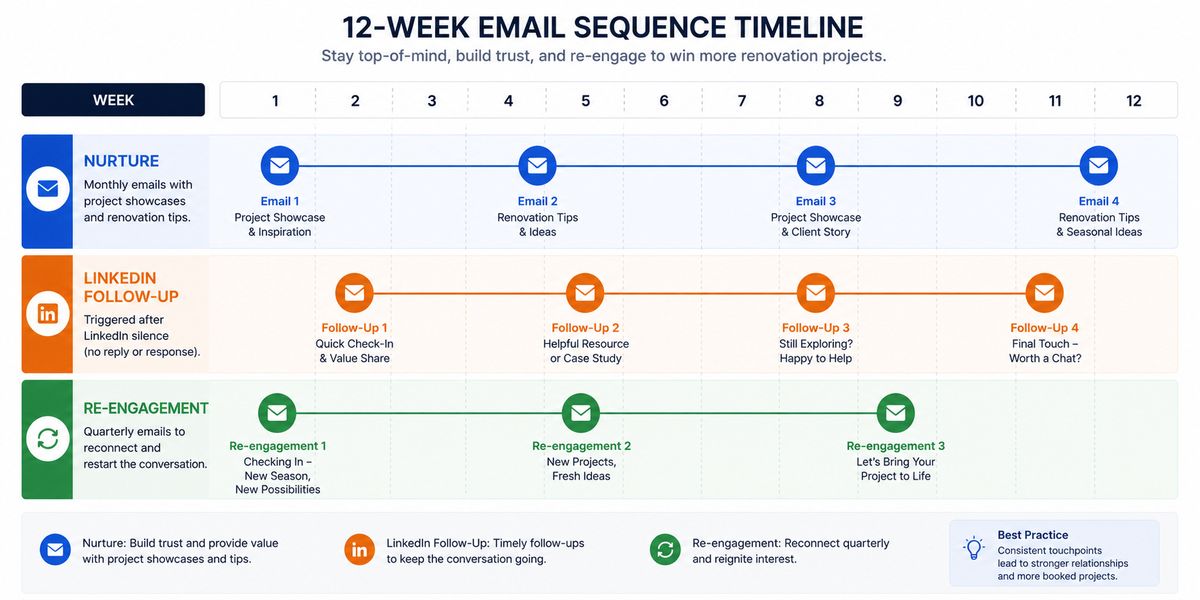
The email component of the system serves three specific functions.
Nurture sequences for new leads. When a prospect enters the CRM from any source, whether a LinkedIn connection, a referral, or an inbound inquiry, an automated email nurture sequence runs alongside the primary outreach. These emails go out on a longer cadence, monthly or bi-monthly, with useful content rather than sales messages. Project showcases, renovation planning tips, industry observations. The goal is to keep the company name present and relevant without creating the feeling of being followed up on.
Follow-up sequences for dormant connections. LinkedIn connections who accepted a request but did not respond to the outreach sequence enter an email follow-up track after a defined waiting period. A different channel sometimes reaches the same person more effectively, and an email that arrives with relevant content can restart a conversation that went quiet on LinkedIn.
Re-engagement for cold pipeline entries. Commercial leads that entered the pipeline but did not convert enter a periodic re-engagement sequence. A brief, friendly email every two to three months that references the original conversation and invites them to reconnect when their timing is right. Commercial renovation budgets are cyclical. A prospect who was not ready in Q1 may be actively planning in Q3.
Email and LinkedIn reinforce each other rather than duplicating effort. A prospect who sees content from your company on LinkedIn and also receives a relevant email from the same company experiences two-channel consistency that builds credibility and recall in a way that either channel alone cannot achieve.
Read More: AI for Painting Businesses: The 2026 Guide to More Leads, Less Chaos
Content That Makes the Outreach Work
Content is not a separate activity from outreach. It is the element that makes every other part of the system work better.
When a property manager receives a connection request from a renovation contractor whose LinkedIn profile is empty and shows no activity, they accept it or ignore it based on nothing but the request itself. When the same request comes from a contractor whose profile shows consistent, relevant content about commercial renovation work, the request carries credibility. The prospect can see evidence of expertise before they have even read the personalized note.
The content that supports a commercial contractor lead generation system falls into three categories that serve different purposes within the overall flow.
Credibility content demonstrates that the company has done relevant commercial work. Specific before-and-after project showcases with details about scope, timeline, and outcomes. Client testimonials from recognizable commercial organizations. Case studies from the specific verticals being targeted. This content answers the fundamental question a commercial decision maker is asking when they consider a new vendor: have you done work like this before?
Educational content demonstrates that the company understands the world its commercial clients operate in. Posts about planning renovations in occupied commercial spaces without disrupting operations. Insights about what drives renovation timelines and costs in specific sectors. Guidance on evaluating renovation proposals for complex, multi-phase projects. This content positions the company as a knowledgeable partner rather than just a vendor seeking work, which is a fundamentally different and more valuable relationship.
Topical content keeps the company present in the feeds of commercial decision-makers between direct touchpoints. Brief observations on industry trends affecting renovation priorities. Comments on relevant developments in commercial real estate, facility management, or construction. Engagement-driving questions that invite the audience to share their own perspective. This content maintains visibility without requiring a high production effort for every piece.
The publishing cadence matters as much as the content quality. Two to three posts per week, published consistently over months, builds a content history that commercial decision-makers can evaluate when they visit the profile. Sporadic posting, even if individual pieces are high quality, does not create the same impression of sustained expertise and engagement.
Read More: Complete Guide to Free Instagram Automation: Posts, DMs & Comments
The CRM Layer: Connecting Everything
The LinkedIn outreach, the email sequences, the content strategy, and the meeting booking all generate contacts, conversations, and data. Without a CRM layer organizing and connecting all of this, the system produces activity without building a manageable pipeline that the sales team can work effectively.
The CRM in a commercial contractor lead generation system does several specific things.
Unified contact records. Every prospect, regardless of how they entered the system, whether through LinkedIn outreach, an email sequence, an inbound inquiry, or a referral, exists as a single contact record with a complete history of every touchpoint across every channel. No contact appears in both the LinkedIn tool and the email system without being connected.
Pipeline stage tracking. Each contact is in a defined stage of the commercial pipeline: identified, connected, in sequence, had conversation, meeting scheduled, proposal sent, active opportunity, or long-term nurture. These stages tell the sales team exactly where every prospect stands and what the appropriate next action is.
Automation triggers. Stage changes in the CRM trigger the appropriate next action automatically. A contact moves to the meeting scheduled stage, and a reminder goes out to the sales team. A contact reaches the end of the outreach sequence without responding and moves into long-term email nurture automatically. A proposal is sent, and the estimate follow-up sequence begins.
Reporting on what is working. The CRM is where the data that shows which parts of the system are producing results actually lives. Which verticals are generating the most conversations. Which outreach messages are getting the best response rates. Which content pieces are driving profile visits that lead to connection requests. This data makes the system improvable over time rather than static.
Measuring the System
A lead generation system that is not measured cannot be improved, and a system that cannot be improved eventually stops producing results as the market changes and the original approach becomes less effective.
The metrics that matter for a commercial contractor lead generation system are organized across three levels.
Activity metrics show that the system is running as intended. Connection requests sent per week. Content posts published per week. Email sequences active. These metrics confirm the system is operating but do not tell you whether it is producing results.
Engagement metrics show how the target audience is responding to the system. LinkedIn connection acceptance rate. Message response rate across the outreach sequence. Email open and reply rates. Profile visits driven by content. These metrics reveal whether the targeting and messaging are resonating with the right audience.
Pipeline metrics show whether the activity and engagement are translating into actual business outcomes. Conversations started per month. Meetings booked per month. Proposals sent from system-generated leads. Conversion rate from meeting to proposal. Conversion rate from proposal to signed contract. Revenue generated from commercial leads originating in the system.
Reviewing these metrics monthly gives a clear picture of where the system is performing and where it is underperforming. A high acceptance rate but low message response rate suggests the connection requests are targeted correctly, but the follow-up messaging needs improvement. A high meeting rate but low proposal conversion rate suggests the sales conversation needs work. The metrics make the right fix obvious rather than leaving improvement to guesswork.
How FatCamel AI Builds and Runs the System
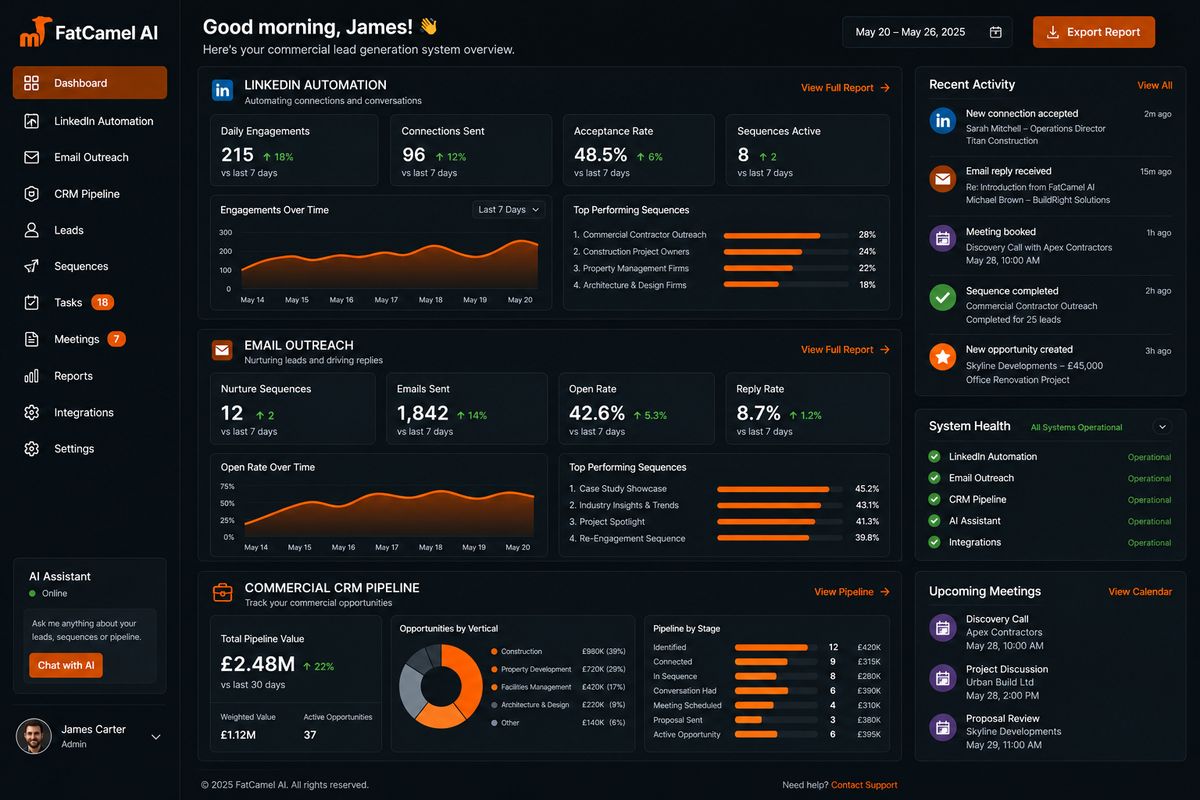
Building the system described in this guide manually requires coordinating multiple tools, maintaining consistent daily execution across LinkedIn and email, managing a growing pipeline of commercial contacts, producing content regularly, and tracking metrics across several different platforms simultaneously. For a contractor running active projects, this level of operational complexity is not realistic without the right AI system managing it.
FatCamel AI is built to run the complete commercial lead generation system for contractors and renovation businesses. Not as a collection of separate tools that need to be integrated, but as a single connected platform designed around how commercial contractors sell and how commercial property clients buy.
Daily LinkedIn engagement with target decision-makers runs automatically, building familiarity across the contractor's ideal client profile before any direct outreach begins. A continuously refreshed target list ensures connection requests are always going to the most relevant profiles in the market, with each request personalized from real profile data. Multi-stage outreach sequences run automatically after each connection is accepted, timed and personalized to build the relationship toward a meeting in a way that feels natural rather than automated.
Email nurture sequences run in parallel, maintaining contact with prospects who are not yet engaged through LinkedIn while building a second channel of visibility that reinforces the primary outreach. Content is planned, drafted, and scheduled automatically around the contractor's commercial expertise and project history, keeping the LinkedIn profile active and credible without requiring dedicated content creation time.
Every lead, conversation, meeting, and proposal is tracked in a unified CRM that shows the health of the commercial pipeline at a glance and triggers the appropriate next action automatically at each stage transition. A reporting dashboard shows the full system's performance across activity, engagement, and pipeline metrics, making improvement data-driven rather than intuitive.
FatCamel AI runs the entire system in the background while the contractor's team focuses on delivering the active projects that the system generates. The result is a commercial pipeline that grows continuously and predictably without relying on the business owner to find time for prospecting in an already full schedule.
👉 Get a Free AI Revenue Audit for Your Renovation Business at https://www.fatcamel.ai/contact
FAQ
1. What is a commercial contractor lead generation system and why do I need one?
A commercial contractor lead generation system is a structured, automated process for consistently reaching commercial decision makers, building relationships with them over time, and converting those relationships into renovation or construction contracts. Most contractors rely on referrals and occasional outreach that stops when things get busy. A system runs continuously in the background regardless of project load, building a commercial pipeline that does not depend on the contractor's personal time to sustain.
2. How is commercial lead generation different from residential lead generation for contractors?
Residential lead generation typically involves capturing demand that already exists through Google ads, referrals, and review platforms. Commercial lead generation involves creating awareness and building relationships with decision-makers who are not yet actively searching but will need a contractor when their renovation cycle, budget approval, or property acquisition happens. The buying cycle is longer, the decision involves more stakeholders, and familiarity and credibility matter far more than price comparison.
3. Why is LinkedIn the best channel for commercial contractor outreach?
LinkedIn is where commercial property decision-makers spend their professional time. Property managers, facility directors, and asset managers are active on LinkedIn in a professional capacity, thinking about their buildings, their vendors, and their operational challenges. Unlike paid ads that capture active search intent, LinkedIn allows a contractor to build familiarity with decision makers over time, so that by the time a project opportunity arises, the contractor is already a known name rather than an unknown bidder.
4. How long does it take to build a commercial pipeline through a lead generation system?
The earliest results, connection acceptances and initial message responses, typically appear within the first two weeks. Booked meetings usually begin coming in during weeks three to six. A meaningful commercial pipeline with multiple active opportunities typically develops within three to four months of consistent system operation. Results compound over time as the network grows, content builds credibility, and warm relationships progress through longer commercial buying cycles.
5. What content should a renovation contractor publish on LinkedIn to attract commercial clients?
Commercial renovation contractors should publish three types of content on LinkedIn: credibility content such as specific commercial project showcases with real scope and outcome details, educational content that addresses the practical concerns of property managers and facility directors, and topical content that demonstrates awareness of trends affecting the commercial property world. Publishing two to three times per week consistently over several months builds meaningful authority with the right audience.
6. How does email outreach support LinkedIn in a commercial contractor lead system?
Email supports LinkedIn by providing a second channel for prospects who are not yet engaged through direct LinkedIn outreach, maintaining visibility through nurture sequences during the long gaps in commercial buying cycles, and re-engaging cold pipeline entries with periodic relevant touchpoints. The two channels reinforce each other: a prospect who sees consistent content from a contractor on LinkedIn and also receives relevant emails from the same company experiences multi-channel consistency that builds recall and credibility.
7. How does FatCamel AI make commercial lead generation sustainable for a busy contractor?
FatCamel AI automates every repetitive element of the commercial lead generation system, including daily LinkedIn engagement, personalized connection requests, multi-stage outreach sequences, email nurture campaigns, content scheduling, meeting booking, and CRM pipeline management. This allows the contractor to run a commercial outreach operation at the scale and consistency of a dedicated business development team without allocating any of the business owner's daily time to managing it.
References
https://www.projectmark.com/blog/lead-generation-for-contractors
https://blog.strongtie.com/construction-lead-generation-strategies-for-contractors/
https://www.gushwork.ai/blog/contractor-lead-generation
https://www.webfx.com/blog/home-services/contractor-lead-generation-guide/
https://leadsbridge.com/blog/best-lead-generation-for-contractors/
https://www.design-hero.com/business-tips/how-to-generate-leads-with-a-construction-website/
https://projul.com/blog/how-to-get-more-construction-leads/