

You are spending money on ads. The leads are coming in, and yet at the end of the month, the pipeline is thinner than it should be, and the revenue does not reflect the marketing budget you just spent.
This is one of the most frustrating experiences in running a renovation business. You did the hard part. You put money behind the advertising, built the campaign, and generated genuine interest from potential clients. But somewhere between that first inquiry and a booked job, people disappeared.
This is called lead leakage. And it is the single most expensive problem most renovation businesses have, not because the leads were bad, but because the follow-up system failed to convert them.
The good news is that lead leakage is entirely fixable. Not by spending more on ads. Not by hiring more salespeople. By building the right AI-powered follow-up system that catches every lead, responds instantly, and follows up persistently until the contact either converts or makes a clear decision not to.
This guide breaks down exactly where renovation businesses lose leads, why it happens, and what the AI fix looks like at every stage.
Table of Contents
The Lead Leakage Problem Nobody Talks About
Where Renovation Businesses Lose Leads: The Six Leak Points
Why High Ad Spend Makes the Problem Worse
The AI Fix: Closing Every Leak in the System
What an Airtight Lead Follow-Up System Looks Like
How FatCamel AI Stops Lead Leakage for Renovation Businesses
FAQ
References
The Lead Leakage Problem Nobody Talks About
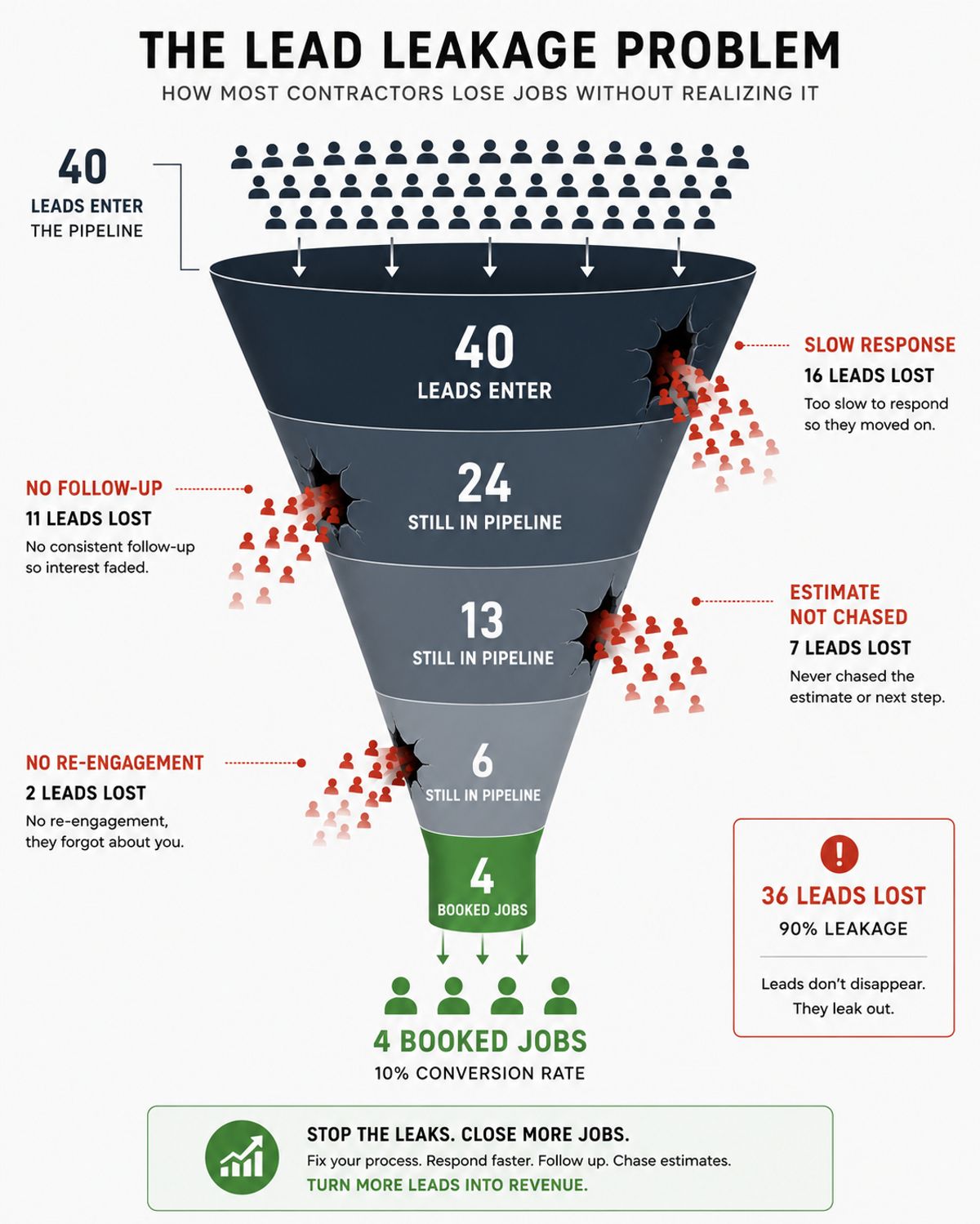
Most renovation business owners focus their growth energy on the top of the funnel. More ads. Better targeting. Higher quality leads. The assumption is that if the leads are good enough, the sales will follow.
But the data tells a different story.
Research across the construction and contracting industry consistently shows that the majority of leads that do not convert are not lost due to price, competition, or poor lead quality. They are lost because of follow-up failure. Slow response times. Inconsistent touchpoints. Estimates that went out and were never chased. Past clients who were never re-engaged.
Lead leakage is the gap between the number of leads that enter your business and the number that actually convert into booked jobs. For most renovation businesses, that gap is enormous. Industry data suggests that contractors lose between 50 and 80 percent of viable leads not to competitors but to their own follow-up process.
Put that in financial terms. If you are spending two thousand dollars a month on advertising and generating forty leads, but losing thirty of them to poor follow-up, you are effectively paying for ten conversions and throwing the money spent on the other thirty away. The ad spend is not the problem. The system receiving the leads is.
Fixing lead leakage does not require more budget. It requires a better system. And in 2026, AI automation makes that system reliable enough to catch every lead, every time.
Read More: Why Social Media Doesn't Work for Painters (And How to Fix It)
Where Renovation Businesses Lose Leads: The Six Leak Points
Lead leakage does not happen in one place. It happens across six distinct points in the renovation sales process. Understanding each one is the first step to fixing them.
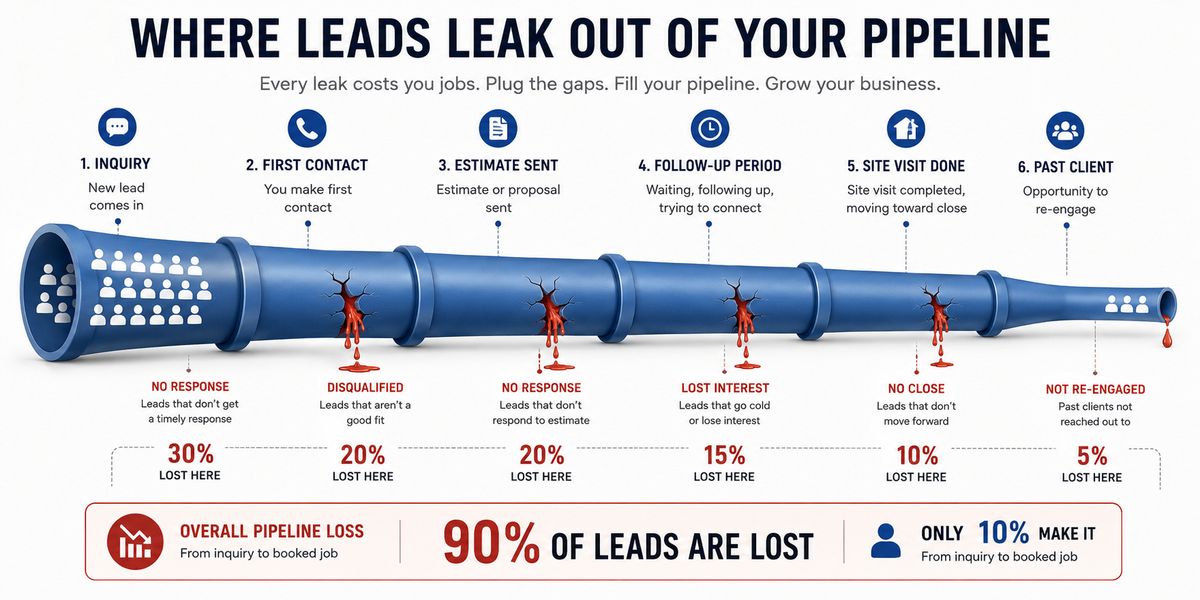
Leak Point 1: Slow Initial Response
The most damaging leak in the entire process happens in the first few minutes after a lead comes in. Research consistently shows that contacting a lead within five minutes of their inquiry produces dramatically higher conversion rates than waiting even an hour. For renovation businesses where the owner is on a job site, and the office manager is handling three other things, a five-minute response is rarely possible manually.
When a potential client submits a quote request and hears nothing for two hours, they have already contacted two other contractors. When they hear nothing for a day, the mental decision to move on has already been made. The lead did not go cold because they were not interested. It went cold because no one was fast enough.
Leak Point 2: Inconsistent Follow-Up After First Contact
Even when a renovation business does respond quickly to the initial inquiry, most fail at what comes next. A lead responds to the first message but is not quite ready to commit. The salesperson follows up once, maybe twice, and then moves on to more active prospects.
The reality is that most renovation clients need five to eight touchpoints before they make a buying decision. They are comparing quotes, discussing with partners, checking budgets, and managing competing priorities. The contractor who gives up after two follow-ups loses the job to the one who stayed in contact long enough to be there when the client was ready.
Leak Point 3: The Estimated Dead Zone
The estimated dead zone is one of the most common and costly lead leakage points in renovation businesses. An estimate goes out. The client says they will think about it. And then nothing happens.
No follow-up on day three. No check-in on day seven. The salesperson assumes the client will reach out when they are ready. The client assumes the contractor is not that interested since they never followed up. The job goes to a competitor who called to ask if they had any questions.
Estimates that are not followed up on a structured schedule convert at a fraction of the rate of estimates that are. The work of preparing and sending the estimate is already done. The revenue is being left on the table purely because of the absence of a systematic follow-up cadence.
Leak Point 4: Leads That Go Cold Between Inquiry and Decision
Renovation projects are rarely impulse decisions. A homeowner enquires about a kitchen renovation in March. They are getting quotes, saving money, and discussing the project scope. They go quiet for six weeks. The renovation business that sent one follow-up in week one has completely forgotten about them by week seven. The business that has an automated nurture sequence running is still in their inbox when they finally decide to move forward in May.
Long-cycle leads are not lost leads. They are leads that require a system patient enough to stay in contact until the client is ready. Manual follow-up cannot sustain that patience. Automated nurture sequences can run indefinitely without anyone managing them.
Leak Point 5: No-Show and Unresponsive Leads After Site Visits
A lead books a consultation or site visit, your estimator shows up, the conversation goes well, and then the client goes quiet after the estimate is sent. This is one of the most demoralizing lead losses for renovation businesses because of the time investment already made.
Most businesses send the estimate, follow up once or twice by phone, and give up. But a structured automated sequence that follows up via email and SMS over two to three weeks, adding value at each touchpoint rather than just asking for a decision, converts a meaningful percentage of these apparently dead leads into booked jobs.
Leak Point 6: Past Clients Never Re-Engaged
The final and most overlooked leak point is the complete absence of any system for re-engaging past clients. A renovation business that completes fifty jobs a year and has no automated process for staying in contact with those clients is leaving an enormous amount of repeat and referral business on the table.
Past clients are the warmest leads a renovation business has. They already trust the quality of your work. They have no reason to go looking for a new contractor if you stay visible. But most renovation businesses go completely silent after the job is done and then wonder why past clients hire someone else for their next project.
Read More: How to Automate Your Painting Business (Step-by-Step System)
Why High Ad Spend Makes the Problem Worse
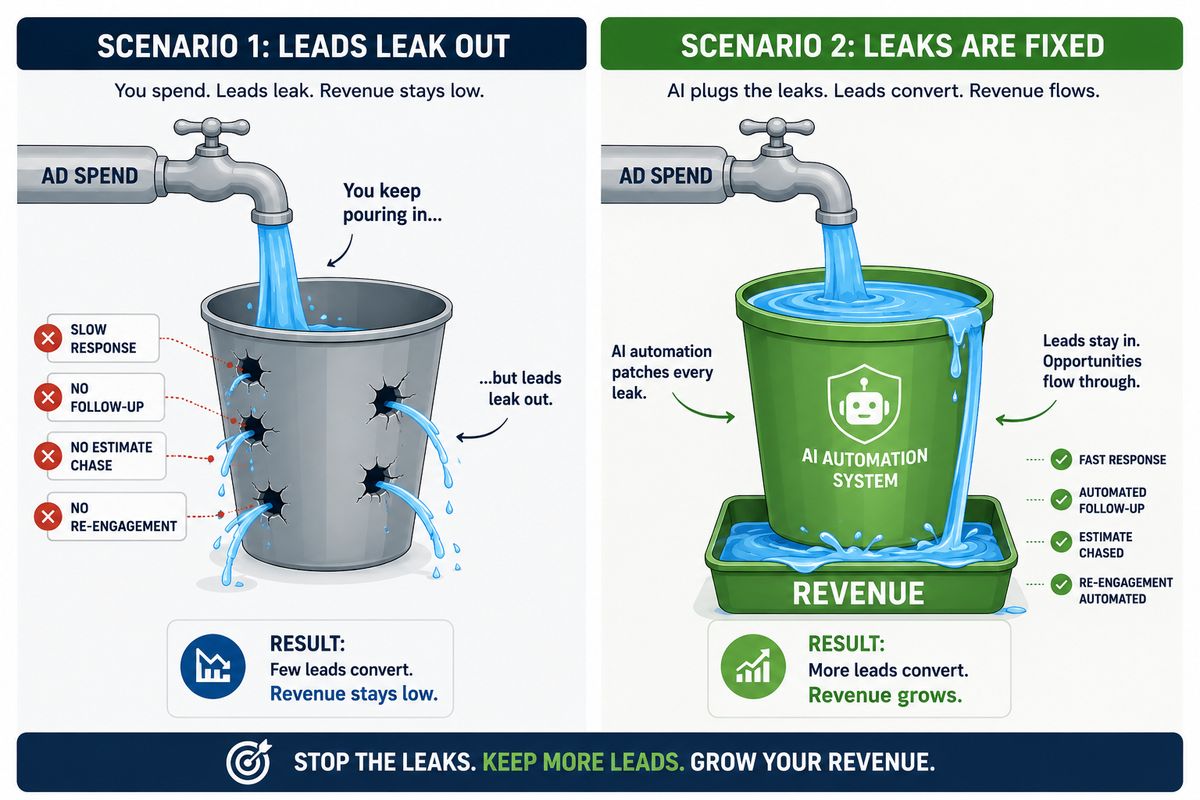
There is a counterintuitive truth about lead leakage that most renovation business owners miss. The more you spend on advertising, the more expensive your lead leakage problem becomes.
When you are generating five leads a month from word of mouth, losing three of them to poor follow-up is painful but manageable. When you are spending two thousand dollars a month on Google and Facebook ads and generating forty leads, losing thirty of them to the same follow-up failures is a catastrophic waste of marketing budget.
High ad spend amplifies every weakness in your follow-up system. More leads coming in means more leads falling through the same cracks. The response time problem gets worse because the volume overwhelms the team. The estimate follow-up problem gets worse because there are more estimates to track. The nurture problem gets worse because there are more cold leads to stay in contact with.
Most renovation businesses respond to a poor return on their ad spend by changing the ads. New creative. Different targeting. Higher budget. But if the leak is in the follow-up system and not the advertising, changing the ads does nothing. You are just generating more leads to lose the same way.
The correct response to poor ad ROI in a renovation business is almost always to fix the follow-up system first. Once you have a system that reliably converts the leads you are already generating, increasing the ad spend produces proportionally better results because the new leads are going into a system that can actually convert them.
The AI Fix: Closing Every Leak in the System
Every leak point described above has a specific AI fix. Here is exactly what the automated system looks like at each stage.
Fix for Leak Point 1: Instant Automated Response
The moment a lead enters your system from any source, an automatic personalized response goes out within seconds. Email and SMS simultaneously. The message acknowledges their inquiry, references the specific service they asked about, and sets expectations for next steps. No human needs to be available. The response goes out at 11 pm on a Sunday, the same as it does at 9 am on a Monday.
This single fix alone has a measurable impact on lead conversion because it eliminates the window in which the lead contacts a competitor. Your business is first to respond every single time.
Fix for Leak Point 2: Multi-Step Follow-Up Sequence
Instead of relying on a salesperson to remember to follow up, an automated sequence runs across email and SMS over the following two weeks. Day one, day three, day seven, and day fourteen touchpoints go out automatically. Each message is different, adding value or addressing a common concern rather than just repeating the same ask. The sequence runs whether the team is on a job site or not. It stops the moment the lead responds or books a consultation.
Fix for Leak Point 3: Estimate Follow-Up Automation
When an estimate is sent, a follow-up sequence starts automatically. Day three brings a friendly check-in asking if they have any questions. Day seven adds a piece of value relevant to their project type. Day fourteen is a final low-pressure message that keeps the door open. The moment the estimate is accepted, the sequence stops, and the job workflow begins. The moment the estimate is declined, the lead is tagged and enters a long-term nurture sequence.
Fix for Leak Point 4: Long-Term Nurture for Slow-Cycle Leads
Leads that complete the initial sequence without converting enter an automated monthly nurture track. Project showcases, renovation tips, seasonal reminders, and useful content go out on a regular schedule without anyone managing the list. Six months from now, when that client is finally ready to move forward, your business is still top of mind because the system never stopped communicating.
Fix for Leak Point 5: Post-Site-Visit Reactivation
Leads that went quiet after a site visit but before booking enter a specific reactivation sequence. A message that acknowledges the time that has passed, references the original conversation, and makes it easy to re-engage. Many renovation businesses find that a meaningful percentage of leads they had written off as lost convert from this sequence because the client simply needed more time and appreciated being followed up professionally rather than aggressively.
Fix for Leak Point 6: Past Client Re-Engagement System
Past clients enter an automated long-term engagement system that sends periodic value messages, project showcases, and seasonal renovation reminders. When the timing is right for their next project, a specific re-engagement sequence triggers. A personalized message that references the original job and opens the door to the next conversation. No manual effort required. The relationship stays warm automatically.
Read More: How to Build Recurring Revenue in a Painting Business
What an Airtight Lead Follow-Up System Looks Like
When all six leak points are fixed with the right automation, the renovation sales process looks fundamentally different from the manual version.
A lead comes in at 8 pm on a weeknight. By 8:01 pm, they have received a professional, personalized response. By the end of day three, they have received two follow-up messages. By the end of week two, they have received four touchpoints across email and SMS. If they have not responded, they are in a monthly nurture sequence that will keep running for the next twelve months.
An estimate goes out on Tuesday afternoon. By Friday, if it has not been accepted, the first automated follow-up has gone out. By the following Tuesday, the second. By the following Friday, the third. Every touchpoint is tracked. The moment the client responds, the sequence stops, and a human picks up the conversation with full context.
A job is completed in March. In April, the client receives a satisfaction check. In May, they received a useful renovation tip. In September, they receive a seasonal reminder about exterior work before winter. In March of the following year, they received a first anniversary message with a note about what projects are worth considering as their renovation ages. None of this requires anyone to write or send anything manually.
This is an airtight lead follow-up system. Every lead is caught. Every estimate is chased. Every past client stays engaged. And the revenue that was previously leaking out of the business stays in it.
Read More: AI for Painting Businesses: The 2026 Guide to More Leads, Less Chaos
How FatCamel AI Stops Lead Leakage for Renovation Businesses
FatCamel AI is built specifically to eliminate lead leakage for renovation businesses and trade contractors. Every leak point described in this guide has a pre-built solution inside the FatCamel AI system, designed around how renovation businesses actually operate and how their clients actually make buying decisions.
Instant lead response runs automatically the moment a new inquiry enters the system from any source. Multi-step follow-up sequences run across email and SMS without anyone managing them. The estimate follow-up starts automatically when an estimate is sent and stops the moment the client responds. Long-term nurture sequences keep cold leads engaged indefinitely. Post-job retention sequences keep past clients connected to the business between projects.
Every touchpoint is personalized using real data from the client record. Every outcome is logged back to the CRM automatically. Every conversion and every loss is tracked so the business can see exactly where leads are converting and where they are still leaking.
The result is a renovation business that converts significantly more of the leads it is already generating before spending another dollar on advertising. Because fixing the follow-up system is almost always the highest-ROI investment a renovation business can make, more valuable than any ad campaign targeting improvement.
👉 Get a Free AI Revenue Audit for Your Renovation Business at https://www.fatcamel.ai/contact
FAQ
1. Why do renovation businesses lose so many leads despite spending on ads?
Most renovation businesses lose leads not because of poor ad quality but because of follow-up failure. Slow initial response, inconsistent follow-up sequences, estimates that are never chased, and past clients that are never re-engaged account for the majority of lost leads in the renovation industry. High ad spend amplifies the problem because more leads entering a broken follow-up system means more leads lost at every stage.
2. What is lead leakage in construction and renovation businesses?
Lead leakage is the gap between the number of leads that enter a renovation business and the number that actually convert into booked jobs. It happens at six key points: slow initial response, inconsistent follow-up, unchased estimates, cold long-cycle leads, unresponsive post-site-visit contacts, and past clients who are never re-engaged. For most renovation businesses, lead leakage accounts for between 50 and 80 percent of viable leads that could have been converted.
3. How does slow response time affect lead conversion for renovation contractors?
Research consistently shows that responding to a lead within five minutes produces dramatically higher conversion rates than waiting an hour or more. When a potential renovation client submits an inquiry and does not hear back quickly, they contact other contractors. By the time a slow-responding business follows up, the client has often already moved forward with a competitor. Automated instant response eliminates this problem.
4. How many follow-up messages should a renovation business send before giving up?
Most renovation clients need five to eight touchpoints before making a buying decision. Most renovation businesses send one or two follow-ups and then give up. An automated follow-up sequence running across day one, day three, day seven, and day fourteen captures a significant percentage of the leads that a one or two-touch approach would lose. Long-cycle leads should receive monthly nurture messages indefinitely until they either convert or opt out.
5. Can AI automation fix lead leakage without replacing the sales team?
Yes. AI automation handles the repetitive, timing-sensitive follow-up tasks that the sales team cannot sustain manually at volume. Instant responses, multi-step sequences, estimate chasers, and past client re-engagement all run automatically in the background. The sales team focuses their time on the conversations that are already warm, the ones the automation has qualified and moved forward. AI does not replace the sales team. It makes every hour the sales team spends dramatically more productive.
6. How much revenue does lead leakage cost a typical renovation business?
The number varies by business size and ad spend, but the principle is consistent. A renovation business spending two thousand dollars a month on advertising and losing sixty percent of its leads to follow-up failure is effectively wasting twelve hundred dollars every month on leads that never had a fair chance to convert. Fixing the follow-up system recovers that lost revenue without any additional ad spend.
7. How does FatCamel AI specifically address lead leakage for renovation businesses?
FatCamel AI provides pre-built solutions for every lead leakage point in the renovation sales process. Instant automated response for new leads. Multi-step follow-up sequences across email and SMS. Automated estimate follow-up cadences. Long-term nurture for cold leads. Post-job retention sequences for past clients. All personalized using real client data, and all writing results back to the CRM automatically, so the business always has full visibility on where leads are converting and where they are still leaking.
References
https://modernize.com/contractor-resources/articles/3-reasons-why-contractors-lose-leads
https://sparkagentics.com/blog/construction-leads.html